

It is 10:47 pm in Gurugram. A regional sales manager has just put her daughter to bed. Her phone buzzes. A senior colleague has dropped a client question into the team group: “Any update? Need this by morning.” Nothing is on fire. The client has not even asked yet. But two teammates have already replied with a thumbs-up, and she knows that a late answer will be noticed far more than a late night.
She types her reply from the hallway.
Nobody in that story broke a rule. There is no rule. That is exactly the point. Always-on culture rarely arrives through policy. It builds through small, reasonable-looking moments until the unspoken expectation becomes the job.
Key Takeaways at a Glance
- Leadership, Not Technology: Always-on culture starts with workplace expectations.
- Burnout Is Real: Constant availability affects well-being and performance.
- Set Clear Boundaries: Define working hours and emergency protocols.
- Lead by Example: Leaders must respect employees’ personal time.
- Train Managers: Reward outcomes, not round-the-clock availability.
What does “always-on culture” actually mean?
Always-on culture is the expectation, spoken or unspoken, that employees stay reachable and responsive outside their agreed working hours. The “right to disconnect” is the counter-idea: that people can switch off from work communication after hours without fear of penalty, while genuine emergencies still have a route through.
It does not mean no one is ever contacted after hours. It means the contact is intentional, rare and agreed, rather than automatic, constant and assumed.
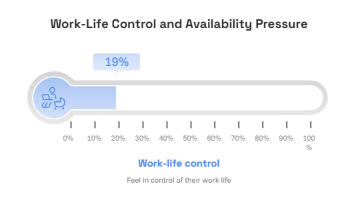
Source: Fortune India
Did You Know?
Nearly half of India’s corporate employees report high stress from availability pressure. A May 2026 study by wellness platform cult.fit found that nearly one in two corporate employees in India deals with high stress because of long hours and pressure to stay reachable after office hours. Only 19% said they feel in control of their work life because of the “Always On” culture.
How Mature Is Your Framework, Really?
Take our free 4-minute assessment and get a personalized report on your leadership fluency, governance, and workforce readiness.
Take the Free AI Readiness Assessment →Work-Life Control and Availability Pressure
It would be easy to blame smartphones. The phone is only the delivery mechanism. The real causes sit in how organisations behave.
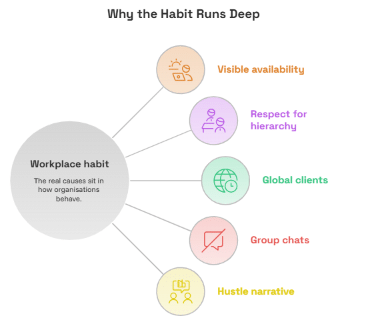
Visible availability looks like commitment
In many teams, the person who answers at 11 pm is seen as dedicated, and the person who answers at 9 am as merely competent. Managers reward what they see, and responsiveness is very visible.
Respect for hierarchy makes “no” hard
A message from a senior leader carries weight. Few employees feel comfortable replying, “I will look at this in the morning.”
Global clients keep the clock running
Many Indian organisations serve customers in the US, Europe or the Middle East. Time-zone overlap quietly stretches the working day for whole teams, often without a handover system to protect them.
Group chats blur every boundary
When work lives on the same messaging app as family and friends, “quick questions” arrive at any hour, and everyone can see who responded and who did not.
The hustle narrative still has fans
Public debates about 70-hour work weeks have kept long hours in the spotlight, even though many professionals point out that extra hours do not automatically produce better output.
The Manager Effectiveness Framework Free guide, instant download.
Get the Guide →What does it cost the organisation?
Leaders sometimes treat after-hours contact as free. It is not.
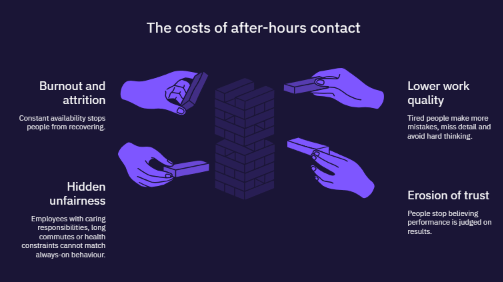
Burnout and attrition
Constant availability stops people from recovering. That wears down energy, judgment and patience. Our piece on manager burnout in India shows how the squeeze lands hardest on the people in the middle, who relay messages both up and down.
Lower quality of work
Tired people make more mistakes, miss detail and avoid hard thinking. The late-night reply often looks like productivity while quietly lowering quality the next day.
Hidden unfairness
Employees with caring responsibilities, long commutes or health constraints cannot match always-on behaviour. Rewarding it can quietly disadvantage them.
Erosion of trust
When people feel they must prove loyalty through availability, they stop believing performance is judged on results.
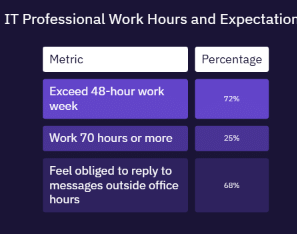
Source: Deccan Herald
DID YOU KNOW?
In IT, the long-hours picture is starker. A survey by the anonymous workplace app Blins, reported by Deccan Herald, found that 72% of IT professionals routinely exceed the legal 48-hour work week and one in four works 70 hours or more. Among respondents, 68% said they feel obliged to reply to work messages outside office hours.
See how we help build this into your organization.
Explore Capability Building Program Training Programs →
Is there a law on the right to disconnect in India?
As far as the sources I reviewed show, India does not currently have an enacted law that creates a general right to disconnect. A private member’s Bill proposing such a right, introduced in Parliament by MP Supriya Sule, would let employees ignore work communication outside agreed hours without disciplinary action. Private member’s Bills rarely become law, so organisations should not wait for legislation.
Australia offers a reference point. Since 2024, its workers can refuse unreasonable after-hours contact, with disputes heard by a tribunal. The lesson for Indian employers is that the standard is “unreasonable” contact, not “any” contact. That leaves room for genuine urgency and puts the burden on clear, shared norms.
The practical conclusion is simple. The fastest route to change is policy and behaviour inside your own organisation.
How does the generational split change the conversation?
The Indeed survey found a sharp generational gap. Around 88% of Baby Boomers said they feel valued when contacted after hours, compared with just over half of Gen Z respondents. A reported 63% of employees said they would consider quitting if a right to disconnect were not respected.
That gap explains many arguments inside real teams. A senior leader sees a late message as a sign of trust. A younger analyst sees it as a boundary breach. Neither is wrong from where they stand. Our guide to managing a multigenerational workforce in India explores how to bridge those expectations, and a shared team agreement on communication is one of the quickest ways to do it.
What can leaders do about it? Five practical moves
Agree on response windows, channel by channel
Decide together what each channel means. For example, email is answered within one working day, chat within a few hours, and calls are for real urgency. When everyone knows the rule, nobody needs to prove anything.
Write a simple emergency protocol
Define what counts as urgent, who can invoke it and how (a phone call, not a group message). A clear route for true emergencies makes it easier to protect everything else.
Let leaders go first
If a senior leader sends messages at midnight and expects replies, the policy is dead on arrival. Use scheduled send, hold non-urgent notes until morning and say openly, “No reply needed before tomorrow.”
Build handovers for global work
If clients sit in other time zones, share the load. Rotate on-call duty, use clear handover notes and give people time off after late sessions, so the same individuals do not absorb every stretch.
Judge on outcomes, not availability
Review performance on results, quality and collaboration. Make it explicit in appraisals that response speed outside agreed hours is not a measure of commitment.
What should manager training cover?
Policies fail without managers who can carry them. Training should help managers practise four skills.
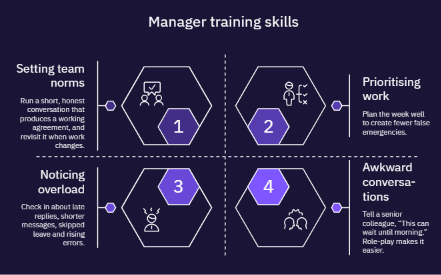
- Setting and keeping team norms. How to run a short, honest conversation that produces a working agreement, and how to revisit it when work changes.
- Prioritising so urgency is rare. Many after-hours pings come from poor planning. Managers who plan the week well create fewer false emergencies.
- Noticing the signs of overload. Late replies, shorter messages, skipped leave and rising errors are all signals to check in.
- Having the awkward conversation. Telling a senior colleague, “This can wait until morning,” takes skill and nerve. Role-play makes it easier.
A sample team agreement you can adapt
Here is a short example any team lead can draft in one meeting.
Our working hours are 9:30 am to 6:30 pm. We do not expect replies to messages sent outside these hours. If something is truly urgent, call, and explain why. We schedule non-urgent messages to send in the morning. Leaders model this first. We review this agreement every few months and after any major project.
The wording matters less than the process. A team that writes its own agreement owns it.
Curious About Other Areas of Your Organization?
Explore our other free assessments and get a fuller picture of where you stand.
View All AssessmentsHow Ebullient can help?
Ebullient works with mid-size enterprises to build healthier, higher-performing cultures. If always-on habits are wearing down your managers and teams, we can help you move from good intentions to everyday practice.
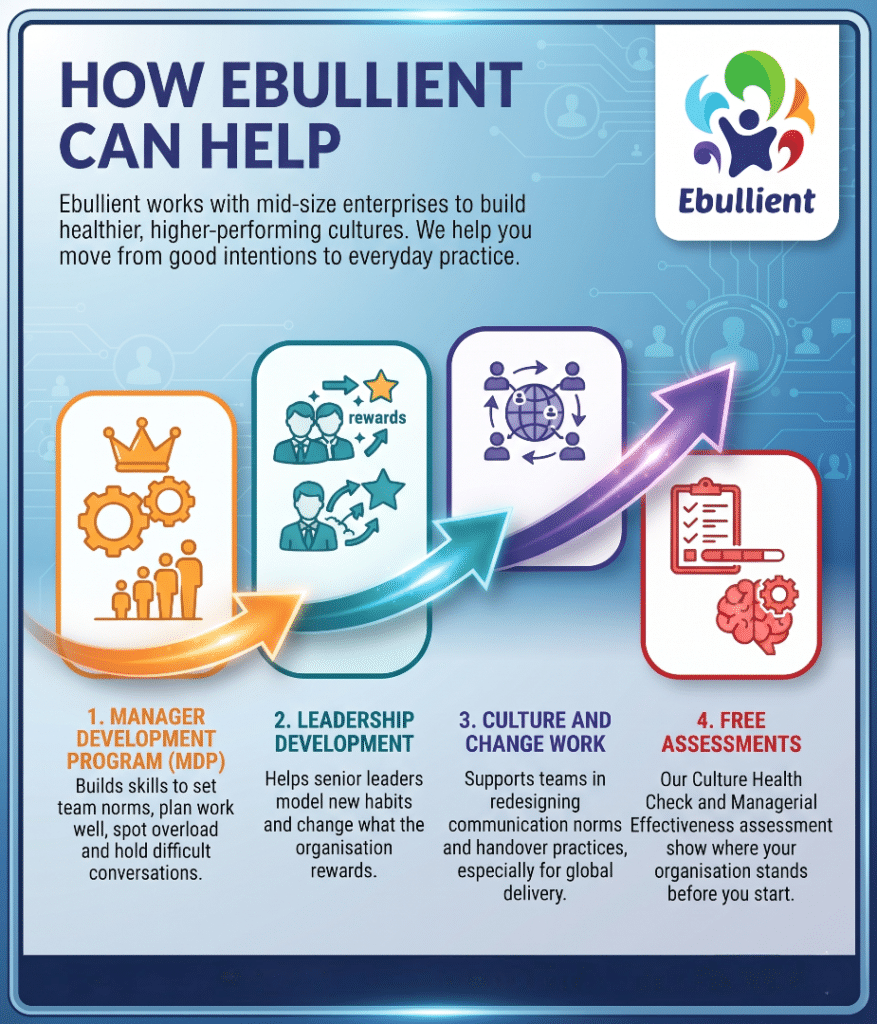
- Manager Development Program (MDP): builds the skills to set team norms, plan work well, spot overload and hold difficult conversations.
- Leadership Development: helps senior leaders model new habits and change what the organisation rewards.
- Culture and Change work: supports teams in redesigning communication norms and handover practices, especially for global delivery.
- Free Assessments: our Culture Health Check and Managerial Effectiveness assessment show where your organisation stands before you start.
Book a discovery call to talk through what a healthier rhythm could look like for your teams.
Want to meet the team?
Start with a 30-min conversation. No commitment needed.
Frequently Asked Questions
What is the right to disconnect?
The right to disconnect is the principle that employees can ignore work calls, emails and messages outside agreed working hours without penalty. It can be set by law or by company policy, and it normally allows exceptions for genuine emergencies.
Is the right to disconnect a law in India?
Based on the sources I reviewed, India has no enacted law that creates a general right to disconnect. A private member’s Bill has been proposed in Parliament, but it is not law. Employers can still adopt clear policies and team agreements now. Check current legal status with a qualified adviser.
How common is after-hours contact in India?
It is very common. An Indeed survey run by Censuswide found that 88% of Indian employees are contacted outside work hours and 85% hear from work during sick leave or holidays. A 2026 cult.fit study links availability pressure to high stress in nearly half of corporate employees.
How can managers reduce after-hours work without hurting results?
Agree response windows for each channel, define what counts as an emergency, schedule non-urgent messages for working hours, share on-call duty fairly and judge people on outcomes. Better planning also cuts false urgency, which is a major driver of late-night messages.
Does protecting personal time reduce productivity?
Not when it is done well. Rested employees think more clearly and make fewer mistakes, and clear norms reduce the stress of constant vigilance. The aim is not less work, but fewer unplanned interruptions and a protected space for recovery.