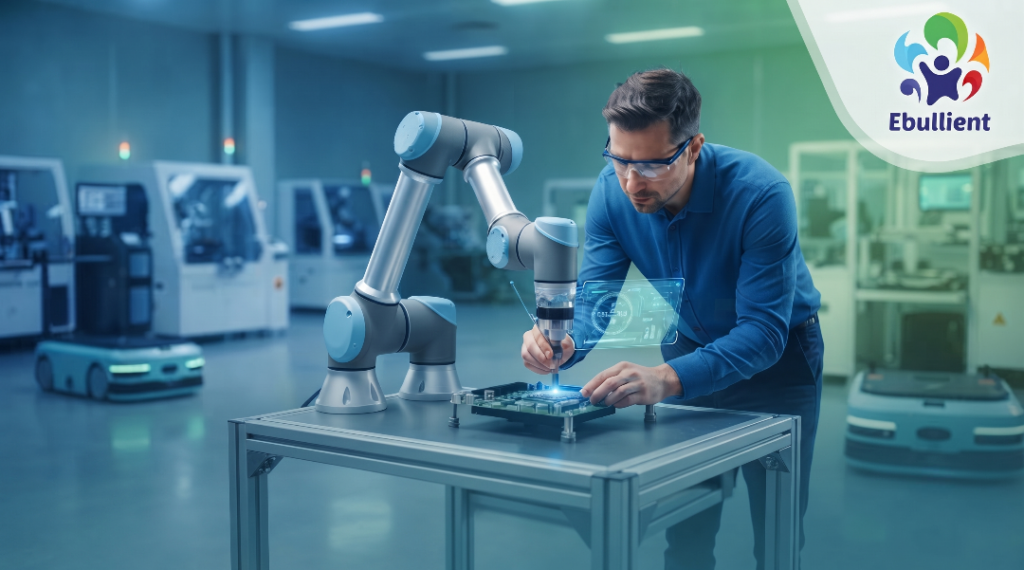
Industry 5.0 is the next evolution in industrial manufacturing, where human expertise and machine intelligence work in, deliberate partnership. In contrast to Industry 4.0’s automation first angle, Industry 5.0 puts human-centered thinking first, with an emphasis on sustainability and societal resilience too. Basically, it shifts smart factories from being efficiency machines into more people-powered systems, Key Takeaways at a Glance Industry 5.0 centres on human-machine collaboration, not automation for its own sake Human-centric smart factories outperform purely automated peers on resilience and retention Cognitive ergonomics is the underinvested variable in most Industry 5.0 deployments Reskilling manufacturing workforce is the primary ROI lever — not technology selection Sustainability must be embedded in learning design, not delivered as a compliance module Ebullient Consultancy offers context-specific Industry 5.0 learning solutions built for operational environments What Is Industry 5.0 and How Is It Different from Industry 4.0? Industry 5.0 moves beyond digitisation and automation to restore the human element inside smart factories. Where Industry 4.0 asked “how do we automate this?” Industry 5.0 asks “how do we make technology serve people better?” The shift is philosophical as much as operational. Industry 4.0 delivered these extraordinary efficiency gains , with connected machines , IoT-enabled supply chains and AI-powered quality control. But it also created a workforce anxiety crisis. Roles were eliminated faster than they were redesigned, and organisations found themselves with agile machines but rigid people strategies. Industry 5.0 in manufacturing corrects this imbalance. It recognises that the most competitive factories of the next decade will not be the most automated — they will be the most adaptive. This means designing production environments where cobots (collaborative robots) augment human judgment, where data systems are transparent enough for frontline workers to interrogate, and where sustainability goals are built into the manufacturing logic itself. The European Commission formally defines Industry 5.0 through three pillars: human-centricity, sustainability, and resilience. These are not aspirational add-ons. They are structural requirements for what it means to operate a modern smart factory. Source: ECI Did You Know? In the European Commission’s Industry 5.0 report, it says that more than 70% of manufacturers who tested human robot cooperation frameworks, noted actual, measurable improvements in worker satisfaction as well as production flexibility, within 18 months.Efficiency without humanity is no longer considered competitive advantage. How AI-Ready Is Your Organization, Really? Take our free 4-minute assessment and get a personalized report on your leadership fluency, governance, and workforce readiness. Take the Free AI Readiness Assessment → What Does a Human-Centric Smart Factory Actually Look Like? A human-centric smart factory is one where automation carries the repetitive, dangerous, and physically demanding load — while human workers own judgment, creativity, and care. Every technology decision is filtered through a single question: does this amplify human dignity, or diminish it? In Industry 5.0, that question is non-negotiable. In our experience working with manufacturing and industrial clients navigating digital transformation, the gap between ‘smart factory’ and ‘human-centric smart factory’ becomes visible almost immediately. Factories optimised purely for throughput generate high turnover, low engagement, and brittle dependency on specific machine configurations. Human-centric Industry 5.0 smart factories treat workers as human beings — not human resources — and design every system accordingly. Consider a precision components manufacturer that deploys collaborative robotics not to reduce headcount, but to eliminate ergonomic strain from repetitive assembly. Workers move into quality oversight, process calibration, and continuous improvement roles. Real-time dashboards give them direct visibility into production metrics they can interrogate and influence. Output improves — but so does retention, safety incident rates, and the institutional knowledge held within the workforce. This is Industry 5.0 in manufacturing: not a reduction in the human contribution, but a profound redesign of what that contribution is. The shift from ‘Human Resources’ to ‘Human Beings’ is not symbolic — it restructures hiring, performance design, development investment, and succession planning around the full range of human capacity, not just compliance with process. See how we help build this into your organization. Explore AI Training Programs → The Critical Niche Factor: Cognitive Ergonomics as a Design Principle Most Industry 5.0 implementation guides address physical ergonomics — the safe placement of cobots, the reduction of strain in manual tasks. Far fewer address cognitive ergonomics: the science of designing information environments that match human mental capacity. In a fully connected smart factory, workers are exposed to enormous volumes of sensor data, alert notifications, and production dashboards simultaneously. Without deliberate cognitive design, this creates decision fatigue, alert blindness, and operator error — negating the safety gains from automation. Leading Industry 5.0 organisations are now partnering with human factors specialists and L&D teams to audit the cognitive load placed on frontline workers. The result is simplified, role-specific dashboards; layered alerting systems that escalate only what demands immediate human judgment; and structured decision protocols built into workflow training. This is not a technology investment. It is a learning design investment — and it is the variable that separates high-performing human-centric factories from those that merely claim the Industry 5.0 label. Why Is Reskilling the Manufacturing Workforce the Most Urgent Industry 5.0 Priority? Technology deployment in smart factories consistently outpaces workforce capability development. This is not a technology problem — it is a culture and leadership problem. Reskilling the manufacturing workforce is not a welfare consideration; it is the primary multiplier on every automation investment. Factories that build human capability before and during technology rollout recover ROI faster, sustain quality more reliably, and build the antifragile resilience that BANI conditions demand. BANI conditions — Brittle, Anxious, Nonlinear, Incomprehensible — describe the operating reality facing manufacturing organisations today. Supply chain volatility. Regulatory shifts. Energy constraints. Geopolitical disruption. No machine resolves these. Only people with developed judgment, well-supported by capable leaders, navigate them effectively. The skills now required on a modern production floor have fundamentally changed. Mechanical dexterity and process memory remain valuable — but they are secondary to data literacy, systems thinking, the capacity to interpret AI-generated production insights, and the judgment to intervene effectively in real time. These