

Manager burnout is the sustained exhaustion of people who lead teams while absorbing pressure from above and below. In India it is rising as flatter structures, larger teams, and AI rollouts land on the same managers. Leaders should audit workloads, fix spans of control, and invest in coaching before this layer gives way.
Every restructuring memo promises fewer layers and faster decisions. Rarely does it say who will do the coaching and escalations the removed layer used to share. Usually the answer is the manager who stayed.
Key Takeaways at a Glance
Key Point | What It Means for Your Organisation |
Managers are losing steam | Global manager engagement fell from 27% to 22% in 2025. |
South Asia fell hardest | Manager engagement in South Asia dropped 8 points in a single year. |
The premium is gone | Managers were 11 points more engaged than their teams in 2022. By 2025 the gap was 3. |
Spans keep widening | US managers now average 12.1 direct reports, nearly double 2013. |
Training helps, structure matters | Coaching programmes lift engagement, but design and workload decide whether it lasts. |
What Is Manager Burnout, and How Is It Different From Employee Burnout?
Manager burnout is exhaustion that comes from carrying two sets of demands at once: targets from senior leaders and needs from the team. Employee burnout usually traces to workload. Manager burnout adds emotional labour, because managers absorb anxiety, mediate conflict, and explain decisions they did not make, often with no one left to do the same for them. That second load is invisible on any dashboard.
A summary of Gallup’s 2026 report describes managers as caught between executive expectations and employee needs that have moved further apart. That is a structural description, not a personal weakness.
It is also easy to miss. Burned-out managers keep showing up and hitting the numbers, but gradually stop coaching, delegating, and noticing. By the time results slip, the damage to the team is a year old.
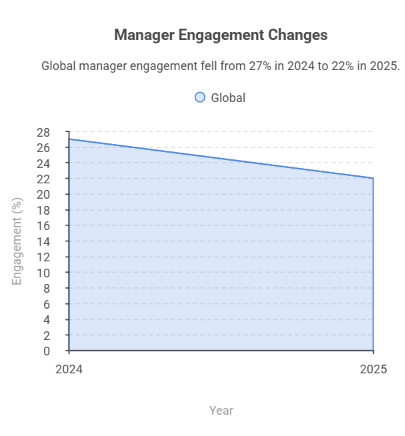
Source: Gallup
DID YOU KNOW?
Gallup’s 2026 State of the Global Workplace report found global manager engagement fell 5 points between 2024 and 2025, from 27% to 22%. In the same report, South Asia, led by India, recorded the steepest regional fall in manager engagement, at 8 points in one year.
How Managerially Effective Is Your Organization, Really?
Take our free 4-minute assessment and get a personalized report on your leadership fluency, governance, and workforce readiness.
Take the Free AI Readiness Assessment →How Serious Is Manager Disengagement in India in 2026?
It is serious and accelerating. Gallup’s 2026 report records an 8-point fall in manager engagement in South Asia in a single year, the steepest of any region. Writing in Forbes on Gallup’s data, Vibhas Ratanjee notes India’s overall engagement fell seven points, seven times the global decline, while only 17% of Indian employees are thriving against 34% globally. The pressure is building at the worst moment.
Gallup puts worldwide manager engagement at 22% in 2025, down from 31% in 2022, while individual contributors slipped only from 20% to 19%. The manager’s engagement premium has almost vanished: the gap narrowed from 11 points in 2022 to 3 in 2025.
A summary of the report adds that the number of managers in India has shrunk, though it gives no exact count. Treat that as a signal, not a statistic: fewer managers, larger teams, same expectations.
Why Are Managers Carrying More Than They Can Hold?
Three pressures stack up on the same people. Organisations flatten structures, which widens each manager’s team. AI and digital rollouts arrive as extra change to lead, not instead of existing work. And managers still do individual work themselves. Gallup finds engagement falls as spans grow once managers spend 40% or more of their time on individual contributor work. Each pressure is manageable alone; together they are not.
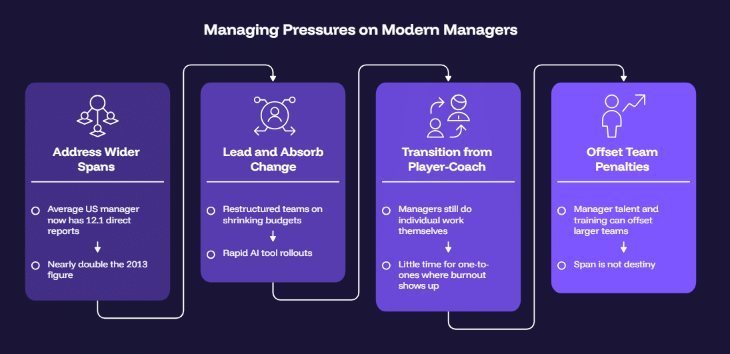
- Wider spans. Gallup tracking cited by Forbes shows the average US manager now has 12.1 direct reports, nearly double the 2013 figure. Indian figures are harder to find, but the direction in restructuring announcements is the same.
- Change they must lead and absorb. A summary of Gallup’s report lists restructured teams on shrinking budgets and rapid AI tool rollouts among the pressures managers face.
- Working in the team, not on it. Player-coach roles leave little time for one-to-ones, where burnout shows up first.
Gallup adds a hopeful finding: manager talent and training can offset the penalty of larger teams. Span is not destiny.
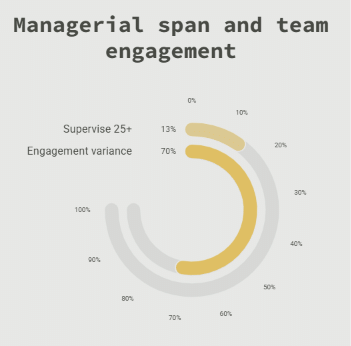
Source: Gallup
DID YOU KNOW?
In the US, the average manager now has 12.1 direct reports, nearly double the figure in 2013, and 13% supervise 25 or more people, according to Gallup tracking cited by Forbes. Gallup’s own research attributes about 70% of the variance in team engagement to the manager.
What Does It Cost an Organisation When Managers Burn Out?
The cost lands on everything managers touch. Because roughly 70% of team engagement variance traces to the manager, a depleted manager lowers engagement across the whole team. It also slows AI adoption, weakens the leadership pipeline, and raises exit risk among the people best placed to run the business. These costs rarely sit on one budget line, which is why they go unmanaged.
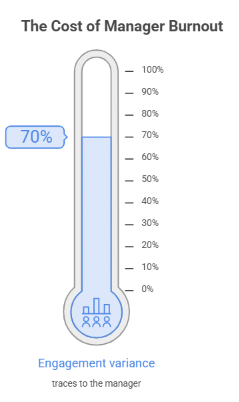
- Team engagement. One tired manager affects every person on the team.
- AI adoption. Coverage of Gallup’s 2026 report notes managers are the strongest predictor of AI adoption success, ahead of technical integration.
- People watching an exhausted manager conclude the next role up is not worth wanting.
- Health and cost. A 2022 Deloitte India study put the annual cost of poor mental health to employers at about Rs 1.1 lakh crore. The figure is four years old but shows the scale.
Old Playbook vs. Next Practice
Area | Old Playbook | Next Practice |
Restructuring | Remove layers, widen spans | Test span and workload first, then redesign roles |
Manager support | One workshop at promotion | Coaching, peer cohorts, and a 90-day application window |
Wellbeing | Employee-focused perks | Manager workload and confidential support included |
Measurement | Team output only | Output plus sustainability: hours, turnover, team health |
AI rollout | Handed to managers on top of the day job | Time and training protected for the change |
The Span Audit: A Practical Check Before You Flatten Again
Most structure decisions rely on a headcount ratio. A better test asks what the manager’s week actually contains. Run this audit on every team that has grown or lost a layer in the last year.
Check | What to Look At | Why It Matters |
Direct reports | Number of reports and how complex their roles are | A span of 12 simple roles differs from 8 specialist ones |
Individual work | Share of the week spent doing, not leading | Gallup links 40% or more to falling engagement as spans grow |
One-to-ones | How many happened in the last month | Skipped one-to-ones are the earliest sign of overload |
Meeting load | Hours in meetings versus time with the team | Calendars full of status meetings crowd out coaching |
Change load | Number of rollouts the manager is leading | AI, systems, and policy changes all need manager time |
Support | Who the manager turns to for help | A manager with no peer or coach has no pressure valve |
These checks are our own framing of the Gallup findings, not a published benchmark. Adapt them to your sector, and ask the questions before the restructure, not after.
The Manager Effectiveness Framework Free guide, instant download.
Get the Guide →Why Do Coaching and Capability Matter More Than Wellness Perks?
Wellness perks treat the symptom, while coaching and capability address the cause. Gallup reports that participants in manager coaching programmes saw up to 22% higher engagement, their teams up to 18% higher, and manager performance metrics improved 20 to 28%. As a summary of the report notes, those effects persisted for 9 to 18 months. The lesson is to build capability, not only to offer relief.
Those figures come from a secondary summary, so confirm them against Gallup’s original before quoting them externally. Managers who learn to coach, delegate, and set boundaries recover capacity that no meditation app can give them.
What Should HR and Business Leaders Do This Quarter?
Start with the managers you cannot afford to lose. Audit their spans, hours, and change load, and remove one burden each. Then build a support structure around them: coaching skills, peer cohorts, and protected time. Small, visible relief now earns more trust than a wellbeing campaign announced next year. None of it needs a new budget line.
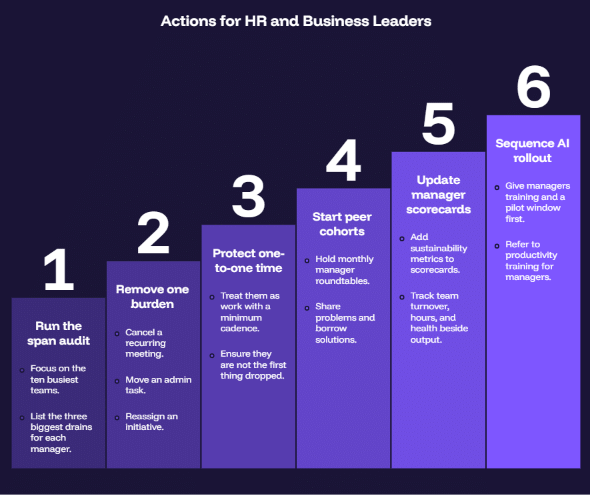
1. Run the span audit
On the ten busiest teams and list the three biggest drains for each manager.
2. Remove one burden per manager
Cancel a recurring meeting, move an admin task, or reassign an initiative.
3. Protect time for one-to-ones
Treat them as work with a minimum cadence, not as the first thing dropped.
4. Start peer cohorts
Monthly manager roundtables give people somewhere to share problems and borrow solutions.
5. Add sustainability to manager scorecards
Track team turnover, hours, and health beside output.
6. Sequence the AI rollout
Give managers training and a pilot window first. See productivity training for managers.
Curious About Other Areas of Your Organization?
Explore our other free assessments and get a fuller picture of where you stand.
View All AssessmentsHow Ebullient Can Help?
Ebullient works with mid-size enterprises on leadership, culture, and team capability. Three starting points suit a manager burnout problem:
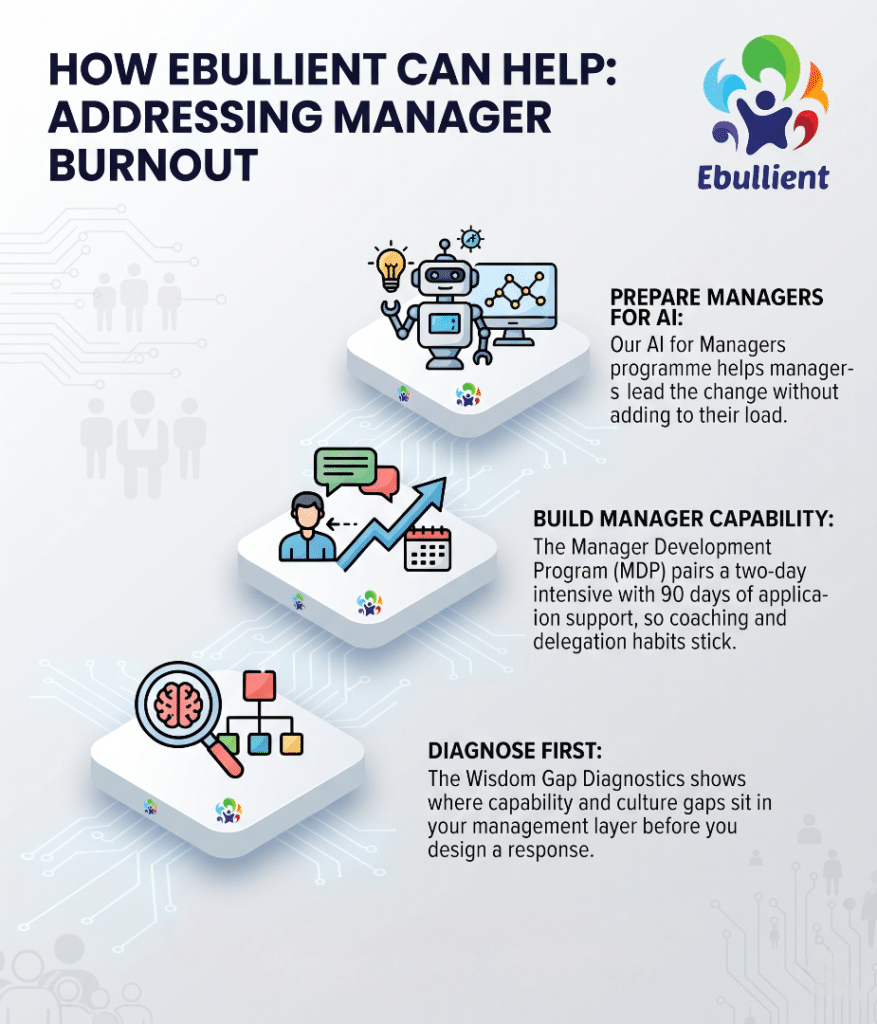
- Diagnose first. The Wisdom Gap Diagnostics shows where capability and culture gaps sit in your management layer before you design a response.
- Build manager capability. The Manager Development Program (MDP) pairs a two-day intensive with 90 days of application support, so coaching and delegation habits stick.
- Prepare managers for AI. Our AI for Managers programme helps managers lead the change without adding to their load.
Every engagement is customised to your context.
Final Thoughts
Flattening an organisation does not remove the work of a management layer. It moves that work onto fewer shoulders, and Gallup’s data says those shoulders are tiring, with South Asia feeling it first.
Leaders who handle this well treat managers as the load-bearing layer. They audit before they restructure, support before they ask for more, and watch the health of the middle as closely as the output of the top.
Want to meet the team?
Start with a 30-min conversation. No commitment needed.
Frequently Asked Questions
What causes manager burnout?
Manager burnout comes from sustained pressure with too little support. Common causes include wider spans of control, restructuring, rapid AI and digital rollouts, and being caught between executive demands and team needs. Gallup also links larger teams and heavy individual workloads to falling engagement. Wellbeing perks alone rarely fix any of these.
What are the signs of a burned-out manager?
Look for skipped one-to-ones, slower decisions, short or reactive communication, reluctance to delegate, and a drop in coaching. Output may stay steady for months, which hides the problem. Falling team engagement, rising small conflicts, and unexplained turnover in their team often appear before the manager says anything. Treat two or three together as a prompt for a conversation, not a diagnosis.
How many direct reports is too many?
There is no single number, because it depends on role complexity and how much individual work the manager still does. Gallup finds engagement falls as spans grow once managers spend 40% or more of their time on individual contributor work. Test the workload, not only the headcount: twelve simple roles can be lighter than six specialist ones.
Can training prevent manager burnout?
Training helps but does not do the whole job. Gallup reports coaching programmes lifted manager and team engagement, yet it also cautions that overloaded behaviour often reflects unstable roles. Combine capability building with workload audits, clear expectations, and peer support so the training has room to work. Neither capability nor conditions is enough alone.
How can HR support managers without adding more work?
Remove before you add. Cancel low-value meetings, simplify reporting, and protect time for one-to-ones. Then offer short, practical support such as peer cohorts and coaching. Measuring manager sustainability alongside output keeps leaders accountable for the management layer below them without creating another form to fill. Ask managers what to remove first; they know.