Free Assessments
Competency Framework Maturity Assessment
How Mature Is Your Organization’s Competency Framework?
Ready to see whether your framework is actually used, or just sitting on a shelf?
Takes about 3 minutes. Your personalized report is emailed to you instantly.
Start AssessmentWhat You'll Get
A clear maturity score
See exactly how your competency framework performs on a 0 to 30 scale.
A personalized report
Get specific strengths, risk areas, and next steps based on your actual answers, not generic advice.
A starting point for action
Understand where to focus first, whether that's consistency, validation, or senior ownership.
Why This Assessment Matters
Most organizations have some version of a competency framework, a document listing the skills and behaviors expected at each level. Far fewer can say with confidence that it’s consistently applied, genuinely future-oriented, or actually used in real hiring, development, and promotion decisions rather than referenced occasionally and otherwise ignored.
This assessment looks past whether a framework exists to examine whether it functions, consistency across levels, behavioral specificity, validation against real outcomes, and senior-level ownership. Your answers generate a personalized report on where your organization’s framework genuinely stands, and where the gaps could be limiting the talent decisions it’s meant to support.
What Is Competency Framework Maturity?
Competency framework maturity is not the same as having a framework on file. An organization can have a well-designed document that different teams interpret inconsistently, that hasn’t been revisited in years, or that nobody senior actually champions in their own decisions.
The pressure to close this gap is intensifying. McKinsey’s 2025 workforce research, widely cited into 2026, found that 87 percent of organizations report either an existing skills gap or one they expect within the next five years, a signal that the competency frameworks meant to guide hiring and development haven’t kept pace with what roles actually require.
This is the gap a competency framework maturity assessment is designed to surface, not whether a framework document exists, but whether it’s consistently applied, evidence-based, and actively championed at a senior level.
The Competency Framework Model Behind This Assessment
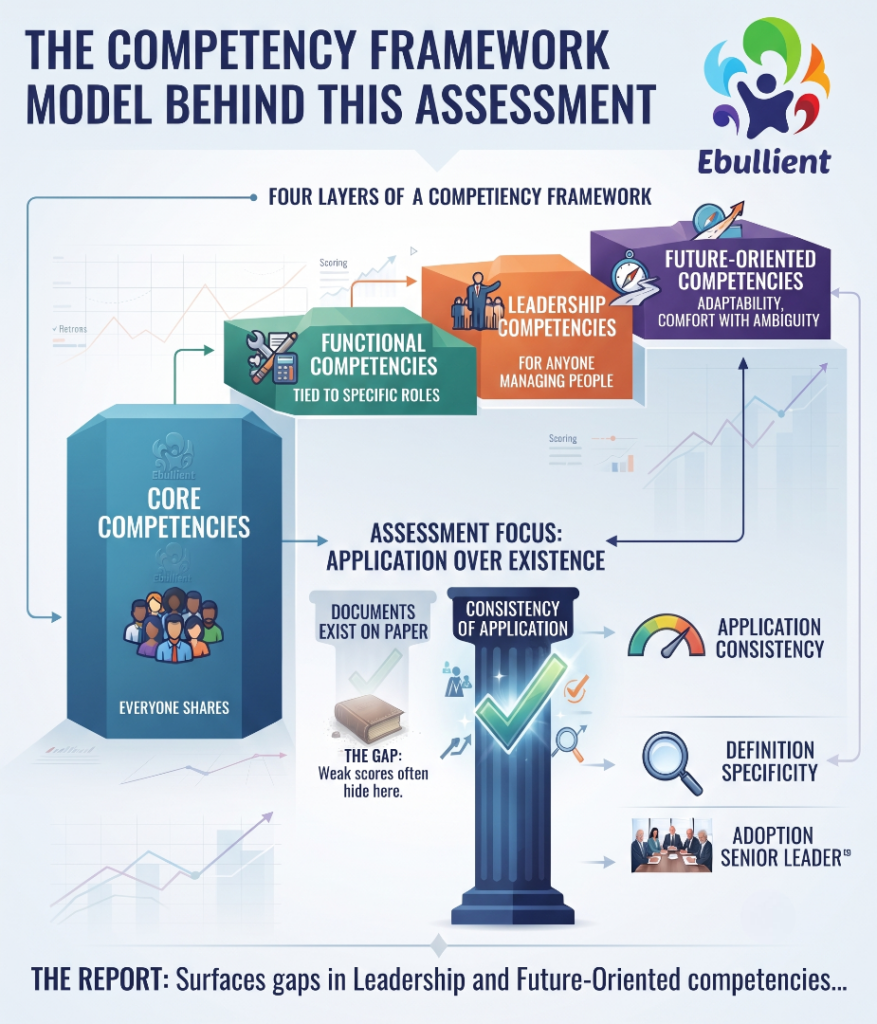
Every competency framework — whatever your organization calls it — is built from four layers: core competencies everyone shares, functional competencies tied to a specific role, leadership competencies for anyone managing people, and future-oriented competencies like adaptability and comfort with ambiguity. This assessment doesn’t just check whether those layers exist on paper; it scores how consistently they’re applied, how specifically they’re defined, and whether anyone senior actually uses them. A framework that’s strong on core and functional layers but thin on the top two will usually score well on documentation and weak on the “future orientation” dimension below — which is exactly the kind of gap the report is built to surface.
The Core Dimensions of Competency Framework Maturity
Whether a clear framework exists
Assessing capability purely through informal manager judgment leaves decisions inconsistent and hard to defend. A documented framework actively used in real decisions changes that.
Future orientation
A framework built entirely around what’s historically predicted success risks optimizing for a world that’s already changing. The strongest frameworks are deliberately redesigned around future needs.
Consistency of application
A framework applied differently across functions and levels isn’t really one framework. Shared language and calibration are what make it function the same way everywhere.
Behavioral specificity
Competencies described at a high conceptual level are hard to assess consistently or give concrete feedback against. Specific, observable behaviors at each level make the framework usable.
How competency is assessed
Relying purely on manager impression over time introduces real inconsistency. Genuine multi-source evidence, 360-degree input and real outcomes, produces a far more reliable read.
Validation against outcomes
Assuming a framework is relevant because of how it was designed, without testing it, risks it drifting out of date. Active validation against retention and performance keeps it grounded.
Review cadence
A framework set years ago and never revisited stops reflecting what the organization actually needs. A deliberate, regular review cycle keeps it current as the environment changes.
Senior ownership
A framework that sits only with HR as a functional responsibility rarely gets real traction. Visible senior sponsorship, someone using it in their own decisions, is what gives it weight.
Current performance vs. future potential
A framework that only assesses current role performance misses who’s actually ready for what’s next. The strongest frameworks assess both, explicitly and separately.
Comfort with ambiguity
A framework weighted entirely toward executing known playbooks well can undervalue exactly the capability needed for what’s ahead. Valuing ambiguity and audacity alongside execution closes that gap.
Want the full framework behind this assessment? Free guide, instant download.
Get the Guide →Why Framework Efforts Fail in Practice
The pattern shows up consistently. An organization invests real effort building a thoughtful competency framework, launches it with real fanfare, and finds that eighteen months later most managers have quietly reverted to their own informal judgment, because the framework was never validated against real outcomes or genuinely championed by anyone senior.
The deeper issue is rarely the quality of the framework itself. It’s the absence of the system around it, consistent application, senior sponsorship, and a regular review cycle that keeps it current. Designing a strong framework is achievable in a single project. Keeping it alive and actually used is the part most organizations skip.
How Competency Framework Maturity Connects to Every Transformation Effort
A competency framework is the shared language every other talent decision runs through, hiring, promotion, development, and succession all depend on some definition of what good looks like. When that definition is inconsistent or outdated, every decision built on top of it inherits the same weakness.
This is why competency framework maturity isn’t treated as a standalone HR project at Ebullient. It underlies leadership development, managerial effectiveness, and capability building, because a strong leadership program built on an outdated or inconsistently applied framework will struggle to actually change who gets developed and promoted.
What This Assessment Actually Measures
A well-designed maturity assessment does more than produce a score. It surfaces patterns across the dimensions that actually predict whether a framework will hold up in real use, and points to where the real leverage sits. One organization might discover the framework itself is strong but nobody senior visibly uses it. Another might find it hasn’t been validated against outcomes in years.
This kind of diagnosis matters because it prevents organizations from defaulting to a framework redesign when the real issue is application or ownership. A beautifully designed document changes nothing if managers still default to gut feeling.
Turning Assessment Results Into Action
A framework maturity score is a starting point, not a verdict. Once an organization understands where its real gaps sit, whether that’s consistency, validation, or senior ownership, the next step is building a focused plan around the one or two areas with the greatest impact.
This usually means resisting the instinct to redesign the whole framework from scratch. An organization with a solid framework but no senior champion needs a very different intervention than one whose framework hasn’t been reviewed in years. Getting the diagnosis right is what makes the plan that follows actually work.
Curious About Other Areas of Your Organization?
Explore our other free assessments and get a fuller picture of where you stand.
View All AssessmentsFrequently Asked Questions
How long does the assessment take? About 3 minutes. It’s 10 scored questions covering consistency, validation, ownership, and behavioral specificity.
Who should take this assessment? CHROs, HR leaders, and L&D heads who want an honest read on whether their framework is actually driving decisions.
What do I get after completing it? A personalized report with your organization’s maturity score, your readiness band, specific strengths and risk areas based on your actual answers, and concrete next steps.
How is my score calculated? Each of the 10 scored questions is weighted based on how strongly the answer reflects genuine framework maturity, not just documentation. Your total score, out of 30, places you into one of four bands, from Framework Gap to Next-Practice Framework.
Is my data kept private? Yes. Your responses and report are used only to generate your personalized results and are not shared with third parties.
Frameworks you can use before you ever speak to us.
Free guides. Built from what actually works.
Explore Free Guides →