
AI is not replacing managers wholesale—it is replacing the functions managers perform poorly: status tracking, scheduling, performance monitoring, and making low-stakes decisions. What AI can’t really is contextual judgment and relational trust, plus adaptive leadership when everything is a bit unclear. Human leaders who understand this difference will probably thrive in 2026.
The question of whether AI is replacing managers has moved from LinkedIn speculation to boardroom agenda. Algorithms now conduct performance reviews at companies like IBM. AI tools at Unilever screen thousands of job candidates before a human reads a single résumé. Scheduling, task assignment, reporting—these were once core to a manager’s role. In 2026, software handles most of them before the workday begins.
But here is the deeper truth: we are living, as Ebullient Consultancy frames it, in a world shaped by “Palaeolithic emotions, medieval institutions, and godlike technology.” The mismatch is not between humans and machines. It is between the pace of technological change and the pace of human development. The organizations that will fail are not the ones without AI tools. They are the ones whose managers were built for a world that no longer exists—equipped with mechanics, not mindsets—and have not been reforged to learn, decide, and act in the world that does.
Key Takeaways at a Glance
| Theme | Core Insight |
|---|---|
| AI replacing managers | AI replaces management tasks, not leadership roles |
| Human vs AI leadership | Empathy, judgment, and meaning-making are exclusively human |
| Management skills for the future | Coaching, adaptive thinking, and relational trust are now premium skills |
| AI workforce transformation | Middle managers are most at risk—and most under-supported |
| Future-ready leaders | Audit your role, invest in human capabilities, become a meaning-maker |
| Ebullient Consultancy | Bespoke programs that close the human-side gap in AI transitions |
Is AI Actually Replacing Managers, or Is It Replacing Management Tasks?
AI is replacing specific management tasks—not the manager as a human role. Routine functions like scheduling, progress tracking, data synthesis, and even compliance monitoring are being handled by AI systems more and more. Meanwhile what still stays, and what AI can not really do is the human judgment part, the relational intelligence, and the ethical accountability piece that actually define real leadership.
The distinction matters enormously for organizational strategy. When companies frame this as “AI replacing managers,” they create fear and resistance. When they frame it correctly—as AI replacing low-value tasks so managers can do higher-value work—they unlock a fundamentally different response.
Consider real-world AI decision-making examples: Amazon uses AI to monitor warehouse worker output in near-real time. But when a worker’s performance drops due to a personal crisis, no algorithm has been built that can hold a compassionate conversation, adjust expectations empathetically, and retain that employee’s loyalty. A manager can. That is not a soft skill—that is a core business capability.
Embracing an AI-first leadership approach—embracing the future of work—means accepting that some of what you once did as a manager will be automated. The strategic imperative is to become excellent at what cannot be: the human leadership functions that sit at the triple intersection of the digital revolution, the sustainability imperative, and the purpose movement.
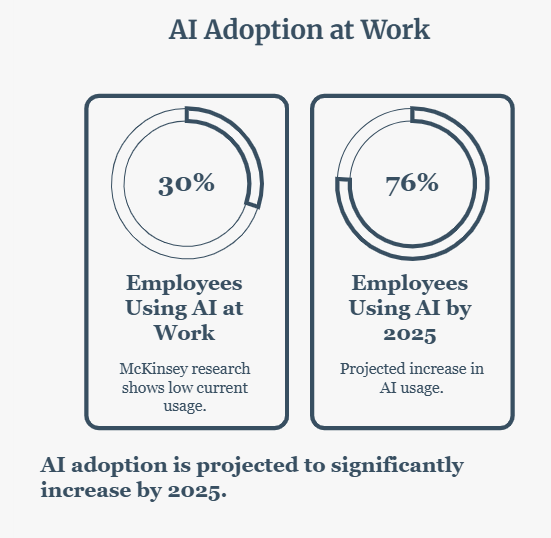
Source: McKinsey
Did You Know?
McKinsey research found 30 percent of employees reported using AI at work , but then again by 2025 around 76 percent said they were using AI in some capacity.
How AI-Ready Is Your Organization, Really?
Take our free 4-minute assessment and get a personalized report on your leadership fluency, governance, and workforce readiness.
Take the Free AI Readiness Assessment →What Makes Human Leadership Different from AI?
Human leadership is distinguished by contextual moral reasoning, emotional attunement, relational trust-building, and the ability to lead in situations where no algorithm offers a reliable answer. AI optimizes at scale, but it cannot navigate competing stakeholder values, build psychological safety, make meaning in a crisis, or lead culture through transformation. In 2026, these are the most commercially valuable leadership capabilities in existence.
Here is a direct comparison every L&D and HR decision-maker should keep front of mind:
Leadership Function | AI Capability | Human Leader Capability |
Performance tracking | Very High — real-time, consistent | Low — time-intensive |
Data-driven decision support | Very High | Moderate |
Empathy & trust-building | None | High |
Ethical judgment in ambiguity | None | Very High |
Culture & change leadership | None | Very High |
Conflict resolution | Low | High |
Motivating under uncertainty | None | High |
Coaching for individual growth | Limited | Very High |
Meaning-making in crisis | None | Irreplaceable |
The impact of artificial intelligence on leadership is not subtraction—it is redistribution. Managers are being freed from transactional work and pushed toward transformational work. Most are not ready for that shift.
In our experience designing leadership development frameworks for financial services, FMCG, and professional services firms, the gap is rarely technical. It is the ability to lead humans who are uncertain, resistant, or quietly grieving the loss of familiar routines. In short: to lead in BANI conditions—environments that are Brittle, Anxious, Nonlinear, and Incomprehensible.
Ebullient Consultancy’s mission is precisely to equip leaders for these conditions—not by resisting exponential tools, but by rewiring culture and capability so that technology becomes an amplifier of human dignity, creativity, and care, rather than a replacement for them. The shift Ebullient calls for is from “Human Resources” to “Human Beings”: across every stage of the employee lifecycle, from hiring to succession.
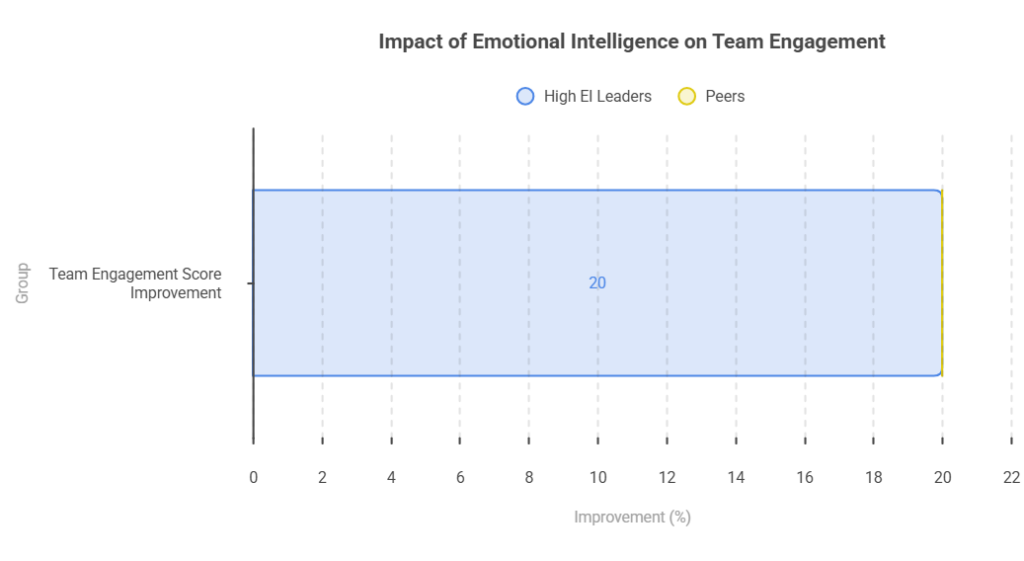
Source: Hay Group
Did You Know?
Hay Group indicates that leaders demonstrating high emotional intelligence outperform peers by up to 20% on team engagement scores—even when those peers have access to superior analytical tools.
What Management Skills for the Future Will AI Never Replicate?
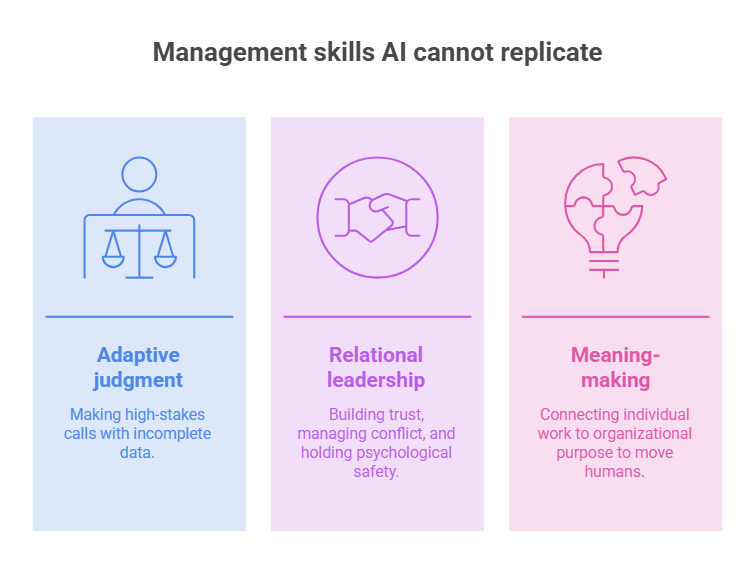
The management skills AI cannot replicate fall into three categories: adaptive judgment (making high-stakes calls with incomplete data), relational leadership (building trust, managing conflict, holding psychological safety), and meaning-making (connecting individual work to organizational purpose in ways that move humans to exceed expectations).
Leadership in the era of AI requires a deliberate shift in the skills managers develop and the behaviours organizations reward. For years, companies promoted managers for operational excellence—hitting targets, managing workflows, reporting upward efficiently. AI now does those things better and faster. That means the old promotion criteria are actively selecting for the wrong skills.
In our experience designing development programs for professional services firms, the most future-ready leaders consistently share three traits:
- They ask better questions than the AI does. An algorithm optimizes for what it is told to optimize for. The human leader’s job is to interrogate whether the right question is even being asked.
- They hold the room when data contradicts intuition. The best AI decision-making examples we have observed involve human leaders who paused an AI-driven recommendation, asked hard questions, and avoided costly decisions that looked right on paper but were wrong in context.
- They invest in relationships before a crisis, not during one. When an AI workforce transformation disrupts team composition or role definitions, the managers who navigate it well are the ones their teams already trust.
These are not innate gifts. They are trainable behaviours—which is precisely where leadership in the era of AI becomes an L&D priority, not just a cultural aspiration.
AI Readiness Score Card Free guide, instant download.
Get the Guide →The Critical Gap No One Is Talking About: AI and the Middle Management Void
The most underreported consequence of AI replacing managers is what is happening to middle management as a structural layer. Senior leaders are leaning into AI-first strategy. Frontline workers are adapting to AI-assisted workflows. But middle managers—the connective tissue of any large organization—are caught in a vacuum.
Their transactional role has been automated. Their strategic role has not been defined. Without deliberate intervention, organizations face a talent retention crisis at exactly the level they can least afford to lose: experienced managers who know the culture, the clients, and the institutional history, but do not yet know how to reposition themselves in an AI-augmented structure.
This is the hidden cost of AI workforce transformation that most leadership development programs still fail to address. The best AI leadership program or best AI capability building program will not just teach leaders to use tools—it will help them redefine their identity, scope, and value in a structurally changed organization.
How Should Future-Ready Leaders Respond to AI Workforce Transformation?
Future-ready leaders should take four concrete actions: audit which of their current tasks AI will absorb within 12 months; deliberately build capabilities in judgment, coaching, and adaptive thinking; champion AI literacy without catastrophizing; and work with L&D partners to build development pathways that close the gap between where they are and where the role is going.
Leading in an AI world is not about learning to code. It is about learning to lead humans who are working alongside code. Practically, this means:
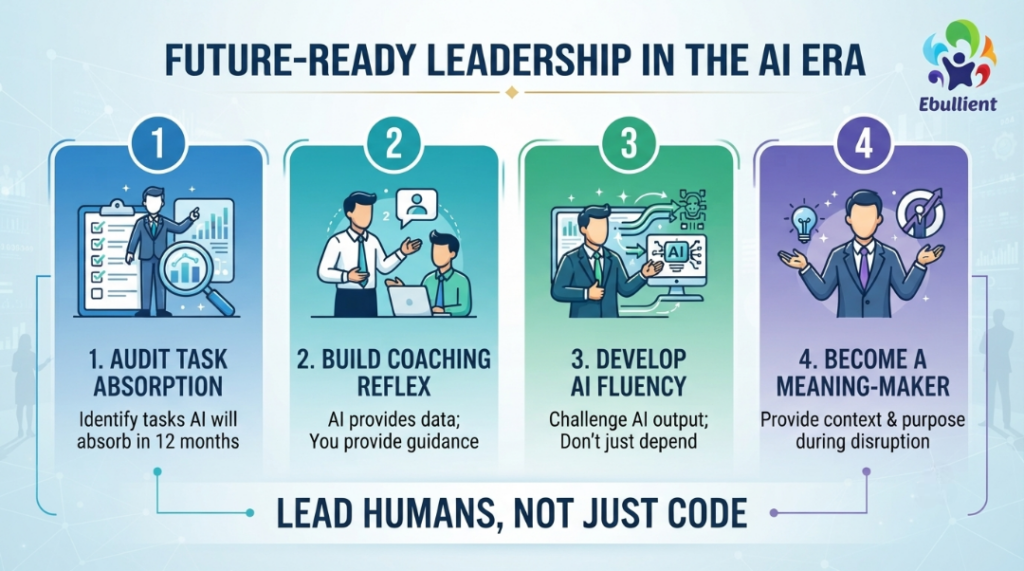
- Reframe your value proposition. If your primary identity was “the person who knows the numbers,” you need to evolve. The numbers are handled. Your value is in what you do with them—and how you bring your team along.
- Develop your coaching reflex. AI can flag performance data. It cannot have a coaching conversation. In 2026, managers who coach are managers who matter.
- Build AI fluency, not AI dependency. Understand what your tools can and cannot do. The leaders who most effectively navigate AI in leadership development are those who can challenge an AI output when context demands it.
- Become a meaning-maker. In periods of disruption, people do not need more data—they need clarity on why the work matters. Human leaders are the only source of that clarity.
Source: Deloitte
Did You Know?
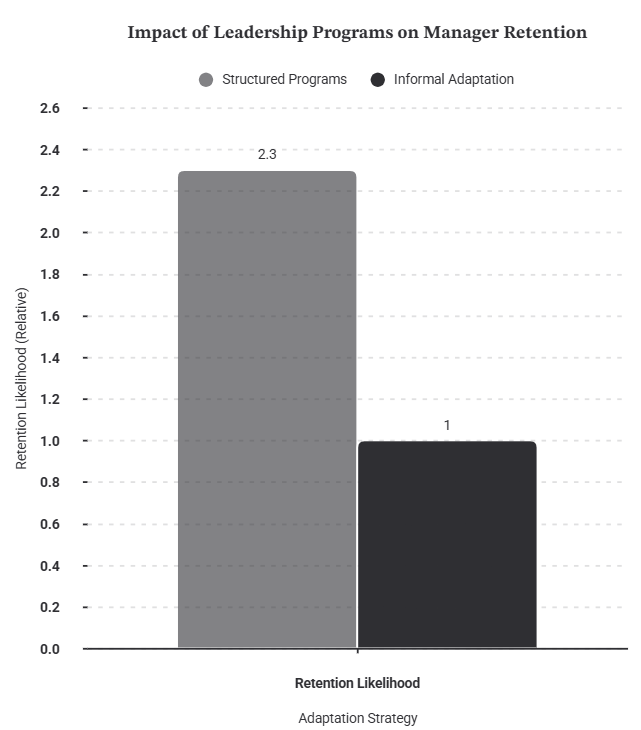
A Deloitte Human Capital report says, that organizations putting money into structured leadership capability programs during AI transitions are 2.3x more likely to retain top, high-performing managers than those who mostly lean on informal on the job adaptation.
Curious About Other Areas of Your Organization?
Explore our other free assessments and get a fuller picture of where you stand.
View All AssessmentsHow Ebullient Consultancy Helps Leaders Thrive in an AI-First World
Ebullient Consultancy exists to help leaders and organizations do what they do not yet know how to do: learn, decide, and act under deep ambiguity. That is not a tagline—it is the precise capability gap that AI workforce transformation has made urgent across every sector.
At the triple intersection of the digital revolution, the sustainability imperative, and the purpose movement, the question is not “how do we implement AI?” It is: “how do we build leaders wise enough, courageous enough, and human enough to lead their organizations through transformation without losing what makes those organizations worth transforming?”
Ebullient’s answer rests on four disciplines—each one addressing a gap that no off-the-shelf program closes:
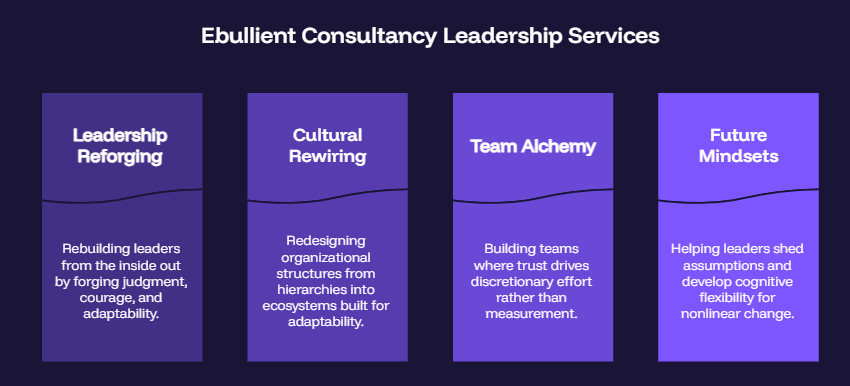
Leadership Reforging —Mindsets Over Mechanics
Rebuilding leaders from the inside out. Not workshop-based training, but the forging of judgment, courage, and adaptability needed to lead when there is no playbook. This is the foundation of AI in leadership development that actually holds under pressure.
Cultural Rewiring — Ecosystems Over Pyramids
Redesigning organizational structures from hierarchies built for stability into ecosystems built for adaptability. In an AI-augmented organization, culture is the last durable competitive moat—and the only thing AI cannot copy.
Team Alchemy — Trust Over KPIs
Building teams where trust—not measurement—drives discretionary effort. When AI handles tracking, human leaders must create the conditions for work that no performance algorithm can mandate.
Future Mindsets — Unlearn → Relearn
Helping leaders shed assumptions built for a stable world and develop the cognitive flexibility to navigate nonlinear, incomprehensible change. Not best-practice downloads—genuine intellectual reforging for an AI-first world.
For organizations evaluating the best AI leadership program or best AI capability building program, Ebullient’s work is not generic. Engagements are bespoke in a cohort-driven way, and they’re built around the actual leadership challenges your organization is already navigating—not some made up future scenario. In the end you get antifragile leadership that doesn’t only survive the disruption, but starts to grow from it.
Final Thoughts
AI replacing managers is a headline. The reality is more nuanced—and more urgent. What is being replaced is a version of management that was never real leadership: the coordination, the monitoring, the administrative overhead that consumed enormous human hours for limited strategic return.
What remains—and what is now expected of every people leader in 2026—is the full weight of human leadership. The organizations that win will not be the ones with the best AI tools. They will be the ones with the best human leaders who know exactly where they add value that AI cannot.
That is not a philosophical point. It is a competitive advantage.
Want to meet the team?
Start with a 30-min conversation. No commitment needed.
Frequently Asked Questions
Is AI really replacing managers in large organizations?
AI is replacing specific management functions—task delegation, performance monitoring, scheduling, and compliance tracking—across sectors. What it has not replaced, and cannot replace, is judgment-based, relational leadership. Organizations that conflate the two are making a costly strategic error.
What skills do leaders need to survive AI workforce transformation?
The skills most in demand are adaptive judgment, empathetic communication, coaching capability, and the ability to lead through ambiguity. These are distinct from technical AI literacy—though understanding how AI decision-making works is increasingly important for anyone in a senior leadership role.
What is the real difference between human vs AI leadership?
Human leadership involves reading emotional undercurrents in a team, navigating competing stakeholder values, building trust over time, and making calls where no data is fully adequate. AI excels at speed, consistency, and pattern recognition—but has no stake in outcomes and no capacity for moral reasoning or genuine empathy.
What makes an effective AI leadership program for senior leaders?
The best AI capability building program goes beyond tool training.It grows the meta-skills—judgment, coaching, meaning-making, that AI can’t really duplicate, while also helping leaders learn how to interrogate, blend, and challenge AI outputs in real day to day business situations.
How does Ebullient Consultancy take on AI leadership development?
Ebullient Consultancy sets up tailor-made leadership programs that are based on experiential learning and application based accountability. They use frameworks that tackle the capability gaps that show up when AI starts absorbing more of the transactional management side, which supports leaders in re-shaping their value inside structurally changed organizations.