

A 24-year-old analyst wants to work from anywhere and get feedback weekly. Her manager, a 41-year-old Millennial, wants her in the office three days a week. His own boss, a Gen X director, still believes respect is shown by how long you stay at your desk. All three are competent, well-meaning, and quietly frustrated with each other.
This is no longer an edge case. Great Place To Work India’s 2026 study puts Gen Z at 26% of the Indian workforce, nearly double its 2023 share. Yet the same body of research shows that most organisations have not taught their managers how to lead across these differences. This article sets out what the data says, where the friction really sits, and what managers and leaders can do about this.
KEY TAKEAWAYS AT A GLANCE
- Gen Z now makes up roughly a quarter of India’s workforce, and India’s CHROs are managing four generations at the same time.
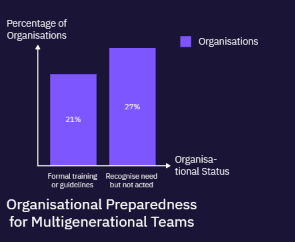
- Only 21% of organisations have formal manager training or guidelines for multigenerational teams, even though half of today’s managers need help.
- Organisations that understand what motivates each generation report 38% lower voluntary attrition.
- The sharpest friction points are flexibility and hybrid work, the pace of technology adoption, communication styles, and attitudes to hierarchy.
- Generational labels are a starting hypothesis, not a diagnosis. The best managers ask, test, and adjust person by person.
What does a four-generation workforce mean for Indian managers?
A multigenerational workforce means Baby Boomers, Gen X, Millennials and Gen Z working side by side. For Indian managers it means one team can hold very different expectations about flexibility, feedback, technology and authority, and the manager is the person who has to reconcile them every day.
The shift is recent and fast. Gen Z’s share of the workforce has roughly doubled in about three years. Great Place To Work India reports that about 58% of CHROs are dealing with AI-related and generational challenges at the same time, which is why a skill that used to be a nice-to-have has become a core management competency.
How Leadership-Ready Is Your Organization, Really?
Take our free 4-minute assessment and get a personalized report on your leadership fluency, governance, and workforce readiness.
Take the Free Leadership Readiness Assessment →Where the friction really sits
In Great Place To Work India’s Voice of CHRO 2026 survey, CHROs were asked what causes generational tension. The answers are specific and fixable:
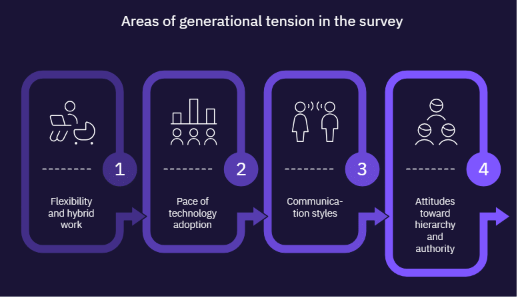
- Flexibility and hybrid work: cited by about two-thirds of CHROs as the largest area of friction.
- Pace of technology adoption: named by 40%.
- Communication styles: named by 38%.
- Attitudes toward hierarchy and authority: also 38%.
A caution on the evidence: that survey covered 135+ HR and business leaders across 10+ industries, and its authors describe the findings as directional rather than representative of all Indian organisations. Treat the numbers as a strong signal, not a census.
Source: Great Place To Work India
DID YOU KNOW?
Only 21% of organisations have formal manager training or guidelines for leading multigenerational teams. Another 27% recognise the need but have not acted, and half of today’s managers say they need help navigating a multigenerational workforce.
Why is the manager the deciding variable?
Because generational differences rarely cause exits on their own. They cause exits when a manager cannot translate between them. In the same survey, 64% of CHROs traced early exits to manager or team fit, and only about three in ten said they clearly understand what motivates each generation.
The upside of getting this right is measurable. Organisations that do understand generational motivations report 38% lower voluntary attrition.
For a mid-size enterprise losing high performers every quarter, that is one of the few retention levers that sits entirely inside management capability rather than the compensation budget.
Is Your Leadership Pipeline at Risk? Free guide, instant download.
Get the Guide →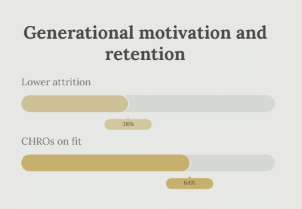
Source: Great Place To Work India
DID YOU KNOW?
Organisations that understand what motivates each generation report 38% lower voluntary attrition, and 64% of CHROs trace early exits to manager or team fit rather than to pay or the market.
How can managers adapt without stereotyping?
Treat generational patterns as hypotheses and confirm them in one-to-one conversations. The data itself shows why: the signals are mixed. Randstad India’s Gen Z Workplace Blueprint (750 workers, November 2025) found 37% rank better pay as a stronger motivator than traditional perks, while an Unstop report from March 2026 found 90% of Gen Z professionals would accept lower pay for richer learning. Both can be true for different people on the same team.
Three other findings are worth a manager’s attention:
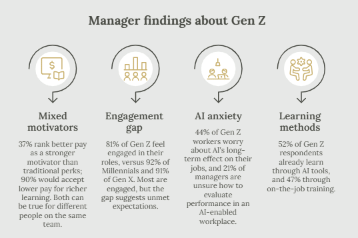
- Engagement is not the problem, expectations are. Randstad found 81% of Gen Z feel engaged in their roles, versus 92% of Millennials and 91% of Gen X. Most are engaged, but the gap suggests unmet expectations.
- AI anxiety is generational and managerial. 44% of Gen Z workers worry about AI’s long-term effect on their jobs, and Great Place To Work India found 21% of managers are unsure how to evaluate performance in an AI-enabled workplace.
- Learning is the common language. 52% of Gen Z respondents already learn through AI tools, and 47% through on-the-job training, which gives managers a shared starting point across ages.
From Old Playbook to Next Practice
Old Playbook | Next Practice |
One management style applied to everyone | A small set of principles, flexed by person: ask what each team member needs from feedback, flexibility and growth |
Annual review as the main feedback moment | Short, frequent check-ins, with the depth of feedback agreed with each person |
Flexibility treated as a perk or a policy exception | Flexibility designed as a team agreement: core hours, handoffs and outcomes made explicit |
Seniority as the default signal of credibility | Credibility built through contribution, with reverse mentoring so experience and fresh skills flow both ways |
Manager training aimed at the first-time manager only | Multigenerational leadership skills built into every manager and leadership pipeline programme |
Performance judged on visible activity | Performance judged on outcomes, including a clear rubric for work done with AI support |
What to Do About It This?
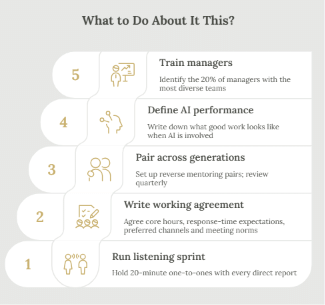
1. Run a listening sprint
Hold 20-minute one-to-ones with every direct report and ask three questions: what helps you do your best work, how do you like to receive feedback, and what would make you stay.
2. Write a team working agreement
Agree core hours, response-time expectations, preferred channels and meeting norms. This turns the flexibility and communication friction into a visible, negotiable document.
3. Pair across generations
Set up reverse mentoring pairs: a senior leader learns AI tools and new platforms, a younger colleague learns how decisions get made. Review quarterly.
4. Define AI-era performance
Write down what good work looks like when AI is involved, what must be verified by a human, and how the output will be assessed.
5. Train the managers who are carrying this
Identify the 20% of managers with the most diverse teams and give them structured development before the next appraisal cycle.
Curious About Other Areas of Your Organization?
Explore our other free assessments and get a fuller picture of where you stand.
View All AssessmentsHow Ebullient Helps Organisations Lead Across Generations?
Ebullient Consultancy works at the point where technology change meets human capability. For multigenerational teams, that work typically runs through four areas:
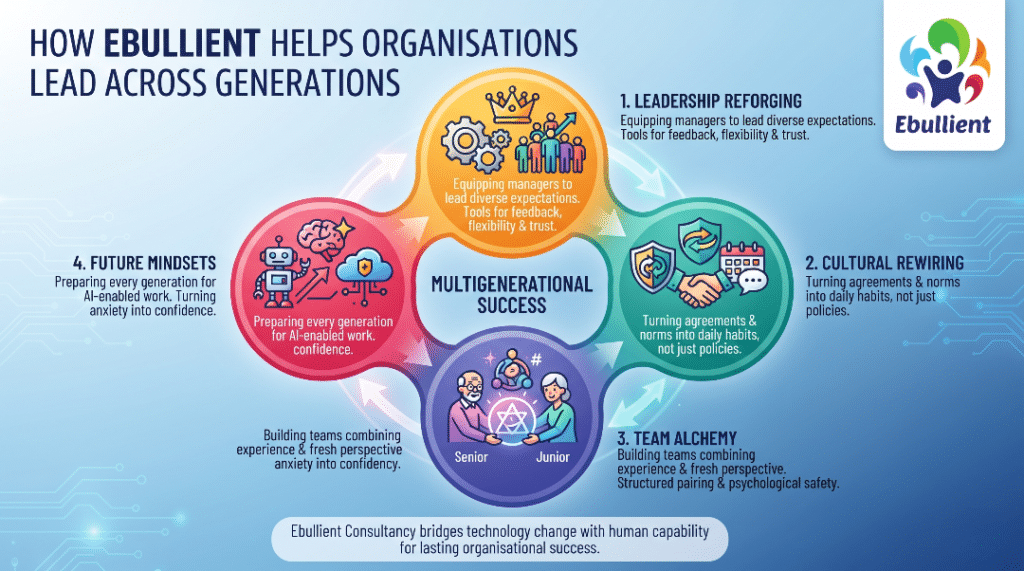
Leadership Reforging
Equipping managers and senior leaders to lead people whose expectations differ from their own, with practical tools for feedback, flexibility and trust.
Cultural Rewiring
Turning working agreements, communication norms and decision rights into daily habits across generations, not just policy documents.
Team Alchemy
Building teams that combine experience and fresh perspective, through structured pairing, shared rituals and psychological safety.
Future Mindsets
Preparing every generation for AI-enabled work, so that anxiety about the technology becomes confidence in using it.
Want to meet the team?
Start with a 30-min conversation. No commitment needed.
Frequently Asked Questions
What is a multigenerational workforce?
A multigenerational workforce is one where employees from up to four generations, usually Baby Boomers, Gen X, Millennials and Gen Z, work together in the same organisation. Each group tends to bring different expectations about flexibility, feedback, technology and authority, which managers must balance.
What are the biggest challenges of managing multiple generations in India?
According to Great Place To Work India’s Voice of CHRO 2026 survey, the main challenges are flexibility and hybrid work (about two-thirds of CHROs), the pace of technology adoption (40%), communication styles (38%) and attitudes to hierarchy (38%). Managers also struggle to evaluate performance fairly in AI-enabled work.
How can managers retain Gen Z employees?
Start with flexibility, since 59% of CHROs name its absence as the top reason Gen Z employees leave. Add visible learning paths, frequent feedback and clear career steps. Then confirm each person’s priorities in conversation, because Gen Z employees are not uniform and pay, learning and purpose matter differently to each.
Are generational stereotypes useful for managers?
Only as hypotheses. Patterns such as Gen Z’s emphasis on flexibility are real in survey data, but individuals vary widely within every generation. Use the patterns to ask better questions, then adapt to what each person actually tells you instead of assuming their preferences from their birth year.
Should companies train managers specifically for multigenerational teams?
Yes. Only 21% of organisations have formal training or guidelines for it, while half of managers say they need help. Effective programmes cover one-to-one conversations, feedback styles, flexible-work agreements, reverse mentoring and performance evaluation in AI-enabled roles, and they practise these skills on real team situations.