

Quiet quitting in India means employees who meet basic job requirements but invest little extra effort. Gallup’s 2026 data show 59% of Indian employees are “not engaged”. Leaders point mainly to weak culture and trust, and to stretched managers. The most effective fixes are better manager selection and coaching, clear roles, daily culture practices and visible growth paths.
Key takeaways at a glance
- The problem is detachment, not defiance. Most disengaged employees are present but not invested.
- Culture comes first. Leaders rank weak culture and values misalignment as the top driver.
- Managers are the lever, and they are strained. Manager engagement in India fell nine points in a year.
- Select and train managers well. Talent and coaching skills matter more than past performance alone.
- Make culture daily. Clarity, feedback and recognition beat values statements.
Why Quiet Quitting Is India's Biggest Engagement is a Challenge ?
When leaders worry about disengagement, they often picture open resistance: people who complain, undermine or walk out. In India, the larger problem looks quieter. Many employees show up, complete their tasks and go home, without offering the initiative, ideas and extra effort that drive performance.
A new report from Gallup and the Institute of Directors (India), published in 2026, puts numbers on this. It finds that the engagement decline is being driven not by more people working against their organisations, but by more people who are present and psychologically detached.
This guide is for leaders and managers. It explains what quiet quitting is, what the latest research says about why it is rising in India, and bringing people back.
How Healthy Is Your Organizational Culture, Really?
Take our free 4-minute assessment and get a personalized report on your leadership fluency, governance, and workforce readiness.
Take the Free Organizational Culture Assessment →What is quiet quitting?
Quiet quitting describes employees who do what their role strictly requires but invest little discretionary effort, initiative or commitment. Gallup classifies them as “not engaged”: physically present, psychologically detached from their work, team and organisation, but not actively working against the company.
Not engaged versus actively disengaged
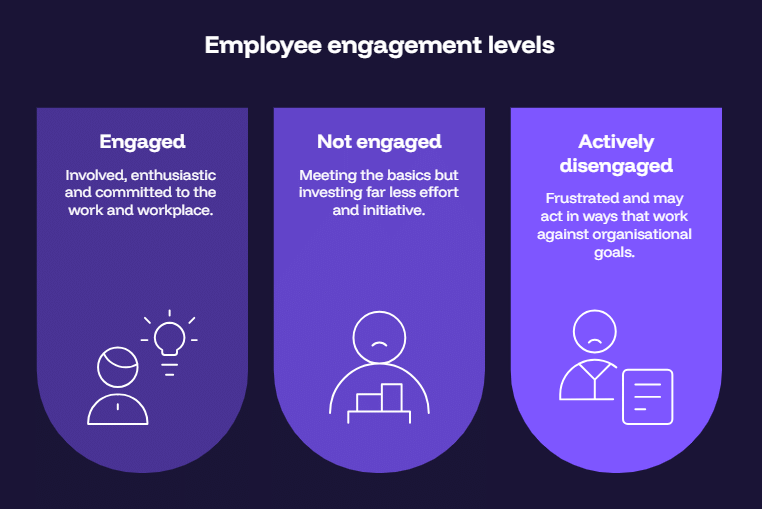
- Engaged: involved, enthusiastic and committed to the work and workplace.
- Not engaged: meeting the basics but investing far less effort and initiative.
- Actively disengaged: frustrated and may act in ways that work against organisational goals.
Why it matters more than it sounds
Disengagement drains initiative, adaptability, resilience and willingness to solve problems beyond the minimum. These are exactly the qualities organisations need as AI adoption and constant change raise the demands on people.
Source: Gallup
Did You Know?
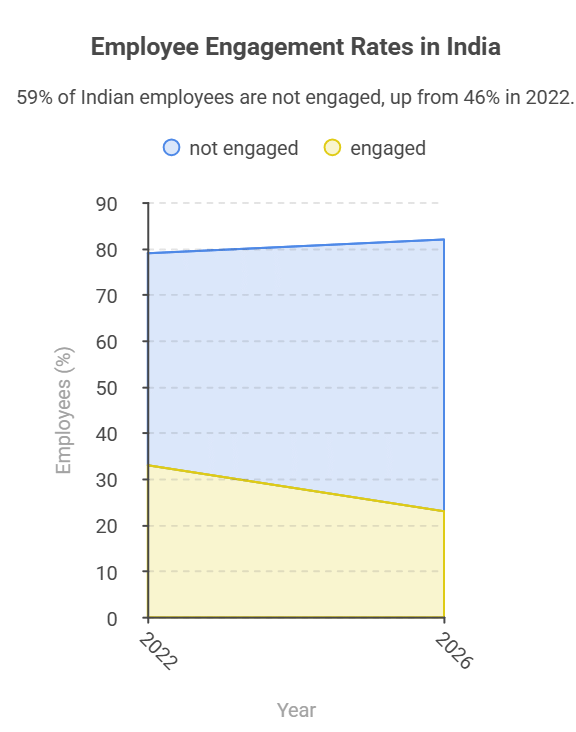
More than half of India’s workforce is present but detached. Gallup’s 2026 data show 59% of Indian employees are “not engaged”, up from 46% in 2022, while engaged employees fell from 33% to 23%. Gallup estimates that disengagement costs India about USD 351 billion, roughly INR 32.7 trillion or about 9% of GDP, in lost productivity each year.
Why is quiet quitting rising in India?
Quiet quitting is rising in India because employees are becoming less psychologically invested while managers, who should be the connecting link, are under growing pressure. Leaders surveyed by Gallup and IOD name weak culture, low trust, lack of purpose and limited growth as the main drivers.
The share of detached employees is growing
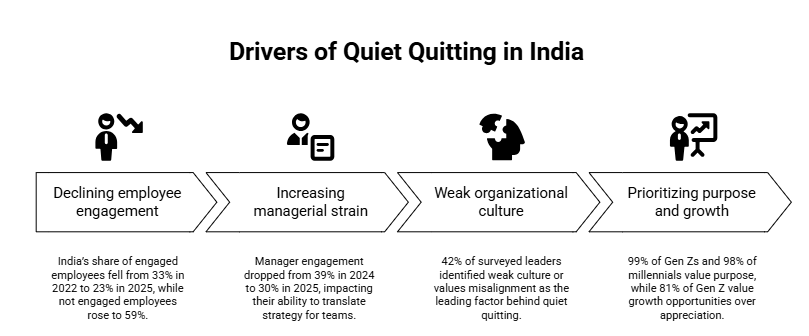
Gallup’s data show that India’s share of engaged employees fell from a high of 33% in 2022 to 23% in 2025, while the share of not engaged employees rose from 46% to 59%. The share of actively disengaged employees edged down from 21% to 18%.
Managers are feeling the strain
In 2025, 30% of Indian managers were engaged, down from 39% in 2024. Engagement among individual contributors fell from 24% to 19% over the same period. Gallup notes that managers translate strategy into daily work, so their strain travels to their teams.
Leaders point to culture
In Gallup and IOD’s survey of 181 members, conducted between 14 May and 22 June 2026, 42% named weak organisational culture or values misalignment as the leading factor behind quiet quitting. Low trust in leadership or poor communication, lack of meaningful work or purpose, limited career growth and poor recognition were each named by 31%.
Younger workers want purpose and growth
Deloitte India’s 2026 Gen Z and Millennial Survey found that 99% of Gen Zs and 98% of millennials in India say a sense of purpose is important for job satisfaction, and 48% of Gen Zs have rejected potential employers because of personal beliefs. Naukri’s Gen Z Work Code report (January 2026) found that 81% of Gen Z respondents value growth opportunities over verbal or public appreciation.
A five-step playbook to reverse quiet quitting
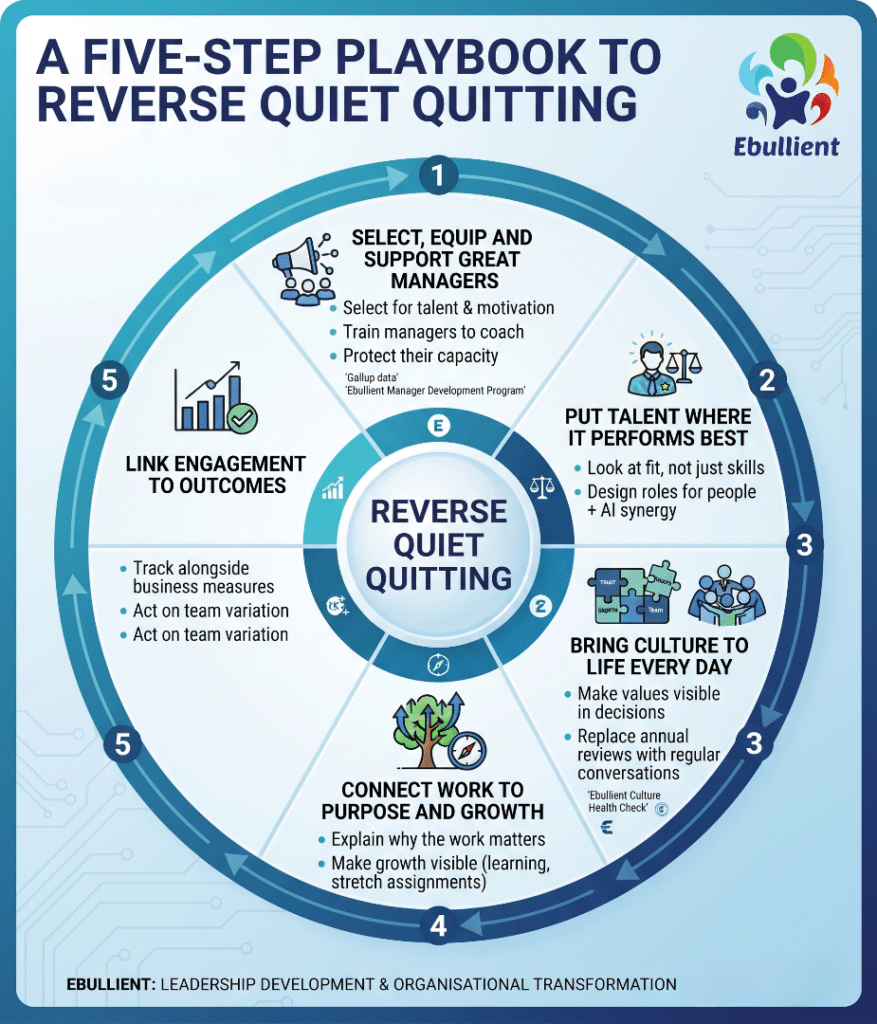
Step 1: Select, equip and support great managers
Because managers carry so much of the team experience, start there.
Select for talent, not just performance
Promotion to manager should not be an automatic reward for technical excellence. Ask who has the talent and motivation to help other people perform at their best, and create strong career paths for specialists who do not want to manage people.
Train managers to coach
Gallup reports that coaching-focused manager training has been associated with up to 22% higher engagement for participants and up to 18% higher engagement in their teams. Ebullient’s Manager Development Program builds these skills.
Protect their capacity
Review spans of control, workload and administrative burden. Managers cannot coach if they have no time. Ebullient’s Managerial Effectiveness assessment and Manager Effectiveness Framework can help you see where capacity is stretched.
Step 2: Put talent where it performs best
People engage more when their role fits their strengths.
Look at fit, not only skills
Add strengths and role fit to talent reviews and succession discussions. Shape roles around what each person does best while keeping accountability clear.
Design roles around people and technology
As AI takes on routine tasks, redesign roles so people spend more time on judgment, relationships and creativity.
Step 3: Bring culture to life every day
Employees judge culture by everyday experiences, not by a values poster.
Make values visible in decisions
Show how values shape promotion decisions, resource allocation, change communication and recognition. Where behaviour contradicts the stated culture, say so and fix it. Ebullient’s Culture Health Check can help you find the gaps.
Replace episodic reviews with regular conversations
Short, specific, weekly or fortnightly conversations about expectations, progress and growth do more than annual surveys and appraisals. See our article on building a culture of impact.
Step 4: Connect work to purpose and growth
The research shows that meaning and development keep people invested.
Explain why the work matters
Help every team see how its work contributes to customers, colleagues and the organisation’s mission.
Make growth visible
Offer learning, stretch assignments and clear paths, including for those who do not want to manage. Younger employees in particular often value growth over praise.
Step 5: Link engagement to outcomes
Engagement is a means to results, not a score to admire.
Track it alongside business measures
Review team-level engagement next to customer, productivity, quality and retention data, so leaders can see where better management is paying off.
Act on variation
Compare similar teams with very different results and find out what the strong ones do differently. Then spread those practices.
The Organizational Transformation Checklist Free guide, instant download.
Get the Guide →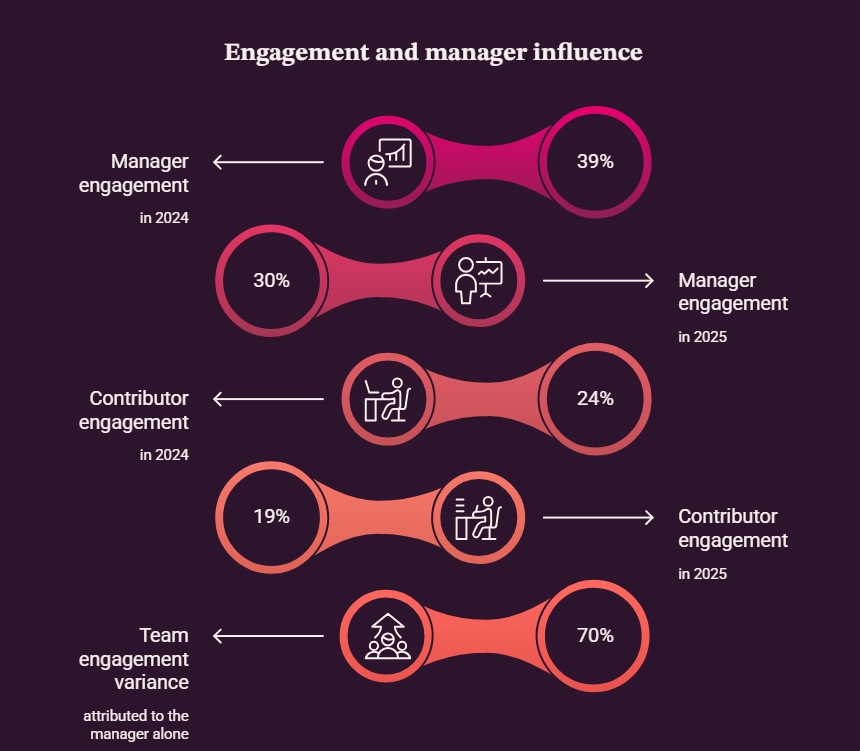
Source: IOD
Did You Know?
Indian managers’ engagement fell nine points in one year. In the Gallup and IOD (India) report, manager engagement dropped from 39% in 2024 to 30% in 2025, and individual contributor engagement fell from 24% to 19%. Gallup attributes 70% of the variance in team engagement to the manager alone.
Common mistakes when tackling disengagement
- Treating engagement as an annual survey.
- Blaming employee attitude. Leaders surveyed point to culture and conditions.
- Promoting top performers into management without support.
- Offering perks instead of fixing role clarity, feedback and recognition.
- Overloading managers and still expecting coaching.
- Measuring happiness instead of conditions for performance.
- Ignoring variation between teams. The best teams show what is possible.
Curious About Other Areas of Your Organization?
Explore our other free assessments and get a fuller picture of where you stand.
View All AssessmentsHow Ebullient Helps Organisations Re-engage Their People?
Ebullient is a leadership development and organisational transformation firm based in Noida, India. We have worked with 40+ organisations and developed 5,000+ professionals across sectors including banking, IT, manufacturing and pharma. We build leadership, culture and AI-readiness together, so that engagement is built into how work gets done.
Our approach
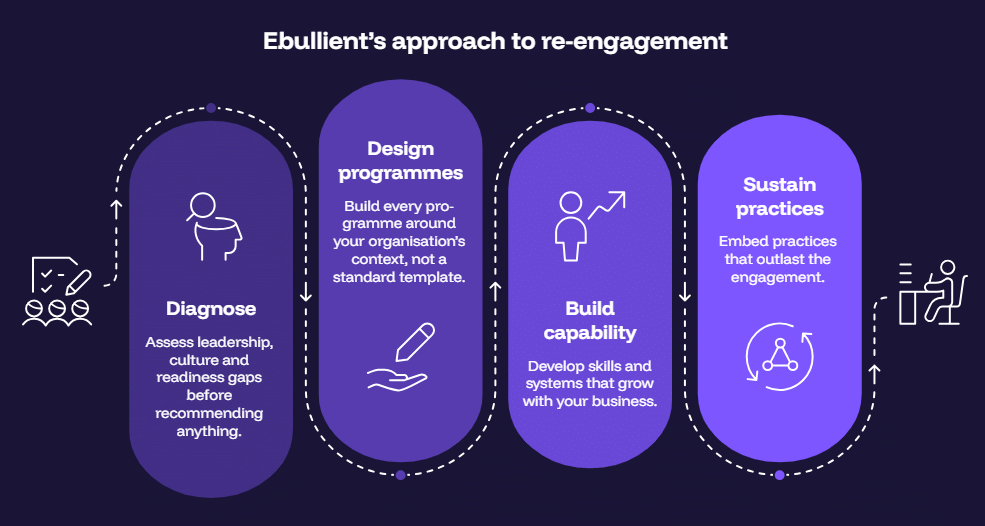
- Diagnose: we assess leadership, culture and readiness gaps before recommending anything.
- Design: every programme is built around your organisation’s context, not a standard template.
- Build capability: we develop skills and systems that grow with your business.
- Sustain: we embed practices that outlast the engagement.
Final thoughts
India does not have a sudden wave of employees turning against their employers. It has a growing number who have quietly stopped investing. That is harder to see, and easier to ignore, but its cost is large.
The encouraging message from the 2026 research is that the fixes lie within organisations’ control. Choose and train managers well, protect their time, make culture visible in daily decisions, and show people why their work matters and where they can grow.
Want to meet the team?
Start with a 30-min conversation. No commitment needed.
Frequently Asked Questions
What is quiet quitting?
Quiet quitting describes employees who do only what their role requires and invest little extra effort, initiative or commitment. Gallup calls them “not engaged”: present at work but psychologically detached, without actively working against the organisation.
How common is quiet quitting in India?
Gallup’s 2026 data show 59% of Indian employees are not engaged, 23% are engaged and 18% are actively disengaged. The share of engaged employees has fallen from 33% in 2022, its lowest level in four years.
What causes quiet quitting in India?
In Gallup and IOD’s survey of 181 leaders, 42% named weak culture or values misalignment as the leading cause. Low trust or poor communication, lack of purpose, limited career growth and poor recognition were each named by 31%.
How can managers reduce quiet quitting?
Managers can set clear expectations, hold regular specific conversations, recognise good work, match tasks to strengths and show how work connects to purpose. They need selection for talent, coaching training and enough time to do this well.
How much does disengagement cost India?
Gallup estimates that India’s disengagement costs about USD 351 billion, or roughly INR 32.7 trillion, in lost workplace productivity each year, equivalent to about 9% of GDP. It is an estimate based on Gallup’s modelling.