
Capability anxiety is employees’ worry that they cannot keep up with fast-changing work. It grows when skills are not tracked, career paths are unclear, internal moves slow down and managers have little time to coach. Leaders can reduce it by making skills visible, opening internal paths, equipping managers and protecting time for hands-on learning.
Key takeaways at a glance
- Capability anxiety is a new workforce risk. People know work is changing, but doubt they can keep up.
- Make skills visible. You cannot develop what you do not track.
- Show real career paths. Internal roles and learning routes reduce uncertainty.
- Equip managers to coach. Employees look first to their manager for development.
- Teach applied adaptability. Use AI to learn by doing, not just to attend tool training.
Why Capability Anxiety Is the Workforce Risk Leaders Are Missing?
On the surface, the Indian job market looks steady. Hiring is growing modestly, attrition has cooled and many teams are busy. But underneath, something else is stirring: a quiet worry among employees about whether their skills will be enough for the work coming next.
AI is reshaping tasks inside existing roles, hiring demand is tilting towards specialised and experienced talent, and promotions and internal moves are not keeping pace. People are being asked to adapt faster, often with less visible guidance on how.
This guide is leaders and managers. It explains what capability anxiety is, why it is rising now, and a five-step playbook to help your people keep up with confidence.
How Mature Is Your Framework, Really?
Take our free 4-minute assessment and get a personalized report on your leadership fluency, governance, and workforce readiness.
Take the Free AI Readiness Assessment →What is capability anxiety?
Capability anxiety is employees’ uncertainty about whether they have, or can build, the skills their work will need. It shows up when people accept that work is changing but are unsure which skills matter, where to learn them, or whether their organisation will support them in doing so.
Capability anxiety versus fear of job loss
Fear of job loss is about whether the job will exist. Capability anxiety is about whether I will be good enough at it. Employees can feel secure in their jobs and still worry about falling behind, which affects confidence, engagement and willingness to try new things.
Why it matters to the business
People who doubt their own capability tend to play it safe, avoid new tools and quietly look elsewhere. That slows AI adoption, weakens internal talent pipelines and raises the risk of losing the people you most want to keep.
Source: WTW
Did You Know?
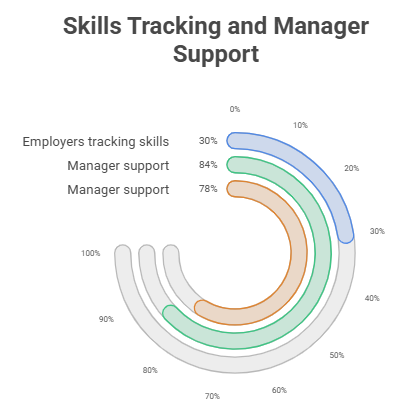
Only about 30% of employers track skills, and manager support for development is slipping. WTW’s October 2026 research, based on a survey of more than 7,000 employees and over 500 employers, found that only about 30% of employers have processes for identifying and tracking worker skills, and that the share of employees saying their manager helps develop their abilities dropped from 84% to 78% over four years.
The Manager Effectiveness Framework Free guide, instant download.
Get the Guide →Why is capability anxiety rising now?
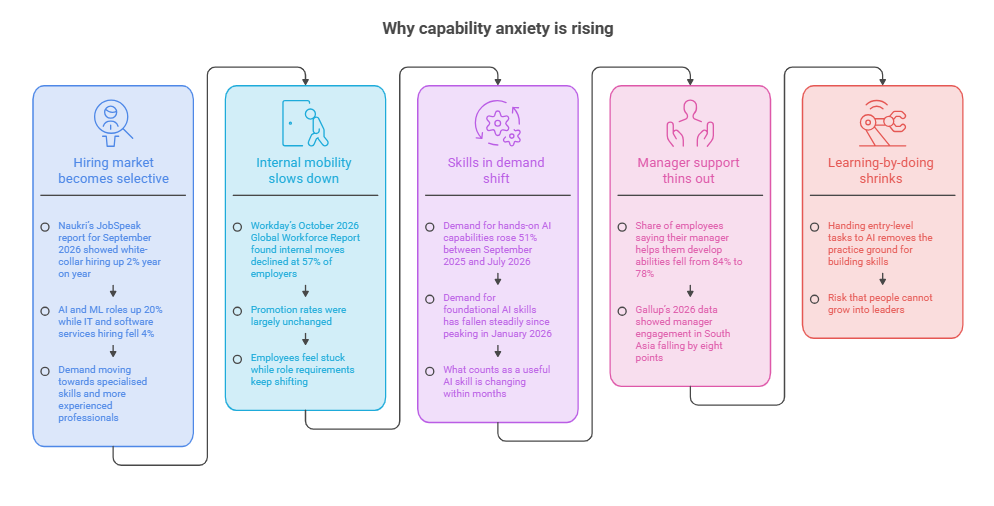
Capability anxiety is rising because work is changing faster than the systems that support people through it. Skills are rarely tracked, internal career moves are slowing, hiring is more selective, and managers have less capacity to coach, so employees are left to work out their own development.
The hiring market is steady but selective
Naukri’s JobSpeak report for September 2026 showed white-collar hiring up 2% year on year, with AI and ML roles up 20% while IT and software services hiring fell 4%. Info Edge’s CEO described a market that is steady but more selective, with demand moving towards specialised skills and more experienced professionals.
Internal mobility is slowing
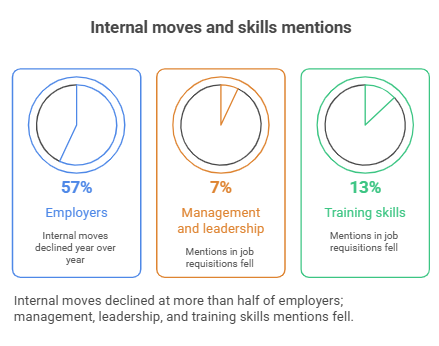
Workday’s October 2026 Global Workforce Report found that internal moves declined at 57% of employers year over year, while promotion rates were largely unchanged. With fewer internal doors opening, employees can feel stuck while the requirements of their roles keep shifting.
The skills in demand keep moving
The same report found that demand for hands-on AI capabilities such as building AI tools and automating workflows rose 51% between September 2025 and July 2026, while demand for foundational AI skills has fallen steadily since peaking in January 2026. What counts as a useful AI skill is changing within months.
Manager support is thinning
A WTW report released on 7 October 2026 found that the share of employees saying their manager helps them develop their abilities fell from 84% to 78% over four years. Gallup’s 2026 data also showed manager engagement in South Asia, primarily India, falling by eight points in 2025, the largest decline of any region.
Learning-by-doing may be shrinking
HR Dive’s coverage of recent research from Talogy and Coqual noted a risk that handing entry-level tasks to AI removes the practice ground where people build skills and grow into leaders.
See how we help build this into your organization.
Explore Capability Building Program Training Programs →
A five-step playbook to reduce capability anxiety
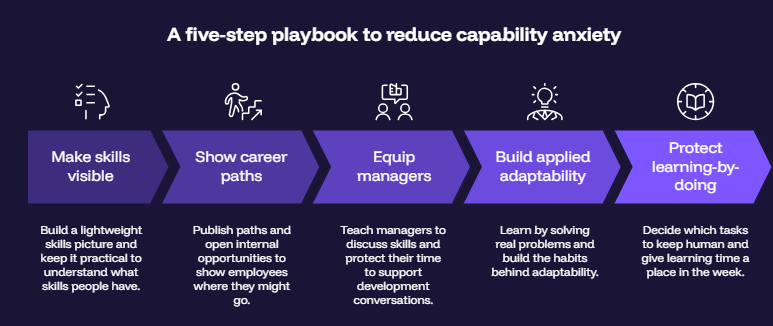
Step 1: Make skills visible
Start with a simple truth: most organisations cannot say what skills their people have.
Build a lightweight skills picture
- List the five to ten skills that matter most for each role family over the next 12 to 18 months.
- Ask employees and managers to rate current strength and the skills people want to build.
- Update it regularly rather than treating it as a one-time project.
Keep it practical
A basic, honest skills map that managers actually use beats a sophisticated system nobody trusts. Ebullient’s Competency Framework Blueprint can help structure this.
Step 2: Show real career paths and internal roles
Uncertainty shrinks when people can see where they might go.
Publish paths, not just titles
Show the skills, experiences and learning routes needed to move between roles, including lateral moves.
Open internal opportunities first
With internal mobility under pressure at many employers, advertising roles internally and giving internal candidates a fair look signals that growth is possible within your organisation.
Step 3: Equip managers to hold development conversations
Employees look first to their managers, so managers need the skill and time to support them.
Teach managers to discuss skills
Managers should be able to talk about skills, strengths, gaps and next steps in plain terms. Ebullient’s Manager Development Program builds these coaching skills.
Protect their time
If managers have no capacity, development conversations will not happen. Review spans of control and administrative load so coaching is realistic. See also The Manager Effectiveness Framework.
Step 4: Build applied adaptability, not just tool familiarity
Workday’s data shows that the useful AI skills are shifting from basic use towards building and applying.
Learn by solving real problems
Give teams real work problems to solve with AI, with time to experiment and share what they learn. Ebullient’s AI for Managers and AI for Teams programmes are designed around practical application.
Build the habits behind adaptability
Curiosity, willingness to test small ideas, and comfort asking for help are teachable. Reward them visibly.
Step 5: Protect learning-by-doing
As AI takes on routine tasks, make sure people still get the practice that builds judgment.
Decide which tasks to keep human
Identify entry-level and early-career tasks that build core skills, and keep some of them with people, supported by AI rather than replaced by it.
Give learning time a place in the week
Learning in the flow of work only happens if there is room for it. Ebullient’s article on learning in the flow of work offers ideas for building it into daily routines.
Source: GWR
Did You Know?
Internal moves fell at more than half of employers. Workday’s October 2026 Global Workforce Report found internal moves declined year over year at 57% of employers. It also found that mentions of management and leadership skills in job requisitions fell 7% and training skills fell 13% between September 2025 and July 2026.
A guide to a 30-minute capability conversation
Managers can use this simple structure once a quarter with each team member.
Part | What to explore | Example question |
Today | Strengths and current confidence | “Which parts of your work feel strongest right now?” |
Change | How the role is shifting | “What is changing in your work, and how does it feel?” |
Gaps | Skills to build | “What skill would make the biggest difference in the next six months?” |
Paths | Roles and moves of interest | “Where would you like to grow, here or in another team?” |
Support | What the manager and company will do | “What is one thing I can do to help, and what will we try first?” |
Agree one action and follow up within 30 days.
Curious About Other Areas of Your Organization?
Explore our other free assessments and get a fuller picture of where you stand.
View All AssessmentsHow Ebullient Helps Organisations Build Capability with Confidence?
Ebullient is a leadership development and organisational transformation firm based in Noida, India. We have worked with 40+ organisations and developed 5,000+ professionals across sectors including banking, IT, manufacturing and pharma. We build leadership, culture and AI-readiness together, so that people grow confidently as work changes.
Our approach
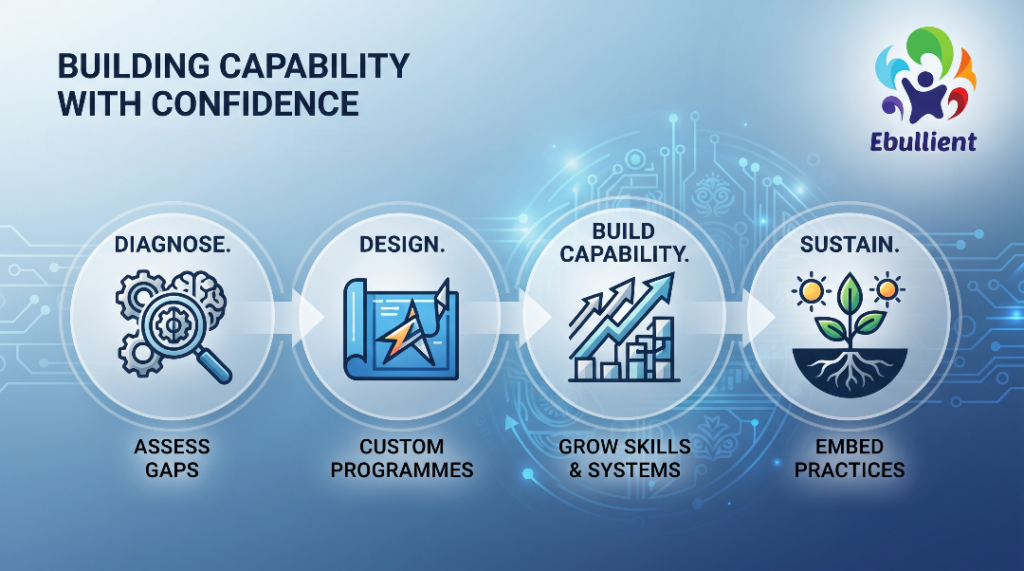
- Diagnose: we assess leadership, culture and readiness gaps before recommending anything.
- Design: every programme is built around your organisation’s context, not a standard template.
- Build capability: we develop skills and systems that grow with your business.
- Sustain: we embed practices that outlast the engagement
Final thoughts
The market looks calm, but employees are asking a harder question than “Will I have a job?” They are asking “Will I be good enough for the work that is coming?” When organisations cannot answer, anxiety fills the gap.
Track skills, show real paths, support managers, teach applied adaptability and protect time to learn by doing. None of it needs a big transformation to begin.
Start with one team. Map the five skills that matter most, run a 30-minute capability conversation with each person, and act on what you hear within a month.
Want to meet the team?
Start with a 30-min conversation. No commitment needed.
Frequently Asked Questions
What is capability anxiety?
Capability anxiety is employees’ uncertainty about whether they have, or can build, the skills their work will need. People accept that work is changing but are unsure which skills matter, where to learn them, or whether the organisation will support them.
What causes capability anxiety at work?
Common causes are fast-changing skill requirements, little visibility of which skills matter, unclear career paths, slower internal moves and managers with little time to coach. AI changing tasks inside existing roles adds to the uncertainty.
How can managers reduce capability anxiety?
Managers can hold regular, structured development conversations, discuss strengths, gaps and next steps in plain terms, point to learning opportunities and internal roles, and give people real problems to practise on. They need time and training to do this well.
What is internal mobility and why does it matter?
Internal mobility is the movement of employees into new roles, teams or projects within the same organisation. It matters because visible internal paths help people see a future, reduce uncertainty and keep valued talent from looking elsewhere.
What skills are in demand in India in 2026?
Naukri’s September 2026 data shows AI and ML roles growing 20% year on year, with demand stronger for experienced professionals. Workday’s global data shows hands-on AI skills, such as building tools and automating workflows, rising faster than basic AI use.