

What Is the Manager Effectiveness Framework?
The manager effectiveness framework is a way of evaluating managers on whether they make their team permanently better at the work — not just whether the work gets done on time. Ask most organizations what makes a manager good, and the answer arrives quickly: they hit their numbers, their team meets deadlines, escalations stay low, the dashboard stays green.
Ask the people who report to that manager, and a quieter answer often surfaces: they’ve stopped growing, they can’t remember the last time they got real feedback, and they’ve learned not to bring problems forward because nothing ever seems to change. Both descriptions can be true of the same person, at the same time. That gap is what this framework exists to close.
KEY TAKEAWAYS AT A GLANCE
- Effectiveness measures durable team capability, not just hitting the dashboard.
- Six dimensions matter more than one output score: leverage, feedback, decision rights, strategic translation, cross-boundary negotiation, psychological safety.
- Managers account for at least 70% of the variance in team engagement (Gallup).
- Training alone rarely fixes the gap — 60% of new managers still fail within 24 months (Gartner).
- Fix: audit evaluation criteria, structure first-year manager support, clarify decision rights, run a quarterly psychological-safety pulse.
Why Does Efficiency Measure the Wrong Layer of Management?
Efficiency asks whether the work got done. Effectiveness asks whether the manager made the people around them better at doing it — and whether that improvement will still be there next quarter, with or without the manager in the room.
Most organizations have built extensive systems to measure the first and almost nothing to measure the second. That gap means a genuinely limiting manager can operate for years, quietly capping their team’s growth, while every visible metric says everything is fine.
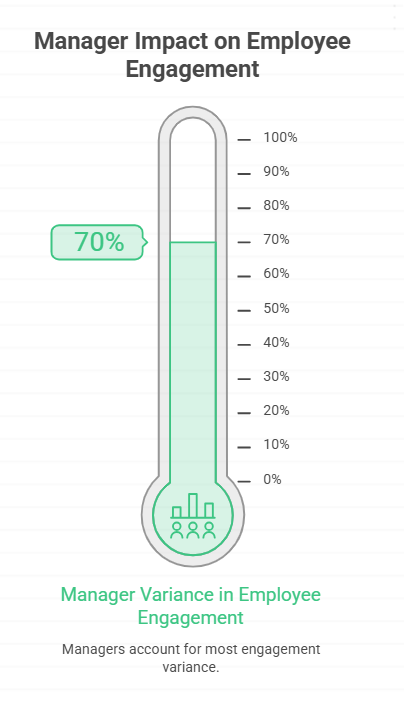
Source: Gallup
Did You Know?
Gallup’s landmark study of manager quality found that managers account for at least 70% of the variance in employee engagement scores across business units (State of the American Manager). In practice, the gap between a company’s strongest and weakest teams is explained less by pay, perks, or mission statements than by who happens to manage them.
How Managerially Effective Is Your Organization, Really?
Take our free 4-minute assessment and get a personalized report on your leadership fluency, governance, and workforce readiness.
Take the Free AI Readiness Assessment →What Are the Six Dimensions of Managerial Effectiveness?
A manager’s real impact shows up across six specific, observable dimensions — not in a single output number.
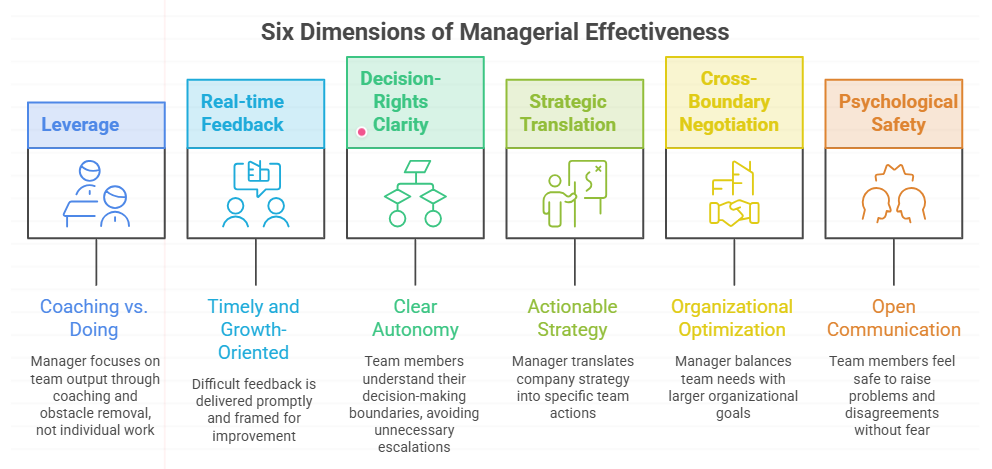
1. Leverage
Does the manager spend their time doing the individual work themselves, or coaching and removing obstacles so the team’s collective output multiplies? A manager who is the busiest person on the team is usually the biggest bottleneck on it.
2. Real-time feedback
Is difficult feedback given close to the moment it’s needed and framed for growth, or does it get softened, delayed, or saved entirely for a formal review cycle months later?
3. Decision-rights clarity
Do team members understand clearly what they can decide on their own versus what genuinely needs to be escalated — or does everything default upward “to be safe,” slowing the whole team to the pace of the manager’s calendar?
4. Strategic translation
Can this manager turn company-level strategy into something specific that changes what their team actually does on a Tuesday morning, or does strategy stay abstract the moment it passes through them?
5. Cross-boundary negotiation
When priorities collide with another team’s, does this manager optimize for the larger organizational outcome, or defend their own team’s metrics regardless of the cost elsewhere?
6. Psychological safety
Do people on this team raise problems, disagreement, and bad news early — or do they filter what they say, particularly the bad news, because past experience has taught them it isn’t welcome?
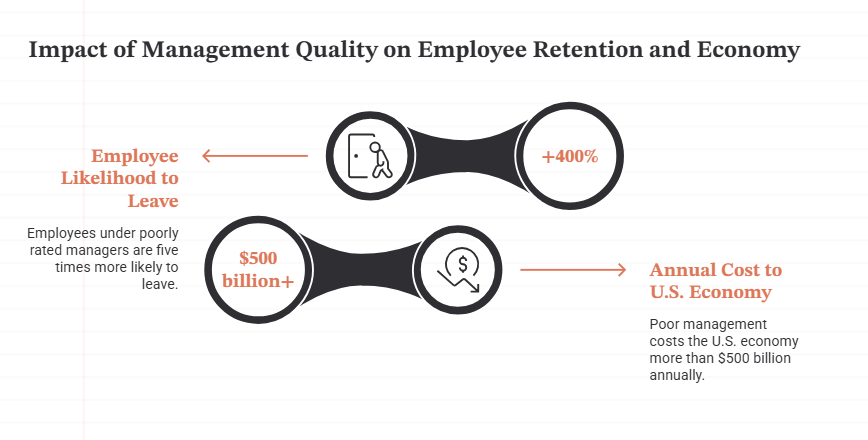
Source: Perceptyx
Did You Know?
Recent 2026 research from Perceptyx found that employees working under poorly rated managers are five times more likely to leave their organization within a year than those with excellent managers — and poor management now costs the U.S. economy more than $500 billion annually.
Why Does the Standard Fix for Manager Development Fall Short?
Most organizations respond to a managerial effectiveness gap with more training: a workshop on giving feedback, a module on delegation, a refresher on the performance review process.
Training addresses skill. It rarely addresses the deeper issue — that most first-time managers are promoted for excellence in a role that management then asks them to stop doing.
Old Playbook | Next Practice | |
Approach | Promote the strongest individual performer into the management role | Treat the transition from expert to manager as a genuine identity shift |
Support | A short onboarding on the basics | Coaching, peer cohorts, and deliberate unlearning of the “doer” identity in the first year |
Assumption | Doer expertise transfers naturally into making others excellent | Evaluation is tied explicitly to the six dimensions — not only to team output |
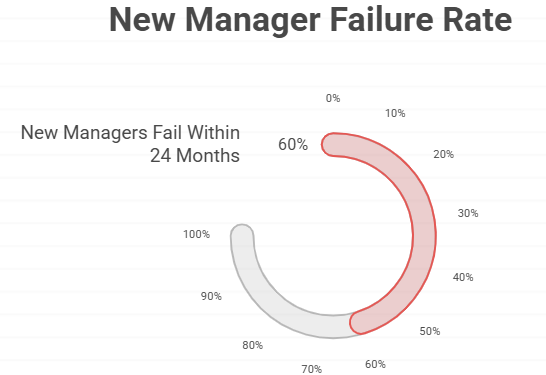
Source: Wharton work
Did You Know?
Research from Wharton work has consistently found that roughly 60% of new managers fail within their first 24 months, largely due to a lack of training in leadership and management skills — the same gap between “promoted for doing” and “trained for leading” this framework is built to close.
The Manager Effectiveness Framework Free guide, instant download.
Get the Guide →How Can Organizations Build This Into Manager Evaluation?
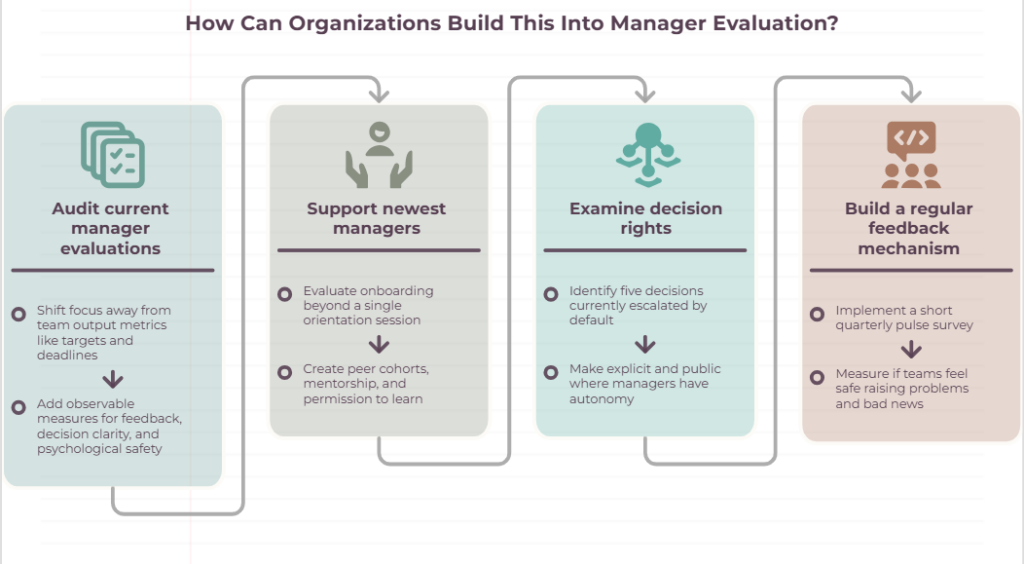
1. Start by auditing how managers are currently evaluated
If the criteria are almost entirely about team output — hitting targets, meeting deadlines, keeping escalations low — that’s the first thing to change. Add explicit, observable measures against at least three of the six dimensions above: feedback frequency and quality, decision-rights clarity as reported by the team itself, and psychological safety, ideally measured through an anonymous pulse rather than the manager’s own self-report.
2. Next, look specifically at your newest managers
Those promoted within the last eighteen months. Ask whether they received anything beyond a short orientation when they moved from individual contributor to manager. If the answer is a single onboarding session, build a structured first-year support path: a peer cohort of other new managers, a coach or mentor outside their direct reporting line, and explicit permission to be visibly still learning the role without it counting against them.
3. Then examine decision rights directly
Pick five decisions your managers currently escalate by default and ask, honestly, whether they need to. Where the answer is no, make that explicit and public, not just implied. Ambiguity about decision rights is one of the most common, least examined sources of organizational slowness.
4. Finally, build a simple, regular mechanism
A short quarterly pulse survey works well — for teams to report anonymously on whether they feel safe raising problems and bad news to their manager. This single measure often reveals more about a manager’s actual effectiveness than almost any output metric available.
What Is the Deeper Pattern Behind Manager Effectiveness?
There is an old distinction, present across many wisdom traditions, between power exercised over others and power cultivated within others. A manager optimizing purely for efficiency tends, often without realizing it, toward the first: extracting output, managing tasks, controlling outcomes. A manager operating with genuine effectiveness practices the second — their real work is making their own presence, eventually, less necessary, because the people around them have grown capable enough not to need it.
This is a harder thing to measure than a dashboard, and a far more valuable thing to build. An organization that only ever asks “did the work get done” will keep producing managers skilled at extraction. An organization that asks “did the people around this person get more capable because of them” starts producing something rarer, and considerably more durable.
Curious About Other Areas of Your Organization?
Explore our other free assessments and get a fuller picture of where you stand.
View All AssessmentsHow Ebullient Helps You Build Manager Effectiveness?
Ebullient Consultancy designs manager effectiveness interventions around an organization’s actual evaluation gaps — not generic leadership content pulled off a shelf. A typical engagement includes:
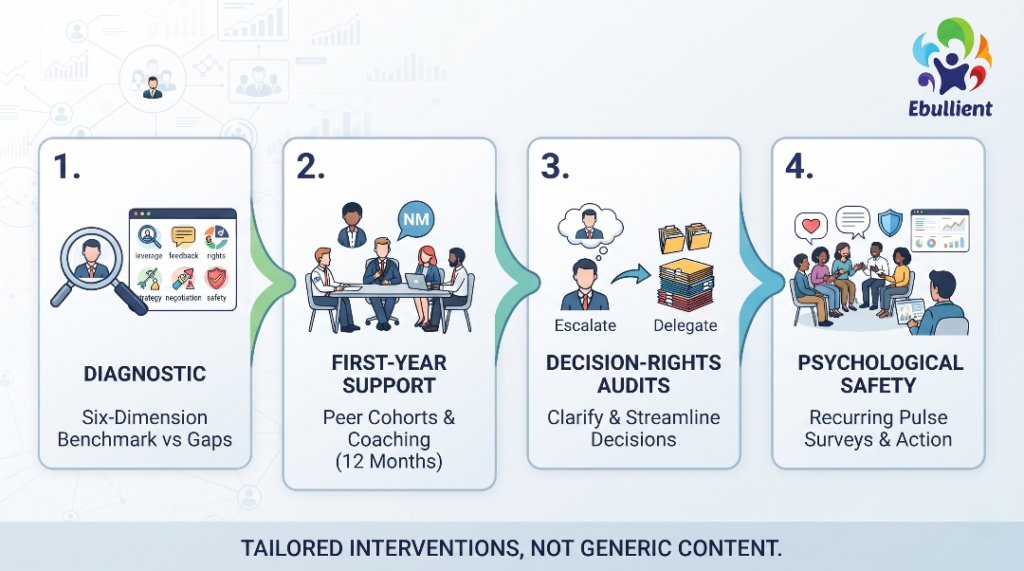
- Six-Dimension Diagnostic. Benchmark your management layer against leverage, feedback, decision rights, strategic translation, cross-boundary negotiation, and psychological safety — not just output metrics.
- Structured First-Year Manager Support. Peer cohorts, external coaching, and identity-shift workshops for newly promoted managers, built into the first twelve months rather than a single onboarding session.
- Decision-Rights Audits. Working sessions that map which decisions genuinely need escalation and which don’t, removing artificial bottlenecks from the manager’s calendar.
- Psychological Safety Pulse Programs. Recurring, anonymous team surveys with manager-level reporting, so effectiveness gaps surface before they show up in attrition data.
Every engagement is tailored to where an organization’s management layer actually is today, not a fixed curriculum — which is why it usually starts with a diagnostic read, not a training calendar.
Want to meet the team?
Start with a 30-min conversation. No commitment needed.
Frequently Asked Questions
What is the manager effectiveness framework?
It’s a way of evaluating managers on six dimensions — leverage, real-time feedback, decision-rights clarity, strategic translation, cross-boundary negotiation, and psychological safety — rather than on output metrics alone.
What is the difference between manager efficiency and manager effectiveness?
Efficiency measures whether the work got done. Effectiveness measures whether the manager made their team permanently better at doing it, in a way that holds up even when the manager isn’t in the room.
Why do most first-time managers struggle?
Most are promoted for individual performance and given a short onboarding, not ongoing support for the identity shift from “doer” to manager — a gap linked to roughly 60% of new managers failing within their first two years.
What are the six dimensions of managerial effectiveness?
I’m thinking about leverage, real time feedback, and also decision rights clarity, but in a way that helps with strategic translation and not just, cross boundary negotiation. Then add psychological safety.
How can organizations measure managerial effectiveness beyond output?
By auditing evaluation criteria against the six dimensions, building structured first-year support for new managers, clarifying decision rights, and running a regular anonymous psychological-safety pulse survey.