
To rebuild the early-career ladder in the AI era, redesign entry-level roles around judgment and verification, run a structured first-year programme, teach domain and AI skills together, equip managers to coach juniors, and track whether juniors become productive and stay. Indian IT firms report slowing entry-level hiring, so developing the juniors you do hire matters more than ever.
Key takeaways at a glance
- The first rung is under pressure. More firms report falling entry-level employment than rising.
- Redesign junior roles. Keep learning-rich tasks with people, supported by AI.
- Teach hybrid skills. Domain knowledge plus AI and data skills are in demand.
- Managers decide adoption. Employees with an AI-capable manager use AI far more.
- Measure the pipeline. Track time to productivity, retention and internal moves.
Why the First Rung of the Career Ladder Matters More in the AI Era?
Every senior leader in your organisation was once a beginner who made mistakes, asked questions and learned the business through small, repeatable tasks. Those early tasks were never only about output. They were how people built judgment.
Now AI can perform or speed up many of those tasks, from routine coding and testing to documentation and data processing. Some companies are responding by hiring fewer freshers, and by expecting the ones they hire to contribute faster and with more complex skills.
The risk is not only that fewer graduates get a first job. It is that organisations quietly dismantle the pipeline that produces tomorrow’s managers and specialists. This guide explains what the latest research says and offers a five-step playbook for building early-career talent in an AI-enabled workplace.
How Leadership-Ready Is Your Organization, Really?
Take our free 4-minute assessment and get a personalized report on your leadership fluency, governance, and workforce readiness.
Take the Free Leadership Readiness Assessment →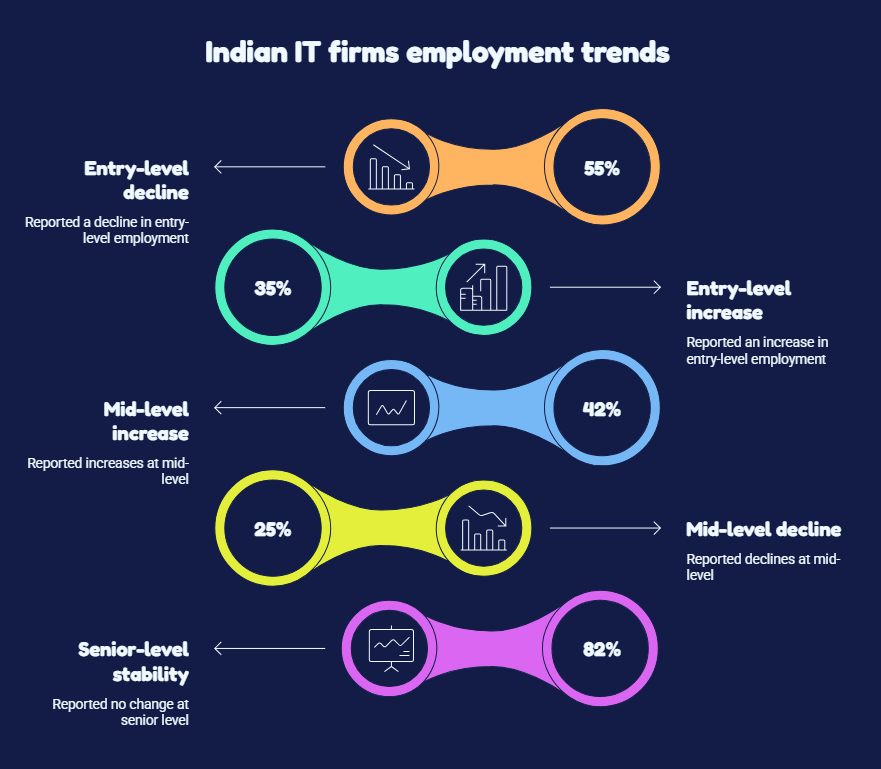
Source: ICRIER
Did You Know?
More Indian IT firms report falling entry-level employment than rising. The ICRIER study of 651 IT firms (November 2025 to January 2026) found that 55% reported a decline in entry-level employment and 35% an increase. At mid-level, 42% reported increases and 25% declines, while 82% reported no change at senior level.
What is early-career talent development?
Early-career talent development is the planned effort to help new graduates and junior hires become productive, confident and committed in their first one to three years. It covers hiring, onboarding, structured learning, mentoring, real work experience and feedback, so that juniors grow into capable mid-level professionals.
Fresher hiring versus early-career development
Fresher hiring is the act of bringing people in. Early-career development is what happens afterwards. Organisations can hire well and still lose people, or waste potential, if the first year is left to chance.
Why it matters to the business
Strong early-career programmes build a pipeline of mid-level talent, reduce costly early attrition and keep institutional knowledge alive. When the entry pipeline thins, the shortage shows up a few years later in mid-level roles.
Why is AI narrowing the entry-level career ladder?
AI is narrowing the entry-level ladder because it can perform many routine tasks that juniors traditionally handled, so firms may need fewer people for that work and expect new hires to bring higher-order skills sooner. At the same time, training for juniors often remains thin.
Routine tasks are the first to be automated
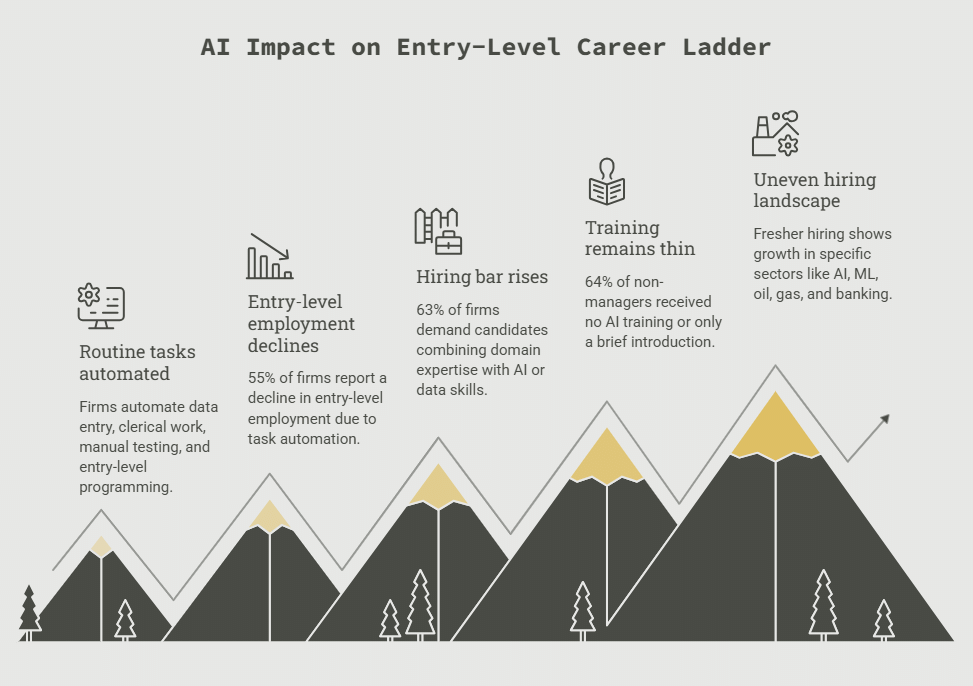
In the ICRIER study of 651 Indian IT firms, the most frequently cited areas of declining demand included data entry, clerical and back-office work, manual testing and entry-level programming, as reported by e27. These are classic first-job tasks.
Entry level feels it most
The ICRIER survey, conducted between November 2025 and January 2026 and supported by OpenAI, found that 55% of firms reported a decline in entry-level employment while 35% reported an increase. Mid-level roles looked stronger, with 42% of firms reporting increased employment, and 82% of firms reported no change at senior level.
The hiring bar is rising
The same study found that 63% of firms reported increased demand for candidates who combine domain expertise with AI or data skills. Juniors are increasingly expected to arrive with, or quickly build, hybrid capabilities.
Training for juniors is still thin
ICRIER noted that more than half of surveyed firms support AI adoption through awareness or training, but training coverage remains limited. Jabra’s WorkLife 2026 study found that 64% of non-managers had received no AI training or only a brief introduction, compared with 26% of senior leaders.
The picture is uneven, not uniformly bleak
Naukri’s September 2026 JobSpeak report showed fresher hiring up 1% overall, with AI and ML fresher hiring in IT up 19%, and fresher hiring up in oil and gas (21%), banking and financial services (14%), pharma and biotech (10%) and healthcare (10%).
Lorem ipsum dolor sit amet, consectetur adipiscing elit. Ut elit tellus, luctus nec ullamcorper mattis, pulvinar dapibus leo.
A five-step playbook for early-career talent in the AI era

Step 1: Redesign entry-level roles around judgment, not just tasks
If AI absorbs the routine work, rethink what a junior role is for.
Keep the learning-rich tasks with people
- Decide which entry-level tasks build core skills, such as reviewing, testing, analysing and explaining, and keep some of them with juniors.
- Use AI as a support tool, so juniors learn to check, challenge and improve its output.
- Shift juniors towards verifying, interpreting and communicating results earlier.
Be explicit about accountability
Make clear that people remain responsible for the final result, even when AI produces the first draft.
Step 2: Build a structured first-year programme
A planned journey beats an informal “learn as you go”.
Give the first year a shape
Combine induction, learning modules, real projects, rotations, a buddy and a mentor, with clear milestones at 30, 90, 180 and 365 days. Ebullient’s Capability Building programmes help structure this.
Make learning part of the work
Tie learning to live projects so juniors apply skills immediately. See our article on learning in the flow of work.
Step 3: Teach domain and AI skills together
The market is rewarding hybrid skills, so teach them side by side.
Combine fundamentals with applied AI
Pair core domain knowledge, whether banking, engineering, pharma or operations, with practical AI and data skills. Ebullient’s AI for Teams programme focuses on hands-on application for individual contributors.
Build the human skills too
Communication, collaboration, problem framing and ethical judgment are hard for AI to replace. Include them deliberately. Our guide to essential hard and soft skills can help.
Step 4: Equip managers and mentors to coach juniors
Jabra’s findings suggest the manager is a major factor in whether employees adopt AI and feel optimistic about their careers.
Make managers AI-capable
Managers need enough AI fluency to guide juniors, and enough coaching skill to give regular, specific feedback. Ebullient’s AI for Managers and Manager Development Program are built for this.
Protect time for mentoring
Coaching juniors takes time. Build it into workloads and recognise it in performance reviews.
Step 5: Measure the pipeline, not just the intake
What you measure shapes what you protect.
Track a small set of signals
- Time to productivity for new hires.
- Twelve-month retention of early-career employees.
- Share of mid-level roles filled internally.
- Junior employees’ own views on learning, feedback and growth, gathered through short pulse surveys.
Is Your Leadership Pipeline at Risk? Free guide, instant download.
Get the Guide →Common mistakes in early-career talent development
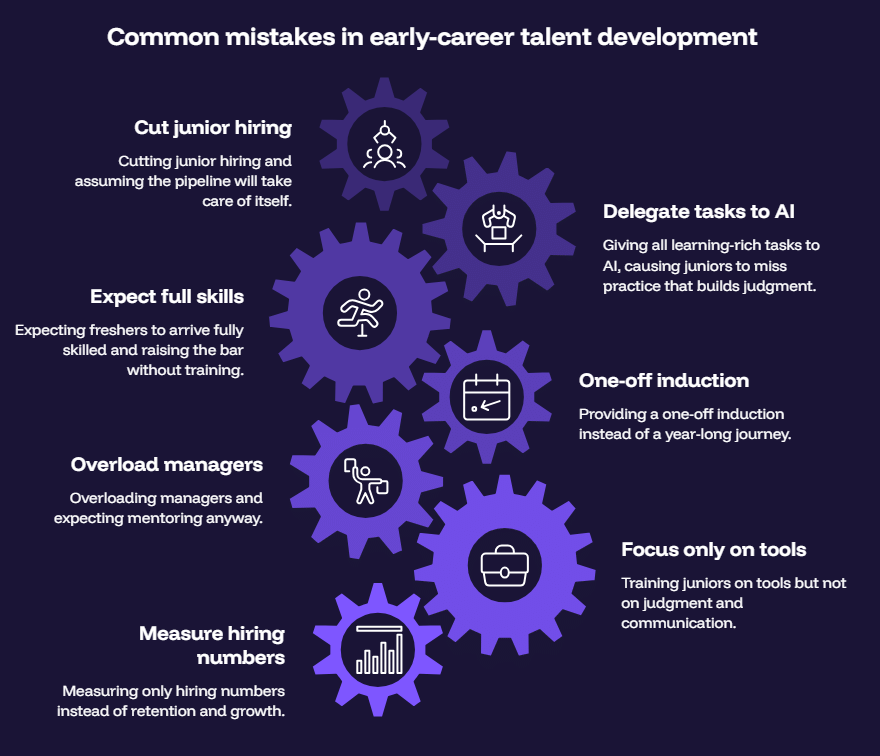
- Cutting junior hiring and assuming the pipeline will take care of itself.
- Giving all learning-rich tasks to AI. Juniors then miss the practice that builds judgment.
- Expecting freshers to arrive fully skilled. Raising the bar without training sets people up to fail.
- One-off induction instead of a year-long journey.
- Overloading managers and expecting mentoring anyway.
- Training juniors on tools but not on judgment and communication.
- Measuring only hiring numbers. Retention and growth tell you more.
Curious About Other Areas of Your Organization?
Explore our other free assessments and get a fuller picture of where you stand.
View All AssessmentsHow Ebullient Helps Organisations Build Early-Career and Emerging Talent?
Ebullient is a leadership development and organisational transformation firm based in Noida, India. We have worked with 40+ organisations and developed 5,000+ professionals across sectors including banking, IT, manufacturing and pharma. We build leadership, culture and AI-readiness together, so that new talent grows with confidence.
Our approach
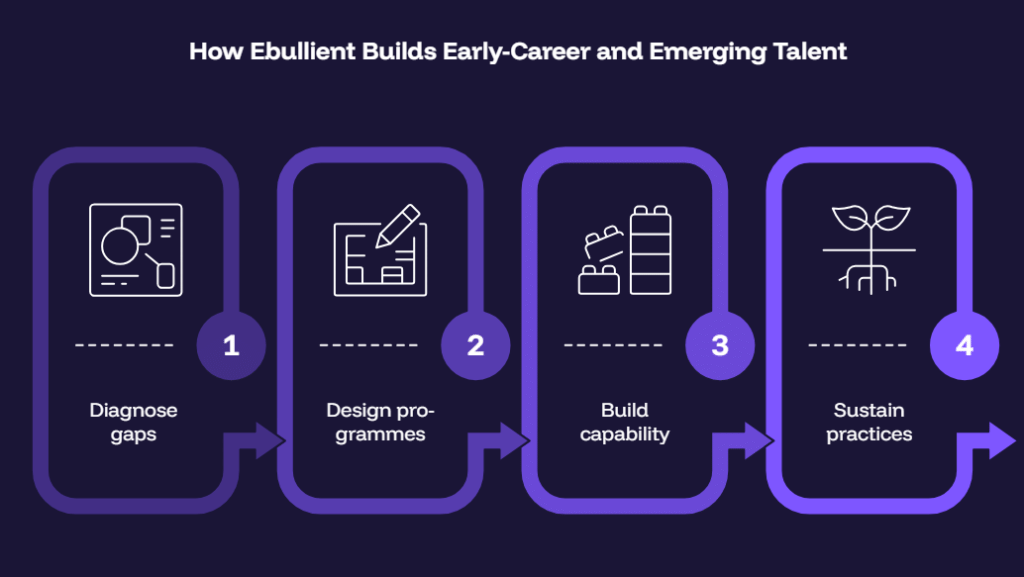
- Diagnose: we assess leadership, culture and readiness gaps before recommending anything.
- Design: every programme is built around your organisation’s context, not a standard template.
- Build capability: we develop skills and systems that grow with your business.
- Sustain: we embed practices that outlast the engagement.
Final thoughts
AI is changing the first steps of a career, but it does not remove the need for people to start somewhere. Organisations that thin out their early-career pipeline today will feel the gap in mid-level capability in a few years.
The practical response is to redesign junior roles around judgment, teach domain and AI skills together, make managers genuine coaches and measure whether your juniors are becoming productive and staying.
Start small: pick one function, redesign two entry-level tasks so juniors check and improve AI output, assign a mentor to each new joiner and review progress.
Want to meet the team?
Start with a 30-min conversation. No commitment needed.
Frequently Asked Questions
What is early-career talent development?
Early-career talent development is the planned effort to help new graduates and junior hires become productive, confident and committed in their first one to three years, through onboarding, structured learning, mentoring, real work and regular feedback.
Is AI reducing fresher hiring in India?
Evidence is mixed. An ICRIER study of 651 IT firms found 55% reported declining entry-level employment and 35% increases. Naukri’s September 2026 data showed overall fresher hiring up 1%, with AI and ML fresher roles in IT up 19%.
What skills do freshers need in the AI era?
Freshers benefit from strong domain fundamentals combined with practical AI and data skills, plus the ability to check AI output, communicate clearly, collaborate and solve problems. ICRIER found 63% of firms report rising demand for this hybrid mix.
How can companies train freshers in the AI era?
Use a structured first-year programme with real projects, mentors and regular feedback. Teach domain and AI skills together, keep learning-rich tasks with people, and give managers the time and training to coach.
Why do managers matter for AI adoption among junior staff?
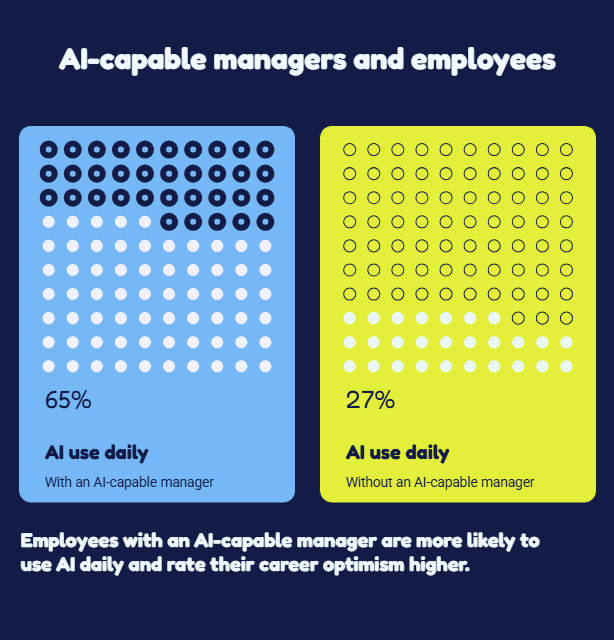
Jabra’s WorkLife 2026 study found employees with an AI-capable manager were 2.4 times more likely to use AI daily (65% versus 27%) and reported higher career optimism. Managers set the example, give permission to experiment and provide feedback.