
Imagine an operations executive at an Indian bank. In twelve months she has seen a new AI tool, a restructured reporting line, a revised target system and a round of cuts in a sister team. Each change arrived with a launch email. None arrived with fewer tasks. At the town hall, the CEO calls the year a transformation success. She is still doing her old job, plus three new ones.
She is not an outlier. In the 2026 Edelman Trust Barometer special report, Trust at Work, which surveyed 10,018 employees in ten countries, 96% of employees in India said they had gone through at least one major transformation in the previous 12 months. That is the highest of any country surveyed. This article looks at what the data says about how differently leaders and frontline employees experience that change, what it costs, and what leaders can do about it. It ends with a BANI lens on why the problem is so hard to see from the top.
Key Takeaways at a Glance
- 96% of Indian employees went through at least one major transformation in the past year, the highest of the ten countries in Edelman’s 2026 Trust at Work survey (76% across all countries).
- 26% of non-management employees describe their transformation experience as negative, against 9% of senior management.
- The leading driver of negative experiences is added work without additional pay. The leading driver of positive ones is a more manageable workload.
- Employees with a negative experience trust their CEO far less (49% versus 82%) and are less likely to want to stay for many years (51% versus 83%).
- 80% of Indian employees worry about being monitored without consent, which makes how AI tools are introduced a trust issue.
What is change fatigue?
Change fatigue is the loss of energy, trust and willingness to engage that builds when employees face repeated organisational changes without enough time, support or say. It rarely looks like open resistance. It looks like quiet compliance, slower adoption and a steady decline in trust.
The Edelman report does not use the term, but its data describes the pattern. Across the survey, the changes people reported were AI integration (53%), strategy shifts (47%), culture changes (45%) and layoffs or workforce reductions (38%). More than 40% of employees had been through three or more transformations within a year. Leaders tend to count each initiative on its own. Employees feel them all at once.
How AI-Ready Is Your Organization, Really?
Take our free 4-minute assessment and get a personalized report on your leadership fluency, governance, and workforce readiness.
Take the Free AI Readiness Assessment →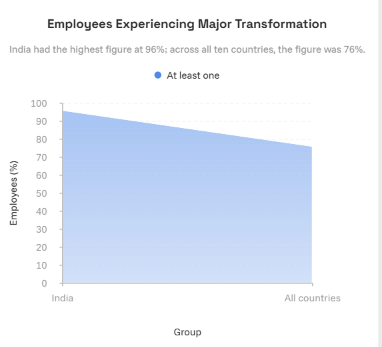
Source: Edelman Trust Barometer Special Report
DID YOU KNOW?
96% of employees in India experienced at least one major transformation in the past 12 months, the highest of the ten countries surveyed. Across all ten countries the figure was 76%, and over 40% of employees had faced three or more changes within a year.
Why do leaders and frontline employees experience the same change so differently?
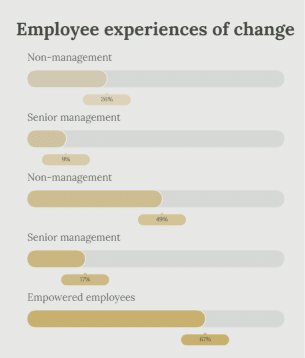
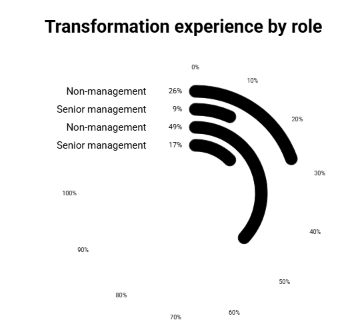
Because the cost of change lands unevenly. Leaders see the strategy and the upside. Frontline employees absorb the extra workload, the unclear instructions and the surprises. In Edelman’s survey, 26% of non-management employees reported a negative transformation experience, against 9% of senior management.
The gap widens when mixed results are included. 49% of non-management employees had a less-than-positive experience, compared with 17% of senior management. The report notes that it cannot establish why the gap exists, but it does show what separates good experiences from bad ones:
- The leading driver of negative experiences was added work without additional pay. Weak strategic alignment, divisions among employees and surprise announcements also featured.
- The leading driver of positive experiences was more manageable workloads. Strategic alignment, adequate guidance and growth opportunities followed.
- 67% of employees with at least one positive experience credited being empowered to adapt on their own terms, through guidance, planning time, skill development and having a voice.
A useful way to see the gap is to put the two views side by side. The table below is illustrative, built on the drivers Edelman identified.
Type of change | What the leadership team sees | What the frontline often experiences |
AI integration | A productivity gain and a competitive necessity | A new tool on top of existing targets, and worry about being monitored |
Strategy shift | A sharper direction for the business | Unclear priorities and targets that move without explanation |
Culture change | A stronger set of shared values | New slogans with no change to workload or incentives |
Workforce reductions | Cost discipline and a leaner structure | The same work shared among fewer people, and fear for their own role |
Source: Trust at Work 2026
DID YOU KNOW?
26% of non-management employees describe their transformation experience as negative, nearly three times the 9% of senior management who say the same. Including mixed experiences, the gap is 49% against 17%.
What does badly handled change cost an organisation?
Trust, and with it commitment. Edelman compared employees who had at least one negative transformation experience with those who had at least one positive one. The differences are large:
Measure | Negative experience | Positive experience |
Trust in their manager | 60% | 85% |
Trust in the CEO | 49% | 82% |
Want to stay for many years | 51% | 83% |
Willing to go beyond expectations | 57% | 83% |
Two cautions apply. The survey shows association, not causation, and the report notes that pay, economic insecurity and career prospects also shape trust. Even so, the pattern is consistent across every measure.
The wider picture is also worrying. Across the seven markets with historical data, employer trust fell from 79% in 2024 to 74% in 2026, and India recorded one of its lowest employer-trust levels in the study’s history. Managers carry much of the load in between: Gallup’s 2026 data for India shows manager engagement fell from 39% to 30% in a year, and the managers who must explain each new change to their teams are the ones with the least room left.
Source: Edelman Trust Barometer Special Report
DID YOU KNOW?
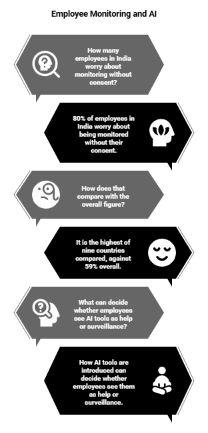
80% of employees in India worry about being monitored without their consent, the highest of nine countries compared, against 59% overall. As AI tools arrive, how they are introduced can decide whether employees see them as help or surveillance.
AI Readiness Score Card Free guide, instant download.
Get the Guide →How can leaders reduce change fatigue? Five practical steps
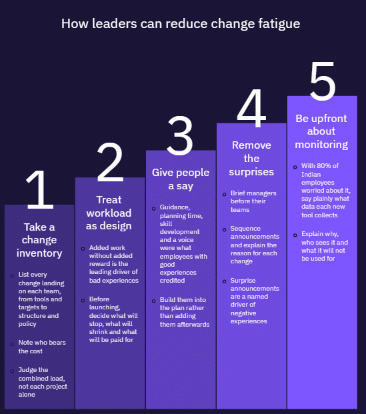
1. Take a change inventory
List every change landing on each team, from tools and targets to structure and policy, and note who bears the cost. Judge the combined load, not each project alone.
2. Treat workload as a design decision
Added work without added reward is the leading driver of bad experiences. Before launching, decide what will stop, what will shrink and what will be paid for.
3. Give people a say in how change lands
Guidance, planning time, skill development and a voice were what employees with good experiences credited. Build them into the plan rather than adding them afterwards.
4. Remove the surprises
Brief managers before their teams, sequence announcements and explain the reason for each change, since surprise announcements are a named driver of negative experiences.
5. Be upfront about monitoring
With 80% of Indian employees worried about it, say plainly what data each new tool collects, why, who sees it and what it will not be used for.
One more habit ties these together: judge the success of a transformation by the experience of the people affected, not only by the sponsor’s targets.
Seen through the BANI lens: why change fatigue is so easy to miss
BANI is a framework from futurist Jamais Cascio. It stands for Brittle, Anxious, Nonlinear and Incomprehensible, and it describes conditions that the older VUCA model no longer captures: a world where systems can fail suddenly, people feel the strain, effects are out of proportion to causes, and the reasons are hard to see. Change fatigue shows all four at once, which is why it often stays invisible to the people running the change.
The lesson of the BANI lens is that change itself is not the enemy. Unmanaged load is. In a world where conditions can turn brittle and opaque quickly, a leader’s job is to absorb complexity so that teams do not have to. That takes capacity, empathy, context and transparency, which are human capabilities built through leadership and culture, not through a better project plan.
Curious About Other Areas of Your Organization?
Explore our other free assessments and get a fuller picture of where you stand.
View All AssessmentsHow Ebullient Helps Organisations Lead Change Without the Fatigue
Ebullient Consultancy works at the point where technology change meets human capability. For change fatigue, that work typically runs through four areas:
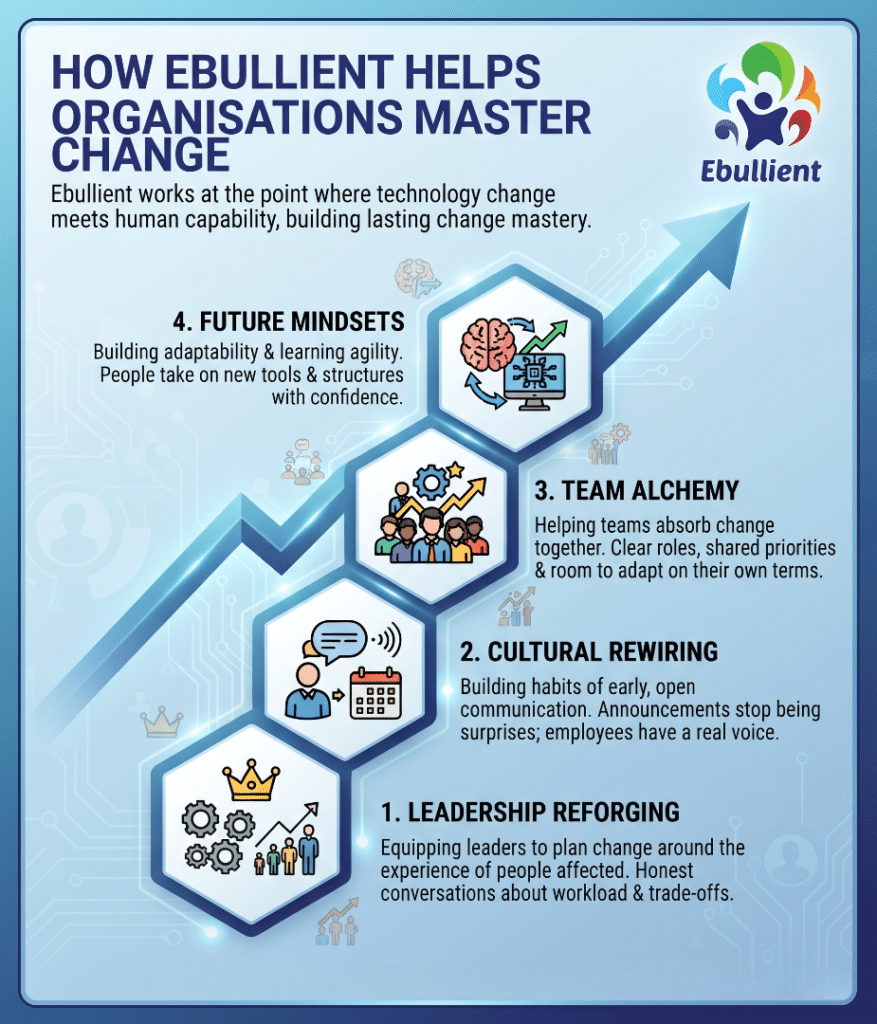
Leadership Reforging
Equipping leaders and managers to plan change around the experience of the people affected, and to have honest conversations about workload and trade-offs.
Cultural Rewiring
Building habits of early, open communication, so announcements stop being surprises and employees have a real voice.
Team Alchemy
Helping teams absorb change together, with clear roles, shared priorities and room to adapt on their own terms.
Future Mindsets
Building the adaptability and learning agility that let people take on new tools and structures with confidence.
Want to meet the team?
Start with a 30-min conversation. No commitment needed.
Frequently Asked Questions
What is change fatigue?
Change fatigue is the exhaustion and loss of trust that builds when employees face repeated organisational changes without enough time, support or say. It usually appears as quiet compliance, slow adoption and falling engagement rather than open resistance, and it is most common where several changes land at the same time.
How common is organisational change for employees in India?
Very common. Edelman’s 2026 Trust at Work survey found 96% of employees in India experienced at least one major transformation in the previous 12 months, the highest of ten countries, against 76% overall. More than 40% of employees across the survey had faced three or more changes within a year.
Why do frontline employees experience transformation more negatively than senior leaders?
The survey shows the gap, not its cause. 26% of non-management employees reported a negative experience against 9% of senior management. The main drivers of bad experiences were added work without added pay, weak strategic alignment and surprise announcements, all of which fall hardest on people doing the day-to-day work.
How does poorly managed change affect trust and retention?
Employees with a negative transformation experience reported lower trust in their CEO (49% versus 82%) and manager (60% versus 85%), and fewer want to stay for many years (51% versus 83%). The survey shows association rather than proof of cause, but the pattern holds across every measure.
How can managers reduce change fatigue in their teams?
Count the combined load on the team, protect workload when new work arrives, involve people in how changes are rolled out, explain the reasons before announcements and be clear about monitoring and data. Edelman found 67% of positive experiences were linked to feeling empowered to adapt on their own terms.