

Picture a credit-risk team lead in Pune. Her company’s new AI tool marks a loan application as low risk. Something about the borrower’s pattern bothers her, but the tool gives no reason for its rating, and nobody has told her whether she is allowed to overrule it. She approves the loan, and says nothing.
That small silence is the real AI adoption problem in many Indian workplaces. People are not refusing AI. They are using it more than almost anyone else in the world. What they are unsure about is who is in charge when the machine and the human disagree. This article looks at what the latest data says about AI trust at work, offers a simple way to set decision rights, and closes with a BANI lens that explains why the problem keeps coming back.
Key Takeaways at a Glance
- Indian professionals are enthusiastic about AI: 97% are willing to build AI skills and 88% expect productivity gains, according to Michael Page India’s 2026 Candidate Pulse survey.
- But 65% worry about losing human judgement and intuition in AI-led processes, and 61% raise privacy and data security concerns.
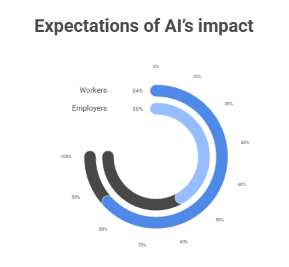
- Employees and employers see AI differently: 84% of workers expect AI to touch a high share of their tasks, against 55% of employers (Randstad Workmonitor 2026).
- Trust grows when people know who decides, why the tool decided, and what happens to their data.
- AI trust is a BANI problem. Brittle systems, anxious people, nonlinear effects and opaque outputs all show up together.
What is AI trust at work?
AI trust at work is employees’ confidence that AI tools are accurate, secure and used fairly, and that people stay in charge of the decisions that matter. It is earned through transparency, clear human oversight and training, not through the technology’s capability alone.
The enthusiasm is real. Randstad’s Workmonitor 2026 survey of more than 27,000 workers across 35 markets found 89% of Indian workers say AI has improved their productivity, against 62% globally, and 86% feel confident using the latest tools, against 69% globally. Indian workers also report unusually high trust in company leadership (89% versus 72% globally).
The worry sits underneath. In Michael Page India’s Candidate Pulse Report 2026 (3,401 professionals, including 2,550 in India), 65% said they are concerned about losing human judgement and intuition in AI-led processes. The report’s own spokesperson put the stakes plainly:
“These safeguards have to be built into the ecosystem; otherwise, the trust factor will go away.” Nilay Khandelwal, Michael Page India
Note on the evidence: the Michael Page figures reach us through press coverage of the report, and the Randstad figures cover self-reported attitudes. Read them as strong signals about sentiment, not as measures of how well any particular AI tool performs.
How AI-Ready Is Your Organization, Really?
Take our free 4-minute assessment and get a personalized report on your leadership fluency, governance, and workforce readiness.
Take the Free AI Readiness Assessment →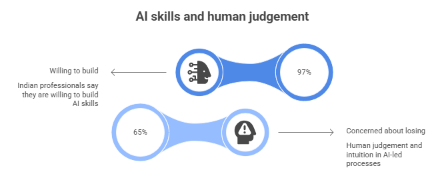
Source: Michael Page India
DID YOU KNOW?
97% of Indian professionals say they are willing to build AI skills, yet 65% are concerned about losing human judgement and intuition in AI-led processes. People want the tools. They do not want to give up their own judgement to get them.
Why do employees and employers see AI differently?
Because they are looking at different parts of the same change. Randstad found 84% of workers expect AI to affect a high proportion of their tasks, while only 55% of employers expect the same. Leaders who think AI will touch half the work are managing a workforce that expects it to touch most of it.
There is also a fairness gap. 59% of Indian workers expect AI to benefit their company more than themselves, compared with 47% globally. When people believe the gains will not come back to them, caution about handing over decisions is a rational response, not resistance to change.
The good news is that India starts with a trust reserve. With 89% of workers trusting company leadership, leaders have credit to spend. The risk is that vague AI rollouts, with no stated rules on decisions or data, draw that credit down.
Source: Randstad Workmonitor 2026
DID YOU KNOW?
84% of workers expect AI to affect a high proportion of their tasks, compared with just 55% of employers. The people doing the work see the change coming faster than the people planning it.
Who decides when AI and a human disagree?
Most trust problems come from unclear decision rights, not from bad technology. A simple way to settle them is to set a dial for each type of decision, based on how much is at stake and how easily the outcome can be reversed.
Dial setting | What it looks like | Best suited to | Safeguard needed |
1. AI suggests, human decides | The tool offers a ranked view or recommendation. A person makes the call and records why. | Hiring shortlists, performance ratings, credit and compliance exceptions | Explanation of the tool’s reasoning; freedom to disagree |
2. AI drafts, human edits | The tool produces a first version. A person checks, corrects and owns the final output. | Reports, emails, research summaries, first-pass analysis | Mandatory human review; source checking |
3. AI decides, human can override | The tool acts by default. A person can reverse it quickly. | Routing tickets, scheduling, routine approvals that can be undone | Easy, blame-free override; logging of overrides |
4. AI decides, human audits | The tool acts alone at volume. People review samples and patterns. | High-volume, low-risk, reversible tasks | Regular sampling; clear escalation when patterns drift |
The dial matters because it gives the Pune team lead an answer. If credit exceptions sit at setting 1, her judgement is part of the process, and her doubt becomes a recorded decision rather than a silence.
How can leaders build AI trust at work? Five practical steps
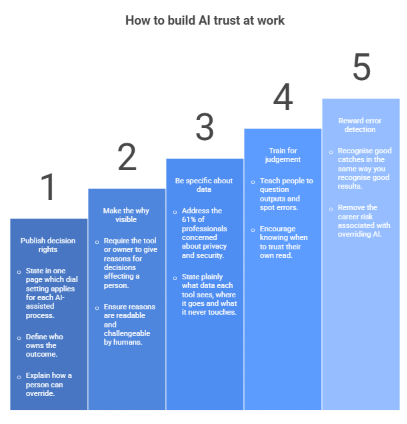
- Publish the decision rights. For each AI-assisted process, state in one page which dial setting applies, who owns the outcome and how a person can override.
- Make the “why” visible. For any decision that affects a person (a rating, a shortlist, a credit outcome), require the tool or the owner to give reasons a human can read and challenge.
- Be specific about data. With 61% of professionals flagging privacy and data security, say plainly what data each tool sees, where it goes and what it never touches.
- Train for judgement, not just prompts. Teach people to question outputs, spot errors and know when to trust their own read. Skill in using the tool without skill in doubting it creates the problem it was meant to solve.
- Reward the person who catches the error. If overriding the AI is risky for a career, people will stop doing it. Recognise good catches in the same way you recognise good results.
AI Readiness Score Card Free guide, instant download.
Get the Guide →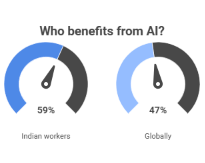
Source: Randstad Workmonitor 2026
DID YOU KNOW?
59% of Indian workers expect AI to benefit their organisation more than themselves, against 47% globally. Fairness in who gains from AI is part of the trust equation, not a separate topic.
Seen through the BANI lens: why AI trust keeps coming back
BANI is a framework from futurist Jamais Cascio, built to describe conditions that the older VUCA model no longer captures. It stands for Brittle, Anxious, Nonlinear and Incomprehensible. Where VUCA described a world that is shifting, BANI describes one where systems can fail suddenly, people feel the strain, effects are out of proportion to causes, and the reasons are hard to see. AI at work shows all four at once.
BANI condition | How it shows up with AI at work | The leadership response |
Brittle | Processes look efficient until the model errs or goes offline, and teams have lost the manual skills to step in. | Build capacity. Keep human fallback skills alive, and design backups so one failure does not stop the work. |
Anxious | 65% fear losing human judgement. 59% expect the company to gain more than they do. | Lead with empathy. Talk openly about concerns, share the gains fairly, and listen before rolling out the next tool. |
Nonlinear | A small change in a model or a prompt can cause an outsized change in decisions. Adoption does not grow in a straight line either. | Build context and adaptability. Pilot small, watch for side effects, and adjust before scaling. |
Incomprehensible | Outputs arrive with no explanation, so people cannot tell a good result from a confident error. | Make it transparent, and treat human intuition as legitimate evidence rather than as noise. |
The point of the BANI lens is that buying a better tool does not fix any of these on its own. Capacity, empathy, context and transparency are human capabilities. They are built through leadership and culture, which is why AI trust sits with managers and HR as much as with IT.
Curious About Other Areas of Your Organization?
Explore our other free assessments and get a fuller picture of where you stand.
View All AssessmentsHow Ebullient Helps Organisations Build AI Trust
Ebullient Consultancy works at the point where technology change meets human capability. For AI trust, that work typically runs through four areas:
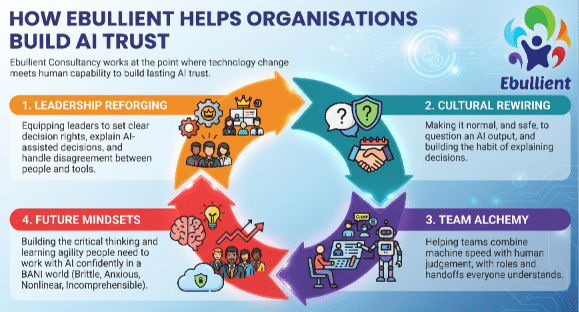
Leadership Reforging
Equipping leaders and managers to set clear decision rights, explain AI-assisted decisions and handle disagreement between people and tools.
Cultural Rewiring
Making it normal, and safe, to question an AI output, and building the habit of explaining decisions.
Team Alchemy
Helping teams combine machine speed with human judgement, with roles and handoffs everyone understands.
Future Mindsets
Building the critical thinking and learning agility people need to work with AI confidently in a BANI world.
Want to meet the team?
Start with a 30-min conversation. No commitment needed.
Frequently Asked Questions
What is AI trust at work?
AI trust at work is employees’ confidence that AI tools are accurate, secure and fair, and that people keep control of the decisions that matter. It depends on transparency about how tools reach outputs, clear human oversight, protection of personal data and training that builds judgement alongside tool skills.
Why are Indian employees both enthusiastic and worried about AI?
Both reactions are true at once. Michael Page India’s 2026 survey found 97% willing to build AI skills, yet 65% concerned about losing human judgement and intuition, and 61% about privacy. People value what AI can do for productivity but want to keep their own judgement and data protected.
Should AI be allowed to make decisions at work?
It depends on the stakes and how reversible the decision is. Low-risk, easily reversed tasks can run with human oversight after the fact. Decisions affecting people, such as hiring, ratings or credit, should keep a human decision-maker who can see the tool’s reasoning and disagree with it.
How can leaders build trust in AI among employees?
Set and publish decision rights, explain the reasons behind AI outputs, be specific about data use, train people to question results and recognise those who catch errors. Trust also depends on fairness, since 59% of Indian workers expect AI to benefit their company more than themselves.
What is the BANI framework and how does it apply to AI at work?
BANI, coined by futurist Jamais Cascio, stands for Brittle, Anxious, Nonlinear and Incomprehensible. It describes conditions where systems fail suddenly and causes are hard to see. AI at work shows all four, which is why leaders need capacity, empathy, context and transparency, not just better tools.