

The language of “skills-first hiring” is everywhere in 2026, but most organisations, including many that claim to have made the shift, have changed little beyond their job postings. For mid-size Indian enterprises, that gap is an opportunity. The businesses that build real skills infrastructure now, not just the rhetoric of it, will out-hire, out-promote and out-retain competitors still running on degrees and designations. This article explains what a skills-based organization actually is, what the latest data says about India’s progress, and how a mid-size enterprise can start building one without a Fortune 500 budget.
Key Takeaways at a Glance
- A skills-based organization uses demonstrated skills, not job titles or degrees, to drive hiring, promotion and development decisions.
- Indian adoption is real but shallow: only 21% of companies have fully dropped academic scores in campus hiring.
- Simply removing a degree line from a job post barely moves outcomes; real skills-assessment infrastructure is what delivers results.
- Mid-size enterprises that wait for a “skills-first revolution” to arrive fully may lose their best people to employers already running on skills data.
What a Skills-Based Organization Actually Is?
A skills-based organization hires, deploys, develops and pays people primarily according to demonstrated skills rather than job titles, tenure or academic credentials. The job description does not disappear, but it stops being the primary unit of workforce planning. Skills data becomes the primary unit instead.
This shows up in four places:
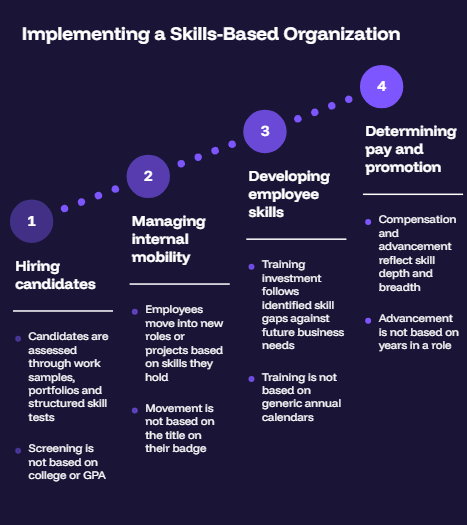
- Hiring: candidates are assessed through work samples, portfolios and structured skill tests rather than screened by college or GPA.
- Internal mobility: employees move into new roles or projects based on skills they hold, not only the title on their badge.
- Development: training investment follows identified skill gaps against future business needs, not generic annual calendars.
- Pay and promotion: compensation and advancement increasingly reflect skill depth and breadth, not years in a role.
How AI-Ready Is Your Organization, Really?
Take our free 4-minute assessment and get a personalized report on your leadership fluency, governance, and workforce readiness.
Take the Free AI Readiness Assessment →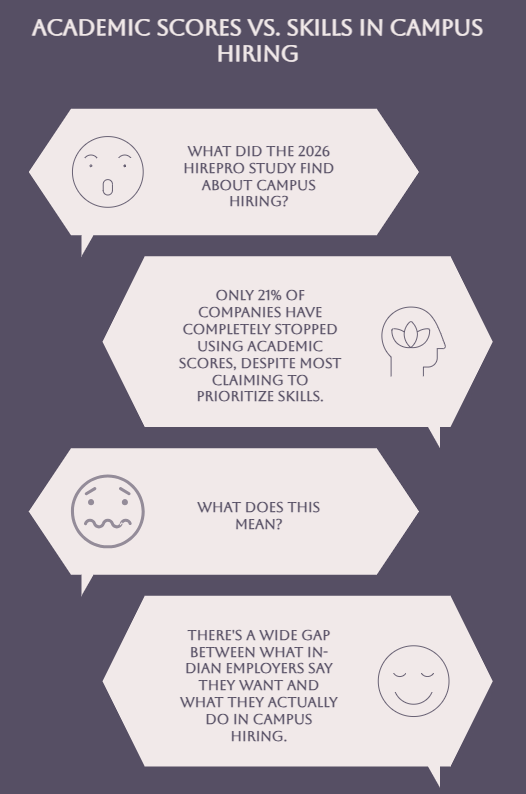
Source: HirePro
DID YOU KNOW?
A 2026 HirePro study of campus hiring found that just 21% of companies had completely moved away from using academic scores, even as most claim to prioritise skills. The gap between stated intent and actual practice remains wide across Indian employers.
Why the Shift Is Accelerating, and Why It’s Still Incomplete?
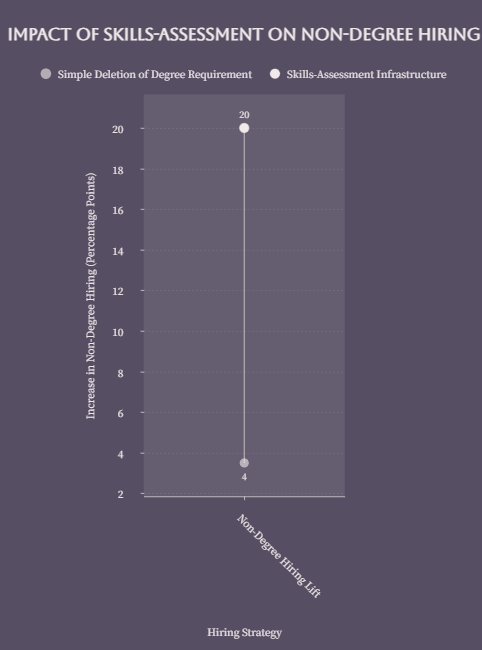
Globally, 70% of employers now say they use skills-based hiring for at least some roles, and 53% have removed degree requirements from at least some job postings. But the same research that documents this momentum also documents its limits: among companies that genuinely stripped degree requirements, policy change alone lifted non-degree hiring by only about 3.5 percentage points. Building real skills-assessment infrastructure, not just editing a job ad, produced a lift closer to 20 points.
India tells a similar story. Employer hiring intent for FY 2026–27 has jumped to 40%, up from 29% the previous year, and over 90% of employees across sectors already use generative AI tools at work. Demand for demonstrable, current skills is rising faster than the infrastructure to assess them.
Source: Dheya analysis
DID YOU KNOW?
Employers who simply deleted “bachelor’s degree required” from a job posting saw non-degree hiring rise by only about 3.5 percentage points. Those who built genuine skills-assessment infrastructure alongside the policy change saw a lift closer to 20 percentage points.
The Business Case: What Skills-Based Organizations Actually Gain
Skills-based transformation is often discussed as a talent-equity story, but the documented financial case is just as strong. Across sectors, organisations that moved from job-based to skills-based workforce planning report gains in speed, cost and retention that are difficult to achieve through hiring policy alone.
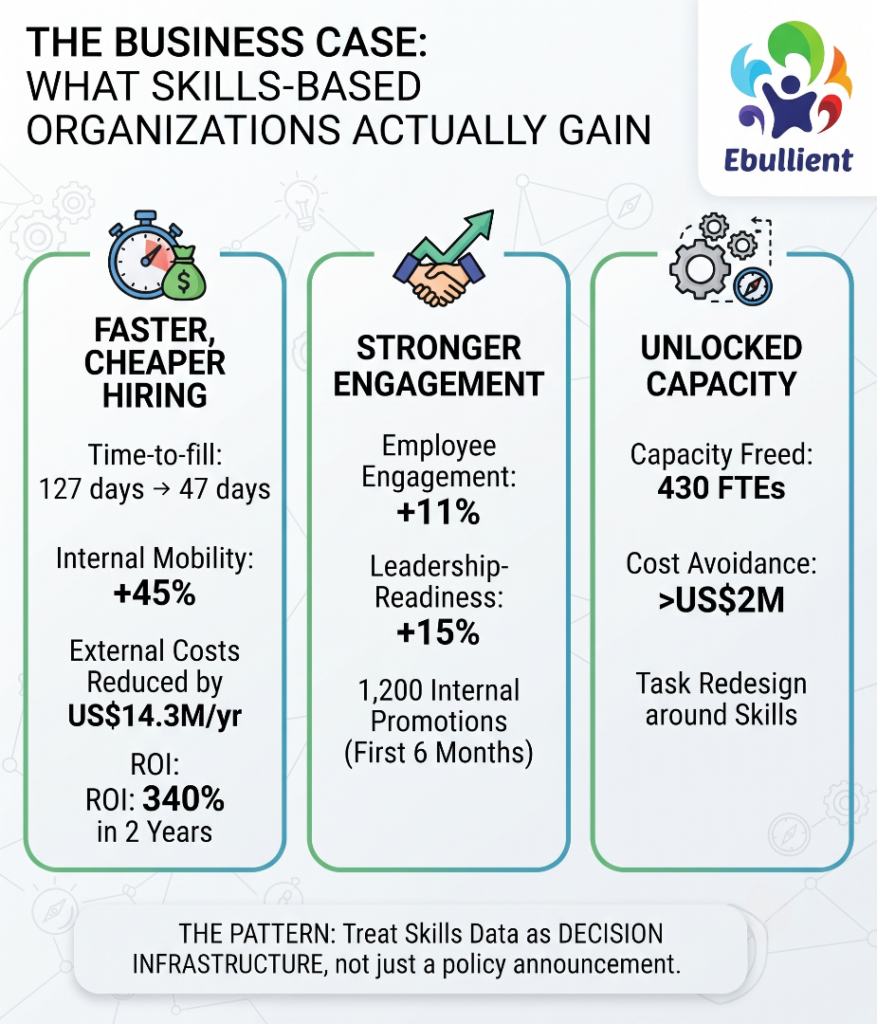
- Faster, cheaper hiring: one technology firm cut critical time-to-fill from 127 days to 47 days and increased internal mobility by 45% after launching an internal talent marketplace, reducing external hiring costs by US$14.3 million a year and returning 340% on the investment within two years.
- Stronger engagement and promotion velocity: a global financial services firm raised employee engagement scores by 11% and leadership-readiness scores by 15%, and made 1,200 internal promotions in the first six months of its skills platform.
- Capacity unlocked through task redesign: a large healthcare system freed capacity equivalent to 430 full-time employees and generated more than US$2 million in cost avoidance by redesigning work around skills rather than fixed roles.
For a mid-size Indian enterprise, the lesson is not the dollar figures, which assume far larger scale, but the pattern: the return comes from treating skills data as decision infrastructure, not from a one-time hiring-policy announcement.
Why Most Skills-Based Transformations Stall?
If skills-based hiring delivers these results, why do so many initiatives quietly fade? Recent employer research points to a consistent set of reasons, and mid-size enterprises are better placed to avoid them than large organisations with legacy systems to unwind.
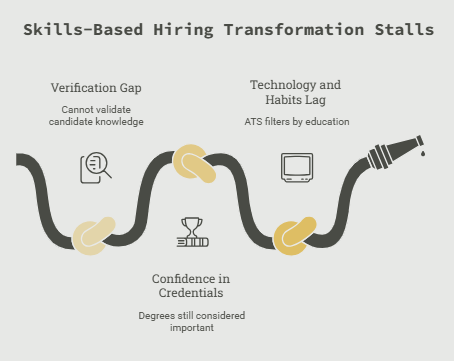
The verification gap
53% of employers say they cannot adequately validate what a candidate actually knows, so recruiters fall back on degrees and job titles as a proxy for competence, even inside organisations that have publicly committed to skills-first hiring.
Confidence in credentials persists
68% of employers still consider degrees important, and only 37% believe higher education adequately prepares candidates with the skills they need. That gap pushes employers toward hybrid signals, such as internships and demonstrated work history, rather than skills data alone: 78% now view work history as equal to or more valuable than a degree.
Technology and habits lag the policy
Most applicant tracking systems still filter by education level and job title rather than specific skills, and many employers cite costly or inadequate skills-testing platforms as a practical barrier. As a result, only 46% of employers planned to expand skills-based hiring further in 2026, even after years of stated commitment.
The organisations that avoid this stall treat skills-based hiring as an operating change, not a messaging change: they invest in assessment tools, train managers to use skills data in real decisions, and track whether behaviour, not just job postings, actually shifted.
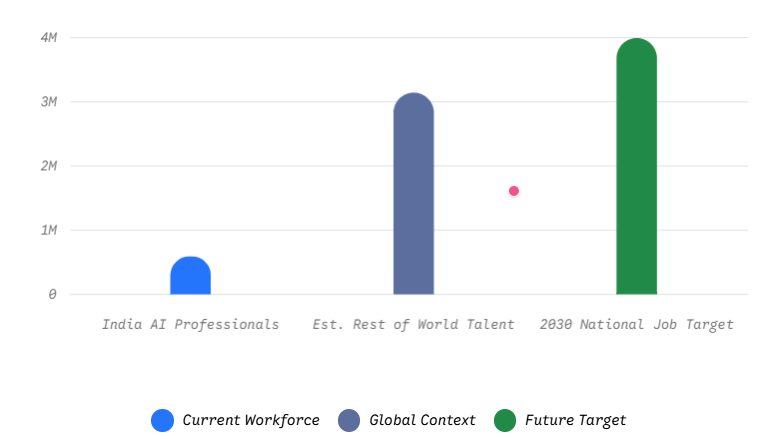
Source: India Skills Report
DID YOU KNOW?
India now holds roughly 16% of the world’s AI talent pool, with over 600,000 AI professionals in the country and a national target of 4 million new AI-related jobs by 2030. For mid-size enterprises, this means the competition for scarce, current skills is only intensifying.
What This Means for Mid-Size Enterprises?
Large enterprises and GCCs have the budget to build elaborate skills taxonomies and AI-driven talent marketplaces. Mid-size organisations do not need to replicate that scale to get the benefit. What matters is starting with one function, proving the model, and scaling deliberately.
1. Start with a skills audit, not a hiring policy
Before changing a single job posting, map the skills your organisation currently has in one business-critical function. This single step reveals gaps that no amount of degree-optional hiring will fix on its own.
2. Tie skills to strategy, not just roles
A skills map only has value if it is compared against where the business is going in the next 12 to 24 months, not just the skills a role has always required. This is where most frameworks stall: they describe the present accurately and say nothing about the future.
3. Pilot before you scale
Choose one live decision, a promotion cycle, a project staffing exercise, or a single hiring round, and run it on skills data. Measure the outcome before expanding the approach across the organisation.
4. Make skills data a living asset, not a one-time project
A competency framework built once and left untouched for two years is already outdated. The organisations capturing real advantage treat skills data the way they treat financial data: updated, reviewed and acted on continuously.
Old Playbook vs. Next Practice
Dimension | Old Playbook | Next Practice |
Hiring filter | Degree, college pedigree, years of experience | Demonstrated skills via assessments and work samples |
Promotion basis | Tenure and manager judgment alone | Skills depth and breadth, validated against role needs |
Training investment | Generic annual calendar for all employees | Targeted to identified, strategy-linked skill gaps |
Workforce planning unit | Job description, fixed at creation | Live skills inventory, reviewed continuously |
Internal mobility | Informal, dependent on manager networks | Structured, based on documented skills data |
Competency Framework Maturity Free guide, instant download.
Get the Guide →Skills-Based Practices by Function
A skills-based shift rarely starts everywhere at once. Most mid-size enterprises get the fastest, clearest wins by starting with the function where skill gaps already show up as a business problem.
Sales and relationship roles
Relationship managers and sales teams are judged on outcomes, which makes skills easy to observe and hard to fake. Map skills such as consultative selling, digital product fluency and client retention, and use that map to guide coaching and territory assignment, not just annual appraisals.
Technology and data teams
Technical skills age quickly, so a job title from two years ago tells you little about what someone can do today. A living skills inventory, refreshed each quarter, is more useful here than almost anywhere else in the organisation, particularly as AI and automation tools reshape what “data skills” means month to month.
Operations and compliance
Regulatory and process knowledge changes in small, frequent steps. Track skills tied to specific procedures and compliance requirements, and use gaps in that map to target training before an audit finds them.
HR and people teams
A skills-based organization needs an HR function that can run it. That means HR itself should be an early adopter: building its own skills inventory in talent acquisition, learning design and people analytics before asking the rest of the business to trust the model.
Curious About Other Areas of Your Organization?
Explore our other free assessments and get a fuller picture of where you stand.
View All AssessmentsBuilding Blocks: Key Terms to Know
A skills taxonomy is a structured, organisation-wide list of defined skills, used as the common vocabulary that makes skills data comparable across roles, teams and systems.
An internal talent marketplace is a platform or process that matches employees to projects, gigs or open roles based on their documented skills, rather than relying solely on manager networks or formal job postings.
A skills passport is a portable record of an individual’s verified skills and credentials, carried across roles, employers or even industries, rather than a static resume tied to past job titles.
Skills verification is the process of confirming a claimed skill through assessment, work samples or structured evaluation, rather than accepting it on the strength of a resume line or self-report.
How Ebullient Helps?
Ebullient works with mid-size enterprises to build the capability infrastructure a skills-based shift requires, not just the policy language around it. Our Capability Building engagements turn competency frameworks into living, decision-ready tools, and our Competency Framework Maturity assessment benchmarks where your organisation stands today against where it needs to be.
Want to meet the team?
Start with a 30-min conversation. No commitment needed.
Frequently Asked Questions
What does “skills-based organization” actually mean?
A skills-based organization hires, deploys, develops and pays people primarily according to demonstrated skills rather than job titles, tenure or degrees. Roles still exist, but skills data, not a static job description, drives decisions about who does what work and who gets developed next.
Is this just about hiring without a degree?
No. Degree-optional hiring is one visible piece, but the larger shift is internal: mapping the skills your organisation already has, identifying gaps against where the business is going, and using that map for promotions, internal mobility and reskilling, not only recruitment.
Does skills-based hiring actually work in India, or is it mostly talk?
It is real but partial. A 2026 HirePro study found only 21% of companies have fully dropped academic scores from campus hiring, and global research shows policy announcements rarely translate into practice unless paired with genuine skills-assessment infrastructure.
Where should a mid-size enterprise start?
Start with a skills audit of one business-critical function, map those skills against near-term strategic goals, and pilot skills-based decisions, such as a promotion or project staffing, in that function before scaling organisation-wide.
How is this different from a competency framework we already have?
A competency framework defines the skills a role requires; a skills-based organization goes further by continuously updating that data and using it in live decisions. Most Indian mid-size firms have the framework. Few have made it operational.