

Picture a strong senior analyst in your finance team. She has been in the same role for three years, has quietly built data skills nobody asked for, and has just seen a vacancy for a business-analytics lead on a competitor’s careers page. Your own analytics team has an identical vacancy open. She has never heard of it.
That gap between the talent a company has and the talent it thinks it has to go and buy is where internal talent mobility lives. With 72% of professionals in India looking for a new role this year, according to LinkedIn research, it has moved from an HR nice-to-have to a retention strategy. This article covers what the 2025-26 data says, why internal moves stall, and way to fix it.
KEY TAKEAWAYS AT A GLANCE
- Job-hunting is high and getting harder: LinkedIn research reports 72% of Indian professionals seeking a role this year, with 76% saying the search has become harder.
- Nearly nine in ten GCCs in India expect up to half of their FY26 hiring to be filled through internal mobility.
- 86% of Indian professionals report major changes at work, so roles are shifting faster than job descriptions can keep up.
- Internal moves stall for predictable reasons: managers who hoard talent, opportunities nobody can see, and skills that are not mapped.
- A basic internal marketplace, a skills inventory and a manager release norm can all be started in one quarter, with no new technology.
What is internal talent mobility?
Internal talent mobility is the movement of existing employees into new roles, projects or functions within the same organisation, through promotions, lateral moves, stretch assignments or rotations. It treats the current workforce as the first source of talent for every open role, before the company looks outside.
For Indian organisations, the case is practical rather than philosophical. Hiring from outside is slower and more expensive, and a new hire takes months to learn how the company actually works. An internal candidate already knows the clients, the systems and the politics. What they lack is usually a visible path and a manager willing to let them go.
How AI-Ready Is Your Organization, Really?
Take our free 4-minute assessment and get a personalized report on your leadership fluency, governance, and workforce readiness.
Take the Free AI Readiness Assessment →The market pressure behind the shift
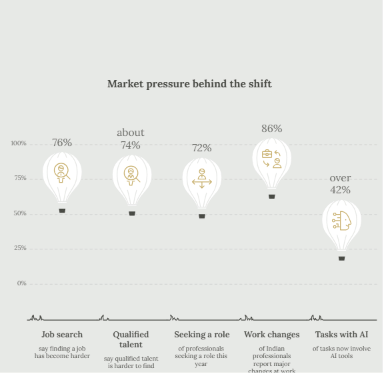
- A tougher external market. LinkedIn research reported in January 2026 found 76% of professionals say finding a job has become harder, and applicants per open position in India have more than doubled since early 2022. Recruiters echo the pain: about 74% say qualified talent is harder to find.
- A restless internal workforce. With 72% of professionals seeking a role this year, a company that cannot show its own people a next step is effectively inviting them to look elsewhere.
- Faster-changing roles. The Human Progress Report 2026 found 86% of Indian professionals report major changes at work, and that over 42% of tasks now involve AI tools. Roles built for last year’s work are already out of date.
A note on the evidence: several of these figures come from news coverage of surveys whose sample sizes were not published. Treat them as directional signals about the market, not precise measurements.
Why are Indian companies turning to internal mobility?
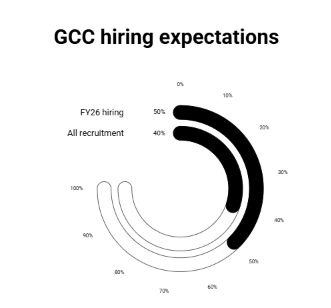
Because it is faster, cheaper and a better predictor of fit. Global capability centres, which hire at scale and compete fiercely for talent, are the clearest example. A Taggd report with CII and JLL India found nearly nine in ten GCCs expect up to 50% of their FY26 hiring to come from internal mobility.
The same report shows why that matters: replacement hiring was expected to account for nearly 40% of total recruitment. When so much hiring is simply refilling seats, every role you can fill from within is one fewer exit you have to replace from outside. Older LinkedIn Global Talent Trends data, widely cited in India, also found employees stay about 41% longer at companies that practise internal mobility, though that finding is from 2020 and the original sample was not stated.
Source: Taggd
DID YOU KNOW?
Nearly nine in ten GCCs in India expect up to 50% of their FY26 hiring to come through internal mobility, while replacement hiring is expected to make up nearly 40% of all recruitment. For the most talent-hungry employers, the existing workforce is already the main hiring channel.
What stops internal moves from happening?
Rarely a lack of talent. The usual blockers are organisational habits that nobody designed on purpose:
- Manager gatekeeping. Managers who fear losing a top performer quietly block or delay a transfer. If a manager is measured only on their own team’s output, hoarding is the rational response.
- Invisible opportunities. Open roles are posted externally first, or shared informally with a favoured few. People cannot apply for what they cannot see.
- Unmapped skills. HR often knows job titles but not what people can actually do. The finance analyst with data skills stays invisible to the analytics team.
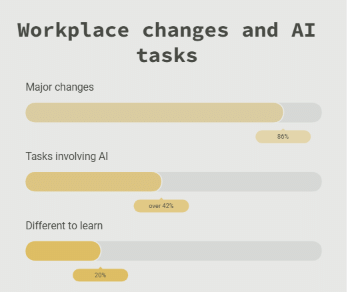
- Skill gaps with no bridge. Even when an employee is interested, there is no short, structured way to close a 20% gap, so the move is rejected as too risky.
The last point matters for credentials too. In the Human Progress Report 2026, 90% of respondents said official skill credentials matter more than before. Employees want proof they are ready, and companies that offer a short, assessed bridge programme give them both the proof and the confidence.
Source: Human Progress Report
DID YOU KNOW?
86% of Indian professionals report major changes at work, and over 42% of their tasks now involve AI tools. When roles are changing this quickly, the person best placed to fill a new role is often someone already inside who can learn the 20% that is different, not someone outside who must learn the company from scratch.
From Old Playbook to Next Practice
Old Playbook | Next Practice |
Vacancies advertised externally first, internally as an afterthought | Internal first: every role is visible to employees for a set window before it goes outside |
Promotion as the only visible career move | A career lattice: lateral moves, rotations and stretch projects count as real growth |
Managers judged only on their own team’s results | Managers also rewarded for the talent they develop and release to other teams |
HR knows job titles, not skills | A living skills inventory, built from self-declared skills, project history and manager validation |
Training as an annual catalogue | Short bridge programmes tied to specific target roles, ending in an assessed credential |
Exit interviews to learn why people left | Stay conversations to learn what would make people move within the company |
AI Readiness Score Card Free guide, instant download.
Get the Guide →How Can Companies Improve Internal Mobility in India?
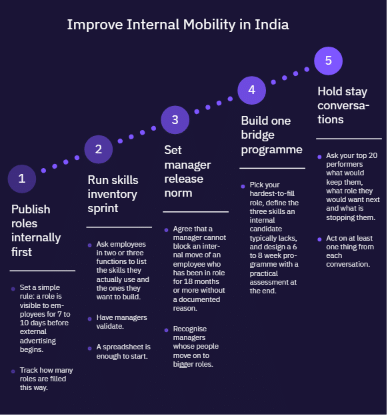
1. Publish every open role internally first
Set a simple rule: a role is visible to employees for 7 to 10 days before external advertising begins. Track how many roles are filled this way.
2. Run a skills inventory sprint
Ask employees in two or three functions to list the skills they actually use and the ones they want to build. Have managers validate. A spreadsheet is enough to start.
3. Set a manager release norm
Agree that a manager cannot block an internal move of an employee who has been in role for 18 months or more without a documented reason. Recognise managers whose people move on to bigger roles.
4. Build one bridge programme
Pick your hardest-to-fill role, define the three skills an internal candidate typically lacks, and design a 6 to 8 week programme with a practical assessment at the end.
5. Hold stay conversations
Ask your top 20 performers what would keep them, what role they would want next and what is stopping them. Act on at least one thing from each conversation.
Curious About Other Areas of Your Organization?
Explore our other free assessments and get a fuller picture of where you stand.
View All AssessmentsHow Ebullient Helps Organisations Build Internal Mobility?
Ebullient Consultancy works where technology change meets human capability. For internal mobility, that work typically runs through four areas:
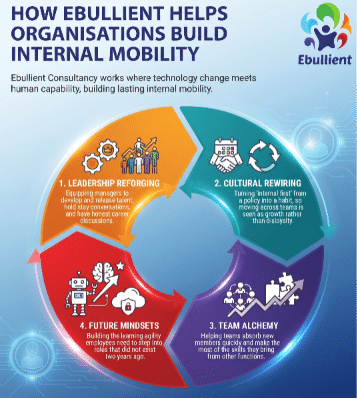
Leadership Reforging
Equipping managers to develop and release talent, hold stay conversations and have honest career discussions.
Cultural Rewiring
Turning “internal first” from a policy into a habit, so moving across teams is seen as growth rather than disloyalty.
Team Alchemy
Helping teams absorb new members quickly and make the most of the skills they bring from other functions.
Future Mindsets
Building the learning agility employees need to step into roles that did not exist two years ago.
Want to meet the team?
Start with a 30-min conversation. No commitment needed.
Frequently Asked Questions
What is internal talent mobility?
Internal talent mobility is the movement of existing employees into new roles, projects or functions within the same organisation. It includes promotions, lateral moves, rotations and stretch assignments, and it makes the current workforce the first source of talent for open roles before the company hires from outside.
Why does internal mobility matter for retention in India?
Employees who see no next step tend to look outside. LinkedIn research reports 72% of Indian professionals seeking a role this year. SHRM India has cited about 61% of employees treating career growth as a major retention factor. A visible internal path gives people a reason to stay and grow.
How can a company start an internal talent marketplace without new software?
Begin with a shared, regularly updated list of open roles and short projects visible to all employees, plus a simple skills inventory in a spreadsheet. Add an easy way to express interest and a rule that managers respond within a set time. Software can follow once the habits work.
What are the biggest barriers to internal mobility?
The main barriers are managers who resist releasing strong performers, opportunities that employees cannot see, skills that nobody has mapped, and skill gaps with no short route to close them. Most are fixable through visibility rules, manager incentives and targeted bridge programmes rather than large technology spend.
How do you measure whether internal mobility is working?
Track the share of open roles filled internally, the time to fill internal versus external roles, retention of employees who move compared with those who do not, and the number of managers who release talent. Review these quarterly and compare them with your external hiring costs.