

Job hugging is when employees stay in a role out of fear and uncertainty, not commitment. In India, AI-driven layoff anxiety keeps attrition low while engagement quietly falls. Leaders should treat retention numbers as incomplete, measure why people stay, and rebuild manager capability before the job market thaws.
Your attrition dashboard may look better than it has in years. Before anyone celebrates, ask a harder question: how many of those people would walk out tomorrow if an equally good offer landed in their inbox? In 2026, that question separates healthy retention from a pause button.
Key Takeaways at a Glance
Key Point | What It Means for Your Organisation |
Staying is not loyalty | 57% of US workers call themselves job huggers, up from 45% in six months. |
Effort is draining | 63% of Indian companies report falling discretionary effort (Great Place To Work India). |
Fear drives the grip | 66% of AI and ML professionals in India expect layoffs within six months. |
Managers hold the lever | Manager engagement fell from 27% to 22% in 2025. |
The thaw is the risk | Nearly half of US workers plan to job hunt within six months. |
Act this quarter | Split retention data, run stay interviews, publish an AI roadmap, equip managers. |
What Is Job Hugging, and How Is It Different From Quiet Quitting?
Job hugging is when employees stay in a role they would otherwise leave because the outside market feels too risky. Quiet quitting means doing the bare minimum inside a role. The two overlap, but they start from different places: quiet quitting is a decision about effort, while job hugging is a decision about safety. A job hugger can work hard or hardly at all.
The term took hold in US coverage during 2025 and has since reached Indian boardrooms, helped along by high-profile layoffs and a steady stream of AI headlines. The remedies differ. Quiet quitting responds to purpose, recognition, and workload. Job hugging responds to security, a visible future, and the belief that growth is still possible inside the company. We covered the effort side in our piece on quiet quitting in India.
How Healthy Is Your Organizational Culture, Really?
Take our free 4-minute assessment and get a personalized report on your leadership fluency, governance, and workforce readiness.
Take the Free Organizational Culture Assessment →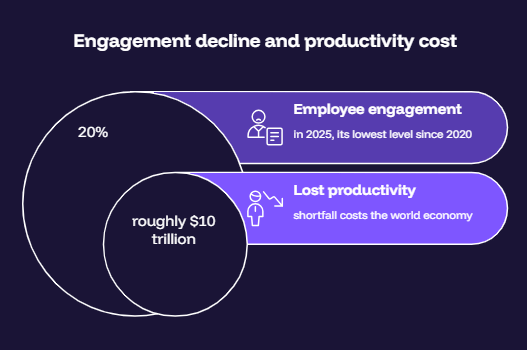
Source: Gallup
DID YOU KNOW?
Global employee engagement fell to 20% in 2025, its lowest level since 2020. Gallup’s 2026 State of the Global Workplace report estimates the shortfall costs the world economy roughly $10 trillion in lost productivity.
How Common Is Job Hugging in India in 2026?
India has no single survey that counts job huggers the way US studies do, so leaders must triangulate. Globally, ManpowerGroup’s 2026 Global Talent Barometer finds 64% of workers plan to stay with their current employer. Great Place To Work India reports 38% of employees are looking for a new job, while 6% want to leave but feel they cannot. Treat these as directional signals.
The Indian signals point the same way as the global ones. Great Place To Work India’s research shows 63% of companies reported a decline in discretionary effort, against 55% in 2024 and 43% in 2023. Read those numbers together and a pattern appears: people stay put, but the extra effort that drives innovation and customer outcomes drains away. ManpowerGroup’s India data adds a second layer, with 75% of Indian workers reporting burnout.
Measurement is further along in the US. ResumeBuilder’s February 2026 survey of 2,188 workers found 57% identify as job huggers, up from 45% in August 2025. Treat that as a direction of travel, not an Indian benchmark.
Why Are Employees Holding On to Roles They Might Otherwise Leave?
Fear of AI-driven restructuring and layoffs is the main driver. ResumeBuilder found 70% of US job huggers worry AI will affect their job security within six months, and 63% fear layoffs. In India, a July 2026 Blind survey of 1,552 professionals found 66% of AI and ML workers expect layoffs or headcount cuts within three to six months. Anxiety, not contentment, is doing the work.
The Blind result reflects expectations, not confirmed plans, and it covers the very people building the technology. Sales and marketing employees were even more anxious, at 68%. The worry also runs ahead of the hiring data: a Nomura analysis reported in August 2026 counted 83,100 AI-related hires in India against 31,921 layoffs and attrition since 2022.
Employees react to headlines and to what they see in their own teams, whatever the net numbers say. That links to capability anxiety at work: people who doubt they can keep up do not volunteer for stretch roles. They protect what they have.
Source: MetLife
DID YOU KNOW?
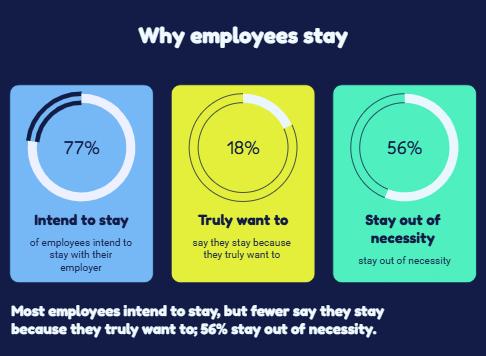
MetLife’s February 2026 study found 77% of employees intend to stay with their employer, but only 18% say they stay because they truly want to. 56% stay out of necessity.
What Does Job Hugging Cost an Organisation?
It costs effort, energy, and bench strength while headcount looks stable. Employees who stay out of necessity tend to protect their current role instead of extending it, so discretionary effort falls, workload creeps up, and promotions stall. The bill arrives later, as a concentrated exit wave once better options open up, and by then the damage to engagement and succession is done.
- Lower discretionary effort. Idea submissions, voluntary projects, and the extra customer mile fade first, because they carry risk and nobody rewards them in a nervous year.
- Quiet overload. More than half of job huggers work longer hours and nearly half have absorbed duties beyond their core role, according to ResumeBuilder. That feeds the burnout already visible in India.
- Blocked movement. The same survey found 22% of huggers missed raises and 20% missed promotions. Ladders jam, which hits early-career talent hardest.
The Organizational Transformation Checklist Free guide, instant download.
Get the Guide →Old Playbook vs. Next Practice
Area | Old Playbook | Next Practice |
Retention signal | Attrition rate as the health metric | Attrition plus stay-reason data: chosen or necessary |
Listening | Annual engagement survey | Pulse questions and stay interviews with critical talent |
Manager role | Task allocation and review | Career conversations and everyday coaching |
AI change | Silence until rollout | Role-by-role roadmap shared early |
Growth | Promotion depends on a vacancy | Rotations, projects, and stretch assignments |
The Thaw Risk: Why a Quiet Year Can Precede a Loud Exit
Job hugging is a weather response, not a permanent state. In the US, Robert Half reports nearly half of workers now plan to look for a new position within six months, up from 38% earlier in 2026 and 27% a year ago. Its data also shows new hires earning 3.6% more than tenured staff with equivalent skills, a standing nudge to test the market.
India is not the US, but the mechanics travel. Reluctant stayers keep one hand on the door: ResumeBuilder found 44% of huggers passively browsing and 19% actively applying, so they need only a better signal to move. Hiring for AI and R&D roles at global capability centres in India is reported to carry premiums of 30 to 40% over traditional market rates, according to greytHR.
People who stayed because they felt trapped tend to leave together once the trap opens. A company that spent the freeze coasting on low attrition will meet that moment with disengaged teams, depleted managers, and no relationship worth drawing on. The quarter to build one is the one before the thaw.
Why Do Managers Decide Whether Staying Turns Into Commitment?
Managers shape most of the team experience. Gallup’s long-running research attributes about 70% of the variance in team engagement to the manager, yet its 2026 State of the Global Workplace report shows manager engagement fell from 27% to 22% between 2024 and 2025. When managers are depleted, reluctant stayers get no reason to change. The people closest to your teams are running out of energy to coach.
Gallup also found that managers have lost their engagement premium: the gap between managers and individual contributors narrowed from 11 points in 2022 to 3 points in 2025. Stretched managers with larger teams and AI rollouts to lead have little room left for the career conversation that turns a reluctant stayer into a willing one.
The fix is capability, not exhortation. Psychological safety belongs here too, because people who fear speaking up will not tell you they are looking.
Source: Gallup
DID YOU KNOW?
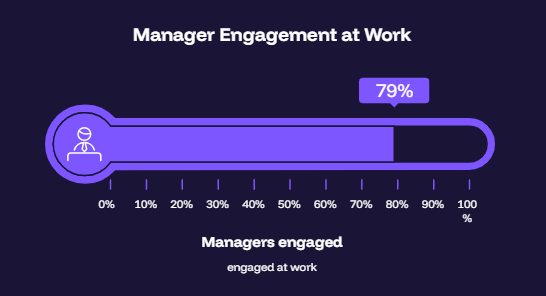
In Gallup’s best-practice organisations, 79% of managers are engaged at work, nearly four times the global average.
What Should Leaders Do About Job Hugging This Quarter?
Start by finding out who stays by choice and who stays by default. Then act on three fronts: listen directly to critical talent, tell people plainly how AI will change their roles, and give managers the time and skills to hold real career conversations. Small, visible moves now matter more than a large programme next year. Each step costs little and shows people you noticed.
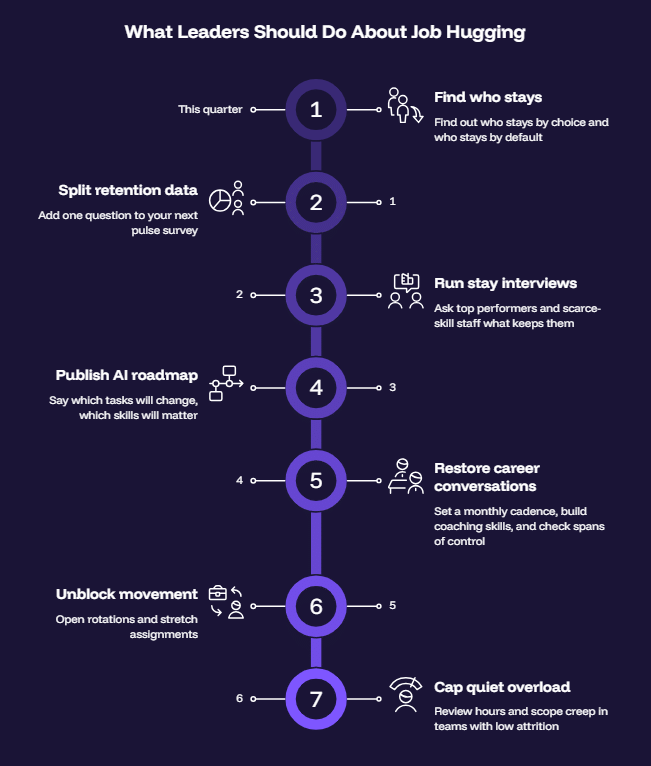
1. Split your retention data
Add one question to your next pulse survey: “If you received an equally good offer tomorrow, would you stay?” Chosen stayers and necessity stayers need different responses, and attrition cannot tell them apart.
2. Run stay interviews with critical talent.
Ask top performers and scarce-skill staff what keeps them, what would make them leave, and what they would change this quarter. Ten honest conversations beat a forty-question survey.
3. Publish an AI roadmap by function.
Say which tasks will change, which skills will matter, and what support exists. Silence reads as threat. A clear path reads as a future.
4. Give managers back the career conversation
Set a monthly cadence, build coaching skills, and check spans of control. A manager with too many reports cannot coach anyone.
5. Unblock movement
Open rotations and stretch assignments so growth does not depend on a vacancy above.
6. Cap the quiet overload
Review hours and scope creep in teams with low attrition, and redistribute the load before burnout does it for you.
Curious About Other Areas of Your Organization?
Explore our other free assessments and get a fuller picture of where you stand.
View All AssessmentsHow Ebullient Can Help?
Ebullient partners with mid-size enterprises on leadership, culture, and team capability. For the job hugging problem, three starting points fit most organisations:
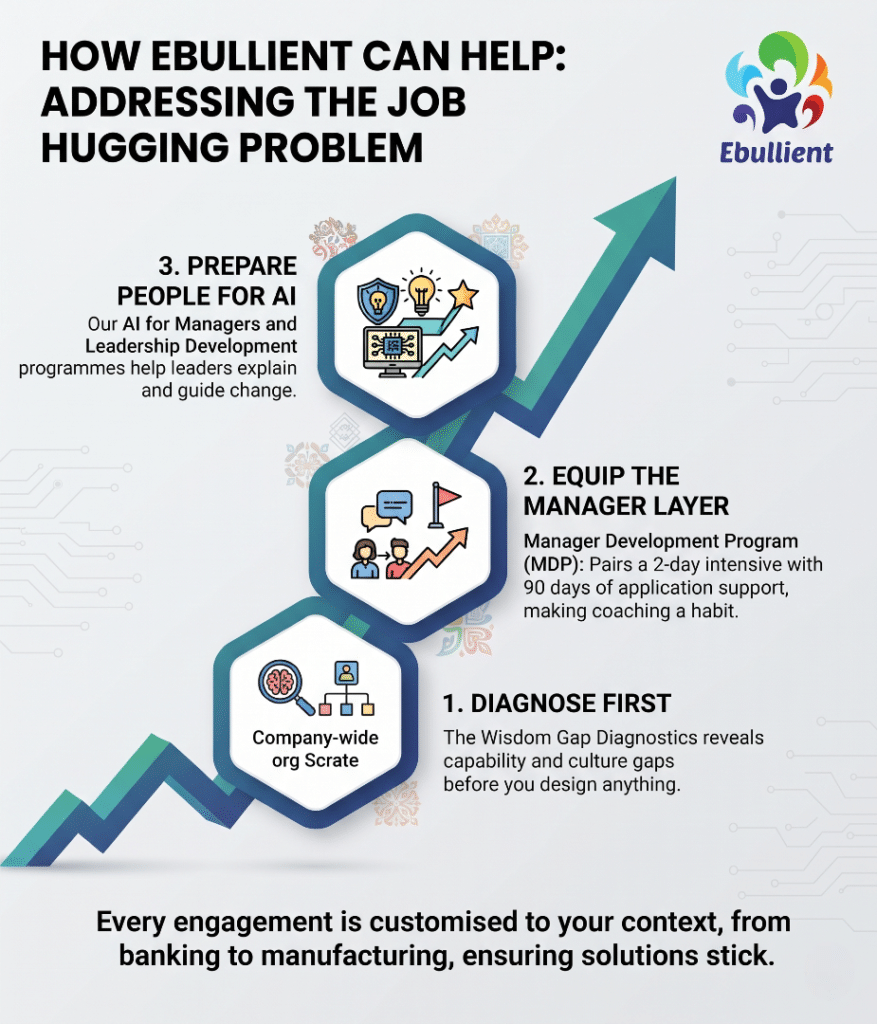
- Diagnose first. The Wisdom Gap Diagnostics shows where capability and culture gaps sit before you design anything.
- Equip the manager layer. The Manager Development Program (MDP) pairs a two-day intensive with 90 days of application support, so coaching becomes a habit, not a workshop note.
- Prepare people for AI. Our AI for Managers and Leadership Development programmes help leaders explain and guide the change that is driving the anxiety.
Every engagement is customised to your context, because a retention problem in a bank looks different from one in a manufacturer.
Final Thoughts
A low attrition rate tells you who is in the building. It says nothing about who is in the game. The data from Gallup, Great Place To Work India, and Blind points the same way: people are staying because they feel they must, and the effort that drives your business is the first thing they ration.
The organisations that come through the thaw intact will be the ones that used the quiet to rebuild trust, equip managers, and give people an honest picture of where AI leaves them. Start with one question this week: do your people stay because they choose to, or because they have to?
Want to meet the team?
Start with a 30-min conversation. No commitment needed.
Frequently Asked Questions
What is job hugging?
Job hugging is when employees stay in their current role mainly because leaving feels too risky, not because they are committed or satisfied. Economic uncertainty, layoff fears, and anxiety about AI drive it. Staying keeps attrition low, but it can hide falling engagement, stalled growth, and a pool of people ready to move when conditions improve.
Is job hugging bad for companies if employees are still performing?
It can be. Performance on assigned tasks may hold, but the extra effort that drives improvement tends to fall. Great Place To Work India found 63% of companies saw discretionary effort decline. Job huggers also carry higher burnout risk and may leave together once opportunities open up again.
How can HR measure job hugging?
Add a chosen-or-necessary question to pulse surveys: would you stay if you had an equally good offer elsewhere? Pair it with stay interviews, internal mobility rates, and discretionary effort indicators such as voluntary project work. Compare results by manager. A team with low attrition but weak answers is a job hugging team.
Is job hugging happening in India?
The signals say yes, though India lacks a single dedicated survey. Great Place To Work India reports 38% of employees seeking a new job and 6% who want to leave but feel they cannot. A Blind survey found two-thirds of AI and ML professionals expect layoffs within three to six months. Treat these as strong directional evidence.
How long will job hugging last?
No one can say precisely. In the US, Robert Half reports nearly half of workers now plan to job hunt within six months, up from 38% earlier in 2026, which suggests the grip loosens as hiring recovers. India’s timing will depend on AI-related restructuring and sector hiring. Plan for the thaw rather than waiting to see it.