

An accidental project manager is an employee who leads projects without holding a project management title or formal training. A marketer launches a campaign, an engineer runs a system migration, or an HR specialist rolls out a new policy, and suddenly they own scope, timelines, budgets and stakeholders. They need a short, practical toolkit: clear goals, a simple plan, regular communication, risk tracking and the ability to lead without formal authority.
Nearly every function now runs on projects. In many organisations, a large share of that work lands with people who are experts in their own field but have never been taught how to run a project. Nobody doubts their ability. They simply were not given the tools.
Key Takeaways at the Glance
- Someone who leads projects without the title or formal training.
- Project demand is rising, and PMI forecasts a gap of up to 29.8 million professionals by 2035.
- Defining success, planning, stakeholders, communication, risk, leading without authority and scope control.
- A one-page charter, task list, weekly check-in, and a risk log.
- Clear authority, protected time, templates and mentoring.
Why Do So Many Employees Become Accidental Project Managers?
1. Growth outpaces structure
Mid-size and fast-growing companies take on new initiatives faster than they can build a project office. Someone has to run each one, and the most capable person gets the job.
2. Lean teams
When there is no dedicated project manager, the work goes to whoever knows the subject best. Subject expertise is not the same as delivery skill.
3. Cross-functional work is the norm
Digital rollouts, compliance programs, customer launches and AI adoption all cut across departments. They need someone to coordinate, and that role often has no formal home.
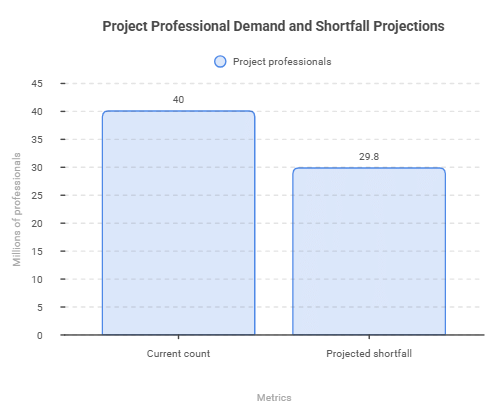
Source: PMI
Did You Know?
The world needs millions more project professionals. The Project Management Institute’s Global Project Management Talent Gap report (2025) counts nearly 40 million project professionals today and projects that demand could grow by 64% between 2025 and 2035. It estimates a shortfall of up to 29.8 million professionals by 2035.
How AI-Ready Is Your Organization, Really?
Take our free 4-minute assessment and get a personalized report on your leadership fluency, governance, and workforce readiness.
Take the Free AI Readiness Assessment →What Challenges Do Accidental Project Managers Face?
- No authority. They must get work from colleagues who do not report to them.
- Vague goals. The brief says “launch the new portal” but not what success looks like.
- Scope creep. New requests arrive mid-project, and nobody has agreed how to say no or trade off.
- Poor estimates. Without experience, they guess timelines and budgets, then miss them.
- Stakeholder surprises. Senior leaders learn about problems late and lose confidence.
- Competing priorities. Project work sits on top of a full-time job.
- Unclear ownership. Tasks drift because nobody is accountable for them.
These are not personal failings. They are the predictable result of asking people to run projects without a method.
Which Skills Do Accidental Project Managers Need Most?
Focus on eight practical skills. Together they cover most of what a typical project needs.
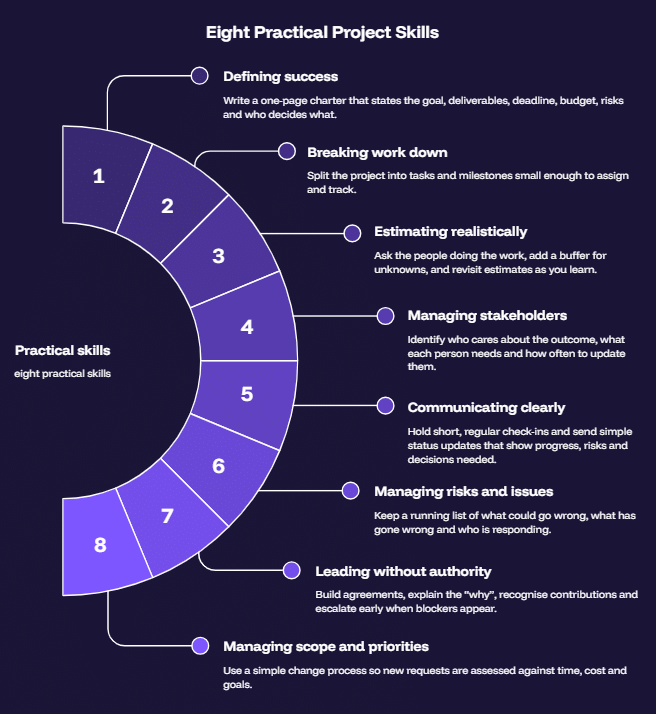
1. Defining success
Write a one-page charter that states the goal, deliverables, deadline, budget, risks and who decides what.
2. Breaking work down
Split the project into tasks and milestones small enough to assign and track.
3. Estimating realistically
Ask the people doing the work, add a buffer for unknowns, and revisit estimates as you learn.
4. Managing stakeholders
Identify who cares about the outcome, what each person needs and how often to update them.
5. Communicating clearly
Hold short, regular check-ins and send simple status updates that show progress, risks and decisions needed.
6. Managing risks and issues
Keep a running list of what could go wrong, what has gone wrong and who is responding.
7. Leading without authority
Build agreements, explain the “why”, recognise contributions and escalate early when blockers appear.
8. Managing scope and priorities.
Use a simple change process so new requests are assessed against time, cost and goals.
Is Your Leadership Pipeline at Risk? Free guide, instant download.
Get the Guide →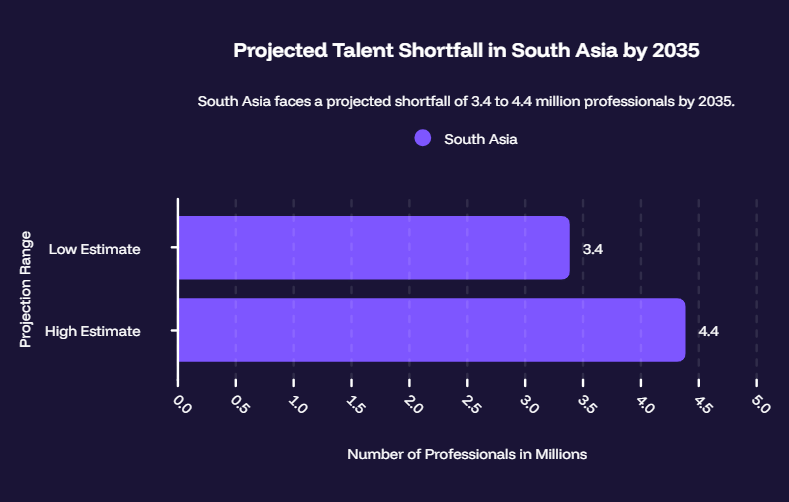
Source: PMI
Did You Know?
South Asia is among the fastest-growing regions. PMI names South Asia, alongside Sub-Saharan Africa and China, as one of the fastest-growing regions for project talent, driven by infrastructure investment and digital innovation. Its figures put the region’s projected shortfall at roughly 3.4 to 4.4 million professionals by 2035.
What Does a Simple Five-Phase Toolkit Look Like?
Accidental project managers do not need heavy frameworks. A light, repeatable structure works better.
Phase | Goal | Simple Tool | Key Question |
1. Initiate | Agree what the project is for | One-page project charter | What does success look like, and who signs off? |
2. Plan | Decide how and when work happens | Task list with owners and milestones | Who does what by when? |
3. Execute | Keep work moving | Weekly check-in and shared tracker | What is blocked, and who can unblock it? |
4. Monitor | Spot problems early | Risk and issue log, short status report | Are we on track for time, cost and scope? |
5. Close | Capture value and lessons | Handover note and short review | What worked, what did not, what do we repeat? |
What Belongs in a One-Page Project Charter?
The charter is the single most useful document for a new project manager. Keep it to one page and agree it with your sponsor before work starts.
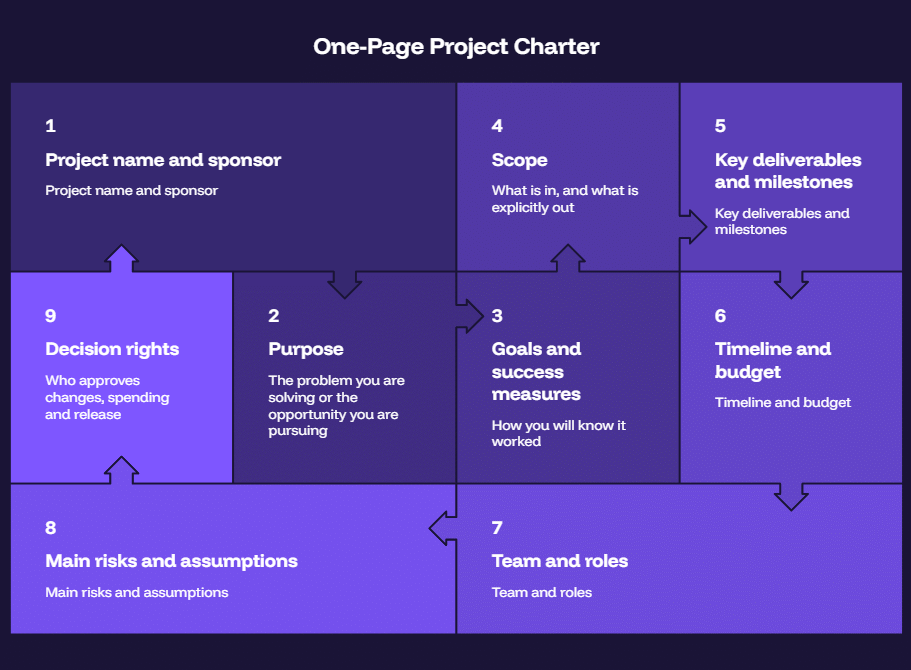
- Project name and sponsor
- Purpose: the problem you are solving or the opportunity you are pursuing
- Goals and success measures: how you will know it worked
- Scope: what is in, and what is explicitly out
- Key deliverables and milestones
- Timeline and budget
- Team and roles
- Main risks and assumptions
- Decision rights: who approves changes, spending and release
A clear charter prevents more arguments than any other project document.
Should You Use Agile, Waterfall or Hybrid?
Most accidental project managers do not need to choose a methodology on day one. Use the work itself as a guide.
Approach | Works Best When | Example |
Predictive (step by step) | Requirements are clear and changes are costly | Office relocation, compliance deadline |
Agile (short cycles) | Needs will evolve and quick feedback matters | New digital product, marketing experiments |
Hybrid | A fixed deadline exists, but details emerge along the way | Software rollout with a go-live date |
Start with the lightest approach that gives your team clarity, then add structure only where problems appear.
How Can AI Tools Help Accidental Project Managers?
AI assistants can save time on routine project tasks, as long as you check the output.
- Drafting: first versions of charters, status updates and meeting agendas
- Summarising: meeting notes, action items and decisions
- Risk brainstorming: lists of possible risks to review with your team
- Planning support: suggested task breakdowns you can refine
Keep sensitive data out of public tools, and treat AI output as a draft. The judgment about priorities, trade-offs and people stays with you.
What Should Organisations in India Consider?
India’s growth in infrastructure, technology services, global capability centres and manufacturing generates a steady stream of projects. PMI’s data shows South Asia among the regions where project talent demand is rising fastest, so competition for experienced project managers will stay intense.
Mid-size enterprises face a particular challenge. They often run several initiatives at once with lean teams and limited project management offices. Building basic project skills across managers and high-potential employees is a faster and more affordable route than hiring specialists for every project. It also helps people stretch into bigger roles, which supports retention.
How Can Managers and Organisations Support Accidental Project Managers?
Skills alone are not enough. The environment matters too.
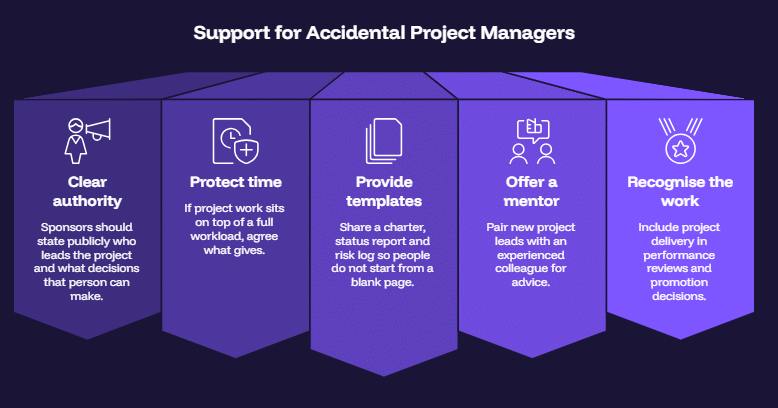
- Give clear authority. Sponsors should state publicly who leads the project and what decisions that person can make.
- Protect time. If project work sits on top of a full workload, agree what gives.
- Provide templates. Share a charter, status report and risk log so people do not start from a blank page.
- Offer a mentor. Pair new project leads with an experienced colleague for advice.
- Recognise the work. Include project delivery in performance reviews and promotion decisions.
How Do You Measure Whether the Training Works?
- Skill use: Do participants write charters, hold regular check-ins and keep risk logs?
- Delivery: Are projects led by trained participants delivered closer to plan on time, budget and scope?
- Stakeholder confidence: Do sponsors rate communication and predictability higher?
- Participant confidence: Do project leads report feeling better prepared?
- Retention and progression: Do participants take on larger projects or move into bigger roles?
Set baselines before training and compare against similar projects led without it.
How Can Leaders Build Project Skills Across the Organisation? A 5-Step Plan
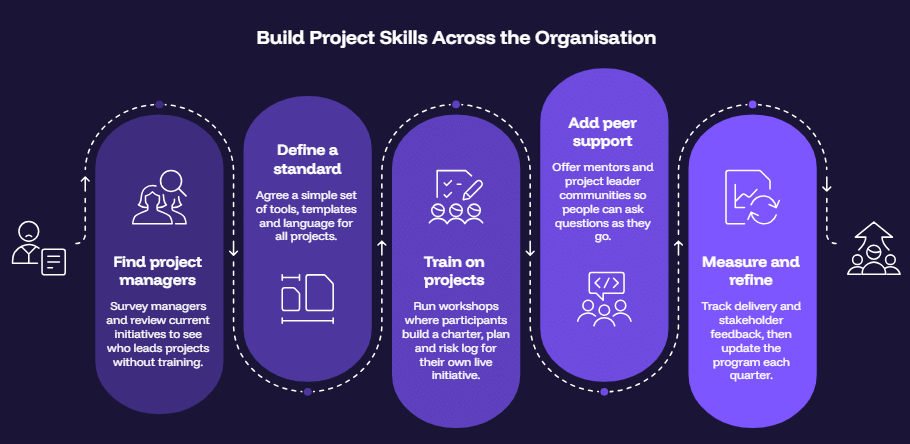
1. Find the accidental project managers
Survey managers and review current initiatives to see who leads projects without training.
2. Define a lightweight standard
Agree a simple set of tools, templates and language for all projects.
3. Train on real projects
Run workshops where participants build a charter, plan and risk log for their own live initiative.
4. Add coaching and peer support
Offer mentors and project leader communities so people can ask questions as they go.
5. Measure and refine
Track delivery and stakeholder feedback, then update the program each quarter.
Curious About Other Areas of Your Organization?
Explore our other free assessments and get a fuller picture of where you stand.
View All AssessmentsEbullient Solutions: Building Project Capability Across Your Organisation?
Ebullient partners with mid-size enterprises to build capability that lasts, from leadership and culture to team skills and AI readiness. We help HR leaders give the people who run projects the tools, confidence and support they need.
How Ebullient can support your project leaders
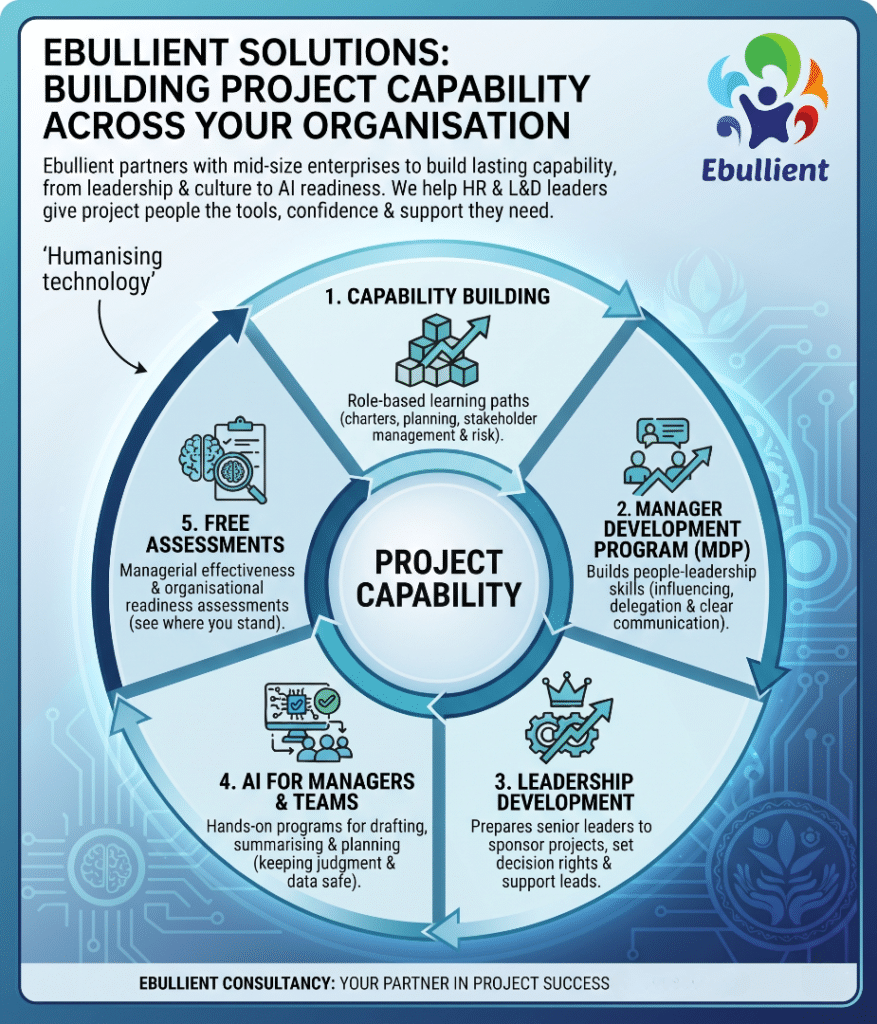
- Capability Building. Role-based learning paths that give managers and team leads practical project skills, from charters and planning to stakeholder management and risk.
- Manager Development Program (MDP). Builds the people-leadership skills behind project success, including influencing without authority, delegation and clear communication.
- Leadership Development. Prepares senior leaders to sponsor projects, set clear decision rights and support the people who lead them.
- AI for Managers and AI for Teams. Hands-on programs that show project leads how to use AI for drafting, summarising and planning, while keeping judgment and data safe.
- Free Assessments. Use our managerial effectiveness and organisational readiness assessments to see where your project capability stands today.
Book a call with Ebullient to discuss a tailored program.
Want to meet the team?
Start with a 30-min conversation. No commitment needed.
Frequently Asked Questions
What is an accidental project manager?
An accidental project manager is someone who leads projects without a project management title or formal training. They usually move into the role because they know the subject well, then learn planning, stakeholder management and delivery on the job.
What skills do accidental project managers need?
They need to define success, break work into tasks, estimate realistically, manage stakeholders, communicate clearly, track risks, lead without authority and control scope. A simple charter, task list and risk log cover most day-to-day needs.
Do accidental project managers need PMP certification?
Not necessarily. Practical skills and templates often matter more at the start. Certification such as PMP can help if someone plans a long-term career in project management, but many accidental project managers benefit most from short, applied training on their own projects.
How can I manage a project without formal authority?
Agree goals and decision rights with your sponsor, explain why the work matters, build relationships with contributors, keep updates transparent and escalate blockers early. Recognising people’s contributions publicly also strengthens cooperation when you cannot give orders.
How can companies train non-project managers?
Use short, practical workshops built around real projects, supply templates, pair participants with mentors and create a peer community. Combine this with manager support for time and authority, and measure results through delivery and stakeholder feedback.