

Executive presence is the way a leader’s clarity, composure, credibility and connection make people want to follow. Strategic storytelling is the practice of using a short, purposeful narrative to explain why a decision matters and what people should do next. Together they help leaders turn data and strategy into trust and action.
Most senior leaders already have the facts. What many lack is a way to make those facts land with employees, boards and clients who are busy, sceptical and short of attention.
Key Takeaways at the Glance
- Clarity, composure, credibility and connection that earn trust.
- It turns data and strategy into meaning and action.
- Employees trust organisations more than leaders to build trust, and trust in change is low.
- Situation, stakes, shift and step.
- Messages that sound generic and lose authenticity.
- Diagnose the gap, then build each leader’s own story bank.
Why Does Executive Presence Matter More in 2026?
Three pressures have raised the stakes for how leaders show up.
Constant change
Restructures, new technology and shifting markets mean leaders must explain change repeatedly. When people do not understand the reason, they fill the gap with worry.
Distance between data and people
Dashboards give leaders speed and precision, but they can also create distance. The Staffbase finding that many leaders notice friction late shows how easily the human picture goes missing.
More channels, less attention
Leaders now communicate through town halls, emails, chat, video and social platforms. Ketchum’s February 2026 research on what employees want from leaders in the AI era found that generations agree more than they differ, and that role and professional level often matter more than age. It also found that younger employees value listening and face-to-face conversation over flashy content.
Presence is not about performance. It is about the trust people place in the person speaking.
Source: ETB
Did You Know?
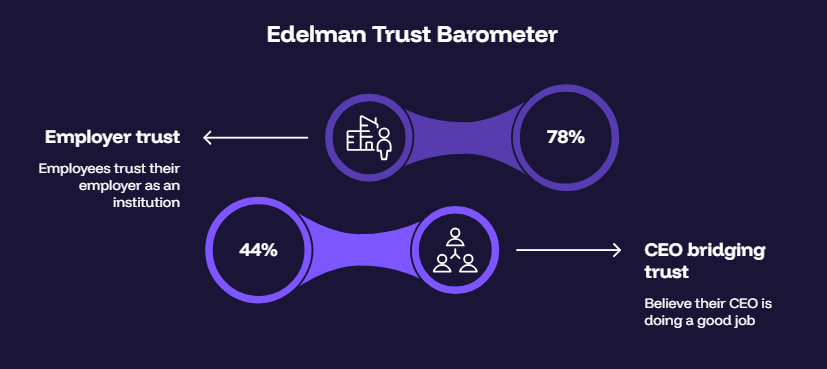
Employees trust the organisation more than they trust its leaders to build trust. The 2026 Edelman Trust Barometer, which surveyed nearly 34,000 people across 28 countries, found that 78% of employees trust their employer as an institution, yet only 44% believe their CEO is doing a good job of bridging internal trust divides, according to a February 2026 summary by Engagedly.
How Ready Is Your Organization for Transformation, Really?
Take our free 4-minute assessment and get a personalized report on your leadership fluency, governance, and workforce readiness.
Take the Free AI Readiness Assessment →What Is the Difference Between Presence, Charisma and Polish?
Often Mistaken For Presence | What Presence Actually Is |
Charisma and big personality | Being fully attentive and consistent with others |
Polished slides and speeches | Clear thinking and honest, plain language |
Speaking loudly or often | Knowing when to speak, listen and pause |
Appearing confident at all times | Staying calm and credible when uncertain |
Senior title | Trust earned through actions over time |
Presence is learnable. It can be observed, described and developed through practice and honest feedback, which is why it belongs in leadership development programs.
What Are the Four Pillars of Executive Presence?
Pillar | What It Means | Behaviours to Practise |
Clarity | People understand your message quickly | Lead with the point, use short sentences, name the decision or ask |
Composure | You stay steady under pressure | Slow your pace, pause before answering, manage tone in difficult moments |
Credibility | People believe you and trust your judgment | Back claims with evidence, admit what you do not know, follow through on commitments |
Connection | People feel heard and included | Listen actively, use names and real examples, ask questions and respond to concerns |
Storytelling supports all four. A good story makes the message clear, shows calm purpose, gives evidence a human face and invites connection.
Why Does Data Alone Not Persuade?
Data answers “what is happening”. People also need to know “why it matters” and “what does it mean for me”. A chart showing a 12% cost overrun tells a finance team something. It tells a plant supervisor or a sales manager very little until a leader links it to a real customer, a real risk or a real decision.
Narrative leadership closes that gap. Staffbase describes it as a way to move from explaining what the organisation is doing to explaining why it matters. When people understand the purpose behind a change, confusion and resistance tend to fall.
The best leaders pair both. They use data to show the problem is real and a story to show why it deserves attention.
Source: Gartner
Did You Know?
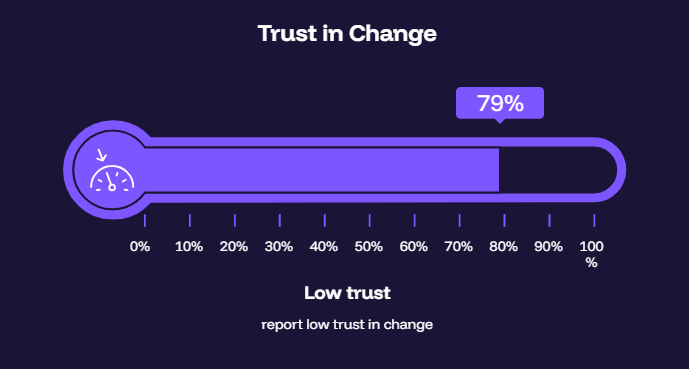
Trust in change is low. A Gartner survey of nearly 3,000 employees found that 79% report low trust in change. Leadership development firm Ariel Group notes that this kind of distrust builds one conversation at a time, especially when leaders enter high-stakes moments without preparation.
What Makes a Story Strategic?
A strategic story is not an anecdote told for entertainment. It has a job: to move people toward a decision or behaviour. Use these tests before you tell one.
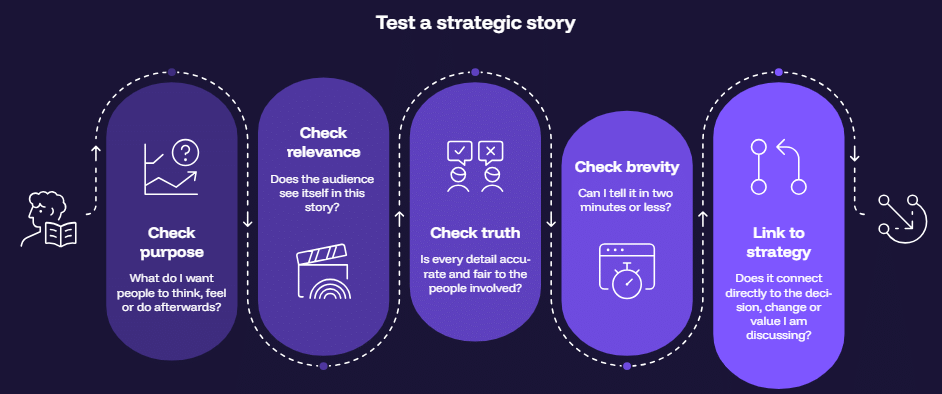
- Purpose: What do I want people to think, feel or do afterwards?
- Relevance: Does the audience see itself in this story?
- Truth: Is every detail accurate and fair to the people involved?
- Brevity: Can I tell it in two minutes or less?
- Link to strategy: Does it connect directly to the decision, change or value I am discussing?
What Is a Simple Structure for Business Storytelling?
Use a four-part structure that works for town halls, board meetings, client pitches and one-to-one conversations.
- Situation: Where we are. Set the scene in one or two sentences.
- Stakes: What is at risk or possible. Make the consequence real.
- Shift: What changed, what we learned or what we decided. This is the turning point.
- Step: What happens next and what you need from the audience.
Illustrative example (hypothetical). A regional head of operations must explain a new quality process to plant supervisors.
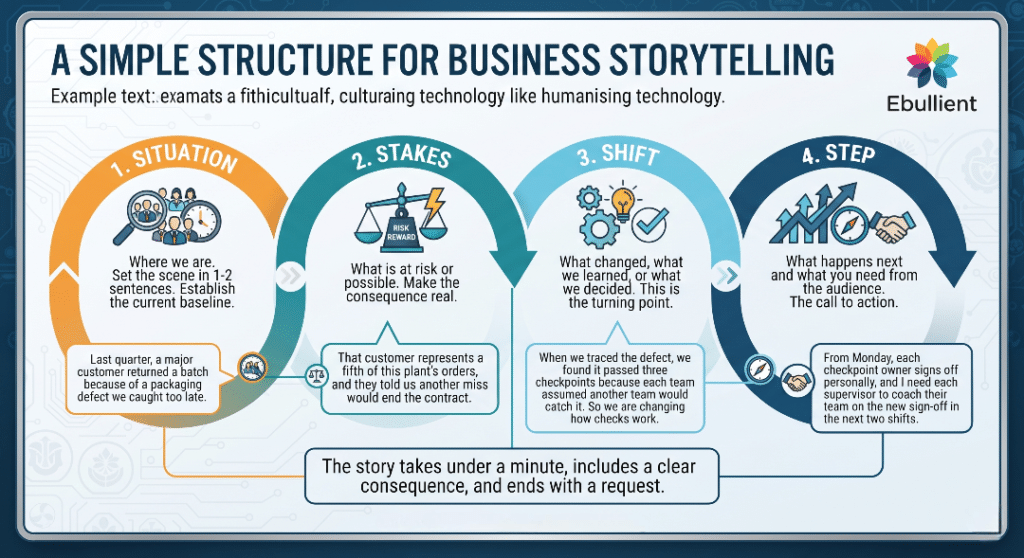
Situation: Last quarter, a major customer returned a batch because of a packaging defect we caught too late. Stakes: That customer represents a fifth of this plant’s orders, and they told us another miss would end the contract. Shift: When we traced the defect, we found it passed three checkpoints because each team assumed another team would catch it. So we are changing how checks work. Step: From Monday, each checkpoint owner signs off personally, and I need each supervisor to coach their team on the new sign-off in the next two shifts.
The story takes under a minute, includes a clear consequence and ends with a request.
When Should Leaders Use Storytelling?
- Announcing change: Explain why the change is needed and what stays the same.
- Setting strategy: Turn goals into pictures people can remember and repeat.
- Building culture: Illustrate values with real examples of good decisions.
- Giving feedback: Share a short example of what good looks like.
- Handling a setback: Acknowledge what happened, what was learned and what comes next.
- Persuading a board or client: Open with the human or commercial stakes before the numbers.
How Can Leaders Hold Presence in Difficult Conversations?
Difficult conversations test presence more than any speech. Ariel Group observes that when a leader stays present, calm and clear, others feel safer, while an unsettled leader makes people uneasy or defensive.
Practical habits include:
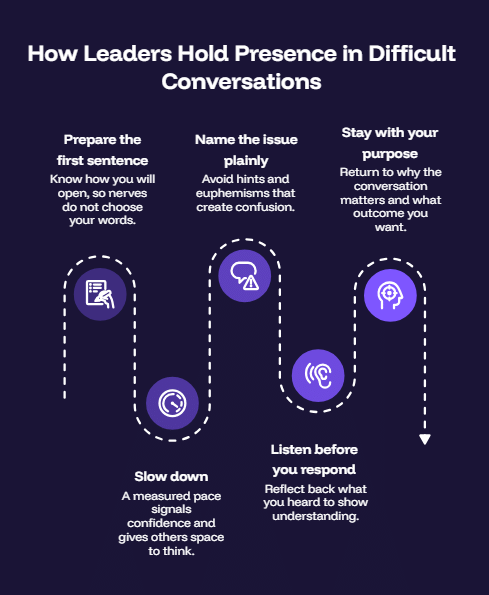
- Prepare the first sentence. Know how you will open, so nerves do not choose your words.
- Slow down. A measured pace signals confidence and gives others space to think.
- Name the issue plainly. Avoid hints and euphemisms that create confusion.
- Listen before you respond. Reflect back what you heard to show understanding.
- Stay with your purpose. Return to why the conversation matters and what outcome you want.
How Does Presence Work in Hybrid and Virtual Settings?
On video, small signals carry more weight. Keep your camera at eye level, look at the lens when you make key points, and remove distractions. Open with the point, because attention fades quickly on screen. Invite input early, and follow up in writing so remote colleagues are not left behind.
For important moments such as a restructure, a leadership change or a values discussion, consider meeting in person. Ketchum’s research highlights the value employees place on leaders who listen and show up face to face.
What Should Indian Leaders Consider?
Indian organisations often combine hierarchy, large teams, multiple languages and fast growth. Each shapes how a leader’s message is received.
- Hierarchy can mute feedback. Employees may not question a senior leader openly, so leaders should invite challenge and thank people who raise concerns.
- Plain language travels further. In multilingual teams, short sentences and concrete examples are easier to understand than polished jargon.
- Stories humanise authority. A short, honest story about a leader’s own mistake can reduce distance and build trust without lowering respect.
- Scale needs repetition. In large or dispersed workforces, one town hall will not reach everyone. Repeat core messages through managers and multiple channels.
- Promoter-led and family-run businesses may rely on founders’ personal credibility. Developing a wider group of leaders who can tell the company’s story protects continuity.
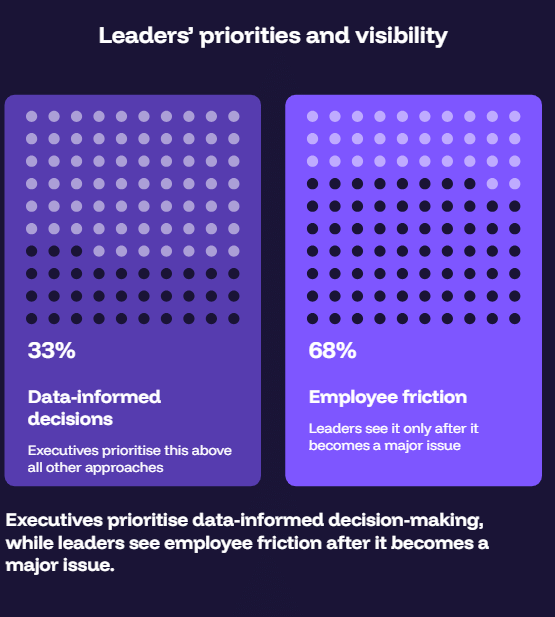
Source: Staffbase
Did You Know?
Leaders see problems late. A Staffbase analysis of the “Executive Priorities for the Next Digital Workplace Era” survey found that 33% of executives prioritise data-informed decision-making above all other approaches, and 68% of leaders say they see employee friction only after it becomes a major issue. Staffbase argues that narrative leadership can help close that visibility gap.
The Organizational Transformation Checklist Free guide, instant download.
Get the Guide →What Mistakes Weaken Executive Presence and Storytelling?
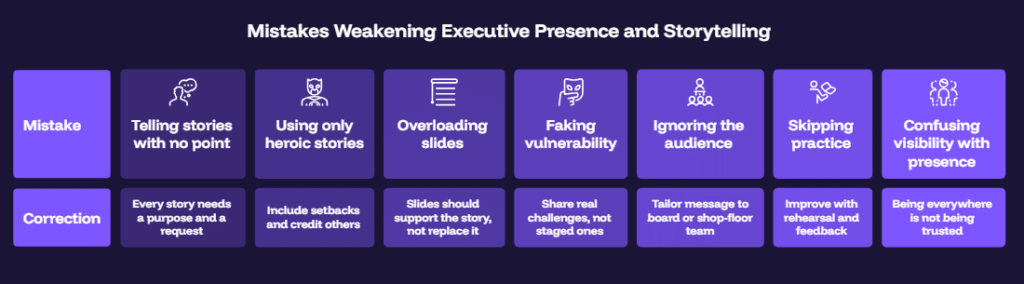
- Telling stories with no point. Every story needs a purpose and a request.
- Using only heroic stories. Stories about the leader’s own success can alienate. Include setbacks and credit others.
- Overloading slides. Slides should support the story, not replace it.
- Faking vulnerability. Share real challenges, not staged ones.
- Ignoring the audience. What moves a board differs from what moves a shop-floor team.
- Skipping practice. Presence improves with rehearsal and feedback, not with inspiration alone.
- Confusing visibility with presence. Being everywhere is not the same as being trusted.
How Leaders Build an Executive Presence Program? A 5-Step Approach
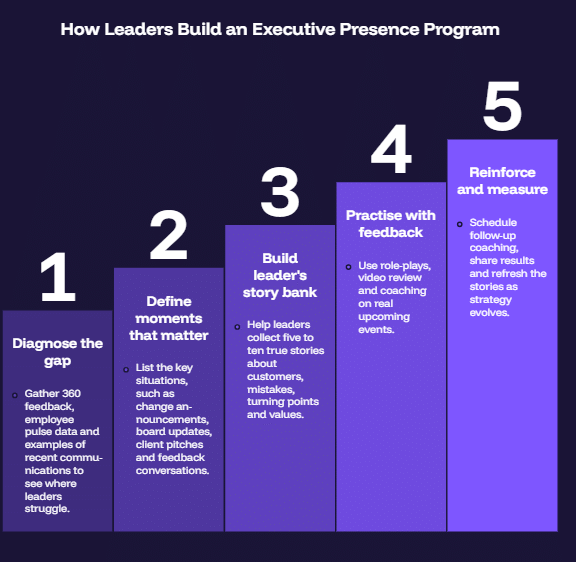
- Diagnose the gap. Gather 360 feedback, employee pulse data and examples of recent communications to see where leaders struggle.
- Define the moments that matter. List the key situations, such as change announcements, board updates, client pitches and feedback conversations.
- Build each leader’s story bank. Help leaders collect five to ten true stories about customers, mistakes, turning points and values.
- Practise with feedback. Use role-plays, video review and coaching on real upcoming events.
- Reinforce and measure. Schedule follow-up coaching, share results and refresh the stories as strategy evolves.
Curious About Other Areas of Your Organization?
Explore our other free assessments and get a fuller picture of where you stand.
View All AssessmentsEbullient Solutions: Leadership Programs That Build Presence and Influence
Ebullient partners with mid-size enterprises to build leadership and capability that last. Our programs help leaders communicate with clarity, tell stories that move people and earn trust during change.
How Ebullient can support your leaders
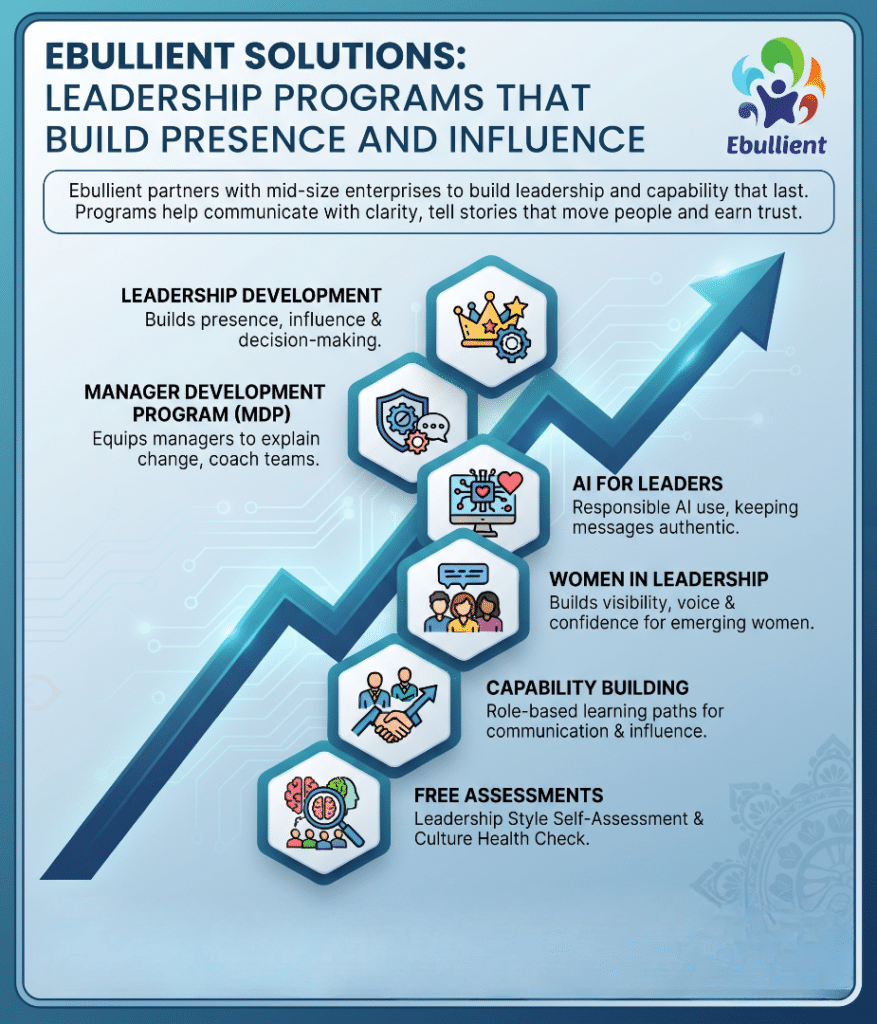
- Leadership Development. Programs that build presence, influence and decision-making for senior and emerging leaders.
- Manager Development Program (MDP). Equips managers to explain change, hold difficult conversations and coach their teams.
- AI for Leaders. Helps leaders use AI tools responsibly while keeping their message authentic and human.
- Women in Leadership. Builds visibility, voice and confidence for emerging women leaders.
- Capability Building. Role-based learning paths that develop communication and influence across levels.
- Free Assessments. Start with our Leadership Style Self Assessment and Culture Health Check to see where your leaders stand today.
Book a call with Ebullient to discuss a tailored executive presence and storytelling program.
Want to meet the team?
Start with a 30-min conversation. No commitment needed.
Frequently Asked Questions
What is executive presence?
Executive presence is the combination of clarity, composure, credibility and connection that makes people trust and follow a leader. It shows up in how leaders speak, listen and behave under pressure, and it can be developed through practice and feedback.
Why is storytelling important for leaders?
Stories give strategy and data human meaning. They help people understand why a decision matters, remember the message and feel motivated to act. Research summaries on narrative leadership suggest that explaining purpose reduces confusion and resistance during change.
Can executive presence be taught?
Yes. Presence is a set of observable behaviours, such as how you open a conversation, handle silence, listen and respond to challenge. Leaders improve through deliberate practice, honest feedback and coaching rather than through personality alone.
How long should a business story be?
Most business stories work best at one to two minutes. Keep them focused on a clear situation, the stakes, the turning point and the next step. Longer stories lose attention, especially in virtual meetings.
How do you measure the impact of executive presence training?
Compare 360-degree feedback, team trust and engagement pulses, message recall and action rates before and after training. Add manager observation of difficult conversations, and review results at 90 days and 12 months.