
Psychological safety is the shared belief that a team is safe for interpersonal risk-taking. Employees can ask questions, admit mistakes, disagree and raise concerns without fear of embarrassment or punishment. Harvard researcher Amy Edmondson introduced the concept, and it is a core condition for learning, quality and innovation in teams.
Psychological safety does not mean comfort, constant agreement or low standards. It means people can tell the truth about work early enough for the team to act on it.
Key Takeaways
A shared belief that people can speak up without fear of punishment or embarrassment.
AI adoption, hybrid work and constant change all depend on honest, early feedback.
45% of surveyed UK employees feel unsafe raising mistakes or risks.
Leaders and managers, through daily behaviours.
Anonymous pulse surveys plus behaviour and outcome indicators.
Baseline survey, then leader training on inviting input and closing the loop.
Why Does Psychological Safety Matter More in 2026?
Three shifts have raised the stakes.
AI adoption depends on human judgment
MHFA England’s chief executive noted that organisations cannot afford employees who are too afraid to speak up when they spot errors in an era of rapid AI adoption. People must challenge outputs, flag risks and admit when a tool produced something wrong.
Hybrid work hides weak signals
Remote and hybrid teams lose hallway conversations and body language. If people stay silent in meetings, leaders may never learn about problems until they grow.
Change arrives continuously
Teams that face frequent restructures and new tools need honest feedback to adapt. Silence slows every change program.
Research on team performance, including Google’s Project Aristotle, has pointed to psychological safety as a leading factor in effective teams.
How Managerially Effective Is Your Organization, Really?
Take our free 4-minute assessment and get a personalized report on your leadership fluency, governance, and workforce readiness.
Take the Free AI Readiness Assessment →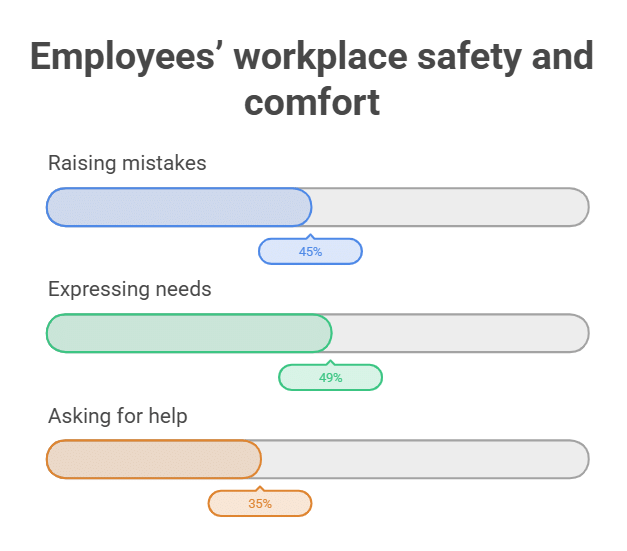
Source: MHFAE
Did You Know?
Nearly half of employees hold back. New 2026 research from Mental Health First Aid England, covering 2,000 UK working adults, found that 45% do not feel safe raising mistakes or risks, 49% are not comfortable expressing their needs, and 35% do not feel safe asking for help. Another 15% admitted making mistakes because they felt unable to speak up.
What Does Psychological Safety Look Like and What Does It Not?
What It Is | What It Is Not |
People raise problems early | People never face disagreement |
Mistakes become learning points | Mistakes carry no consequences |
Challenge is welcome and respectful | Everyone must agree or stay polite |
High standards with open dialogue | Lowered expectations |
Leaders ask questions and listen | Leaders avoid difficult conversations |
Feedback flows in every direction | Only managers give feedback |
The distinction matters because leaders sometimes resist the idea, assuming it means softness. The best teams combine high standards with high safety.
Why Do Employees Stay Silent?
Silence is rarely random. It follows patterns that leaders can recognise.
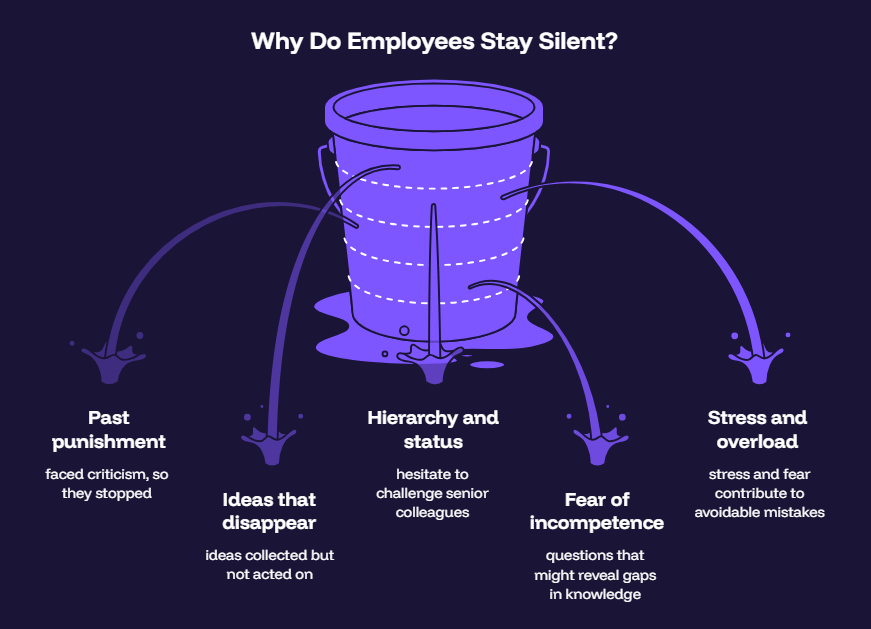
Past punishment
Someone raised a concern once and faced criticism, so they stopped.
Ideas that disappear
The Forrester study found that half of employees see ideas collected but not acted on. People stop contributing when nothing happens.
Hierarchy and status
Junior employees may hesitate to challenge senior colleagues, especially in hierarchical workplace cultures.
Fear of looking incompetent
People avoid asking questions that might reveal gaps in knowledge.
Stress and overload
MHFA England found that stress and fear contribute to avoidable mistakes.
The Manager Effectiveness Framework Free guide, instant download.
Get the Guide →What Warning Signs Should Leaders Watch For?
- Meetings dominated by a few voices while others stay quiet
- Problems that surface only when they become urgent
- Few questions or dissenting views in project reviews
- Repeated mistakes that nobody discussed earlier
- Low scores on survey items about speaking up
- Exit interviews that mention fear, blame or not being heard
Treat these signals as data about the environment, not as proof that individuals lack courage.
Source: FC
Did You Know?
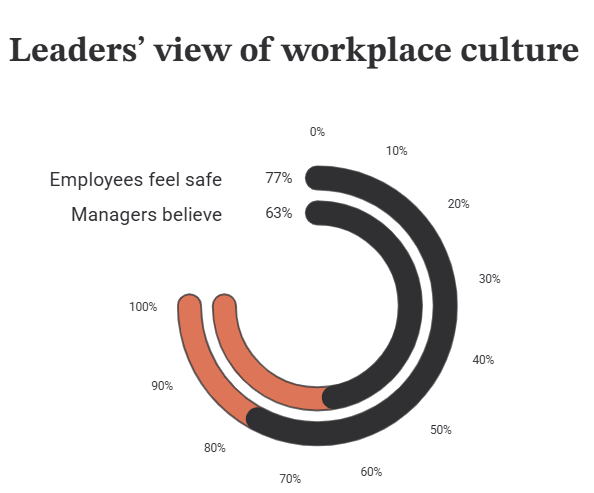
Leaders may misread their own culture. A Forrester Consulting study for SafetyCulture, published in April 2026, found that 77% of UK frontline employees feel safe to speak up, yet only 63% of senior managers believed their workers felt that way. The same study found that about half of employees say their leaders act on ideas, while the other half only collect them.
Which Manager Behaviours Build Psychological Safety?
Managers shape psychological safety through everyday actions more than through policy statements. Training should teach six behaviours.
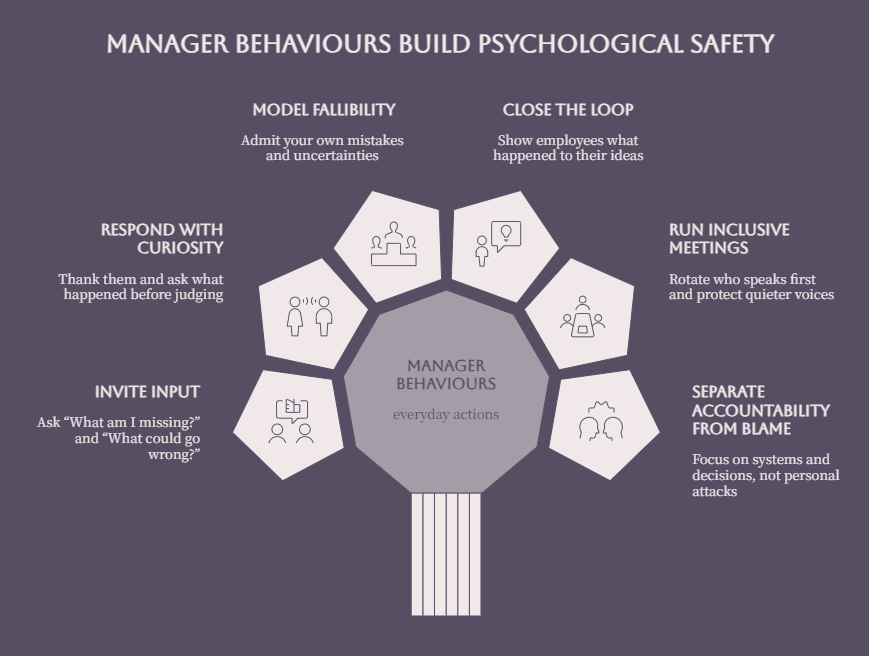
- Invite input directly. Ask “What am I missing?” and “What could go wrong?” rather than “Any questions?”
- Respond with curiosity. When someone raises a problem or admits an error, thank them and ask what happened before judging.
- Model fallibility. Admit your own mistakes and uncertainties so others see that it is acceptable.
- Close the loop. Show employees what happened to their ideas, including when you decide not to act and why.
- Run inclusive meetings. Rotate who speaks first, use written input before discussion and protect quieter voices.
- Separate accountability from blame. Hold people responsible for results and learning while focusing on systems and decisions, not personal attacks.
See how we help build this into your organization.
Explore Adaptive Management Excellence Training Programs →
What Should Organisations in India Keep in Mind?
Many Indian workplaces combine fast growth, large teams and strong respect for seniority. Respect is a strength, but it can also discourage junior colleagues from questioning decisions or reporting problems to senior leaders.
Leaders can respond by making speaking up an explicit expectation. They can hold small-group discussions before large meetings, invite written input and thank people publicly for raising issues early. Training programs that include senior leaders, not only junior staff, show that responsibility for safety sits at the top.
How Can Leaders Build Psychological Safety? A 5-Step Plan
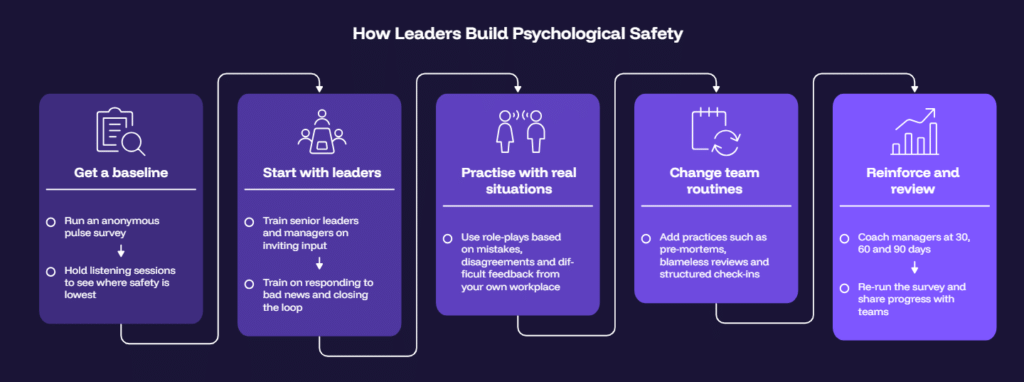
1. Get a baseline
Run an anonymous pulse survey and hold listening sessions to see where safety is lowest.
2. Start with leaders
Train senior leaders and managers on inviting input, responding to bad news and closing the loop.
3. Practise with real situations
Use role-plays based on mistakes, disagreements and difficult feedback from your own workplace.
4. Change team routines
Add practices such as pre-mortems, blameless reviews and structured check-ins.
5. Reinforce and review
Coach managers at 30, 60 and 90 days, re-run the survey and share progress with teams.
Source: NPF
Did You Know?
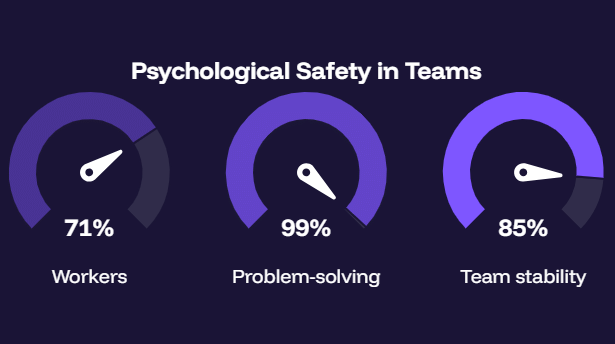
Safe teams solve problems and stay together. A March 2026 survey by the Nowe Przestrzenie Foundation in Poland found that 71% of workers did not feel psychologically safe in their teams. In high-safety teams, 99% of respondents said they could solve problems constructively and 85% described their teams as stable.
Curious About Other Areas of Your Organization?
Explore our other free assessments and get a fuller picture of where you stand.
View All AssessmentsEbullient Solutions: Training That Builds Speak-Up Cultures?
Ebullient Consultancy helps leaders create workplaces where people can raise concerns early, learn from mistakes and perform at their best. We work with leaders and managers on the daily behaviours that shape team culture, and we tailor every program to your organisation.
What we offer
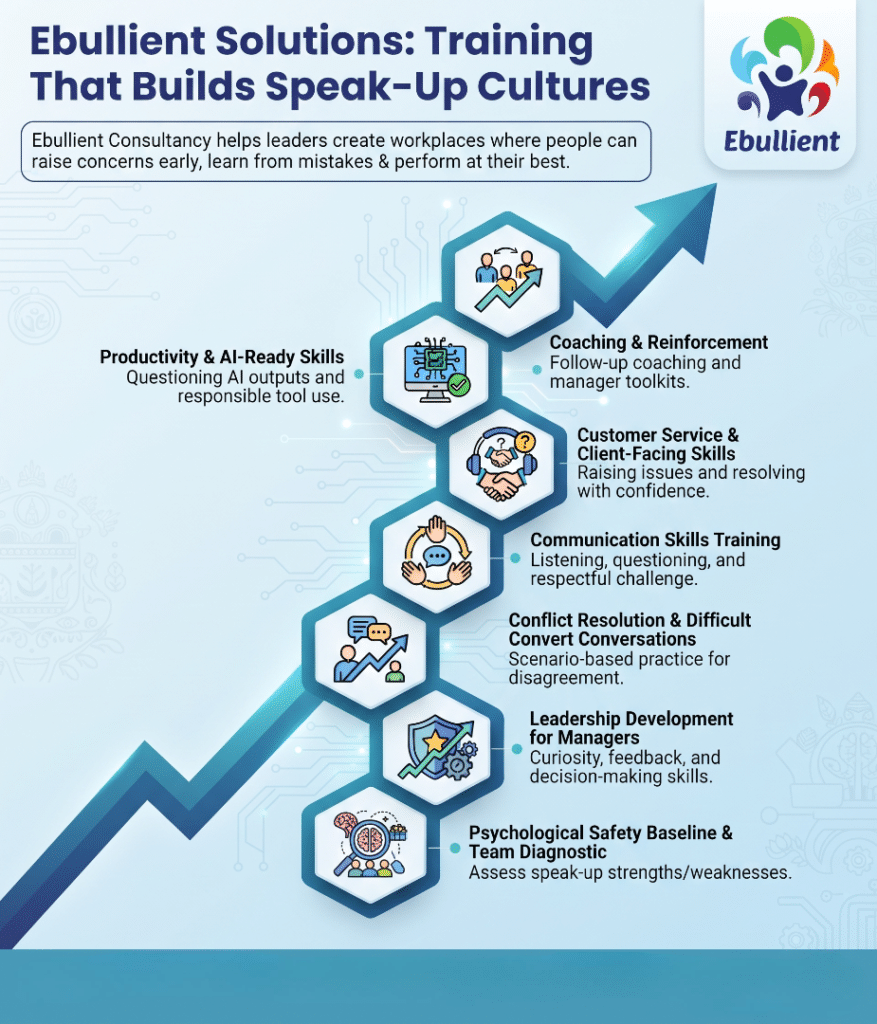
- Psychological Safety Baseline and Team Diagnostic. We assess where speaking up is strongest and weakest, using anonymous surveys and listening sessions.
- Leadership Development for Managers and Senior Executives. Programs that build curiosity, feedback and decision-making skills.
- Conflict Resolution and Difficult Conversations. Scenario-based practice for disagreement, escalation and performance discussions.
- Communication Skills Training. Workshops that strengthen listening, questioning and clear, respectful challenge.
- Customer Service and Client-Facing Skills. Programs that help front-line teams raise issues and resolve them with confidence.
- Productivity and AI-Ready Skills. Sessions that help teams question AI outputs and use new tools responsibly.
- Coaching and Reinforcement. Follow-up coaching, peer cohorts and manager toolkits that make new habits stick.
Contact Ebullient Consultancy for a culture conversation and a tailored program proposal.
Want to meet the team?
Start with a 30-min conversation. No commitment needed.
Frequently Asked Questions
What is psychological safety in the workplace?
Psychological safety is the shared belief that a team is safe for taking interpersonal risks, such as asking questions, admitting mistakes or disagreeing. Employees expect respect, not punishment or humiliation, when they speak up.
Why is psychological safety important for team performance?
Teams find problems earlier, learn from mistakes and share ideas when people feel safe. Research on effective teams, including Google’s Project Aristotle, identifies psychological safety as a leading factor. Silence lets small issues grow into costly failures.
How can managers build psychological safety?
Managers can invite input directly, respond with curiosity to bad news, admit their own mistakes, close the loop on ideas, run inclusive meetings and focus on learning rather than blame. Consistent behaviour matters more than a single announcement.
Does psychological safety mean lower standards?
No. High-performing teams combine high standards with high safety. People can disagree, challenge ideas and own mistakes openly, which helps the team reach better results. Safety removes fear, not accountability.
How long does it take to build psychological safety?
Small shifts can appear within weeks when managers change daily behaviours, but lasting change usually takes several months of consistent practice. Trust builds slowly and breaks quickly, so leaders must respond well to the first difficult conversations.