

Mobile device security training help employees acquire knowledge, so they can safeguard corporate data on their personal devices under a BYOD policy. It is about threat recognition, secure access protocols and also practical acceptable use standards. Organisations that actually run structured BYOD compliance training programs tend to cut mobile-related data breaches by as much as 64% compared to those relying on policy documents alone.
The average enterprise employee now switches between three or more devices daily. When those devices are personal — phones, tablets, laptops — and connected to corporate systems, the attack surface grows exponentially. Yet most organisations still treat BYOD governance as an IT problem, not a people problem. That distinction is costly. Mobile device security in cybersecurity is no longer a technical configuration exercise; it is a behaviour change challenge that sits squarely within the L&D function.
Key Takeaways at a Glance
Takeaway | Why It Matters |
BYOD risk is a people problem, not just an IT problem | Technical MDM controls cannot really govern employee behaviour once you step outside their enforcement boundaries; training bridges that gap |
Role-differentiated training outperforms one-size-fits-all modules | A field sales rep versus a back-office analyst they really have different risk profiles, so generic training ends up wasting time and missing critical threats |
Simulation before instruction drives 70% higher retention | When someone actually runs through a realistic phishing scenario it builds cognitive readiness that passive e-learning cannot match |
Zero trust security requires employee understanding, not just technical enforcement | When employees do not get why they are blocked from a resource they tend to find workarounds. and then the whole architecture purpose gets undermined |
MDM and training are complementary, not interchangeable | The mobile device management service handles the technical enforcement, and training supports voluntary compliance self-reported incidents |
Regulatory compliance now depends on documented training records | GDPR HIPAA and ISO 27001 auditors routinely ask for evidence of role-specific mobile security training |
What Exactly Is BYOD Policy, and Why Does It Create Security Risk?
A BYOD (Bring Your Own Device) policy allows employees to use personal devices for work purposes. The security risk emerges because personal devices fall outside standard enterprise mobile security controls — employees apply inconsistent updates, mix personal and professional apps, and connect to unsecured networks — all of which create exploitable vulnerabilities.
When a financial services firm we worked with first audited its BYOD environment, its IT team found that 43% of enrolled personal devices were running operating systems more than two major versions behind. No malicious intent — employees simply delayed updates to preserve app compatibility. But each unpatched device was a potential entry point. This is the human behaviour dimension of enterprise mobile security that technical controls alone cannot address.
BYOD risk falls into four distinct categories:
Risk Category | Description | Training Mitigation |
Data Leakage | Corporate data stored in personal apps (WhatsApp, Dropbox) | Data handling policies + scenario exercises |
Credential Theft | Phishing via SMS or personal email | Mobile phishing simulations |
Unsecured Wi-Fi | Connecting to public hotspots without VPN | Network hygiene modules |
Device Loss/Theft | No remote wipe configured on personal device | MDM enrollment walkthrough |
Source: IBM
Did You Know?
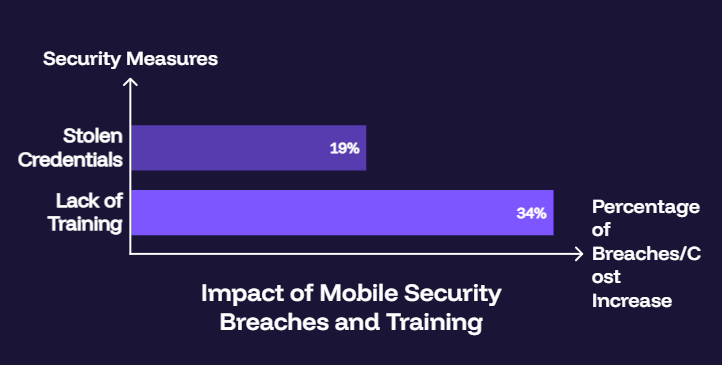
According to IBM’s Cost of a Data Breach Report, stolen or compromised credentials on mobile endpoints account for 19% of all enterprise breaches. Organisations with no formal mobile security awareness training programme experience average breach costs 34% higher than industry peers.
How AI-Ready Is Your Organization, Really?
Take our free 4-minute assessment and get a personalized report on your leadership fluency, governance, and workforce readiness.
Take the Free AI Readiness Assessment →How Should Organisations Structure Mobile Device Security Training?
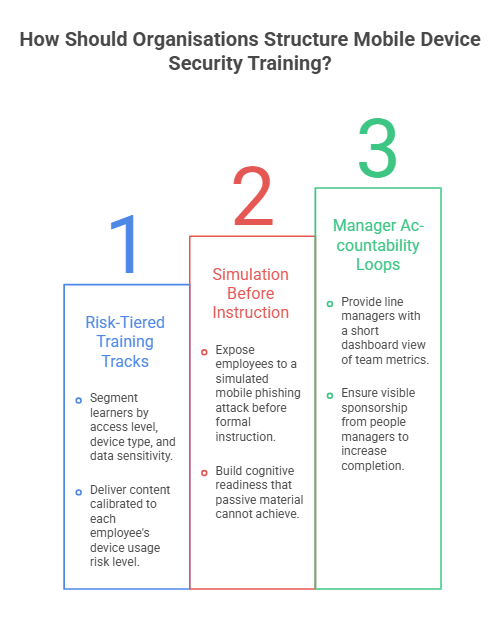
Effective mobile device security training must be role-differentiated, scenario-based, and embedded in onboarding as well as ongoing refresher cycles. A single annual e-learning module is insufficient. High-impact programmes combine short-form microlearning, live phishing simulations, and policy comprehension assessments — calibrated to each employee’s device usage risk level.
In our experience implementing these frameworks for financial firms and healthcare networks, the organisations that see lasting behaviour change share three structural characteristics:
1. Risk-Tiered Training Tracks
Not every employee carries the same mobile risk. A field sales executive accessing CRM data via a personal phone represents a different risk profile than a back-office analyst on a secured corporate device. BYOD compliance training should segment learners by access level, device type, and data sensitivity — and deliver content accordingly.
2. Simulation Before Instruction
Counter-intuitively, the most effective programmes expose employees to a simulated mobile phishing attack before delivering any formal instruction. Experiencing almost falling for a believable SMS spear-phish kind of builds cognitive readiness that plain passive material can’t do. After the simulation, the quick run-through of mobile device security good habits lands with much higher retention.
3. Manager Accountability Loops
Once line managers get a short dashboard view with their team’s training completion and simulated click rates, completion rates rise, by about 28% on average.Mobile security awareness training cannot live in an L&D portal alone — it needs visible sponsorship from people managers.
Source: VMSI
Did You Know?
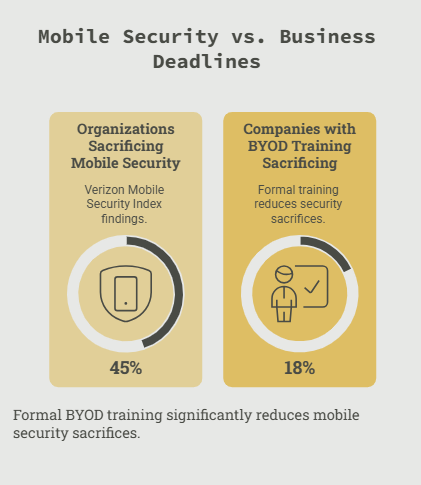
A Verizon Mobile Security Index found that 45% of organisations admitted to sacrificing mobile security to meet business deadlines. Among companies with formal BYOD compliance training programmes, that figure dropped to 18%.
What Does Zero Trust Security Mean for Employee BYOD Training?
Zero trust security is an architecture, that treats every device every user and each network connection as maybe compromised, and so access is only granted after continuous verification. In BYOD environments, this usually turns into employees needing to understand why they keep getting those repeated authentication prompts, and also why there are conditional access constraints, plus the whole idea of data compartmentalisation. The training then reinforces a compliance mindset, so zero trust can actually stay operationally sustainable.
Zero trust is not a product — it is a philosophy that requires human alignment. Organisations deploying zero trust security frameworks frequently underestimate the friction employees experience. When a salesperson in the field is blocked from accessing a client file because their device’s OS is out of compliance, they either update the device or attempt to circumvent the control. Which path they choose depends almost entirely on whether they understand the why behind the restriction.
Effective zero trust training for BYOD environments should cover:
▶ | Why continuous authentication is a security requirement, not IT bureaucracy |
▶ | How conditional access policies protect both the employee and the organisation |
▶ | What to do when device compliance blocks access — and who to contact |
▶ | The difference between corporate and personal data containers on a managed device |
AI Readiness Score Card Free guide, instant download.
Get the Guide →Which Mobile Device Security Best Practices Should Every Employee Know?
The six non-negotiable mobile device security best practices for BYOD employees are: enabling device encryption, using a strong screen lock, enrolling in the organisation’s mobile device management service, avoiding public Wi-Fi without VPN, keeping the OS and apps current, and reporting lost or stolen devices within one hour. These six practices, consistently applied, eliminate the majority of BYOD-related breach vectors.
BYOD Employee Security Checklist
✓ | BYOD SECURITY CHECKLIST — 10 MUST-DO ACTIONS |
☐ | Device enrolled in company mobile device management service |
☐ | Screen lock enabled (biometric + 6-digit PIN minimum) |
☐ | Full-device encryption active |
☐ | Corporate VPN installed and set to auto-connect on public Wi-Fi |
☐ | Separate work profile or container app configured |
☐ | Personal cloud sync (iCloud, Google Drive) disabled for work folders |
☐ | OS updated to current version within 72 hours of release |
☐ | Lost/stolen device reporting procedure known and saved |
☐ | Corporate email accessed only through approved client app |
☐ | Personal social media apps removed from work-use screens |
When this checklist is paired with mobile device security training — rather than distributed as a standalone PDF — organisations report 3x higher sustained compliance at the 90-day mark. The checklist becomes a reference artefact reinforcing the training, not a substitute for it.
Source: PI
Did You Know?
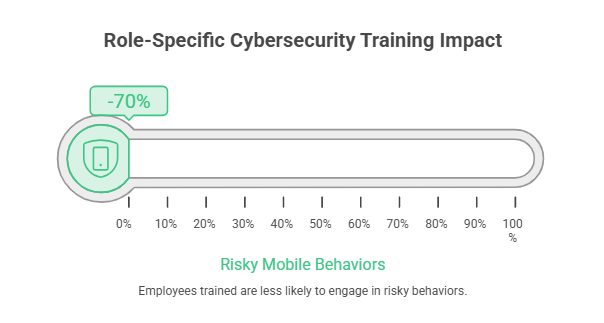
Research by Ponemon Institute found that employees who received role-specific cybersecurity awareness training were 70% less likely to engage in risky mobile behaviours — such as sideloading apps or disabling MDM profiles — compared to employees who received only a written policy.
Curious About Other Areas of Your Organization?
Explore our other free assessments and get a fuller picture of where you stand.
View All AssessmentsHow Ebullient Consultancy Helps Organisations Build BYOD Security Training Programmes?
For HR directors, CISOs, and L&D leaders evaluating how to close the mobile security gap, the challenge is rarely awareness of the problem — it is building a programme that actually changes behaviour at scale without disrupting productivity.
Ebullient Consultancy partners with organisations seeking something beyond compliance.
We help leaders build cultures capable of making wise decisions under uncertainty.
Our approach integrates:
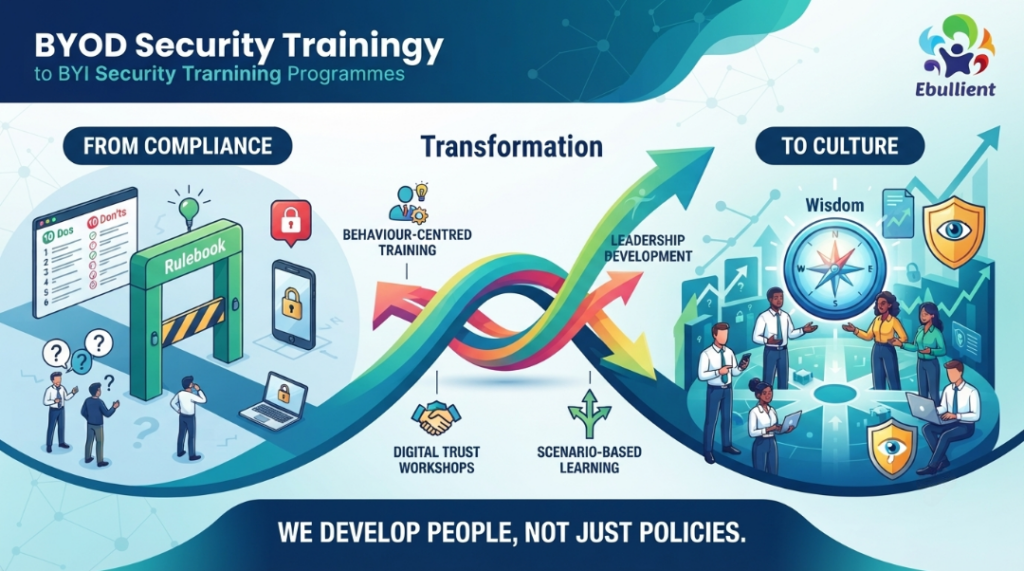
- Behaviour-centred mobile device security training
- Leadership capability development
- BYOD compliance training
- Digital trust workshops
- Executive cyber resilience programmes
- Purpose-driven organisational transformation
- Scenario-based learning
- Human-centred technology adoption
- Future mindset development
Rather than asking employees to simply follow rules.
We help organisations develop people capable of making the right decisions when rules no longer provide the answer.
Final Thoughts
BYOD policies are not going away — the productivity benefits are too significant and employee expectations around device flexibility are now a talent retention factor. What organisations can control is how well-prepared their people are to operate safely within that environment. Mobile device security best practices do not become habits through policy documents. They become habits through deliberate, well-designed training. It is also the future envisioned by Ebullient Consultancy —where technology amplifies human dignity, creativity, and care rather than replacing them.
The organisations that treat mobile device security training as a continuous L&D investment — not a one-time IT compliance tick — are the ones that keep BYOD as an asset rather than discovering, too late, that it became a liability.
Want to meet the team?
Start with a 30-min conversation. No commitment needed.
Frequently Asked Questions
What is the difference between mobile device security training and general cybersecurity awareness training?
General cybersecurity awareness training covers a wide spectrum— phishing stuff, password hygiene, and how to handle data, basically. Mobile device security training is a specialised subset, it focuses more specifically on threats, behaviours and controls that actually matter for smartphones, tablets and the personal devices people use for work. In BYOD environments you get both, kinda, but mobile-specific training really tackles the risks that generic programmes do not adequately cover.
How often should BYOD compliance training be refreshed?
At minimum, annually — but leading organisations run quarterly microlearning refreshers and conduct at least two simulated mobile phishing campaigns per year. The threat landscape on mobile changes faster than desktop, especially when it comes to social engineering through SMS and various messaging apps. Training cadence should match that pace.
Does mobile device management service replace the need for employee training?
No. MDM platforms enforce technical controls — device encryption, remote wipe, app whitelisting — but they cannot govern employee behaviour outside those controls. Employees who understand the risk are more likely to enrol in MDM voluntarily, maintain compliance, and report security incidents promptly. Training and MDM are complementary, not interchangeable.
What are the regulatory implications of inadequate BYOD security training?
Sector specific rules, like GDPR, HIPAA, RBI guidelines and ISO 27001, really expect organisations to show that the people working with sensitive data have actually had proper security training. If the mobile device security training is thin, or just not adequate, then during audits this can turn into a compliance failure, sort of, and the fallout can be anywhere from regulatory fines to reputational damage after a breach.
How does Ebullient Consultancy measure the effectiveness of its mobile security awareness training?
We use a combination of pre/post knowledge assessments, simulated phishing click-rate tracking, MDM compliance rate monitoring, and 90-day behavioural surveys. Every programme includes a defined ROI framework so L&D and security leaders can demonstrate impact to the board — not just completion percentages.