

Conflict Resolution and Customer Service Skills are the combined practices—active listening, root cause analysis, negotiation, and service recovery—that help online businesses turn complaints into loyalty. Companies that train teams systematically see faster resolution, higher CSAT, and measurably lower churn within two to three quarters.
Key Takeaways at a Glance
Key Insight | Business Value |
Conflict resolution and customer service skills must be trained together | Produces agents who are diagnostically and interpersonally effective |
Fast, single-interaction resolution is a stronger loyalty driver than discounts | Improves customer satisfaction improvement while lowering cost |
Root cause analysis must feed back into product and policy teams | Prevents recurring complaints and reduces long-term ticket volume |
Emotional labor management prevents agent burnout | Protects service quality and reduces costly attrition |
Metrics should be tracked together, not in isolation | Prevents gaming speed at the expense of resolution quality |
Every online business eventually faces the same moment: a customer is angry, a ticket is escalating, and the response in the next five minutes decides whether that person stays or leaves a public review costing ten more customers. This is where Conflict Resolution and Customer Service Skills stop being a soft-skill line item and become a revenue-protection function.
Digital-first companies operate without the buffer of face-to-face rapport. An agent providing online business customer support has text, tone, and timing—nothing else—to de-escalate frustration. When Conflict Resolution and Customer Service Skills are underdeveloped, small issues snowball into churn and brand damage within hours.
We have seen this pattern across e-commerce, SaaS, BFSI, and healthcare clients: businesses that treat conflict resolution as a trained, measurable capability consistently outperform those that leave it to individual agent instinct.
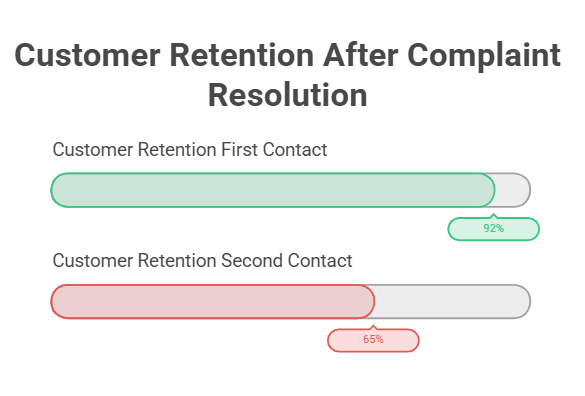
Source: CodeLucky
Did You Know?
Businesses that resolve a complaint on the first contact retain up to 92% of the affected customers, while a second follow-up contact drops retention below 65%, according to aggregated support-industry benchmarking studies.
What Is Conflict Resolution and Customer Service Skills?
Conflict Resolution and Customer Service Skills are those organized skillsets—active listening, emotional intelligence, negotiation, and problem-solving—that help support teams to de-escalate disputes and actually fix complaints without completely wrecking the customer relationship. In practice, they act as the operational backbone of customer experience for online businesses.
Conflict resolution in customer service is the process of identifying the real source of a complaint and reaching an outcome the customer perceives as fair. Customer service skills are the delivery mechanism—tone, clarity, empathy, and speed—that make that process feel human rather than scripted.
In our experience implementing these frameworks across mid-market and enterprise support teams, organizations that separate these two disciplines in training tend to underperform. Agents need diagnostic skill and interpersonal skill simultaneously, in the same conversation.
Why Is Conflict Resolution and Customer Service Skills Important?
Conflict Resolution and Customer Service Skills directly influence retention, reputation, and revenue. Online businesses lose customers faster than physical retailers when disputes go unresolved, because switching costs are lower and public reviews are more visible.
There is no floor manager who can quietly step in when an online conversation goes wrong—the agent is the brand. A poorly handled complaint becomes a screenshot or a one-star review within the hour.
Strong skills also protect margins. Resolving issues in a single interaction cuts repeat contacts and support costs. Effective service recovery reduces chargebacks and refund abuse, and customer conflict resolution examples handled well often convert an unhappy customer into a more loyal one, a pattern well documented in Harvard Business Review’s research on service recovery.
Across multiple customer service improvement projects, we have found leadership underestimates how much unresolved conflict quietly erodes customer lifetime value before churn appears in the numbers.
How Ready Is Your Organization for Transformation, Really?
Take our free 4-minute assessment and get a personalized report on your leadership fluency, governance, and workforce readiness.
Take the Free AI Readiness Assessment →What Challenges Do Organizations Face?
Organizations often run into uneven agent training, and then the whole support workflow feels sort of split, like the ticket management systems are fragmented, plus the escalation paths are unclear. On top of that theres no real way to measure what “good” resolution should look like, not in any measurable way. All of this stacks up fast in high volume online support environments.
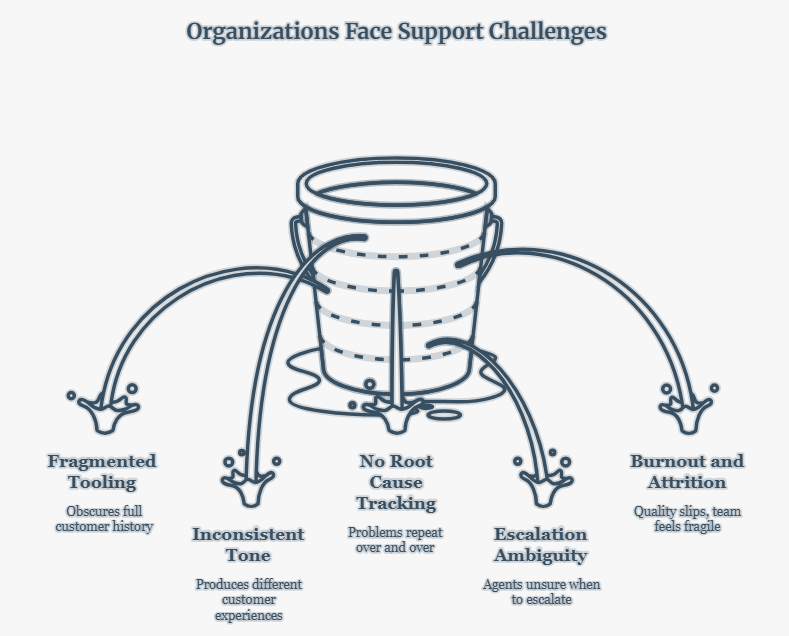
- Fragmented tooling: Tickets, chat, email, and social DMs sit in separate systems, obscuring full customer history.
- Inconsistent tone: Agents improvise, producing wildly different experiences for the same complaint type.
- No root cause tracking: complaints just get closed without any real analysis, so the same problems come back again and again.
- Escalation ambiguity: Agents don’t always know when they should pull in a supervisor or keep working solo.
- Burnout and attrition: when conflict repeats over and over and there’s no actual support , agents start leaving, quality slips and the whole team feels more fragile.
Retail and e-commerce businesses feel this pretty strongly, especially during peak seasons when the ticket volume spikes fast and seasonal staff are often undertrained , but still they have to handle high-stakes conversations with almost no preparation or guidance.
What Are the Biggest Mistakes Businesses Make?
The most common mistakes are treating conflict resolution as an innate trait rather than a trainable skill, measuring only speed instead of resolution quality, and failing to route complaint data back into product and policy improvement.
The biggest mistake we encounter in enterprise transformation initiatives is hiring for friendliness and assuming resolution ability will follow. It will not. A warm agent without negotiation and root cause training still struggles with a customer disputing a billing error.
The second mistake is over-indexing on handle time. When speed is the only metric, agents rush closures and complaints resurface as repeat tickets. The third, common in SaaS and IT, is failing to route insights from handling customer complaints effectively back to product teams—guaranteeing the same conflict repeats at scale.
How Can Organizations Implement Best Practices?
Organizations really should roll out best practices by doing it via more structured training, tiered escalation frameworks , adaptable scripts, and then recurring case reviews, rather than all at once. In practice it works better in phases too, starting with the high-volume complaint categories first , and then scaling upward across the organization-wide.
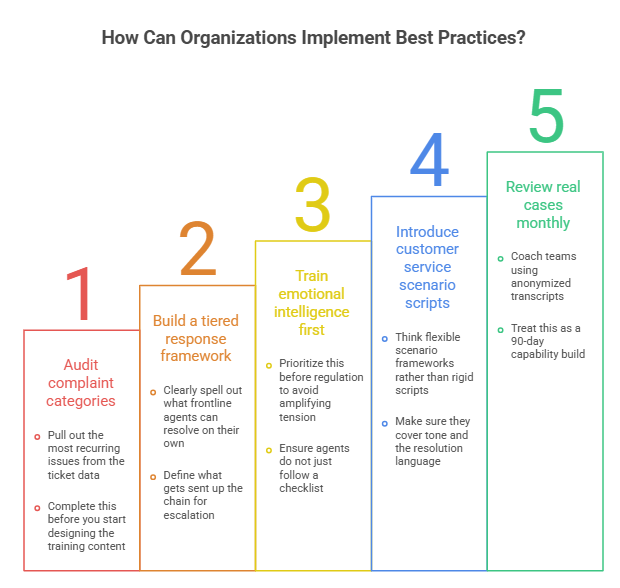
- Audit complaint categories — pull out the most recurring issues from the ticket data , before you start designing the training content.
- Build a tiered response framework — clearly spell out what frontline agents can resolve on their own versus what gets sent up the chain for escalation.
- Train emotional intelligence first — if you only do regulation later then the process training can still create agents who follow the checklist but amplify tension when customers push back.
- Introduce customer service scenario scripts — think flexible scenario frameworks not rigid scripts , and make sure they cover tone , and the resolution language.
- Review real cases monthly — coach teams using anonymized transcripts.
Organizations that consistently outperform competitors typically treat this as a 90-day capability build, not a single workshop, and pair it with change management so agents build judgment rather than just compliance.
What Frameworks or Methodologies Work Best?
The most effective approaches tend to mix structured negotiation models, service recovery frameworks, and some root-cause analysis of work. Like, no single framework works by itself—great programs usually blend diagnostic stuff with emotional cues, and also the procedural angle.
Framework | Core Focus | Best Used For | Limitation |
LAST Method (Listen, Apologize, Solve, Thank) | Structured de-escalation | Frontline agents, high-volume tickets | Can feel scripted without tone training |
Interest-Based Negotiation | Underlying needs vs. stated demands | Complex billing or contract disputes | Requires more agent skill and time |
Service Recovery Paradox | Converting failure into loyalty | High-value customer retention | Not scalable for low-margin issues |
Root Cause Analysis (5 Whys) | Systemic causes of complaints | Product and policy fixes | Operates after the fact |
Most mature support orgs end up layering it like this: structured de-escalation for real-time talk, negotiation for thorny disputes, and root-cause analysis that feeds back into product and policy on a weekly basis.
What Real-World Examples Demonstrate Success?
A successful customer conflict resolution example share some common traits , like quick acknowledgment and transparent communication, but also a solution that goes past what the customer minimum expectation was. You can see it across industries from banking to e-commerce , where there are clear measurable retention gains when these ideas are used consistently.
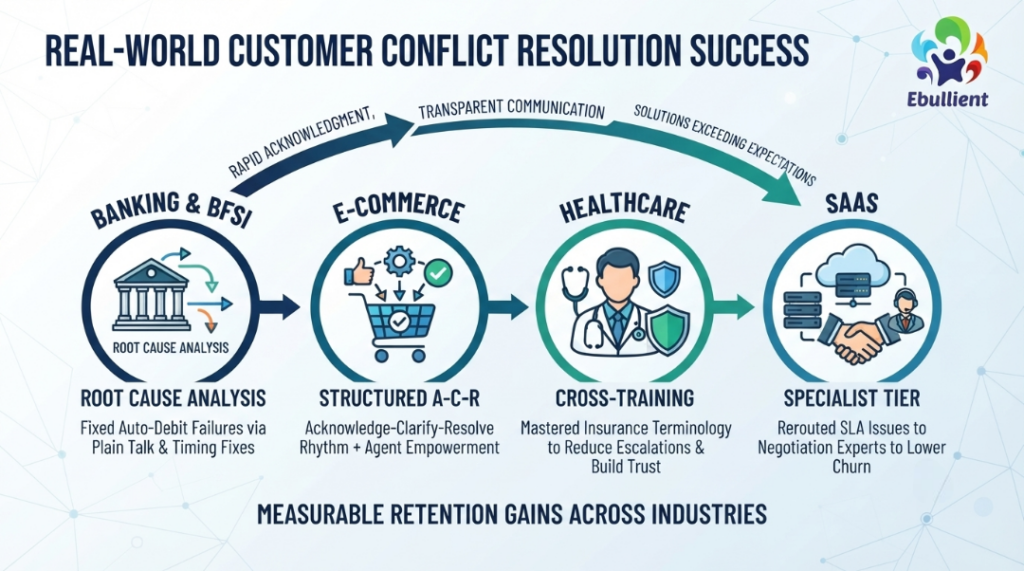
Banking and BFSI
A digital lender we worked with kept seeing the same kinds of disputes over auto-debit failures. When we did a root cause dive, it turned out to be a notification timing trouble; once that was addressed, and we added training that used jargon-free explanations (basically plain talk), the complaints around that thing fell a lot within two billing cycles.
E-commerce
A retail brand that was getting stuck in return related arguments introduced a more structured acknowledge-clarify-resolve rhythm. They also gave agents the right to approve exchanges up to a certain value without looping in extra escalation, and resolution speed.
Healthcare
A telehealth platform noticed that many agents didn’t really know the insurance terminology, so they escalated too quickly. After cross-training, those escalations dropped, and patients seemed to trust.
SaaS
An IT services firm lowered the churn-triggering complaints by rerouting contract and SLA disagreements to a specialist tier. That tier was trained in negotiation, not just general agent handling.
Source: Shep Hyken
Did You Know?
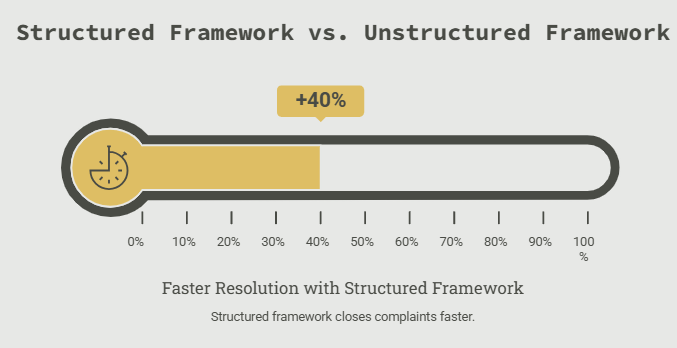
Phone-based complaints resolved using a structured five-stage framework are closed 40% faster on average than those handled without a defined sequence, even though call length per stage is similar.
The Organizational Transformation Checklist Free guide, instant download.
Get the Guide →What Emerging Trends Will Shape the Future?
AI assisted ticket triage , sentiment detection, and knowledge base driven self service are kind of changing how conflict gets handled, but real human judgment still matters a lot , especially when disputes get emotionally charged. Honestly the future seems to lean toward hybrid models where automation deals with the big volume, and trained people do the nuance.
Lately AI systems flag growing sentiment a bit earlier, before things really spiral, so supervisors can step in while there’s still time. Also, improvements to the knowledge base let customers resolve plain problems on their own, without having to reach out to support. Still, in a bunch of enterprise transformation efforts , customers escalate faster rather than slower when they feel they’re talking to a bot during a real complaint. The orgs that are gaining ground usually use automation for accleration process and keep trained humans for the high stakes conversations.
What Role Does Emotional Labor Play in Customer Service Teams?
Emotional labor the effort of keeping your own feelings in check while you’re taking in customer frustration, is too often ignored and that’s a business-critical factor. Left unaddressed, it drives agent burnout and declining service quality, even when technical training is strong.
This is the section most training programs skip, and it often determines whether a program sustains results for years or fades after three months. Agents handling repeated conflict without decompression time or manager check-ins burn out quietly; empathy statements become mechanical and resolution quality drops—not from lack of skill, but accumulated fatigue.
Organizations that build in recovery periods after difficult calls and rotate agents out of high-conflict queues see meaningfully lower attrition. This is a leadership development issue as much as a customer experience one, and deserves its own budget line rather than a generic wellness initiative.
What Customer Service Scenarios and Scripts Help Teams Handle Difficult Conversations?
Effective customer service scenarios scripts are sorta flexible frameworks— not really word for word scripts—, covering acknowledgment, clarification, and resolution language, built around real recurring complaint types rather than those generic templates.
Useful categories include billing disputes, delayed shipments, service outages, refund denials, and repeat-issue frustration. Agents benefit from three components: an opening acknowledgment that validates emotion without prematurely admitting fault, a clarifying question that surfaces the real issue, and a resolution statement with clear next steps.
Practicing it via role-play, not reading off cold during a live call, is what makes these scripts usable under pressure, and it also shows best customer service skills actually happening, in real time.
How Does Resolving Issues Faster Improve Customer Satisfaction?
Resolving issues in that first interaction removes the frustration of having to repeat the same explanations, and follow-ups. Customers who get resolution quickly report significantly higher CSAT and are far less likely to churn than those requiring multiple contacts for the same issue.
Every additional contact required compounds frustration and signals disorganization, regardless of how polite each interaction was. Improving this requires giving agents both authority—approval limits, exception permissions—and unified customer history, so problems are solved without passing customers around. This is as much a CRM design question as a training one, and it is central to good online business customer support.
Source: Leading Culture
Did You Know?
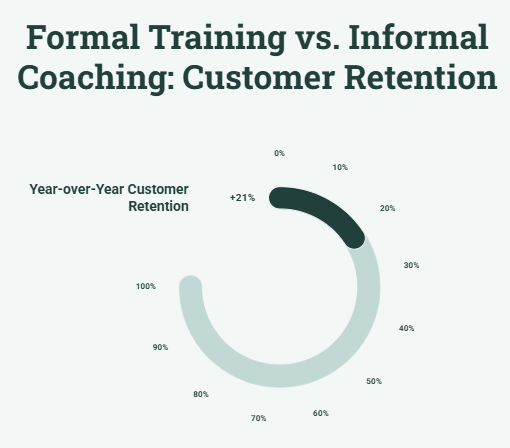
Some companies that give support staff formal conflict resolution training do see 21% higher year over year customer retention compared to firms that mainly lean on informal on-the-job coaching.
Curious About Other Areas of Your Organization?
Explore our other free assessments and get a fuller picture of where you stand.
View All AssessmentsHow Ebullient Consultancy Helps Organizations Succeed?
Building conflict resolution and customer service skills at scale takes more than a one-time workshop, it needs a structured capability-build that links to real business outcomes, not just vibes. Ebullient Consultancy partners with L&D and CX leaders so they can shape training from actual complaint data, rather than generic templates.
This typically includes:
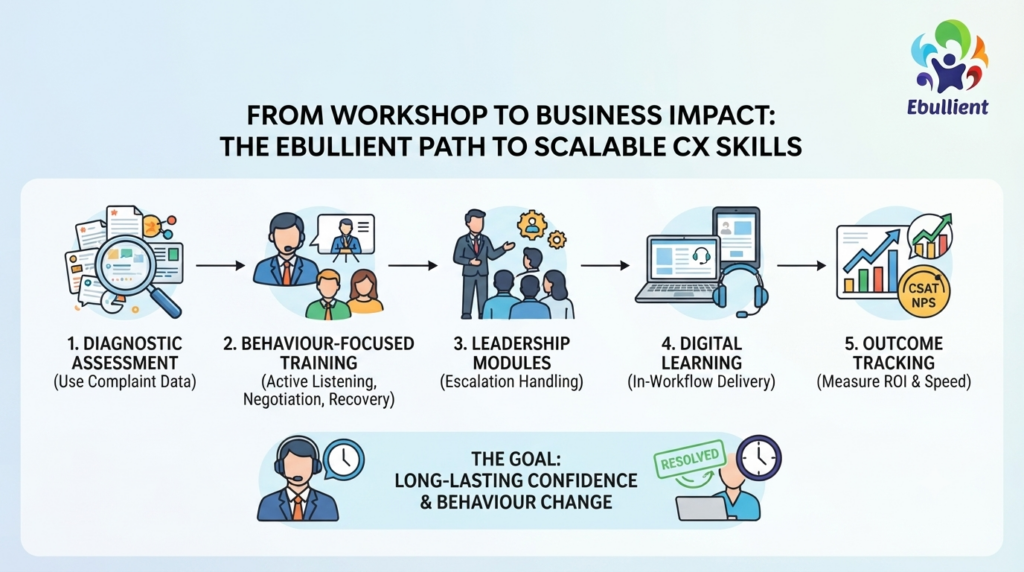
- A diagnostic assessment of how current support ticket management is going and which complaint categories keep reappearing.
- Behaviour-focused training that’s centered on active listening, negotiation, and service recovery. We will tailor it to industry-specific scenarios.
- Leadership development modules for supervisors, so escalation handling improves, along with frontline skills.
- Digital learning delivery that fits into live support environments without pulling teams offline for long periods.
- Outcome tracking aligned to CSAT, NPS, and resolution speed, so training investment is measurable against business impact.
The goal is long lasting behaviour change, it is about teams that deal with conflict resolution in customer service in a confident way, even months after the training , not just during a workshop.
Final Thoughts
Conflict Resolution and Customer Service Skills are no longer a peripheral training topic—they are a direct driver of retention, cost efficiency, and brand reputation for any online business. Organizations that treat this as a structured, measurable capability consistently outperform those leaving it to individual agent instinct, because trained resolution behaviour is repeatable while natural charisma is not.
The practical next step for leadership is straightforward: audit your top five recurring complaint categories this quarter, map them against current training coverage, and identify where agents are handling conflict without structured support. That exercise typically reveals more actionable insight than any generic training catalog, and it is the starting point for building a support function that turns friction into loyalty rather than churn.
Want to meet the team?
Start with a 30-min conversation. No commitment needed.
Frequently Asked Questions
What are the most important conflict resolution and customer service skills for online businesses?
The most crucial skills are active listening, emotional intuition, root cause analysis , and negotiation. Together, they let agents figure out the actual issue underneath a complaint, handle the emotional tension , and arrive at a settlement that feels fair instead of just shutting the ticket down.
How can small online businesses improve customer satisfaction without a large team?
Small teams can get better outcomes by rushing to a quick, one-contact resolution, not dragging it out. Agents should have clear authority limits for the usual stuff like refunds , and they should stay aligned with a shared knowledge base so the answers stay consistent. Structured scenario training, even in short sessions, delivers disproportionate impact for lean teams offering online business customer support.
What is the difference between customer service and conflict resolution?
Customer service covers general support, like helping with delivery stuff too answering questions and handling requests. Conflict resolution is more aimed at frustration and disagreements, so it needs extra competences, for example de-escalation and negotiation, which the usual customer service training often leaves out. When it comes to managing customer complaints well, it really depends on stacking both skill types together.
How does support ticket management affect conflict resolution outcomes?
Poor support ticket management makes things worse, with lost context and the same repeated explanations coming back, which quickly turns into frustration, and well it spirals. When you unify the systems and actually keep the whole interaction history, agents can iron out conflicts faster, and with more empathy, since they aren’t starting each conversation from zero.
What certification or training should HR and L&D leaders prioritize first?
HR and L&D leaders should really put a priority on training that blends applied role-play, with the actual complaint data found in their own systems, rather than certification alone. Programs pairing emotional intelligence with negotiation show the strongest measurable impact on CSAT and retention, and reflect the best customer service skills organizations can build in-house.