An AI readiness assessment is a structured evaluation of your organization’s strategy, data, infrastructure, talent, and culture (all together) to see if you can actually roll out AI successfully. It will score each dimension, highlight missing pieces, and then yield a prioritized action plan to commit budget to AI training or tools.
Most companies don’t fail at AI because the technology is weak. They fail because nobody checked whether the organization could actually support it. In our experience implementing these frameworks for financial firms, banks, and mid-market manufacturers, the pattern repeats: leadership approves a generative AI pilot, the pilot works in a controlled demo, and then it collapses the moment it touches real workflows, real data silos, and real employee resistance. An AI readiness assessment exists to catch that gap before it becomes an expensive lesson.
This guide walks HR and senior management through exactly how to run one — with the methodology, the templates, and the decision points that actually matter.
Key Takeaways at a Glance
Takeaway | Why It Matters |
An AI readiness assessment scores strategy, data, infrastructure, governance, talent, and culture before AI investment begins. | It replaces guesswork with solid evidence, so the budget can go toward repairing the actual gaps, instead of paying for a pilot that can’t scale. |
Most organizations overestimate technology readiness and underestimate data and cultural gaps. | Confidence isn’t a readiness score. Leadership teams often approve AI spend based on a false sense of preparedness. |
Middle-manager literacy is the most commonly overlooked scoring dimension — and often the most predictive one. | Managers are the ones who approve or reject AI-assisted work daily. Without their literacy, oversight breaks down first. |
Reassess quarterly or even just twice yearly, because readiness feels more like a living capability not some one time certificate. | Self scored checklists are ok for low stakes exploration; facilitated assessments stand up better to board and auditor scrutiny. |
Reassess quarterly to twice-yearly; readiness is a continuous capability, not a one-time certificate. | AI capabilities internal data structures move too quickly, so one annual check can leave months of blind spots. |
Ebullient Consultancy has a free scorecard, a facilitated AI readiness assessment, and a certification path for L&D and HR leaders who are navigating the AI terrain in 2026. | For the decision-makers, with a defensible board ready rationale for AI investment, not merely a generic vendor audit. |
What Is an AI Readiness Assessment?
An AI readiness assessment is a diagnostic process that measures an organization’s capacity to adopt AI across defined dimensions — typically strategy, data, infrastructure, governance, talent, and culture. It replaces guesswork with a scored, evidence-based view of where the organization stands.
Think of it as a pre-flight check, not a pass/fail exam. A genAI readiness assessment doesn’t ask “can we use ChatGPT?” It asks whether your data is centralized enough to trust an AI output, whether your managers know how to supervise an AI-augmented workflow, and whether your policies can survive a regulator’s questions. Deloitte’s 2026 enterprise research found that 42% of companies rate their AI strategy as “highly prepared,” yet those same companies report feeling significantly underprepared on infrastructure, data, and talent — proof that confidence and readiness are not the same thing.
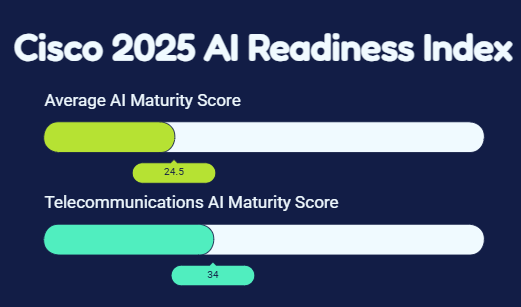
Source: Cisco
Did You Know?
According to Cisco’s 2025 AI Readiness Index, the average AI maturity score across major global companies sits at just 24.5 out of 100 — and even telecommunications, the highest-scoring sector, only reaches 34. Most organizations are far less prepared than their leadership teams assume.
Why Does AI Readiness Assessment Matter Before You Train or Deploy?
Skipping an AI readiness assessment means investing in tools and training that your organization isn’t structurally equipped to use. McKinsey research shows nearly two-thirds of organizations remain stuck in pilot mode, unable to scale AI enterprise-wide — usually because foundational gaps were never diagnosed.
We’ve watched companies buy licenses for AI copilots, run a one-day workshop, and declare the organization “AI-enabled.” Six months later, adoption is near zero because nobody addressed the actual blockers: fragmented data, unclear ownership of AI risk, or managers who were never given a framework for evaluating AI-generated work. An AI readiness assessment forces those conversations to happen in week one, not month eight. That sequencing difference is the entire reason readiness assessments exist as a discipline separate from AI training itself.
How AI-Ready Is Your Organization, Really?
Take our free 4-minute assessment and get a personalized report on your leadership fluency, governance, and workforce readiness.
Take the Free AI Readiness Assessment →AI Readiness Assessment Methodology: The Six-Pillar Approach
A defensible AI readiness assessment methodology tends to look at six pillars— strategy, data, infrastructure, governance, talent, and culture— then score each on a consistent range, after that turning the results into a prioritized roadmap. It kind of resembles the approach that Cisco, McKinsey, and Deloitte use across their enterprise indices.
Here’s how each pillar turns into a working assessment, like in practice rather than theory:
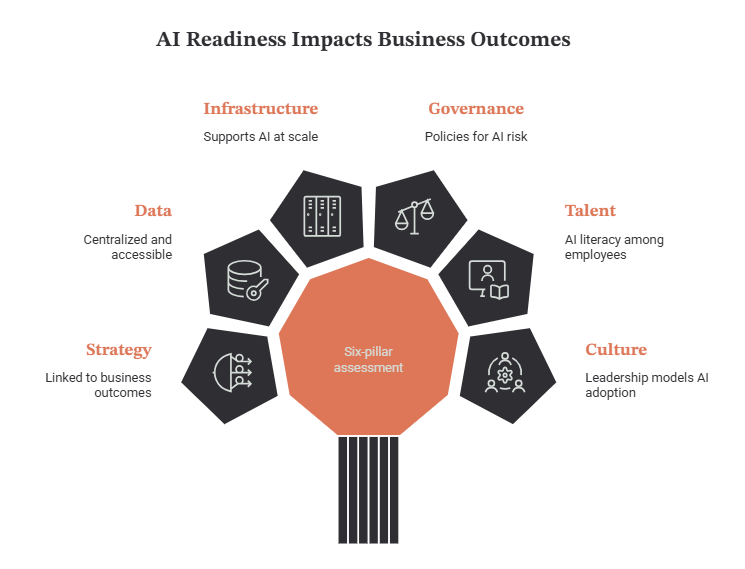
- Strategy – Is there a documented AI roadmap linked to specific business outcomes, or is AI adoption basically reactive, like “we’ll respond later”?
- Data – Are your data sets centralized, properly labeled, and actually accessible, or are they stuck inside departmental silos, unavailable when someone needs them?
- Infrastructure – can your environment support the compute demands, the integration threads, and the security requirements for AI at scale?
- Governance – do you maintain policies for AI risk , bias, and compliance prior to deployment, not after an incident?
- Talent – Do employees and managers have the literacy to use, question, and supervise AI outputs?
- Culture – Does leadership model AI adoption, or does it delegate the initiative entirely to IT?
Score each pillar from 1 (unprepared) to 5 (fully mature), then weight the scores by which pillars matter most to your specific use case. A customer-service AI agent leans heavily on data and governance; an internal productivity tool leans on culture and talent.
AI Readiness Assessment Template: What Should It Include?
A usable AI readiness assessment template includes a scoring rubric per pillar, evidence fields (not just opinions), a gap-severity rating, and an owner assigned to close each gap. Templates without accountability fields become reports nobody acts on.
The strongest templates we’ve built ask assessors to cite evidence — a system name, a policy document, a training completion rate — rather than a gut-feel score. This is what separates a genuine AI readiness assessment methodology from a checkbox survey.
When Ebullient Consultancy builds a template for a client, every score requires a documented reason, because unverifiable scores don’t survive board scrutiny.
The One Factor Everyone Ignores: Middle-Manager Readiness
Most AI readiness assessment example frameworks concentrate on executives and IT. That’s a mistake. Middle managers are the ones who approve or reject AI-assisted work daily, and they are rarely assessed at all. In our experience implementing these frameworks for financial firms, the single biggest predictor of successful AI rollout wasn’t the CIO’s enthusiasm — it was whether frontline supervisors understood enough to catch a hallucinated figure in a report before it reached a client. If your assessment doesn’t include a dedicated management-literacy score, it’s measuring the wrong layer of the organization.
Source: Gartner
Did You Know?
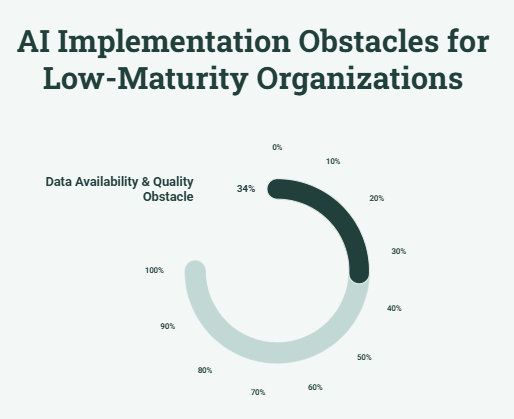
Gartner’s June 2025 research found that 34% of leaders at low-maturity organizations cite data availability and quality as their single biggest obstacle to AI implementation — ahead of budget, talent, or leadership buy-in.
AI Readiness Score Card Free guide, instant download.
Get the Guide →What Does a Real AI Readiness Assessment Example Look Like in Practice?
A real assessment produces a scorecard, not a slogan. For example, a mid-sized logistics firm scoring 4/5 on strategy but 2/5 on data governance would be advised to pause deployment and fund a three-month data-cleanup sprint before touching an AI vendor contract.
Concrete example: a manufacturing group ran successful AI pilots in maintenance planning but couldn’t scale past them. The assessment revealed their learning system and HR system were completely disconnected, so skills-gap analysis was structurally impossible. Once that integration was fixed — a problem previously dismissed as “just an IT ticket” — three stalled AI use cases unlocked within months. That’s the value of a properly run AI readiness assessment: it finds the boring, unglamorous blocker that no pilot demo will ever reveal.
Which AI Maturity Assessment Tool Should You Use?
Choose an AI maturity assessment tool based on whether you need a quick self-diagnostic (spreadsheet-based, 1–2 days) or a formal, benchmarked assessment (external facilitation, 2–4 weeks) that can withstand board or investor scrutiny. Larger regulated organizations should default to the latter.
Assessment Type | Time Required | Best For | Output Quality |
Self-scored checklist | 1–2 days | Small teams, early exploration | Directional, low rigor |
Vendor benchmarking tool | 1 week | Comparing against industry index | Useful but generic |
Facilitated AI readiness assessment (external) | 2–4 weeks | Regulated industries, board reporting | High rigor, defensible |
Free tools give you a rough signal. A facilitated genAI readiness assessment gives you evidence-backed findings you can present to a board or an auditor — a meaningful distinction once AI governance regulation tightens further into the AI landscape 2026.
Curious About Other Areas of Your Organization?
Explore our other free assessments and get a fuller picture of where you stand.
View All AssessmentsHow Ebullient Consultancy Helps Organizations Become Truly AI Ready?
Ebullient Consultancy runs AI readiness assessments and certification programs specifically for HR and L&D leaders who need to make a defensible case to senior management — not generic IT audits. Our methodology combines the six-pillar scoring model with role-specific literacy checks, including manager-level assessments most vendors skip entirely.
Our AI readiness engagements focus on helping organizations:
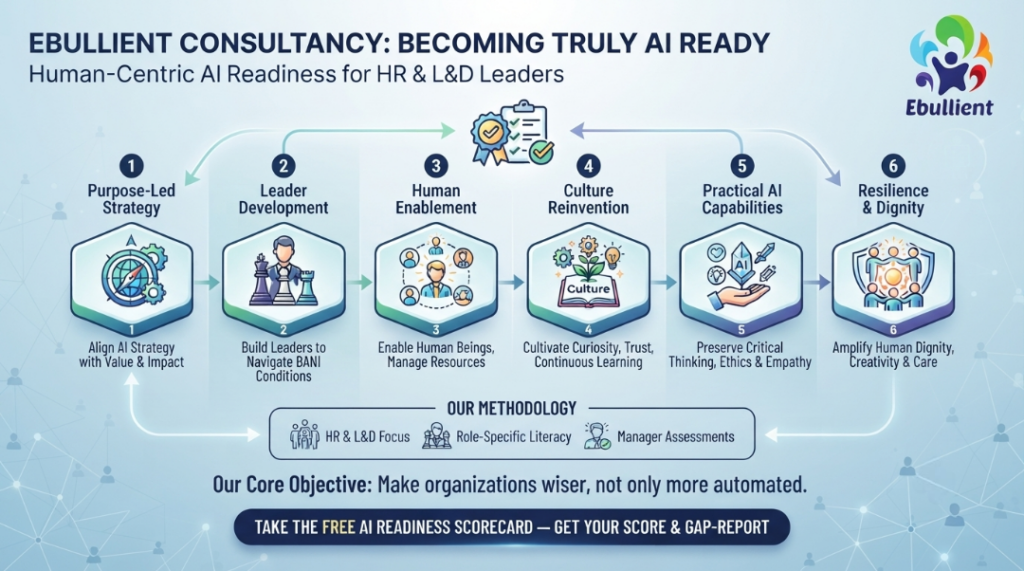
- Build purpose-led AI strategies that stay aligned with long-term business value and societal impact.
- Develop leaders who can make sound decisions under BANI conditions.
- Shift from managing Human Resources into enabling Human Beings across the whole employee lifecycle.
- Rewire organizational culture, so it really encourages curiosity and experimentation, trust and continuous learning.
- Enabling employees with practical AI capabilities, meanwhile preserving critical thinking, creativity, empathy, and ethical judgment.
- Create resilient organizations where technology amplifies human dignity, creativity, and care.
- And whether it’s through executive advisory, leadership reforging, cultural transformation, team alchemy, or future-focused capability development, our objective stays pretty much the same:
To make sure organizations become wiser, not only more automated.
Want your organization’s score? Take our free interactive AI Readiness Scorecard — 12 questions, personalized results, and a benchmark against your industry average. L&D leaders who complete it receive a custom gap-report by email, plus early access to our next AI readiness certification cohort.
Final Thoughts
Readiness isn’t a one-time badge you earn and forget. Organizations that treat their AI readiness assessment as a recurring discipline — reassessed every two to three quarters — consistently outperform those that run it once and move on. The gap between planning AI and actually running it profitably is almost always an organizational gap, not a technology one. Fix the organization first, and the technology adoption gets dramatically easier.
Want to meet the team?
Start with a 30-min conversation. No commitment needed.
Frequently Asked Questions
How often should we repeat an AI readiness assessment?
Reassess every two to three quarters, or immediately after a major system change, acquisition, or new regulation. AI capabilities and organizational data structures shift quickly enough that a single annual check leaves blind spots for months at a time.
Who should own the AI readiness assessment inside the company?
A cross-functional owner works best — typically a joint sponsorship between HR/L&D and IT, with input from Legal and a business-unit leader. Assessments owned solely by IT tend to under-weight workforce and change-management gaps.
Does a small business need a formal AI readiness assessment methodology?
Yes, though scaled down. A lightweight self-scored version across the same six pillars still catches the most common failure points — siloed data and unclear governance — without requiring weeks of external facilitation.
What’s the difference between AI maturity and AI readiness?
AI readiness measures whether you can start adopting AI safely right now. AI maturity measures how deeply AI is already embedded and optimized across the organization. Readiness comes first; maturity is the multi-year outcome of sustained readiness work.
Can an AI readiness assessment prevent compliance issues?
It significantly reduces the risk. By scoring governance as a separate pillar, the assessment brings up the missing policies, the not-documented data flows and the unclear accountability, before regulators or auditors notice them , even if it doesn’t swap in for the formal legal review.