The banking professionals of 2026 require digital skills and data analysis abilities and knowledge of regulations and cybersecurity protection and abilities to manage customer relationships and financial advisory skills and a need for ongoing learning. The professionals use these skills to handle quick technology developments and to comply with changing regulations and to provide individual customer service in the competitive banking sector.
The BFSI Industry in 2026: A Shift You Can’t Ignore
The Banking Financial Services and Insurance BFSI sector now operates with technology and data as its primary driving forces, which create customer-focused innovations. The Banking Financial Services and Insurance BFSI sector now operates with technology and data as its primary driving forces, which create customer-focused innovations.
The banking sector in India and worldwide is presently experiencing fundamental changes because of artificial intelligence and financial technology innovations and digital payment systems and newer compliance regulations. The new regulations require organisations to develop a new strategy for their employee development programmes.
The current question for HR leaders and L&D professionals and senior management has shifted from determining training requirements to finding ways to increase workforce skills.
Key Takeaways – At a Glance
- The BFSI industry is evolving rapidly, which requires continuous upskilling.
- Building competence in BFSI skills enables professionals to advance their careers while achieving their organisational objectives.
- Digital literacy, data analytics, compliance and emotional intelligence constitute essential skill sets.
- Companies having a competitive edge gain advantages from their implementation of BFSI training programmes.
- Organisations maintain their competitive edge through two methods, which involve their BFSI training and their partnerships with BFSI training institutes throughout India.
- The BFSI industry in India requires its professionals to engage in ongoing growth for your organisation’s success.
The New-Age Banker: Beyond Transactions
A decade ago, banking professionals demonstrated their success by showing expertise in three areas, which included portfolio management and transaction processing and compliance verification. The definition of success now requires individuals to demonstrate their technical skills and their ability to understand others and their proficiency in digital technologies.
The leading private bank relationship manager performs two primary responsibilities. The relationship manager needs to handle client accounts while also performing data analysis and creating investment plans and maintaining compliance and giving customised financial guidance. The banking, finance and securities industries require professionals to acquire new skills which demonstrate their commitment to ongoing development.
Organisations that implement structured development programmes through either BFSI training institutes in India experience better operational flexibility and increased customer loyalty and improved employee productivity.
The 7 Essential BFSI Skills Every Banker Needs in 2026

1. Digital Literacy and FinTech Awareness
The rise of FinTech innovations—from blockchain to AI-driven credit scoring—has changed the way banks operate. Professionals who understand these technologies can leverage them for smarter lending, better risk management, and personalized customer solutions.
Key aspects include:
Understanding blockchain and digital payments
Adapting to automation in operations and customer service
Using AI and analytics to improve efficiency
Why it matters:
A digitally literate banker not only keeps up with transformation but becomes a driver of innovation within their organization.
2. Data Analytics and Decision Intelligence
In 2025, data is the new currency. Banks now rely heavily on analytics for insights into customer behavior, risk profiling, fraud detection, and business forecasting.
Core skills to develop:
Data visualization using Power BI or Tableau
Statistical analysis for financial modeling
Data-driven decision-making for customer-centric outcomes
Professionals who can interpret complex datasets are invaluable assets in a world where accuracy and speed define success.
3. Regulatory Compliance and Risk Management
As global regulations evolve, compliance has become one of the most critical skill areas in BFSI. From AML (Anti-Money Laundering) laws to data privacy regulations, banking professionals must stay informed and proactive.
Essential training modules include:
Understanding RBI, SEBI, and IRDAI guidelines
Risk assessment and internal auditing
Ethical banking and governance
Outcome:
Trained professionals reduce organizational risk, ensure operational transparency, and build long-term customer trust.
4. Customer Relationship and Emotional Intelligence
Despite digitalization, banking remains a people-centric industry. Emotional intelligence, empathy, and communication are vital for creating exceptional customer experiences.
Key elements:
Handling customer complaints with empathy
Understanding client psychology and needs
Building long-term customer trust through transparent interactions
When combined with digital tools, emotional intelligence turns a banker into a trusted advisor, not just a service provider.
5. Cybersecurity Awareness
The BFSI sector is a prime target for cyber threats. With growing digitization, understanding cybersecurity basics is no longer optional—it’s essential.
Core areas of focus:
-
Identifying phishing, ransomware, and data breach risks
-
Implementing secure online banking protocols
-
Compliance with data protection and cybersecurity laws
Why it’s crucial:
Even one uninformed employee can jeopardize an entire system. BFSI training ensures your workforce acts as your first line of defense.
6. Sales, Cross-Selling, and Financial Advisory Skills
Modern bankers are also financial advisors—helping customers make informed investment decisions. Upskilling in consultative selling and cross-selling helps banks meet business targets while ensuring customer satisfaction.
Training focus:
-
Personalized financial advisory
-
Understanding market instruments (mutual funds, insurance, loans)
-
Ethical selling practices
These skills bridge the gap between customer needs and business growth, creating a win-win scenario.
7. Agility and Continuous Learning Mindset
In a rapidly evolving BFSI landscape, agility is the ultimate skill. Bankers who embrace lifelong learning adapt faster to new technologies, regulations, and customer behaviors.
What this means:
Staying current with digital transformation trends
Engaging in continuous professional development
Learning from cross-functional collaboration
A continuous learning culture turns challenges into opportunities and professionals into industry leaders.
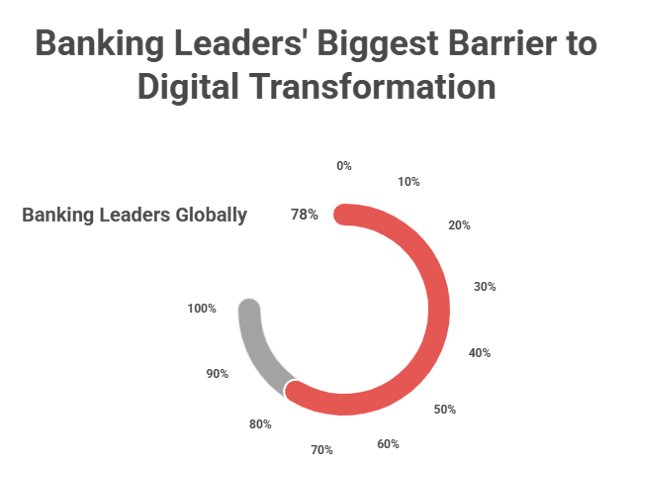
Source: The Financial Brand
Did You Know?
The majority of banking leaders which accounts for more than 78 percent around the world select skill gaps as their primary obstacle to digital transformation.
How Can BFSI Training Help Organisations Scale?
Organisations use structured training programmes to eliminate existing skill gaps. Whether through classroom sessions or the best BFSI training program online, organisations can:
- Workforce productivity increases;
- Operational risks decrease;
- Customer satisfaction levels rise;
- Organisations build stronger competitive advantages.
Indian companies throughout the BFSI sector now implement blended learning methods to develop workforce skills which meet future banking and financial services requirements.
What Challenges Do Organisations Face in BFSI Skill Development?
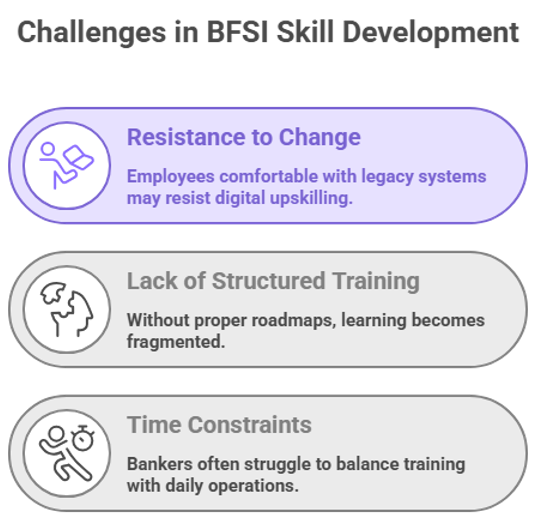
While training is crucial, many organizations face roadblocks such as:
Resistance to change: Employees comfortable with legacy systems may resist digital upskilling.
Lack of structured training frameworks: Without proper roadmaps, learning becomes fragmented.
Time constraints: Bankers often struggle to balance training with daily operations.
The Solution:
Many professionals try to self-learn through banking and financial services book pdf, but structured programs deliver better results. Partnering with an experienced training provider like Ebullient Learning helps organizations overcome these barriers through customized, blended learning programs that fit seamlessly into work schedules.
The Role of Continuous Learning in Building Future-Ready BFSI Professionals
The BFSI industry requires continuous learning, which serves as its fundamental operational approach. Organisations that create a learning environment within their structure experience innovation and performance advancements which continue for an extended period.
The online BFSI training programme and the best BFSI training programme online both provide employees with the opportunity to learn BFSI skills which will remain useful throughout their careers.
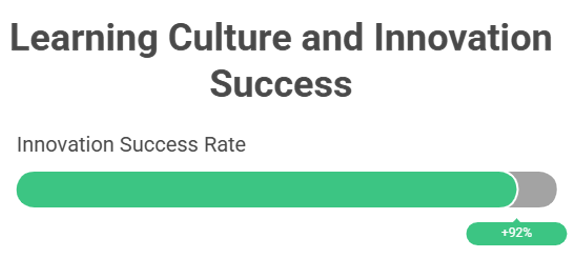
Source: Training Industry
Did You Know?
The research shows that organizations which develop strong learning cultures achieve 92 percent higher innovation success rate.
Why Choose Ebullient Learning for BFSI Training?
At Ebullient Learning, we understand the unique challenges of the BFSI sector. Our training programs are designed by industry experts and learning strategists who know what skills truly matter in 2026 and beyond.
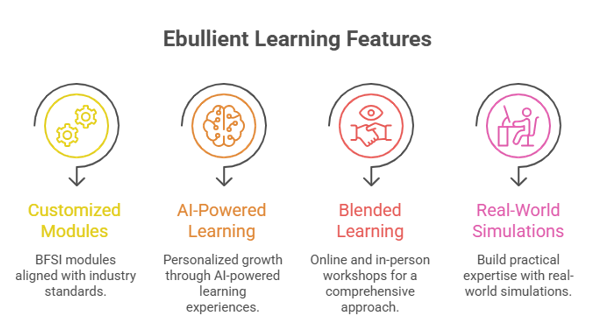
Customized BFSI modules aligned with industry standards.
AI-powered learning experiences for personalized growth.
Blended learning models (online + in-person. workshops)
Real-world simulations to build practical expertise.
We’ve empowered thousands of professionals across India to future-proof their careers and enhance organizational performance.
Final Words: Shape the Future of Banking with Ebullient Learning
The BFSI sector in india stands at at the crossroads of innovation and disruption. To stay relevant, professionals must continuously upgrade their skills in digital finance, compliance, and customer engagement.
Whether your organization striving for excellence, now is the time to invest in bfsi training online or partnering with bfsi training institutes in india is the smartest step forward.
At Ebullient Learning, we don’t just train—we transform professionals into future-ready leaders.
explore www.ebullient.in today to our customized BFSI training programs and take the first step toward building a smarter, more resilient banking workforce.
What are the most critical BFSI skills bankers need to stay competitive in 2026?
Frequently Asked Questions
Get answers to commonly asked questions about Ebullient.
1. What does BFSI stand for?
BFSI stands for Banking, Financial Services, and Insurance. It refers to the sector that includes banks, investment firms, insurance companies, and other financial institutions that deal with money management and financial products.
2. Why is BFSI training important in 2026?
In 2026, the BFSI industry is being reshaped by digital transformation, AI, blockchain, and regulatory updates. Because evolving technologies demand updated bfsi skills, supported by bfsi training online and modern learning platforms.
3. What are the top 7 skills every banker needs in 2026?
The most in-demand skills for BFSI professionals include:
Digital literacy & fintech awareness
Data analytics & interpretation
Cybersecurity knowledge
Regulatory & compliance management
Customer relationship management (CRM)
Financial advisory & investment planning
Adaptability & continuous learning mindset
4. What is the role of digital skills in banking careers?
The digital skills play an important role in banking work, which is to provide digital competencies which bankers need to operate AI systems and conduct data analysis, identify fraudulent activities and create enhanced customer service solutions.
5. Which is the best BFSI training provider in India?
Ebullient Learning delivers customised BFSI training programmes which meet industry standards and prepare professionals for future careers.