
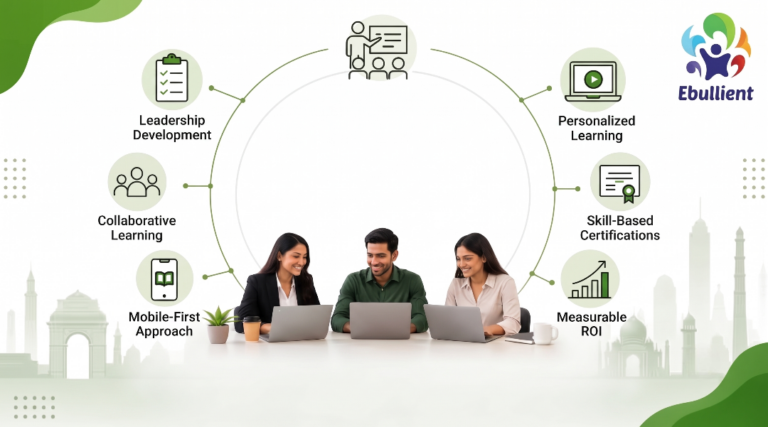
The future of workplace learning is not only about the old classroom method training, or those static LMS modules . In 2026, organisations are investing in AI-driven learning pathforms , human-centric leadership growth, immersive learning moments, and adaptive skill-building strategies which, aligns with productivity, innovation, and employee retention . And the top performers are intergeting corporate learning with business transformation, so it becomes training as a strategic growth driver rather than just a supporting fuction.
As India’s business landscape move ahead with rapid technological disruption, hybrid work arrangements, and dynamic employee expectations, the emerging trends in training are shifting how organisations should grow leaders, managers, and future-ready teams. Across the industries, companies are now adopting on agile learning systems, AI-powered personalisation, and behavioral capability-building, to stay competitive in the market.
Key Takeaways – At a Glance
- AI-powered learning personalization is becoming a foundation for building corporate capability.
- Leadership development is moving away from old authority-led management, toward a more human-centric leadership.
- Soft skills training is not just “nice to have” anymore , it’s turning into strategic business capability development.
- Organisations are investing in microlearning, immersive learning and coaching ecosystems, in this ongoing loop rather than isolated programs.
- Businesses are now leaning hard into adaptability, resilience, emotional intelligence and innovation readiness.
- Corporate learning is getting more ongoing , embedded, and aligned with how the organisation itself grows , expands, or changes direction.
Top Corporate Learning Trends Redefining Training in 2026
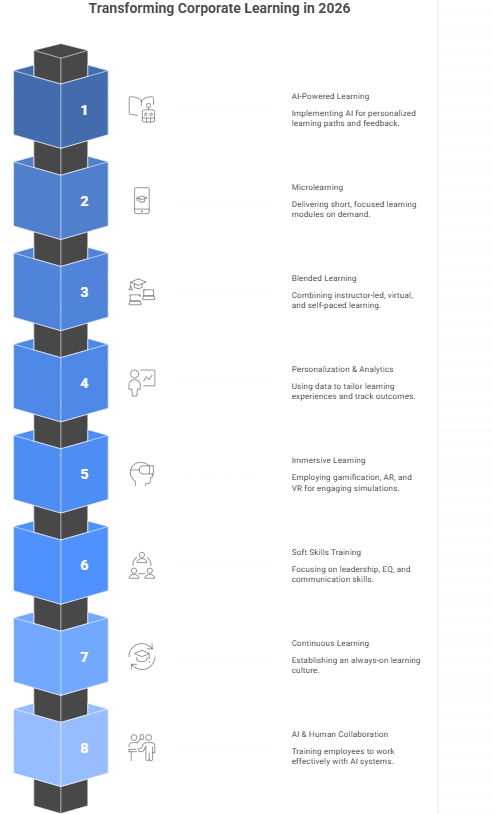
1. AI-Powered Personalized Learning
It’s reshaping workplace learning because Artificial Intelligence is now doing a lot of the heavy multi- tasking through adaptive learning paths, personalized assessments, smart learning recommendations, AI coaches, and automated feedback systems.
Employees don’t really follow one-size-fits-all programs anymore, instead AI maps skill gaps and then assembles those curated learning journeys. Straightforward, though the details.
And companies that are teaming up with advanced providers like Ebullient Consultancy LLP are increasingly embedding AI capability-building inside their enterprise learning ecosystems.
Overall, this shift is among the biggest learning and development trends 2026.
How AI-Ready Is Your Organization, Really?
Take our free 4-minute assessment and get a personalized report on your leadership fluency, governance, and workforce readiness.
Take the Free AI Readiness Assessment →2. Microlearning & Just-in-Time Learning
One of the biggest shifts is away from long, generic training sessions and towards short, focused “bite-sized” modules delivered precisely when the learner needs them.
Why it matters
In a fast-moving workplace, employees often have limited attention/time for long programmes. The microlearning model—short, focused content of 5-15 minutes—fits in better.
Just-in-time learning means content is delivered at the moment the learner needs it—which improves application and retention rather than passive knowledge.
In the Indian scenario, with busy schedules, geographically dispersed teams and a mix of skill-levels, microlearning is highly practical.
Practical considerations
Build a library of short modules (videos, infographics, quizzes) tied to specific tasks or roles.
Use mobile-friendly formats so employees can learn on the move.
Integrate with workflow: when an employee begins a new task, trigger a micro-module that supports that task.
Track completion and application: follow up microlearning with practical tasks or “put into practice” assignments.
Benefit for Indian organisations
Faster rollout and reduced disruption to business operations.
Higher engagement and retention among employees who may not have large blocks of time for training.
Better alignment with modern work rhythms (remote, hybrid, field-based).
3. Blended & Hybrid Learning Models
While digital is growing, many Indian firms recognise that wholly online or offline training is not sufficient. The blended model—mixing instructor-led, virtual, and self-paced learning—is emerging as the norm.
Why it matters
-
According to research, blended learning improves engagement, cost-effectiveness and learning outcomes in India
-
Hybrid models (virtual instructor-led training [VILT] + self-paced modules + on-the-job practice) enable organisations to scale training across geographies while retaining the instructor/mentor component
-
In India, with diverse workforces, different locations, and varied infrastructure, a blended approach gives flexibility and inclusiveness.
Practical considerations
-
Design a curriculum that combines: live or virtual sessions for facilitation and peer interaction + self-paced modules + follow-up on-the-job application.
-
Ensure you have a robust platform or Learning Management System (LMS) to deliver and track the self-paced part.
-
Use local language options or regional facilitators—important in Indian context for accessibility and engagement.
-
Schedule live sessions at times convenient for dispersed teams.
Benefit for Indian organisations
-
Can deliver consistent learning experiences across offices and field locations.
-
Facilitates scalability while retaining human touch & peer network.
-
Promotes inclusivity (regional offices, shift workers) and reduces dependency on face-to-face only.
4. Personalisation, AI & Learning Analytics
Training today is increasingly moving from a “one-size-fits-all” model to personalised learning paths, powered by AI and analytics.
Why it matters
-
Personalisation means training content adapts to an individual’s skill gaps, role requirements and pace of learning.
-
Learning analytics enable organisations to track what works: engagement, completion, performance improvement, business impact.
-
In India where large workforces may have varied entry levels and skills, personalisation ensures relevance and cost-efficiency.
Practical considerations
-
Use an LMS or Learning Experience Platform (LXP) that supports analytics and adaptive modules.
-
Start with a skills audit or competency mapping to identify gaps.
-
Feed those insights into personalised paths: for example, a junior sales person gets a different path than a senior sales manager.
-
Track impact: look beyond completion to behavioural change and business outcomes (eg. sales uplift, error reduction, time saved).
Benefit for Indian organisations
-
Better return on training investment (ROI) when content is targeted.
-
Reduced redundancy: employees don’t waste time on modules they already know.
-
Helps build a culture of continuous improvement rather than one-time training events
5. Immersive & Experiential Learning (Gamification, AR/VR)
Learning that engages deeply and simulates real-world scenarios is increasingly being used—not just theory and slides.
Why it matters
-
Gamification (badges, points, challenges) boosts motivation and engagement.
-
Technologies like Augmented Reality (AR) and Virtual Reality (VR) permit immersive, risk-free simulations which are especially useful in high-risk or technical roles.
-
In India, large companies (especially manufacturing, heavy industry, healthcare) are recognising the value of experiential training for safety, technical operations and skill mastery.
Practical considerations
-
Identify roles/tasks where simulation or scenario-based learning adds value (eg. operating machinery, high-risk tasks, leadership decision making).
-
Use gamified modules for repeatable, measurable behaviour change (customer service, sales, onboarding).
-
Keep cost-benefit in view: high-end VR modules may be costly, so start with pilot use-cases and scale.
-
Blend immersive learning with micro/just-in-time modules to reinforce application.
Benefit for Indian organisations
-
More effective training for complex or technical roles—less reliance on “classroom only”.
-
Increased engagement from younger workforce who expect interactive learning.
-
Can reduce training time, error rates, and supervision costs in critical roles
6. Rise of Strategic Soft Skills Training
As automation and digitalisation increase, the human/soft side of work becomes more important. Skills such as leadership, emotional intelligence (EQ), communication, adaptability and culture fit are gaining prominence.
Why it matters
-
Numerous reports highlight that while technical skills can be taught, soft skills and leadership behaviour drive high performance.
-
In the Indian context—with diverse teams, generational shifts, remote/hybrid working—emphasis on inclusive leadership, collaboration, and culture is critical.
-
Organizations increasingly link training to business outcomes: not just “complete module” but “apply leadership in real work, lead change, influence outcomes.”
Practical considerations
-
Design leadership pipelines that combine self-paced modules + coaching + peer groups + live sessions.
-
Measure behaviour change: e.g., improved team engagement, reduced attrition, improved cross-team collaboration.
-
Embed culture and values: training should reflect the organisation’s mission, values, and behavioural expectations.
-
Upskill managers not just in “management” but in “leading remote/hybrid teams”, “change leadership”, “digital mindset”.
Benefit for Indian organisations
-
Builds better leadership across levels (not just senior management).
-
Creates a culture of continuous learning, adaptability and growth rather than static learning events.
-
Improves retention and employee engagement—important in competitive talent markets.
7. Continuous Learning Ecosystems
Organisations are moving forward from those isolated workshops and toward always-on learning cultures or something along those lines.
In today’s corporate learning ecosystems includes: learning communities, internal academies peer learning that actually works, coaching frameworks, mentorship ecosystems, and mobile learning platforms.
The more forward-looking organisations get that learning part of everyday work.
And this whole idea fits really well with the learning frameworks created by Ebullient Consultancy LLP, because leadership growth is right blends into organizational culture transformation.
8. AI & Human Collaboration Training
The future workplace will hinge a lot on collaboration between humans and AI systems, honestly it will be pretty tied together.
Organisations are now trying to train employees so they can work alongside AI tools and then make better decisions using AI insights, even when things get complex also automate repetitive tasks and boost strategic thinking instead of just keeping up
then, enhance productivity with intelligent systems.
This trend is driving demand for:
- AI readiness workshops;
- Digital fluency training;
- Innovation capability;
- Building programs and wider future workforce transformation tracks.
Meanwhile, several top 10 IT training institutes in india are integrating AI literacy into mainstream enterprise learning solutions.
AI Readiness Score Card Free guide, instant download.
Get the Guide →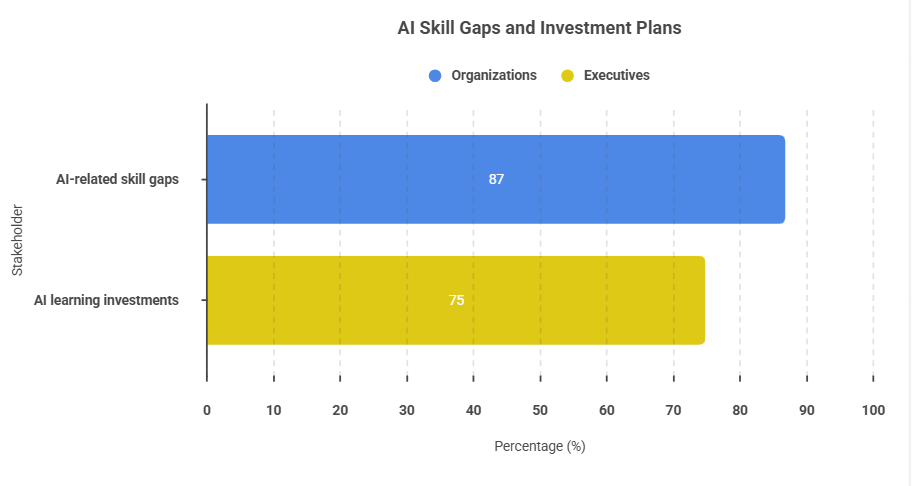
Source: Career Trainer
Did You Know?
Recent 2026 corporate learning data kind of shows that 87% of organizations currently face AI-related skill gaps, and 75% of executives are planning to boost their AI learning investments in the next two years.
Overarching Benefits & Advantages for Organisations in India
When these trends are implemented effectively, the benefits can be transformative:
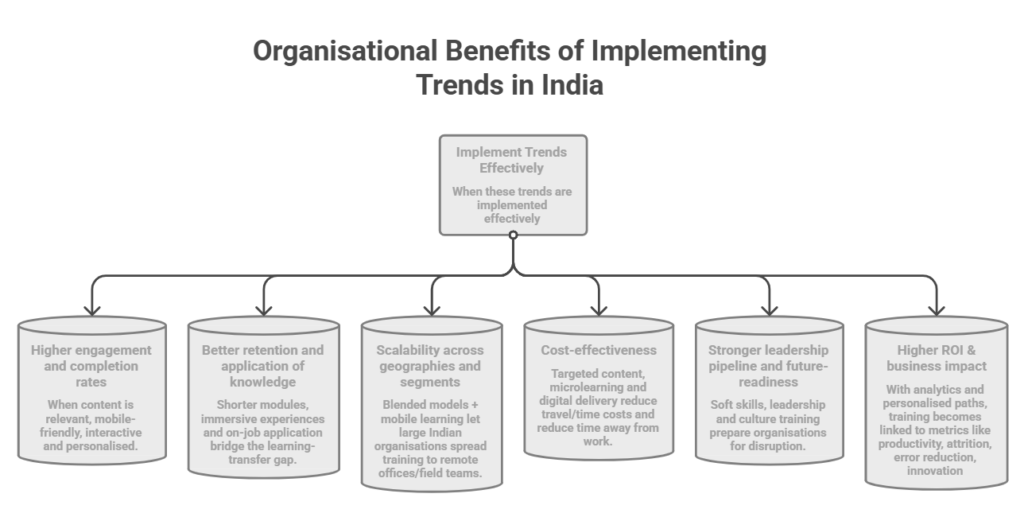
Higher engagement and completion rates: When content is relevant, mobile-friendly, interactive and personalised.
Better retention and application of knowledge: Shorter modules, immersive experiences and on-job application bridge the learning-transfer gap.
Scalability across geographies and segments: Blended models + mobile learning let large Indian organisations spread training to remote offices/field teams.
Cost-effectiveness: Targeted content, microlearning and digital delivery reduce travel/time costs and reduce time away from work.
Stronger leadership pipeline and future-readiness: Soft skills, leadership and culture training prepare organisations for disruption.
Higher ROI & business impact: With analytics and personalised paths, training becomes linked to metrics like productivity, attrition, error reduction, innovation.
Challenges to Adopting L&D Trends
Of course, adopting these trends isn’t without challenge—especially in the Indian context. Some key ones:
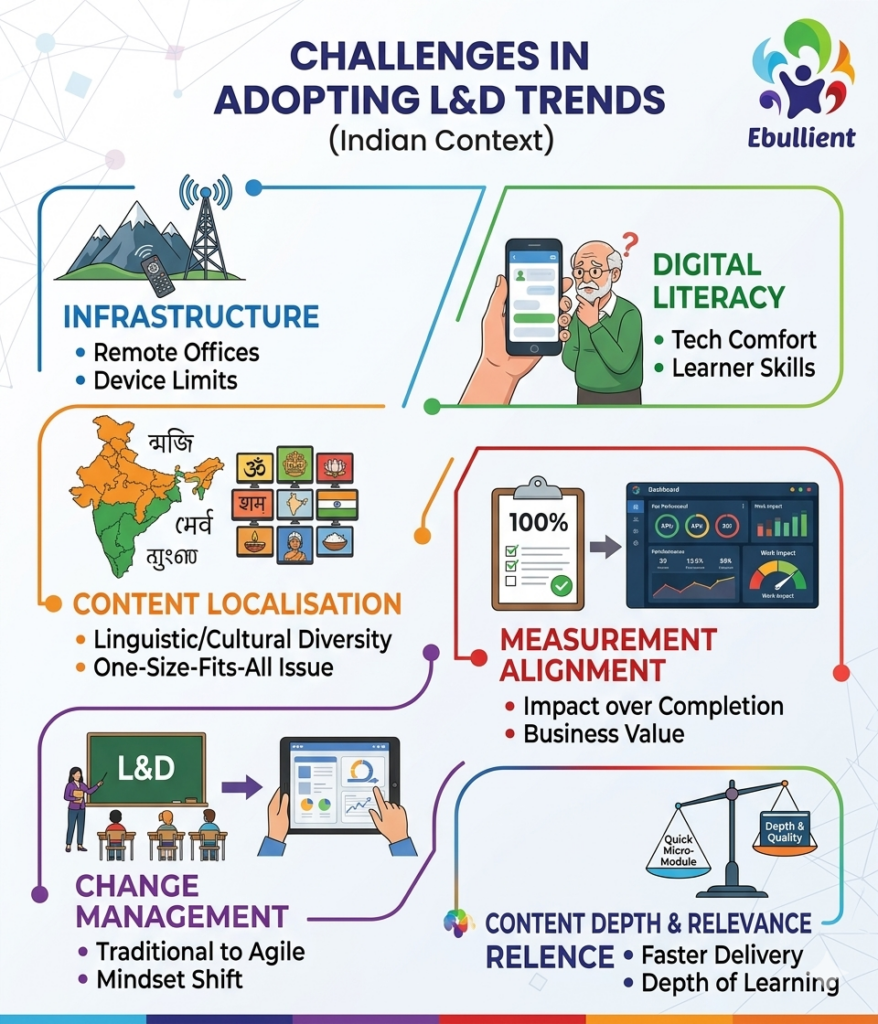
Infrastructure & connectivity: Remote offices or field teams may have connectivity issues or limited devices.
Digital literacy & comfort with technology: Some learners may be less comfortable with mobile or immersive formats.
Content localisation: India’s linguistic and cultural diversity means one-size content may not engage all segments.
Measurement & business alignment: Many organisations still focus on completion rather than impact—need to move to “what changed at work”.
Change management: Shifting from traditional classroom training to agile, blended, tech-driven models requires mindset change in L&D, trainers, managers and learners.
Maintaining quality and relevance: With faster delivery and micro-modules, ensuring depth and quality of content remains key.
Curious About Other Areas of Your Organization?
Explore our other free assessments and get a fuller picture of where you stand.
View All AssessmentsHow Businesses Can Prepare for the Future of Learning
To stay competitive in 2026 and beyond, organizations should keep moving forward for achieving organizational growth:
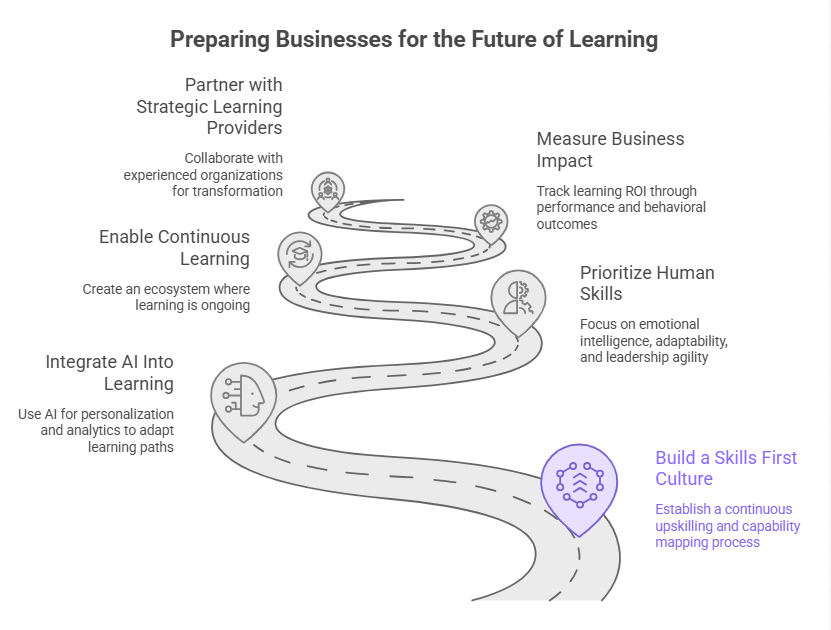
Build a Skills First culture
It is really more about going steady than sudden changes. Going steady means continuous upskilling and capability mapping.
Integrate AI Into Learning
By enabling AI-powered personalization and analytics, which can identify patterns earlier, and changing learning paths without waiting.
Prioritize Human Skills
It’s not about automation of tasks, which can go far, its about focusing on emotional intelligence, adaptability, and leadership agility.
Enable Continuous Learning
It’s where learning becomes an ecosystem rather than isolated training programs.
Measure Business Impact
Track learning ROI via performance and behavioral outcomes, and don’t rely only on course completion.
Partner with strategic learning providers
It works with experienced capability building organisations for both technology and human transformation, without forcing the process at a faster pace.
Source: Economic Times
Did You Know?
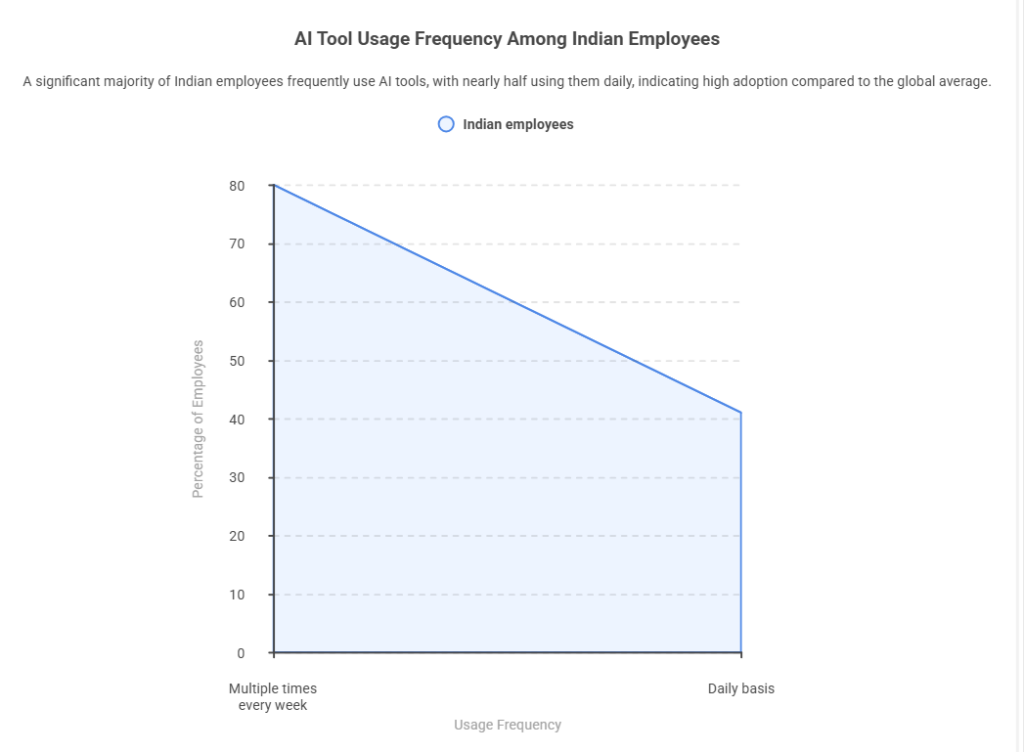
According to the 2026 ADP Research report, about 80% of Indian employees are using AI tools multiple times every week, while 41% interact with AI on a daily basis— which is far above the global average .
Final Thoughts
The future of corporate learning is not only training employees , it’s more like turning organisations into adaptive, resilient and innovation-driven ecosystems. When they embrace that, they can build agile and adaptable, very high-performing workforces, ready for what comes next.
That’s where Ebullient Consultancy LLP is adding real value to it by helping organisations rewire leadership, culture and capability so they can actually thrive at that awkward intersection of technological disruption, sustainability, and purpose-led transformation.
At Ebullient Learning, we’re focused on helping organisations in India convert learning into a competitive advantage . Let’s partner and design training programmes that are engaging and upskill people and drive measurable results.
Want to meet the team?
Start with a 30-min conversation. No commitment needed.
Frequently Asked Questions
What are the latest corporate training trends in India?
The top training trends in India include microlearning, blended and hybrid learning, AI-powered personalisation, immersive learning (AR/VR), and soft skills or leadership-focused programs. These approaches make corporate learning more flexible, impactful, and aligned with business needs.
Why is microlearning becoming popular in Indian companies?
Microlearning delivers short, focused learning modules that employees can complete quickly. With busy schedules and shorter attention spans, Indian professionals prefer quick, mobile-friendly lessons that can be applied immediately on the job.
What is blended learning, and how does it help organisations?
Blended learning combines instructor-led sessions with digital self-paced modules and practical, on-the-job learning. It helps organizations save costs, improve flexibility, and ensure consistent learning outcomes across offices and regions in India.
How is AI changing corporate learning in India?
Artificial Intelligence (AI) is transforming learning through personalization and analytics. AI tools can identify individual skill gaps, recommend tailored training modules, and measure learning impact—making corporate learning more efficient and data-driven.
What is immersive or experiential learning?
Immersive learning uses gamification, Augmented Reality (AR), and Virtual Reality (VR) to simulate real-world scenarios. It helps employees practice skills safely, engage deeply, and retain knowledge better—especially in technical, manufacturing, and leadership roles.