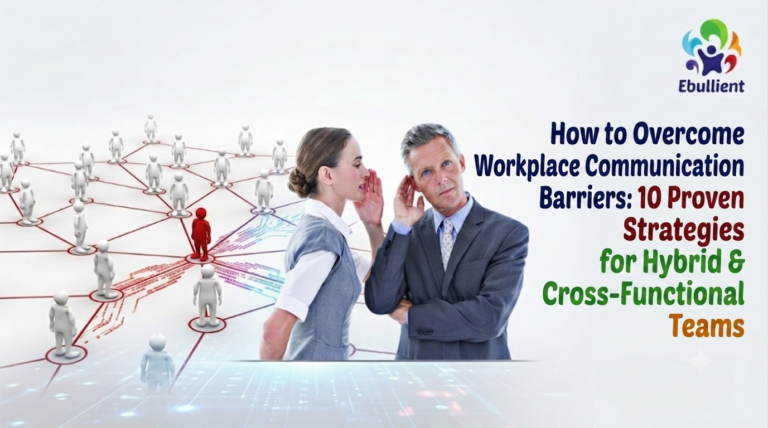
Communication barriers in the workplace overall reduces the productivity, rises conflicts, delay in decision-making process, and slow downs the employee engagement. Organisations can overcome these barriers by active listening, leadership communication training, digital collaboration tools, emotional intelligence development, and systematic feedback systems. In 2026, companies that are heavily investing in workplace communication skills and leadership communication strategies are outperforming competitors in employee retention, innovation, and team collaboration.
Key Takeaways — What You Will Learn
- Understand what the causes for communication challenges in the workplace.
- Explore the most common communication problems and solutions.
- Explore the psychological and organisational roots of communication barriers.
- Discover 10 evidence-based strategies that improve workplace communication.
- Explore the 3 key trends in communication in 2026, reshaping future workplaces.
- To know how Ebullient helps organisations build future-ready communication cultures.
What Are Workplace Communication Challenges?
Workplace communication challenges are barriers that prevent employees, managers, and teams from exchanging information successfully. These barriers may include: unclear messaging, poor listening skills, cultural differences, remote work boundaries, emotional misunderstandings, or inconsistent communication channels.
When these are left unresolved, communication barriers can lower productivity, escalate conflict, delay in decision-making, and negatively impact employee engagement.
Common Workplace Communication Challenges Include:
- Lack of active listening
- Misinterpretation of messages
- Hybrid and remote work
- communication gaps
- Cross-functional collaboration issues
- Cultural and language barriers
- Information overload
- Poor feedback mechanisms
- Emotional misunderstandings
When these left unaddressed, these barriers compound: a misinterpret slack message triggers a cross-department conflict; an unclear brief derails a three-week project; a leader who avoids difficult conversations breeds a team culture of guesswork.

Source: Avocor
Did You Know?
Grammarly and the Harris Poll did a report and it says that weak communication ends up costing companies around $12,506 per employee every year, kind of because of lost productivity and some workplace inefficiencies.
How the Communication Process Actually Breaks Down
Communication isn’t a one-way street. It’s a loop involving:
Sender – Creates the message.
Message – The actual content.
Channel – The medium (verbal, written, visual).
Receiver – The person interpreting it.
Feedback – The response to ensure clarity.
If any stage of this loop breaks down, barriers arise. This model makes it easier to identify where communication gaps occur—whether in delivery, understanding, or response.
10 Proven Strategies to Overcome Communication Barriers at Work

1. Practise Active Listening
Active listening means paying full attention, avoiding interruptions, and responding thoughtfully. It helps reduce misunderstandings and shows respect for the speaker.
2. Use Simple and Clear Language
Avoid jargon and overly technical terms. Keep your language straightforward so everyone, regardless of background, can understand.
3. Align Verbal and Non-Verbal Cues
Body language, tone of voice, and gestures should match your words. Mixed signals can create doubt or confusion.
4. Adapt to Your Audience
Different groups require different approaches. Tailor your communication style to the cultural background, preferences, or knowledge level of your audience.
5. Encourage Feedback
Invite others to share their thoughts or questions. Feedback ensures that the message is not only received but also correctly understood.
6. Show Empathy
Put yourself in others’ shoes. Empathy builds trust, reduces conflict, and makes conversations more meaningful.
7. Clarify Misunderstandings Quickly
If confusion arises, address it immediately with questions or explanations. The longer it lingers, the greater the misinterpretation.
8. Stick to One Message at a Time
Overloading people with too much information creates confusion. Focus on one idea, ensure clarity, then move to the next.
9. Use Visual Aids
Charts, diagrams, or infographics can simplify complex ideas and improve retention.
10. Stay Calm Under Pressure
Stressful situations often cause communication breakdowns. Remaining calm and composed allows for clearer, more effective dialogue.
3 Real-World Workplace Communication Scenarios (And How to Solve Them)
Strategy is useful in scenarios . Below are 3 of the most common workplace communication challenges organisations face today, along with practical, proven responses.

Scenario 1 : Communication Breakdowns in Hybrid Teams
A lot of organisations now run on hybrid setups, where some people work remotely while others are physically in the office. What is happens in informal conversation get made during these more casual discussions. And leaving remote employees feeling excluded.
Solution :
- Put clear communication rules in place
- Write down decisions in shared areas that everyone can access,
- Encourage video-enabled discussions when it actually matters most
- Create structured feedback cycles
Business Impact :
It helps with transparency, makes collaboration smoother, and keeps the team on the same track.
Scenario 2 : Cross-Functional Communication Friction
Teams like Marketing, Operations, Finance, and HR don’t always chase the same outcomes. They also track success using different performance metrics. Because of that, it creates misunderstandings and conflicting expectations.
Solution :
- Define common goals
- Hold regular alignment meetings
- Use of common project dashboards across teams
- Encourage active listening and clarification
Business Impact :
Less waiting time, fewer duplicated efforts, and fewer project bottlenecks overall.
Scenario 3 : Leadership Communication During Change
When organisations go through transformations, employees often feel uncertainty due to insufficient communication.
Solution :
- Communicate more often and with transparency
- Tackle employee concerns proactively
- Encourage two-way communication,
- Repeat and reinforce the key messages consistently
Business Impact :
It builds trust, and it reduces resistance to change.
The Role of Emotional Intelligence in Overcoming Communication Barriers
Emotional Intelligence (EI) is the ability to understand and manage emotions—both your own and others’. High EI improves communication by:
-
Responding with empathy.
-
Managing conflict with composure.
-
Reducing emotional tension.
-
Creating safe spaces for open dialogue.
In 2026, EI is consistently rated among the top leadership capabilities by HR leaders in India. Ebullient consultancy blends EI development into all communication and leadership programmes because it is not a trait you have or don’t — it is a skill that enhances with deliberate practice.
3 Communication Trends Reshaping Workplaces in 2026
The workplace communication landscape is rapidly evolving . Here are 3 key trends in communication in 2026, that are shaping modern organisations in a noticeable way.

1. AI-Assisted Communication
AI tools are helping teams in the usual ways, like:
- Summarise meetings
- Promote writing clarity
- Translate conversations
- Personalise communication
AI-powered communication platforms are enhancing productivity, while also dialing back that whole communication overload thing.
2. Human-Centric Leadership Communication
Employees are starting to expect more than just updates. Like :
- Transparency
- Empathy
- Real-time feedback
- Authentic leadership communication
Because of that shift, there’s also growing demand for the best leadership development programs, centered on emotional intelligence and people-first leadership.
3. Hybrid Collaboration Optimisation
Organisations are redesigning their communication systems for hybrid work environments, adjusting how information moves between people.
This includes:
- Asynchronous communication strategies
- Digital collaboration frameworks
- Virtual engagement practices
- Hybrid leadership
- communication skills
Organisations are transforming their communication architectures for hybrid-first: asynchronous-by-default, documented decisions, structured feedback rhythms, and virtual engagement practices that give remote employees actively participation rather than observer status.

Source: Salesforce
Did You Know?
Salesforce research says that about 86% of employees and executives mention poor collaboration along with ineffective communication as the main cause of workplace failures.
How Organisations Can Build Stronger Workplace Communication Skills
Individual communication coaching helps in improving systemic change lasts. Here is what organisations that develop durable communication cultures do differently:

- Create communication frameworks, so you can standardise what’s expected, and also which channels get used in practice.
- Train managers continuously, because managers shape those everyday employee communication experiences in ways people don’t always notice.
- Encourage a feedback culture, by building systems that support open and honest communication. not just “suggestions”, but real, two-way exchange.
- Use technology strategically, adopt tools that make collaboration easier rather than adding extra overload, and you know, keep it aligned with actual work.
- Invest in leadership development, integrate communication into leadership capability building initiatives, so it’s not treated as separate.
Overall, developing workplace communication skills is now a strategic business priority instead of a soft-skill luxury.
How Ebullient Helps Organisations Build Future-Ready Communication Cultures
At Ebullient, we specialise in helping organisations strengthen workplace communication through customised, research-driven training programmes. Our focus is on building skills that directly improve collaboration, trust, and performance across teams.
At Ebullient, we help organisations stumble through workplace communication issues by boosting both human capability, and the organisational culture.
Our programmes:

Leadership Reforging
We build adaptive leaders who can communicate when the ground is moving, under uncertainty, without losing the thread.
Cultural Rewiring
We take those rigid communication structures and turn them into more cooperative, ecosystem like ways of working.
Team Alchemy
We strengthen trust, psychological safety, and the shared intelligence that shows up when people feel safe enough to think together.
Future Mindsets
We help teams unlearn old communication habits, and relearn more flexible behaviours, so the next conversations land better.
By equipping leaders, managers, and employees with practical tools and strategies, Ebullient empowers organisations to break down communication barriers and nurture a culture of transparency and inclusivity.
Build Stronger Workplace Communication Skills Across Your Organisation
Overcoming communication barriers requires practical skill development, leadership readiness, and continuous reinforcement.
Ebullient’s Communication Skills and Capability Building programs support organisations to strengthen:
- Active listening
- Organisational communication
- Improving Feedback conversations
- Cross-functional collaboration
- Stakeholder management
- Emotional intelligence
Whether your goal is to foster collaboration, build leadership communication, or create a high-performance culture, our offering of learning solutions helps employees communicate with clarity, confidence, and impact.
Ready to Build a High-Communication Culture?Whether your challenge is hybrid team alignment, cross-functional friction, or leadership communication during change, Ebullient has a Capability Building solution designed for it. |
Final Thoughts
Overcoming communication barriers is not about speaking more — it is about creating situation where the right information reaches the right people at the right time, in a form they can act on.
In 2026, the organisations that will outperform their peers are not the loudest or the most technologically advanced. They are the ones that have built cultures of clear, empathetic, and purposeful communication — from the front-line manager to the boardroom.
At Ebullient Consultancy, we believe communication is all about humanising work itself.
Because the organisations that will thrive in the future are not really important for the fastest or technologically advanced, but the ones that can create trust, meaning, adaptability, and human connection at large scale.
By implementing the right strategies, investing in the best workplace communication training, and promoting leaders through the best leadership development programs, businesses can transform communication challenges and gain a competitive edge.
Frequently Asked Questions
Get answers to commonly asked questions about Ebullient.
Are communication gaps creating conflicts across departments?
What are the biggest communication barriers in the workplace?
Mostly the barriers come from language differences, unclear messages, emotional barriers, cultural differences, poor listening habits, too much information at once, and lack of follow-up or feedback.
How do managers overcome communication challenges?
Managers usually do better when they focus on active listening, tweak their communication style, encourage feedback, clarify expectations early, and keep the conversation open, maintaining steady dialogue across the team.
Why is communication important in hybrid workplaces?
Hybrid workplaces lean heavily on digital collaboration, calls, chats, and all those tools. When communication is effective, people stay aligned, misunderstandings drop, engagement gets stronger, and productivity across the teams.
What communication skills are most important for leaders?
Leaders often gain the most from active listening, empathy, the ability to influence, feedback that lands well, conflict resolution, executive presence, and skills for communicating change.