
In the modern workplace, success depends not just on what employees know—but on how quickly they can learn, adapt, and apply new skills. The business environment is evolving faster than ever, and organizations that cling to one-time training sessions are being outpaced by those that foster a continuous learning culture.
Building a learning culture means going beyond traditional training programs. It’s about creating an ecosystem where curiosity is encouraged, mistakes become opportunities, and development is part of everyday work life. When learning becomes a habit, transformation follows naturally.
This blog explores how organizations can move from training to transformation, the key principles of a strong learning culture, and practical steps to make it part of your company’s DNA.
1. What Is a Learning Culture?
A learning culture is an organizational mindset where employees are empowered and motivated to continuously acquire new skills and knowledge. It’s not just about sending employees to workshops—it’s about fostering an environment where learning is ongoing, accessible, and valued at every level.
In such cultures:
-
Leaders act as mentors, not just managers.
-
Mistakes are seen as lessons, not failures.
-
Learning is embedded into workflows, not an afterthought.
-
Curiosity, experimentation, and innovation are encouraged.
When employees feel supported in their growth, they perform better, stay longer, and help the organization stay agile in changing markets.
2. Why Traditional Training Isn’t Enough Anymore
For decades, corporate training focused on isolated workshops or annual skill sessions. While these were useful, they rarely created lasting change.
Here’s why that old approach falls short:
-
One-time training doesn’t stick: Without reinforcement, most employees forget 70% of what they learn within a week.
-
It lacks relevance: Generic training modules don’t align with employees’ day-to-day challenges.
-
It misses engagement: Learning shouldn’t feel like a chore; it should feel purposeful and connected to career growth.
To thrive in today’s dynamic world, companies must shift from a training-centric approach to a learning-centric one—where development is continuous, personalized, and performance-driven.
3. Why a Learning Culture Matters More Than Ever
In 2025 and beyond, the half-life of skills is shrinking. According to LinkedIn Learning, nearly 50% of employees will need reskilling by 2027 due to automation and AI.
A learning culture helps companies:
-
Stay competitive: Continuous learning drives innovation and adaptability.
-
Retain top talent: Employees are more loyal to companies that invest in their growth.
-
Boost productivity: Ongoing learning enhances problem-solving and decision-making skills.
-
Support digital transformation: Learning-ready teams embrace new tools and technologies faster.
In short, a learning culture turns uncertainty into opportunity.
4. The Pillars of a Strong Learning Culture
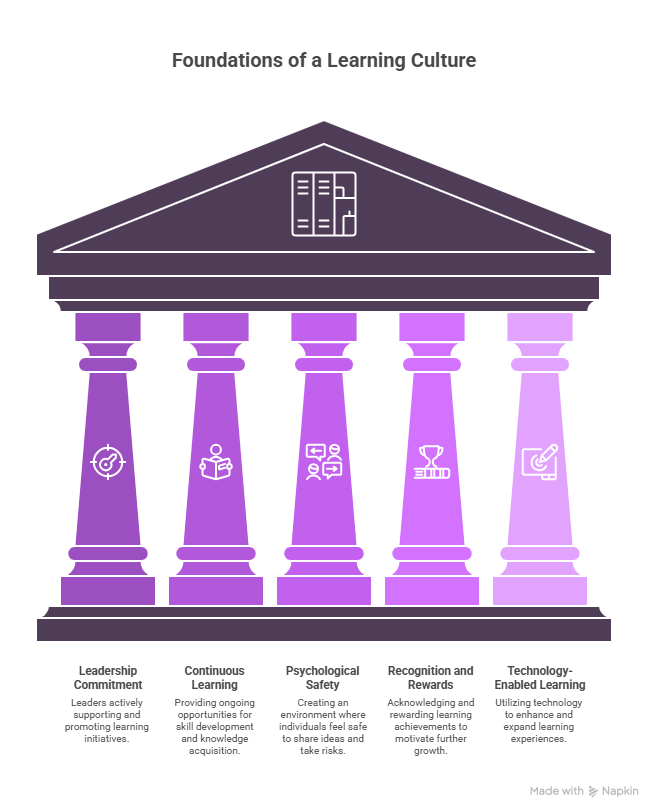
Building a learning culture requires intention and structure. Here are the key pillars that form its foundation:
1. Leadership Commitment
Leaders must champion learning by example. When managers actively participate in learning, it signals that growth is a shared value—not just a policy.
2. Continuous Learning Opportunities
Offer microlearning modules, mentorship programs, and access to digital learning platforms. Short, flexible lessons make it easy for employees to learn in the flow of work.
3. Psychological Safety
Employees must feel safe to ask questions, admit knowledge gaps, and experiment without fear of failure. This fosters curiosity and innovation.
4. Recognition and Rewards
Celebrate learning milestones. Recognize employees who upskill, share knowledge, or apply new ideas. Recognition reinforces positive behavior.
5. Technology-Enabled Learning
Leverage AI-driven learning platforms, virtual classrooms, and mobile tools to personalize and scale learning opportunities across departments.
5. How to Build a Learning Culture: Step-by-Step
Here’s a practical roadmap for moving from training to transformation.
Step 1: Redefine Learning as a Strategic Priority
Learning should not be a side initiative—it must align with business goals. Leaders should articulate how learning contributes to performance, innovation, and growth.
Step 2: Conduct a Skills Gap Analysis
Identify current and future skill needs across teams. This helps design focused learning programs that bridge real performance gaps.
Step 3: Empower Managers as Learning Coaches
Managers are the link between strategy and execution. Train them to provide feedback, mentor employees, and encourage reflective learning.
Step 4: Integrate Learning into Daily Workflows
Encourage “learning in the flow of work.” For example:
-
10-minute learning videos before project meetings
-
Quick e-learning modules in collaboration tools
-
Peer-learning discussions after projects
Step 5: Foster Peer-to-Peer Learning
Create opportunities for knowledge sharing through internal webinars, buddy systems, and team-based challenges. Learning from colleagues is both relatable and practical.
Step 6: Measure and Celebrate Learning Outcomes
Use metrics like skill growth, engagement scores, and innovation rates to evaluate success. Recognize individuals who demonstrate learning agility.
Step 7: Build a Feedback-Driven Environment
Encourage open dialogue about what’s working and what’s not. Continuous feedback keeps learning relevant and adaptable.
6. Real-World Example: How Learning Cultures Drive Transformation
Consider companies like Infosys, TCS, and Wipro, which have made learning a strategic priority. Their internal academies and digital platforms allow employees to continuously upskill in AI, data, and leadership.
This investment pays off in:
-
Faster innovation cycles
-
Higher employee satisfaction and retention
-
Stronger adaptability to market shifts
These examples show that when learning becomes part of daily culture, transformation follows organically.
7. Common Barriers to Building a Learning Culture
Even with the best intentions, many organizations struggle to create a sustained learning environment. Common barriers include:
-
Lack of leadership buy-in – When leaders don’t model learning behavior.
-
Limited time – Employees feel overloaded and can’t prioritize learning.
-
Fear of failure – Rigid work environments discourage experimentation.
-
Outdated technology – Poorly designed platforms make learning tedious.
Overcoming these requires strategic alignment, leadership advocacy, and making learning both accessible and rewarding.
8. The Future of Learning: Personalization and Purpose
The next generation of learning cultures will be personalized, data-driven, and purpose-led. AI and analytics will tailor learning paths for each employee based on their roles, aspirations, and performance.
But the most successful organizations will go beyond technology. They’ll make learning a shared purpose, where employees see growth as part of their identity and contribution to something larger.
Final Thoughts
Transitioning from training to transformation is not about adding more courses—it’s about reimagining how your organization learns, grows, and evolves.
A true learning culture empowers people to think independently, share knowledge freely, and adapt confidently to change. When employees grow, organizations transform—and that’s where the real competitive advantage lies.
If you’re ready to build a future-ready learning culture and turn training into transformation, explore expert-driven leadership and learning solutions at 👉 ebullient.in.
FAQs
1. What is the difference between training and a learning culture?
Training is event-based, while a learning culture is continuous. Training imparts specific skills; a learning culture encourages lifelong development and adaptability.
2. How can leaders promote a learning culture?
Leaders can promote it by modeling learning behavior, providing growth opportunities, and recognizing employees who take initiative to learn.
3. What are the benefits of having a learning culture?
It improves employee engagement, drives innovation, reduces turnover, and helps organizations adapt to technological and market changes.
4. What role does technology play in a learning culture?
Technology enables personalized, scalable, and flexible learning experiences—making continuous development accessible to all employees.
5. How do you measure a learning culture’s success?
Track skill acquisition, employee engagement, innovation output, and internal promotion rates as indicators of cultural and performance transformation.