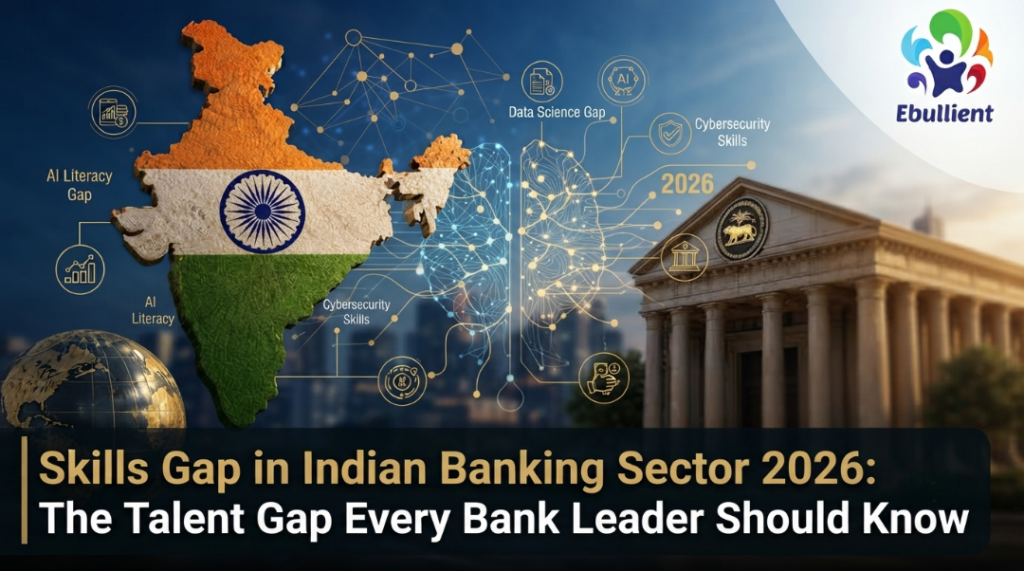
The skills gap in the Indian banking sector is the measurable mismatch between what banking professionals currently know, and what modern financial operations really need. In 2026 , this gap cuts across digital literacy, AI in banking fluency, regulatory compliance, and advisory communication, putting productivity, audit readiness, and competitive positioning at direct risk across public and private sector banks alike.
Key Takeaways at a Glance
Key Takeaway | Why It Matters |
The skills gap in Indian banking sector spans digital, compliance, and behavioural dimensions. | All three must be addressed together. Fixing one in isolation does not move the needle. |
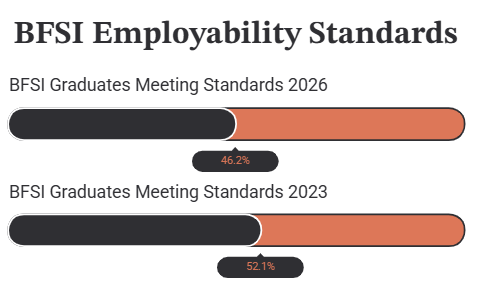
India Skills Report 2026 places BFSI employability at just 46.2%—lowest in three years. | Nearly six in ten BFSI candidates do not meet current employer standards. The pool is shrinking as demands rise. |
AI in banking is redesigning roles, not replacing them. | Employees now need AI-adjacency skills—critical thinking, judgement, and communication around algorithmic outputs. |
Most in-demand BFSI skills: generative AI fluency, DPDP Act compliance, consultative selling, cybersecurity. | These four skill clusters cut across front office, operations, and risk functions simultaneously. |
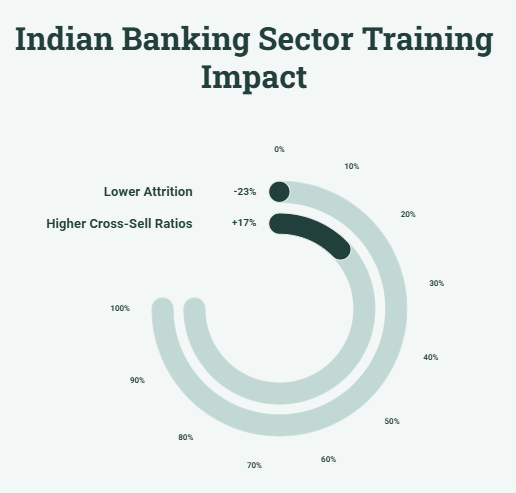
Banks with structured training spend ₹18,000+ per employee annually report 23% lower attrition. | Retention pays for training within months. Attrition at the cost of re-hiring and re-onboarding is far more expensive. |
Ebullient Consultancy delivers role-mapped, outcome-driven BFSI training with L1–L4 measurement. | Board-reportable ROI evidence—not just completion rates—makes the L&D investment defensible at every level. |
Why Is the Skills Gap in Indian Banking Sector Widening in 2026?
The skills gap in Indian banking sector is widening because technology adoption is moving ahead of structured upskilling. Rapid digitisation and the continuing shift in RBI mandates, and the integration of AI in banking, have made role demands that the older training programmes weren’t built for. So, frontline staff, relationship managers, and compliance teams are being pulled in two directions at once over-deployed and under-equipped.
Between 2022 and 2025, Indian banks rolled out more than 14,000 AI enabled touchpoints across retail lending, fraud detection, and customer onboarding. But internal capability building doesn’t usually keep up. For example, branch-level employees who handle cross selling of digital products say they are evaluated on systems they were never properly trained to use.
Relationship managers face mounting pressure to deliver financial planning advisory without the consultative skill frameworks to do so credibly. This disconnect is compounding at scale. The Reserve Bank of India’s push for stronger cybersecurity protocols, combined with SEBI’s evolving compliance requirements, has created an entirely new category of regulatory skills that most banks are scrambling to source externally—at considerable cost and with limited long-term impact.
In our experience implementing banking workforce development programmes for mid-size and large financial institutions, the most critical failure point is not willingness to learn. It is the absence of a structured, role-mapped learning architecture. Banks invest heavily in platforms. They rarely invest in learning design that connects platform usage to measurable behavioural outcomes.
Source: ISR
Did You Know?
According to the India Skills Report 2026 PDF, only 46.2% of banking and financial services graduates actually meet the present industry employability standards, and it’s down from 52.1% in 2023. Now the BFSI workforce seems to be staring at its most serious competency gap in more than a decade, deficits in data literacy, being skilled with AI tools, and handling regulatory compliance handling.
What Does the India Skills Report 2026 Reveal About BFSI Workforce Readiness?
The India Skills Report 2026 PDF it looks like BFSI workforce readiness has been declined for the third consecutive year. The most severe deficits sit in data interpretation, AI tool proficiency, regulatory compliance, and behavioural selling—four areas that directly affect revenue performance, audit scores, and customer retention across Indian banks.
The report draws from over 3.8 lakh students and 600+ employers. For BFSI specifically, experienced professionals show alarming gaps in reskilling speed. Banks that previously relied on tenured employees to carry institutional knowledge are discovering that this knowledge is becoming obsolete faster than individuals can absorb new frameworks.
Skill Category | Current BFSI Proficiency | Industry Requirement | Gap Severity |
Digital Product Knowledge | 38% | 75%+ | Critical |
Regulatory & Compliance Fluency | 52% | 85%+ | High |
Data Literacy & Analytics | 29% | 65%+ | Critical |
Consultative Selling & Advisory | 44% | 70%+ | High |
Cybersecurity Awareness | 31% | 70%+ | Critical |
AI Tool Proficiency | 22% | 55%+ | Severe |
This is not a pipeline problem. Indian banks are not short on people. They are short on people equipped to do what modern banking now demands at every role level.
Source: RBL
Did You Know?
A 2025 analysis of the Indian banking sector, done by FICCI and EY, mentioned that banks spending above ₹18,000 per employee each year on more structured training saw about 23% lower attrition, and also around 17% higher cross-sell ratios compared to peers who were basically running ad-hoc training models. Really, the skills gap in the Indian banking sector is, at its core, a direct business performance issue.
The Hidden Compliance Training Deficit: Why Regulatory Gaps Are the Costliest Skills Failure
This is the dimension of the skills gap in Indian banking sector that most Indian banking sector weekly roundups and sector reports consistently underreport. While industry conversations focus on digital literacy and AI in banking, compliance training deficits carry immediate legal and financial consequences—yet receive the least structured attention in most L&D calendars.
RBI’s framework on KYC, AML, and data localisation has evolving since 2022. The revised Cybersecurity Framework for banks, that was updated in 2024, did bring new expectations too like vendor risk management, incident response timelines and board level reporting.These are not skills an employee acquires from a one-hour e-learning module. They require applied scenario training, case-based assessments, and structured reinforcement cycles with manager accountability.
In our experience working with financial firms on compliance capability-building, the training gap typically runs three years behind the regulatory curve. A branch operations officer trained to 2022 compliance standards is operating with outdated mental models in a fundamentally changed environment. Multiply that across thousands of employees, and the institutional risk is substantial—and largely invisible until an audit surfaces it.
Banking skill development in India must treat compliance upskilling as a core business function. Treating it as a pre-audit checkbox exercise is precisely why the skills gap in Indian banking sector in this domain keeps widening.
Which BFSI Skills Are Most In Demand Across Indian Banks Right Now?
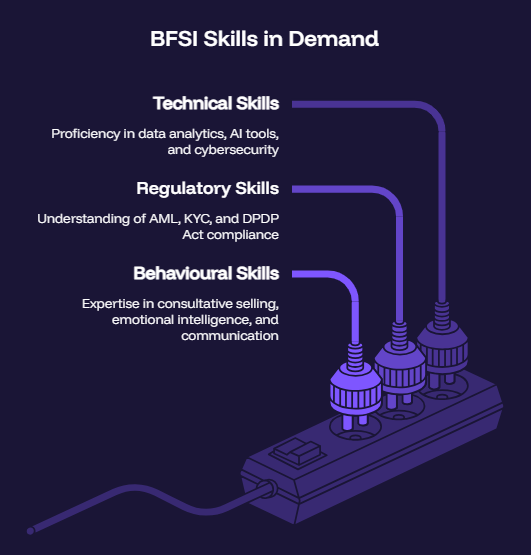
The most sought-after BFSI skills in demand in 2026 span three dimensions: technical (data analytics, AI tool fluency, cybersecurity), regulatory (AML, KYC, DPDP Act compliance), and behavioural (consultative selling, emotional intelligence, advisory communication). Banks addressing all three through integrated banking employee training programmes consistently outperform those treating each dimension as a separate, disconnected initiative.
Technical Skills in Demand
Generative AI and co-pilot tool proficiency for credit underwriting and customer service workflows now sits near the top of every BFSI recruiter’s shortlist. Data-driven decision-making using core banking analytics dashboards, cloud security hygiene, endpoint protection awareness, and vendor risk management follow closely. These are threshold competencies in 2026—not advanced differentiators.
Regulatory Skills in Demand
DPDP Act 2023 data handling and consent management protocols, AML/CFT risk identification, internal audit readiness, and documentation rigour have all intensified as priorities. Candidates who cannot speak fluently about these areas in an interview are being screened out—a reality that reflects how seriously regulators and boards are now treating compliance capability.
Behavioural Skills in Demand
Consultative sales methodology for wealth management and insurance cross-sell, conflict resolution under pressure, and change management capability at the team leader and branch manager level round out the picture. The bfsi skills landscape has shifted so sharply since 2023 that banks are now evaluating behavioural competencies at the same rigour as technical ones during structured assessment centres.
How Can Banks Close the Skills Gap in Indian Banking Sector?
Banks needs to aligns capability strategy that blends with technical upskilling, leadership development, cultural transformation, and on-going learning.
Five Priorities for Banking Leaders:
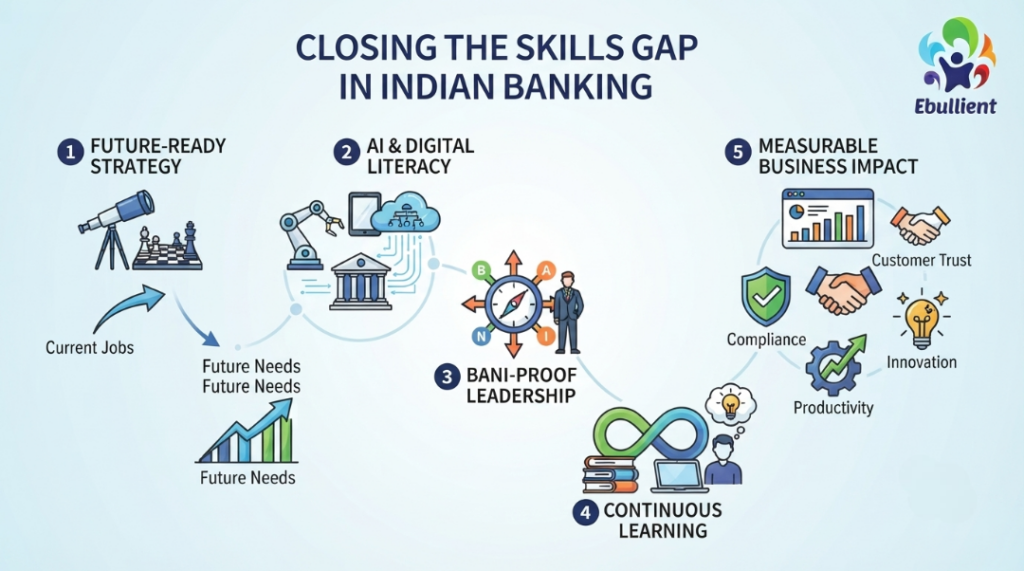
- Assess future capability needs, not only what the current job requirements.
- Building AI readiness and digital literacy across all functions.
- Growing amongst the leaders which can handle BANI conditions.
- Set up continuous learning ecosystems, not just one time training session.
- Track the learning business outcomes which includes: customer trust, compliance, productivity, and also innovation results.
Source: ET
Did You Know?
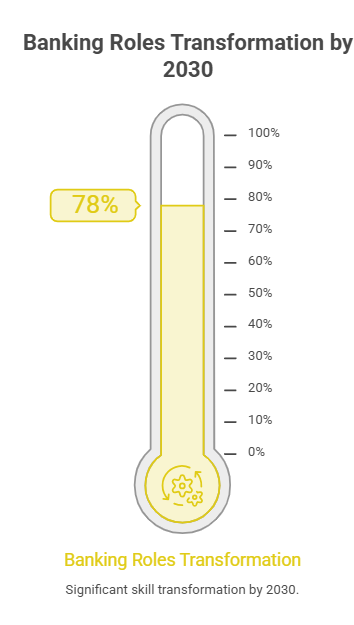
Industry estimates suggest that over 78% of banking roles will have significant skill transformation by 2030, because of automation , AI , digital banking, and also the changing regulatory requirements.
How Is AI in Banking Reshaping Future Skills Requirements?
AI in banking is not reducing the jobs—but it’s remapping them. Relationship managers, credit analysts, and operations staff now need the ability to interpret AI-generated outputs, apply human judgement to algorithm-driven recommendations, and communicate those decisions to customers with credibility and clarity. This is an entirely new skill layer—and no previous generation of banking employee training was built to develop it.
The integration of AI across fraud detection, loan origination, and personalised product recommendations has created a critical operational paradox: employees are now accountable for outcomes driven by systems they were never trained to understand. This is precisely where the skills gap in Indian banking sector becomes an operational and reputational risk rather than merely a performance gap.
Future skills in banking will centre on what researchers are calling ‘AI adjacency’—the human capabilities that complement, verify, and contextualise machine outputs. Critical thinking, ethical judgement in data use, and the ability to translate algorithmic insights into customer-facing language are the defining competencies of this phase. They cannot be automated. They must be deliberately trained.
According to an Indian banking sector analysis produced by IBA in 2025, 68% of senior banking executives said “inability to work effectively alongside AI tools” was their single biggest workforce concern for the next three years. Now, banks that start embedding AI literacy into the workforce development playbooks for banking will, in a measurable way, carry a talent advantage by 2028 . Those that defer aren’t just falling behind, they’re actually stacking a shortfall with serious knock-on effects across audit, customer experience and digital transformation returns ROI .
How Ebullient Consultancy Addresses the Skills Gap in Indian Banking Sector?
Ebullient Consultancy designs and delivers structured capability-building programs for BFSI organisations navigating through complex workforce transitions. Our work operates on three core pillars that establish us as a trusted provider of best banking skill development training in India.
Our purpose is to help leaders and organizations learn, decide, and act under deep ambiguity at the intersection of digital transformation, sustainability, and human purpose.
We help financial institutions move beyond conventional training toward capability transformation through:
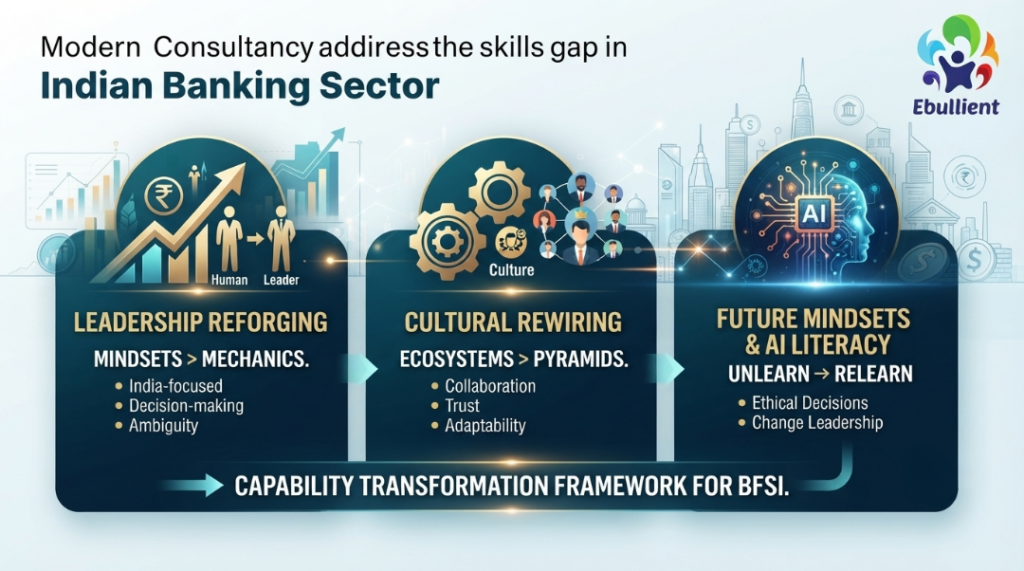
Leadership reforging (mindsets > mechanics)
Cultural rewiring (ecosystems > pyramids)
Team alchemy (trust > KPIs)
Future mindsets (unlearn → relearn)
AI literacy and ethical decision-making
Change leadership for BFSI organizations
Our mission is to humanize technology, corporations, and society so that AI becomes an amplifier of human dignity, creativity, and care rather than a substitute for them.
Whether your institution is addressing the skills gap in Indian banking sector in frontline sales capability, compliance readiness, leadership development, or AI fluency, Ebullient Consultancy builds programmes that close the gap and produce documented business impact—the kind that belongs in board presentations, not just L&D dashboards.
Banking skill development in India sits at a genuine inflection point in 2026. Banks that design role-aligned, outcome-driven training ecosystems now will absorb the next wave of regulatory change, technology disruption, and talent competition without losing operational ground. Those that defer will face mounting costs—in audit penalties, customer attrition, talent loss, and delayed returns on technology investment.
Is Your Bank Ready to Close the Skills Gap Before It Impacts Business Performance?
Frequently Asked Questions
Get answers to commonly asked questions about Ebullient.
What is the primary cause of the skills gap in Indian banking sector in 2026?
The skills gap in Indian banking sector in 2026 is primarily driven by the pace of digital transformation AI in banking, while at the same time training for banking employees doesn’t scale in a structured way. On top of that, regulatory complexity keeps moving faster than internal capability-building cycles, so the deficit adds up across technical, compliance, and behavioural dimensions—often within the same role.
Which roles in Indian banks face the highest skills gap right now?
Credit analysts, relationship managers, branch operations officers, and the compliance teams are facing the sharpest competency shortfalls. These positions now require a blended set of technical, regulatory, and behavioural bfsI skills that traditional training frameworks were not designed to develop—or measure.
Why is AI increasing the skills gap rather than eliminating jobs?
AI does repetitive task, automates repetitive work while increasing demand for analytical thinking, ethical judgment, customer advising talent, and the technology oversight. So the employees really do need new skills, so they can working effectively alongside intelligent systems.
How can banks improve workforce capability?
Banks can improve by funding structured banking employee training, leadership development, personalized learning journeys, AI readiness programs , continuous upskilling, and capability checks that match business priorities.
Why should organizations partner with Ebullient Consultancy?
Ebullient Consultancy supports organizations in designing customized workforce capability solutions, in a way that strengthens leadership, accelerates digital transformation, lifts employee performance, and builds future ready banking talent—aligned to measurable business outcomes.