
Every organisation has people who think, learn and communicate differently. Some process information best in writing, some need quiet to concentrate, and some find open-ended meetings exhausting. Many of them have developed clever ways to cope, and many never tell their employer why.
That silence has a cost. Employees spend energy hiding how they work, managers misread style differences as attitude problems, and organisations lose access to talent they already employ. Neuroinclusion is the practice of designing work so that people with different ways of thinking, including autistic, ADHD, dyslexic and other neurodivergent colleagues, can do their best work.
This guide explains what neuroinclusion means in practice for Indian organisations, what research tells us, and how managers and L&D teams can start with simple, low-cost steps.
Key Takeaways at a Glance
- Neurodivergent employees are already in your workforce, and many hide it. Disclosure feels risky, so they mask.
- Managers are the pivot. Surveys find employers rate their readiness higher than neurodivergent employees do, and a third of workers say managers are poorly trained.
- Most adjustments are cheap and help everyone. Clear agendas, written instructions, quiet spaces and flexible schedules benefit the whole team.
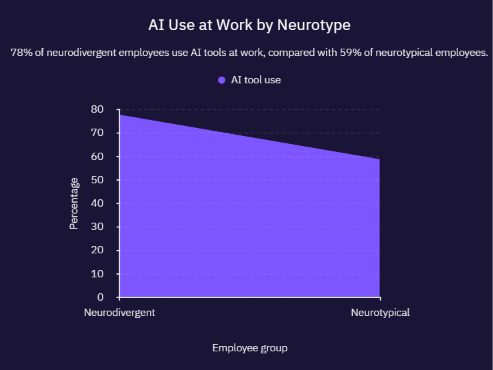
- AI is an emerging enabler. In a 2026 US survey, 78% of neurodivergent employees use AI tools at work, against 59% of neurotypical employees.
- Culture decides disclosure. People speak up where leaders have earned trust and psychological safety.
Why Do Neurodivergent Employees Stay Quiet?
A Gallup survey, reported by HRKatha in December 2025, found that only 3% of neurodivergent respondents believe disclosing their condition to a potential employer would be an advantage. About 46% believe it would be a disadvantage, and 51% say it depends on the employer. The same research found that 37% choose not to tell even their coworkers after being hired.
Their reasons are practical. People fear being seen as difficult, high-maintenance or less capable. The result is masking: suppressing natural behaviours to appear neurotypical. Masking takes constant effort, and it adds stress to the day without improving the work.
The lesson for leaders is that silence does not mean there is no need. In most organisations, it means the culture has not yet made it safe to speak.
Source: Understand.org
DID YOU KNOW?
AI is levelling the playing field for many neurodivergent employees. Understood.org’s third annual Neurodiversity at Work survey, conducted by The Harris Poll in March 2026 among 2,073 US adults (614 neurodivergent) and released on 12 May 2026, found that 78% of neurodivergent employees use AI tools at work, compared with 59% of neurotypical employees. About 61% of US adults believe AI helps level the playing field for people who learn and think differently.
How AI-Ready Is Your Organization, Really?
Take our free 4-minute assessment and get a personalized report on your leadership fluency, governance, and workforce readiness.
Take the Free AI Readiness Assessment →What Does the Law in India Say?
India’s Rights of Persons with Disabilities Act, 2016, recognises several conditions relevant to neurodiversity, including autism spectrum disorder, specific learning disabilities such as dyslexia, and chronic neurological conditions. It prohibits discrimination and expects reasonable accommodation, and it provides for reservation of government vacancies for persons with benchmark disabilities.
How these provisions apply to your organisation depends on its type, size and sector, so ask your legal team to confirm. Whatever the legal minimum, inclusive practice usually goes further.
What Does a Neuroinclusive Workplace Look Like?
It looks less like a special programme and more like good design that works for many people. Common features include:
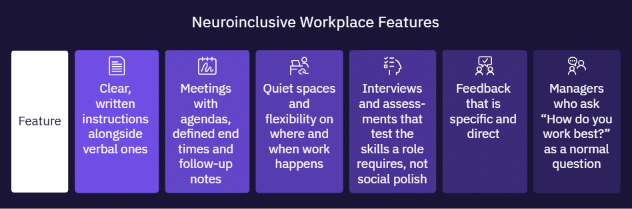
- Clear, written instructions alongside verbal ones
- Meetings with agendas, defined end times and follow-up notes
- Quiet spaces and flexibility on where and when work happens
- Interviews and assessments that test the skills a role requires, not social polish
- Feedback that is specific and direct
- Managers who ask “How do you work best?” as a normal question
Source: Pr Newswire
DID YOU KNOW?
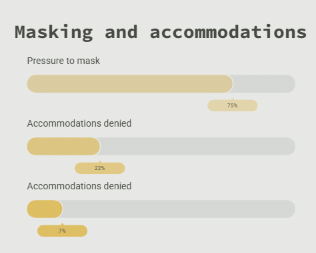
Masking remains widespread, especially for women. The same survey found that three in four neurodivergent women (75%) feel pressure to mask or conform to neurotypical behaviour at work. Among those who requested accommodations, 22% of neurodivergent women said they were denied, compared with 7% of neurotypical women.
An Accommodation Menu: Common Needs and Practical Fixes
Adjustments are usually simple. Use this table as a starting point, and always ask the individual what helps.
Common Challenge | Practical Adjustment | Who Else Benefits |
Processing long verbal instructions | Share key points in writing and allow time to respond | Everyone, especially remote teams |
Difficulty focusing in a noisy space | Quiet zones, noise-cancelling headphones, flexible remote days | Anyone doing deep work |
Long meetings and unclear agendas | Agendas in advance, shorter meetings, written notes afterwards | All attendees |
Reading and writing load (for example dyslexia) | Text-to-speech and dictation tools, extra time for written tasks | Employees working in second languages |
Task planning and prioritisation | Checklists, shared task boards, regular check-ins | New joiners and busy managers |
Sensory sensitivity (light, sound) | Lighting changes, seating options, break flexibility | Whole team |
Ambiguous feedback | Specific, example-based feedback and written follow-up | All employees |
Unstructured interviews | Skills-based tasks, questions shared in advance | All candidates |
Many of these cost little or nothing. Their main requirement is that managers are willing to ask and adapt.
Say This, Not That: Language That Builds Trust
The words managers choose make disclosure easier or harder.
Instead of | Try |
“Why can’t you just focus?” | “What helps you concentrate on this kind of task?” |
“You need to be more professional.” | “Let’s agree what good looks like here, and how you would like to get there.” |
“You are very sensitive.” | “Thank you for telling me. What would make this easier?” |
“I will make an exception for you.” | “This flexibility is available to anyone who needs it.” |
“What is your condition?” | “Do you want to share anything that would help me support you?” |
“We have always done it this way.” | “Let’s try a different approach and see if it works better.” |
Framing adjustments as flexibility for anyone, not as special treatment, reduces stigma and encourages people to ask.
The Manager’s Five-Step Playbook
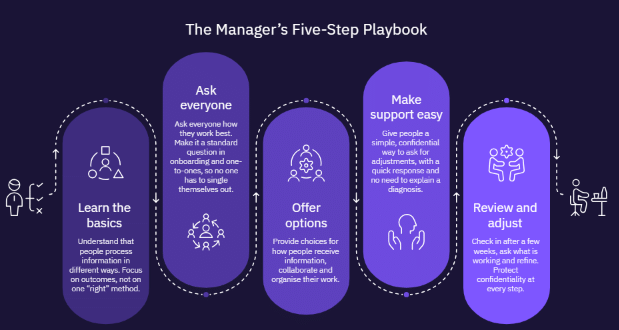
1. Learn the basics
Understand that people process information in different ways. Focus on outcomes, not on one “right” method.
2. Ask everyone how they work best
Make it a standard question in onboarding and one-to-ones, so no one has to single themselves out.
3. Offer options
Provide choices for how people receive information, collaborate and organise their work.
4. Make support easy to request
Give people a simple, confidential way to ask for adjustments, with a quick response and no need to explain a diagnosis.
5. Review and adjust
Check in after a few weeks, ask what is working and refine. Protect confidentiality at every step.
Our Manager Effectiveness Framework gives you a wider view of the skills these habits sit within.
AI Readiness Score Card Free guide, instant download.
Get the Guide →How Does Psychological Safety Fit In?
People disclose where they trust the culture. Psychological safety, the shared belief that you can speak up without being punished or embarrassed, is the foundation of neuroinclusion. Without it, policies stay unused. Read our guide to psychological safety at work for practical steps leaders can take.
Source: linkedin
DID YOU KNOW?
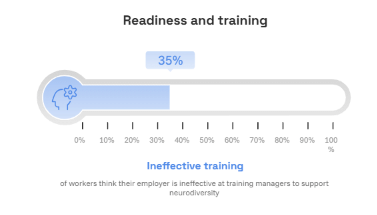
Employers and employees see readiness differently. The Neurodiversity Index Report 2026 found that employers consistently rate their readiness more positively than neurodivergent employees do, who describe more unmet adjustment needs, lower psychological safety and greater exposure to microaggressions. A 2026 UK survey by Acas found that 35% of workers think their employer is ineffective at training managers to support neurodiversity.
What Should Indian Organisations Keep in Mind?
Indian workplaces bring particular strengths and challenges to neuroinclusion.
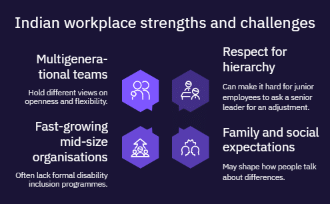
- Respect for hierarchy can make it hard for junior employees to ask a senior leader for an adjustment. Leaders should invite the conversation and normalise it.
- Family and social expectations may shape how people talk about differences. Offer confidential, low-pressure ways to raise needs.
- Fast-growing mid-size organisations often lack formal disability inclusion programmes. Small, consistent manager habits can go a long way before formal programmes arrive.
- Multigenerational teams hold different views on openness and flexibility.
How Do You Measure Progress?
Track a few simple indicators and review them every month at first.
- Manager readiness: share of managers who have completed neuroinclusion training
- Inclusion pulse (anonymous): “I can ask for the support I need at work.”
- Adjustment requests: number made and share resolved quickly
- Hiring process review: are assessments testing job skills, and are instructions clear in advance?
- Retention and engagement: compare teams with trained managers to those still waiting for training
Set a baseline first, share progress with leadership and publish outcomes without naming individuals.
The Best Trainings to Build a Neuroinclusive Workplace
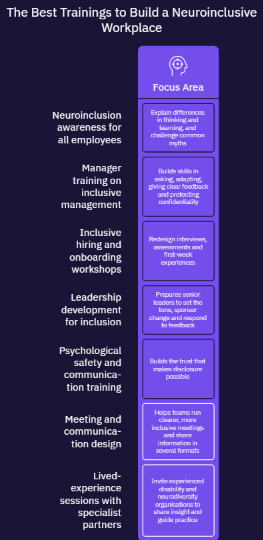
1. Neuroinclusion awareness for all employees
Short, practical sessions that explain differences in thinking and learning, and challenge common myths.
2. Manager training on inclusive management
Builds skills in asking, adapting, giving clear feedback and protecting confidentiality. A Manager Development Program covers these core habits.
3. Inclusive hiring and onboarding workshops
Help HR teams redesign interviews, assessments and first-week experiences.
4. Leadership development for inclusion
Prepares senior leaders to set the tone, sponsor change and respond to feedback.
5. Psychological safety and communication training
Builds the trust that makes disclosure possible.
6. Meeting and communication design
Helps teams run clearer, more inclusive meetings and share information in several formats.
7. Lived-experience sessions with specialist partners
Invite experienced disability and neurodiversity organisations to share insight and guide practice.
Strong programmes use real workplace scenarios, include follow-up coaching and measure behaviour, not attendance.
Curious About Other Areas of Your Organization?
Explore our other free assessments and get a fuller picture of where you stand.
View All AssessmentsWhy Organisations Choose Ebullient?
Ebullient partners with mid-size enterprises to drive organisational transformation, from leadership and culture to team capability and AI readiness.
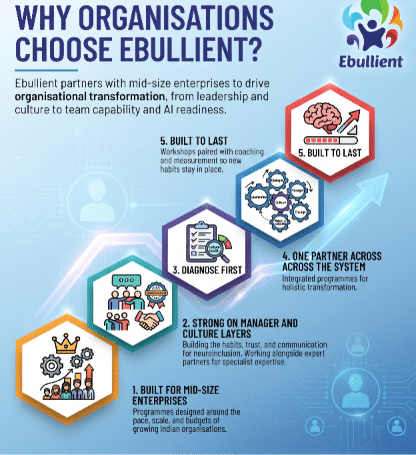
- Built for mid-size enterprises. We design programmes around the pace, scale and budgets of growing Indian organisations.
- Strong on the manager and culture layers. We help leaders build the habits, trust and communication that make neuroinclusion real. For specialist disability expertise and lived-experience input, we work alongside expert partners.
- Diagnose first. Our free Culture Health Check shows where trust and inclusion are strong and where they are thin.
- One partner across the system. Leadership, manager development, culture, women in leadership and change programmes work together.
- Built to last. We pair workshops with coaching and measurement so new habits stay in place.
Book a discovery call to talk about building a more inclusive workplace for your teams.
Want to meet the team?
Start with a 30-min conversation. No commitment needed.
Frequently Asked Questions
What is neurodiversity in the workplace?
Neurodiversity in the workplace recognises that employees think, learn and communicate in different ways. It includes autistic, ADHD, dyslexic and other neurodivergent colleagues. A neuroinclusive workplace adapts management, communication and environments so that all of these employees can do their best work.
How can managers support neurodivergent employees?
Managers can ask everyone how they work best, give written as well as verbal instructions, structure meetings with clear agendas, offer flexibility, give specific feedback and make adjustments easy to request. Protecting confidentiality and focusing on outcomes, not methods, builds trust.
Are workplace accommodations for neurodivergent employees expensive?
Most are low-cost or free. Examples include written instructions, agendas in advance, quiet spaces, flexible schedules and text-to-speech tools. Many of these changes also help the wider team, which makes them good management practice, not special treatment.
What does Indian law say about neurodiversity at work?
The Rights of Persons with Disabilities Act, 2016, recognises conditions such as autism spectrum disorder, specific learning disabilities and chronic neurological conditions, prohibits discrimination and expects reasonable accommodation. How it applies to your organisation depends on its type and sector, so check with qualified legal counsel.
Why don’t neurodivergent employees disclose their condition?
Many fear being judged as difficult, less capable or high-maintenance. Research reported in 2025 found that only 3% of neurodivergent respondents see disclosure as an advantage, and 37% do not tell coworkers after joining. Psychological safety, trained managers and low-stakes ways to ask for support make disclosure feel safer.