

The Business Trends 2027 landscape is defined by five forces: agentic AI deployment, workforce reskilling for future-ready capabilities, India-led global growth pivots, sustainability-linked compliance, and hyper-personalised customer experience. CEOs who align strategy and leadership capacity to these shifts now will outperform peers by a measurable margin within 24 months.
Key Takeaways at a Glance
Takeaway | Why It Matters |
Business Trends 2027 are shaped by five interconnected forces: AI, India’s growth, sustainability, skills, and leadership capability. | CEOs who map strategy to all five forces simultaneously outperform peers who address them in silos — the interactions between forces multiply both risk and opportunity. |
Agentic AI business is moving from pilot to enterprise standard — CEO governance frameworks must evolve in parallel. | Without a Human-AI Decision Matrix, organisations risk delegating high-stakes decisions to systems without accountability structures — a governance and regulatory liability. |
The most in demand skills for the future 2030 are already in shortage — delayed reskilling compounds the cost and capability gap. | Every quarter of delayed investment widens the gap between capability required and capability available — raising the remediation cost by 2–3x over time. |
India represents the highest-velocity opportunity for 2027 business ideas across BFSI, tech, and advisory sectors. | India’s GDP trajectory to the world’s third largest by 2027 makes it a primary market — not a supporting one. Firms without India-specific playbooks will cede first-mover advantage. |
Leadership capability is the execution variable that determines whether every other Business Trend 2027 becomes a strategic asset or a liability. | Technology, capital, and market access are table stakes. Leadership capability is the scarce, non-replicable differentiator — and the one competitors cannot copy at speed. |
Ebullient Consultancy offers context-led, diagnostic-first leadership programmes built for the top business trends every CEO 2027 India environment. | Off-the-shelf training fails because it ignores operating context. Ebullient’s diagnostics ensure every intervention maps directly to the client’s actual strategic capability gaps. |
What Are the Most Critical Business Trends 2027 CEOs Must Act On Right Now?
The most critical Business Trends 2027 include the rise of autonomous AI agents,a kind of machine workforce; the acceleration of India as a global economic powerhouse; sustainability-linked lending compliance; and a demographic shift that rewrites workforce contracts. Acting on these is not optional it is more like a competitive necessity.
The business landscape entering 2027 is structurally different from what most leadership teams planned for in 2023 or 2024. In our experience advising C-suites across BFSI, manufacturing, and technology sectors, the organisations caught flat-footed are almost always those that treated strategy as an annual calendar event rather than a continuous discipline.
Consider a mid-sized private bank that engaged Ebullient Consultancy for a leadership transformation programme in late 2024. Their senior team had identified digitisation as a priority but underestimated how quickly agentic AI business tools would displace traditional decision workflows. By the time competitors had deployed AI agents for credit risk monitoring, they were still piloting basic chatbots. The gap that opened within 18 months was not just technological — it was cultural, structural, and ultimately commercial.
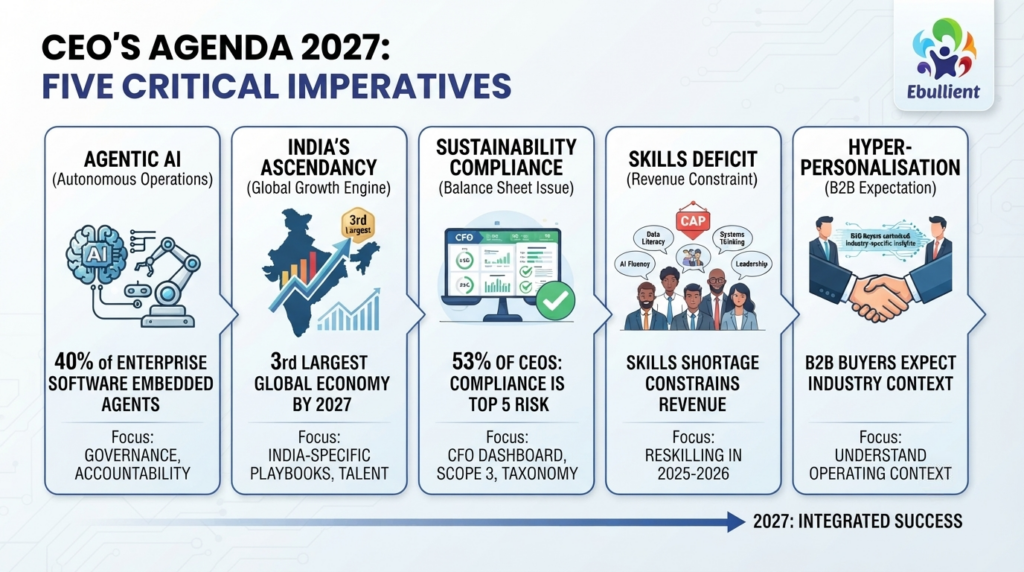
1. Agentic AI Moves from Pilot to Enterprise Standard
Agentic AI business deployment — where AI systems autonomously execute multi-step tasks without per-step human instruction — is no longer a horizon concept. Gartner projects that by 2027, over 40% of enterprise software will embed agentic capabilities. For CEOs, the question has already shifted from ‘Should we use AI?’ to ‘Which decisions should AI own, and which must humans retain?’AI for CEOs is no longer about “getting” prompts, or whatever… it’s more about redesigning governance, accountability structures, and performance metrics around the way people and AI cooperate.
2. India as a Strategic Growth Engine
The top business trends every CEO by 2027, in India conversations, keep circling around one structural reality that feels hard to avoid: India’s GDP is projected to become the world’s third largest by 2027. And for global firms, India is not really a back-office destination anymore it is a primary market, a talent pipeline, and, increasingly, a regulatory benchmark too. So if CEOs have regional, or even global mandates, they need to build India-specific playbooks, not just India-adapted versions of the same global templates.
3. Sustainability Compliance Becomes a Balance Sheet Issue
Green taxonomy rules, ESG tied credit arrangements, and the whole Scope 3 emission disclosures, are slowly moving out of the CSR report and into the CFO’s dashboard. Also, Business Trends 2027 data from PwC’s Global CEO Survey, it confirms that 53% of CEOs everywhere now put sustainability compliance in their top 5 business risks, more than like a reputational afterthought.
4. The Skills Deficit Becomes a Revenue Constraint
The most in-demand skills for the future 2030 are already in shortage: data literacy, AI fluency, systems thinking, cross-cultural negotiation, and adaptive leadership. Organisations that skip structured reskilling in 2025–2026 will hit capability ceilings that directly constrain revenue growth by 2027.
5. Hyper-Personalisation Reaches B2B
Enterprise buyers now expect vendors to understand their industry operating context, not just product preferences. This expectation applies equally to how firms sell and how they develop their teams.
How Managerially Effective Is Your Organization, Really?
Take our free 4-minute assessment and get a personalized report on your leadership fluency, governance, and workforce readiness.
Take the Free AI Readiness Assessment →How Is Agentic AI Reshaping the CEO's Decision Architecture?
Agentic AI business tools are fundamentally changing which decisions require human cognition and which can be delegated to AI systems. CEOs must redesign their decision architecture — mapping which high-stakes judgement calls need human authority and which routine analytical decisions AI can execute faster and at greater scale.
For most leadership teams, this demands a cognitive shift. AI for CEOs is not a technology briefing — it is a strategic redesign exercise. In our experience implementing these frameworks for financial firms and manufacturing conglomerates, the breakthrough moment comes when leadership stops asking ‘What can AI do?’ and starts asking ‘What should only humans decide?’
The firms pulling ahead are building what practitioners call a Human-AI Decision Matrix — a structured map of decision categories assessed by complexity, regulatory sensitivity, and speed requirements, then assigned AI or human ownership accordingly.
Decision Type | AI Ownership Level | Human Oversight Required |
Credit risk scoring | High | Yes — final approval |
Customer churn prediction | High | No |
M&A strategic fit assessment | Low | Yes — fully human |
Compliance monitoring | High | Yes — exception handling |
Talent succession planning | Medium | Yes — always |
This framework is consistent across sectors: agentic AI business does not replace CEO judgement — it elevates the quality of inputs that inform it. The risk is not AI overreach. It is leadership teams who abdicate governance because they do not understand what they are delegating.
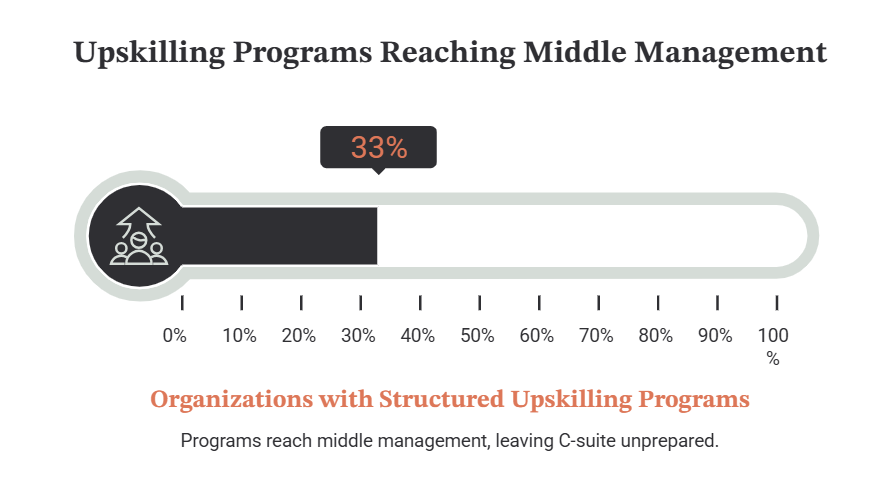
Source: weforum
Did You Know?
According to the World Economic Forum’s Future of Jobs Report 2025, 33% of organizations have structured upskilling programs reaching middle management, but it leaves that C-suite feeder layers, are not ready for AI fluency, analytical thinking, and adaptive leadership
What Are the Most Actionable 2027 Business Ideas for Emerging Market Leaders?
he strongest 2027 business ideas for emerging market leaders kind of cluster around three themes— building AI-native service capabilities, grabbing hold of India’s infrastructure and fintech boom, and making scalable reskilling platforms that sorta tackle the worldwide talent gap. Each represents both a market opportunity and an internal capability imperative.
Global trends examples reveal a consistent pattern: the companies that emerged strongest post-pandemic had invested in capability infrastructure, not just technology. Zoom scaled because the infrastructure existed; thousands of competitors had identical ideas but lacked operational depth.
For Indian CEOs in particular, in 2027 some business ideas with the best proven growth potential, these are standing out:
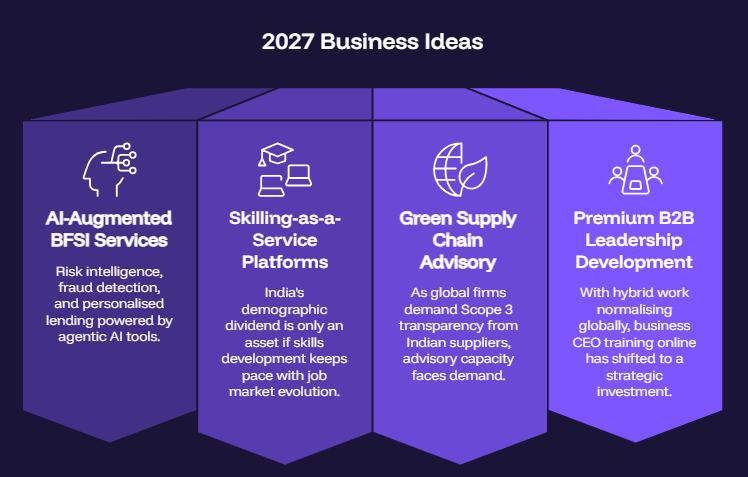
- AI-assisted BFSI services, meaning risk intelligence, fraud detection and personalised lending all driven by agentic AI tools.
- Skilling-as-a-Service platforms: India’s demographic dividend is only an asset if skills development keeps pace with job market evolution — and currently, it does not.
- Green supply chain advisory: As global firms demand Scope 3 transparency from Indian suppliers, advisory capacity in this space faces demand that far outstrips current supply.
- Premium B2B leadership development: With hybrid work normalising globally, business CEO training online has shifted from a scheduling convenience to a strategic investment category with measurable ROI.
The Manager Effectiveness Framework Free guide, instant download.
Get the Guide →Why Is Leadership Capability the Hidden Variable in Every Business Trends 2027 Strategy?
Every Business Trend 2027 — from AI adoption to sustainability compliance — requires leadership capability to activate it. Technology without leadership is infrastructure without a driver. Organisations that deploy advanced tools without building corresponding leadership capacity consistently and predictably underdeliver on projected returns.
The data on global trends examples holds firm: digital transformation initiatives fail at a 70% rate (McKinsey), not because the technology is wrong, but because leadership mindsets, team dynamics, and organisational culture do not evolve alongside the tools.
The most in-demand skills for the future 2030 — adaptive leadership, cross-functional collaboration, and data-informed decision-making — must be developed systematically, not hoped for organically. This is the hidden variable in every boardroom conversation about Business Trends 2027: strategy without leadership capability is a document, not a direction.
The Niche Factor: Why CEO Attention Spans Are the Scarcest Resource in 2027
One aspect of Business Trends 2027 that rarely surfaces in mainstream analysis: the compression of CEO attention. As organisations become more complex — multi-geography, multi-technology, multi-stakeholder — the cognitive load on senior leadership has grown disproportionately. The average Fortune 500 CEO now spends fewer than 6 hours per week on long-horizon strategic thinking (Harvard Business Review, 2024).
This is not a time-management problem. It is an organisational design failure. CEOs who want to lead effectively through Business Trends 2027 must deliberately protect strategic thinking time, delegate operational authority further down the hierarchy, and build leadership benches capable of acting without constant escalation. Organisations that solve this first will compound their advantage across every other trend on this list.
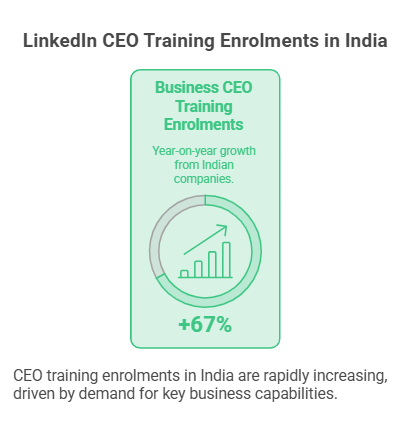
Source: WLR
Did You Know?
LinkedIn’s 2025 Workplace Learning Report found that business CEO training online enrolments from Indian mid-to-large companies grew 67% year-on-year, driven by demand for AI literacy, strategic leadership, and cross-cultural management — the three capabilities most directly tied to capitalising on Business Trends 2027.
Curious About Other Areas of Your Organization?
Explore our other free assessments and get a fuller picture of where you stand.
View All AssessmentsHow Can Ebullient Consultancy Help Your Leadership Team Navigate Business Trends 2027?
Ebullient Consultancy focuses on executive capability building for organisations dealing with those complex transformation cycles that never really sit still. We shape our programmes for BFSI firms, mid-to-large corporates , and high-growth businesses too, where leadership development has to connect to real operating contexts not some generic frameworks that are stitched together from off-the-shelf material.
Our business CEO training online and in-person interventions address the capability gaps that emerge when Business Trends 2027 meet real organisational constraints:
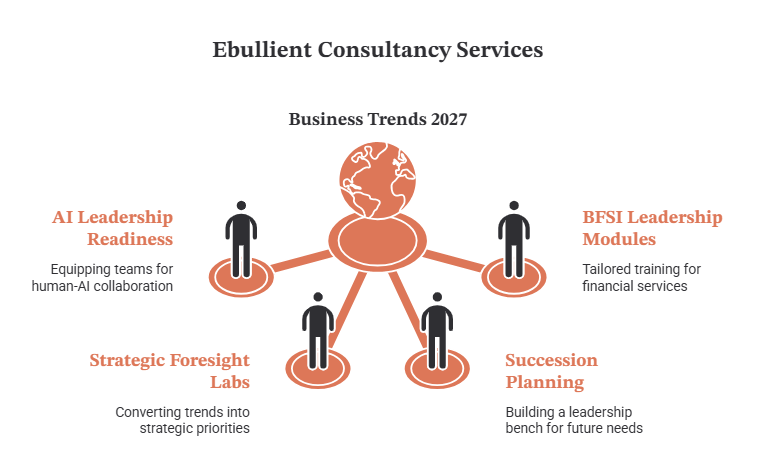
- AI Leadership Readiness: Equipping senior teams to lead human-AI collaborative environments, including decision governance and ethics frameworks tailored to regulated industries.
- Strategic Foresight Labs: Facilitated C-suite workshops that convert trend intelligence into 90-day and 12-month strategic priorities.
- Succession and Capability Planning: Structured programmes to build the leadership bench required for Business Trends 2027 execution — before the vacancy creates the urgency.
- BFSI-Specific Leadership Modules: Designed around the regulatory, cultural, and commercial realities of Indian and global financial services organisations.
If your organisation is assessing the top business trends every CEO 2027 India environment and needs a structured response strategy, Ebullient Consultancy offers diagnostic-led engagements that begin with your actual capability gaps — not a pre-packaged curriculum looking for a client.
Final Thoughts
The Business Trends 2027 playbook is not a list to acknowledge — it is a sequence of decisions to make. Agentic AI business, India’s economic ascent, sustainability compliance, workforce reskilling, and leadership capability are not independent variables. They interact. A CEO who gets one right but neglects the others will find those interconnections working against the strategy.
The organisations that will lead in 2027 are already making capability investments today. The window for deliberate, unhurried planning is narrowing fast. The top business trends every CEO 2027 India and globally demand a structured, leadership-led response — and that response begins with an honest audit of where your team actually stands, not where the last strategy deck assumed it would be.
Want to meet the team?
Start with a 30-min conversation. No commitment needed.
Frequently Asked Questions
What are the top Business Trends 2027 every CEO should prioritise?
In 2027, the five highest-impact business trends are these: agentic AI getting folded into the day-to-day core workflows, India showing up as a real tier 1 global market, ESG compliance turning into a money-grade risk variable, workforce reskilling for future critical capabilities, and leadership development that matches AI augmented operating environments.
How is agentic AI different from the AI tools CEOs have already used?
Traditional AI tools respond to prompts. Agentic AI business systems initiate, plan, and execute multi-step tasks autonomously — with minimal human instruction per cycle. For CEOs, this raises the stakes of governance and oversight significantly, while proportionally expanding the productivity potential.
What are the most in-demand skills for the future 2030 that organisations should develop now?
The most in demand skills for the future 2030 — per WEF and McKinsey data — are analytical and systems thinking, AI fluency, adaptive leadership, cross-cultural communication, and data-informed decision-making. Critically, these are not technical certifications. They are strategic and interpersonal capabilities that take sustained investment to build at scale.
What are viable 2027 business ideas for Indian market leaders?
Some high-potential 2027 business ideas for India, honestly feel like they sit right on the next wave, like AI-boosted financial services, or a green supply chain advisory kind of setup, where companies want cleaner logistics but don’t know where to start. There’s also space for premium B2B leadership training platforms, plus regional tech infrastructure plays, aligned with India’s current infrastructure investment cycle How does
Ebullient Consultancy approach differ from standard training providers?
Ebullient Consultancy builds programmes around the client organisation’s actual strategic context — not pre-built course libraries. Every engagement begins with a capability diagnostic, and all interventions are mapped directly to the specific Business Trends 2027 challenges the client’s leadership team will face in their operating environment.