
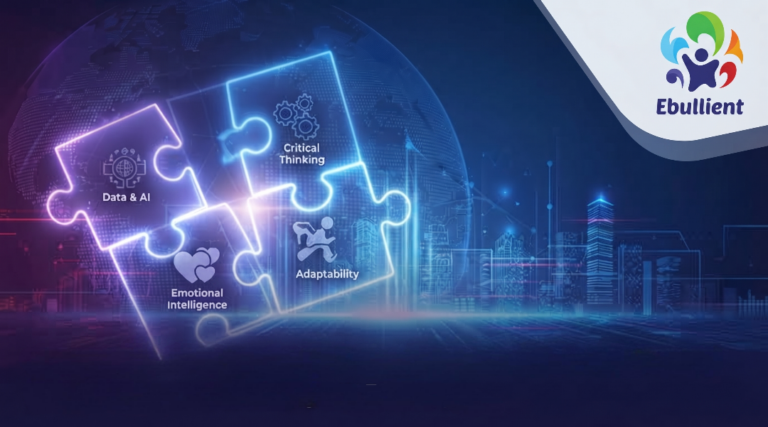
The future skills every organization needs by 2030 span five domains: AI literacy, adaptive thinking, data fluency, emotional intelligence, and cross-functional collaboration. Organizations that embed these into structured corporate training programmes now will build a future-ready workforce capable of competing in BANI (Brittle, Anxious, Nonlinear, Incomprehensible) conditions across every sector.
Key Takeaways at a Glance
- Future skills are combinatorial — they require AI literacy plus human judgment, not one or the other
- The most in demand skills for the future 2026–2030 are already creating measurable competitive gaps between organizations that invest now and those that defer
- Metacognitive agility is the underestimated multiplier behind every other future-ready workforce skill
- Corporate training solutions must move from event-based content delivery to embedded capability ecosystems to produce durable behaviour change
- The WEF skills 2030 framework provides a validated, globally benchmarked starting point for any organizational skills strategy
- Ebullient Consultancy designs programmes that build these future skills at both the individual and organizational level — grounded in evidence, applied in context, and measured at business impact
What Exactly Are "Future Skills" and Why Do They Matter Now?
Future skills are the cognitive, technical, and interpersonal competencies workers need to remain effective as automation, AI, and geopolitical shifts rewrite how work is organized. They matter now because the reskilling timeline for complex capabilities averages 18–24 months — meaning organizations waiting until 2028 to act will already be too late.
The phrase “future skills” has moved well beyond a buzzword. When we work with senior leadership teams inside manufacturing firms, financial services companies, and professional services organizations, the conversation invariably returns to the same tension: the speed at which job roles are changing outpaces the speed at which most L&D departments can design and deploy learning interventions.
The World Economic Forum’s skills 2030 projections confirm this. Analytical thinking, creative thinking, and AI-plus-big-data literacy appear at the top of every major employer survey — not because these are aspirational ideals, but because clients are already screening for them at the hiring stage. The organizations building these capabilities internally, through deliberate corporate training solutions, are the ones winning talent and contracts simultaneously.
What makes future-ready workforce skills different from traditional competency frameworks is their combinatorial nature. In 2030 a finance analyst does not just need to understand Python, she also has to tie data fluency with ethical reasoning to check algorithmic outputs in a responsible way. That requires layered capability-building, not isolated training modules.
Source: WEF
Did You Know?
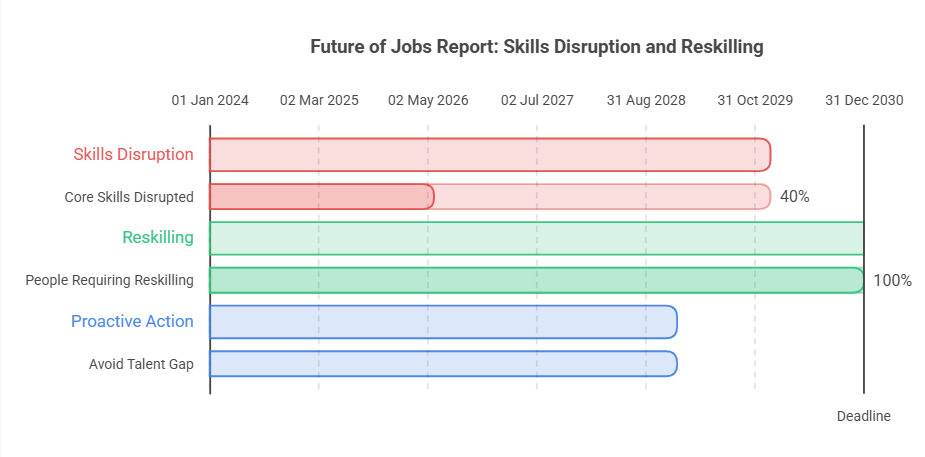
The World Economic Forum’s Future of Jobs Report projects that 40% of workers’ core skills will be disrupted within five years, and over 1 billion people will require reskilling by 2030. Organisations waiting until 2028 to act will be racing against a talent gap that no amount of reactive hiring can close.
How AI-Ready Is Your Organization, Really?
Take our free 4-minute assessment and get a personalized report on your leadership fluency, governance, and workforce readiness.
Take the Free AI Readiness Assessment →Which Skills Will Be Most In Demand for the Future in 2026–2027?
The most in demand skills for the future in 2026–2030 bridge human judgment and machine capability: AI literacy, systems thinking, complex communication, resilience, and ethical reasoning. These are not “soft” skills — they are strategic differentiators that directly affect revenue, retention, and organisational agility.
The WEF’s skills 2030 framework identifies analytical thinking, creative thinking, and AI-plus-big-data literacy at the top of every major employer survey — not because these are aspirational ideals, but because organisations are already screening for them at the hiring stage. The ten future skills below represent the consensus across WEF research, McKinsey Global Institute analysis, and Deloitte’s Human Capital Trends surveys:
Future Skill | Why It Matters Now | Business Impact |
AI Literacy | Teams evaluate, trust, and correct AI outputs — not just use them | Reduces decision errors, AI misuse incidents, and compliance risk |
Adaptive Thinking | Enables rapid role-shifting as workflows automate | Lower attrition during transformation; faster workflow adoption |
Data Fluency | Moves decisions from intuition to evidence | Shorter strategy cycles, higher forecast accuracy |
Emotional Intelligence | Differentiates human value in AI-augmented roles | Stronger client relationships, higher team cohesion |
Ethical Reasoning | Governs responsible AI and data use | Reduced compliance risk and reputational exposure |
Systems Thinking | Reveals second-order consequences in complex decisions | Better change management outcomes, fewer unintended effects |
Metacognitive Agility | Enables learning transfer across contexts | Higher ROI on every future skills training investment |
Complex Communication | Critical for cross-cultural, asynchronous, AI-mediated work | Higher stakeholder confidence, better deal closure rates |
Resilience & Antifragility | Sustains performance under BANI conditions | Faster recovery from disruption cycles |
Cross-Functional Agility | Enables fluid team reconfiguration around problems | Competitive speed in product and service delivery |
Source: LinkedIn Workforce Confidence
Did You Know?
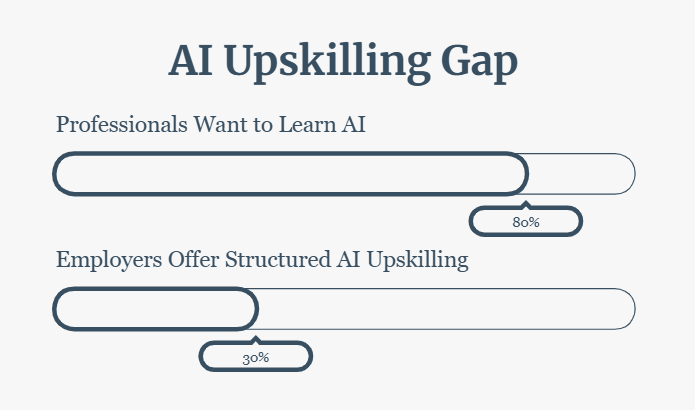
A LinkedIn Workforce Confidence survey found that 4 in 5 professionals want to learn more about how to use AI in their profession — yet fewer than 30% say their current employer offers structured AI upskilling. That gap is both a retention risk and a competitive disadvantage that compounds annually.
The Most Underestimated Future Skill in Corporate Environments
Metacognitive Agility: The Hidden Architecture of a Future-Ready Workforce
Metacognitive agility — the capacity to monitor, evaluate, and adjust one’s own thinking in real time — is the most underestimated future skill in corporate environments. It is the invisible multiplier behind every WEF-listed competency, yet it appears in almost no L&D programme catalogue.
When organisations invest in future-ready workforce skills, they typically focus on the visible layer: AI tools, data dashboards, agile methodologies. What they underinvest in is the cognitive infrastructure that determines whether employees can actually transfer new knowledge into new contexts.
Metacognitive agility is what allows a mid-career finance manager to shift her mental model when a new AI tool invalidates her previous workflow — rather than resisting change or applying old logic to new problems. In our experience working with leadership cohorts across BANI conditions (Brittle, Anxious, Nonlinear, Incomprehensible), this proves to be the differentiator between participants who complete a training intervention and genuinely change behaviour, versus those who revert to pre-training patterns within three months.
The practical implication for L&D leaders is significant: embedding reflective practice, scenario-based debriefs, and structured self-assessment into corporate training solutions is not a “nice to have.” It is the mechanism that makes every other future skill investable and durable. Organisations that treat learning design as content delivery — rather than cognitive rewiring — will continue to report low training ROI regardless of the quality of their learning content.
This is also why Ebullient’s model is built around leadership reforging rather than training delivery. Reforging operates at the level of mindsets, not mechanics. A manager who has been reforged thinks differently under pressure — she has internalised the capacity to unlearn as a precondition for relearning, which is the foundational future mindset for every other skill on this list.
AI Readiness Score Card Free guide, instant download.
Get the Guide →How Should Organisations Structure Corporate Training to Build Future Skills?
Organisations should structure corporate training around three capability tiers — foundational fluency, applied practice, and leadership integration — delivered through blended learning, real-work application challenges, and cohort-based peer accountability. Single-channel training cannot produce the depth or retention that future work skills 2030 demands.
The firms making the most measurable progress on organisational skills for the future are not those with the largest L&D budgets — they are the ones that have moved from event-based training to embedded capability ecosystems. The distinction is architectural, and it maps directly onto Ebullient’s four practice disciplines:
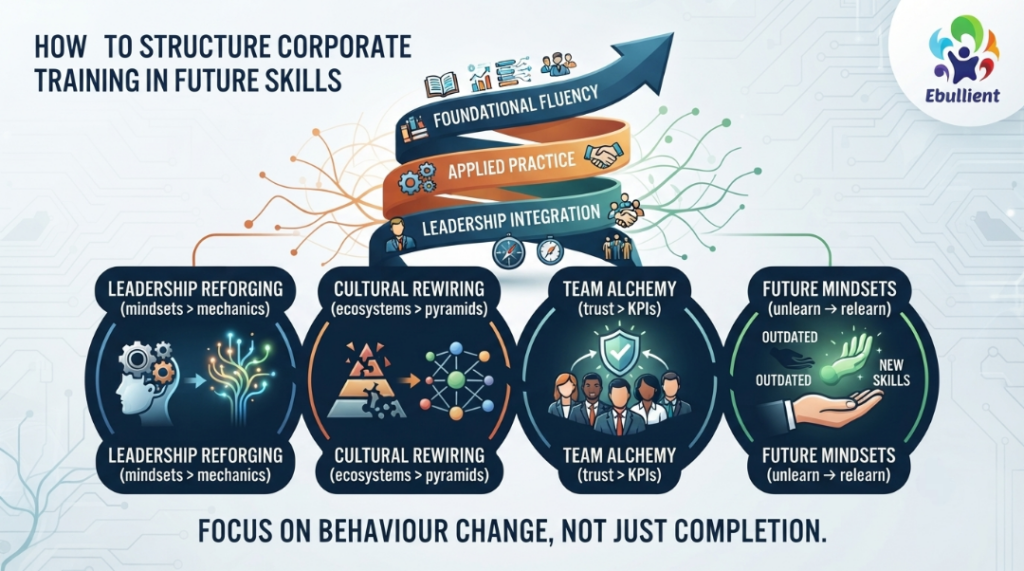
Leadership Reforging (mindsets > mechanics)
Building the cognitive and emotional foundations that determine how leaders think and decide under pressure — not simply equipping them with new frameworks to apply on Monday morning.
Cultural Rewiring (ecosystems > pyramids)
Redesigning the environment in which future skills either survive or get suppressed. A capability intervention inside a hierarchical, command-and-control culture will not hold. The ecosystem must change alongside the individuals.
Team Alchemy (trust > KPIs) Building the
relational foundations — psychological safety, shared purpose, honest communication — that enable teams to apply future skills collaboratively under real conditions of ambiguity and pressure.
Future Mindsets (unlearn → relearn)
Equipping people to consciously release outdated mental models as the first step in acquiring new capability. The ability to unlearn is arguably the most commercially valuable cognitive skill of the next decade.
This architecture matters especially for future skills 2030 competencies because adaptive thinking, ethical reasoning, and cross-functional agility cannot be assessed through a post-training quiz. They must be observed in behaviour over time — which means the corporate training solution must be built around behaviour change as the primary output, not learning completion as a metric.
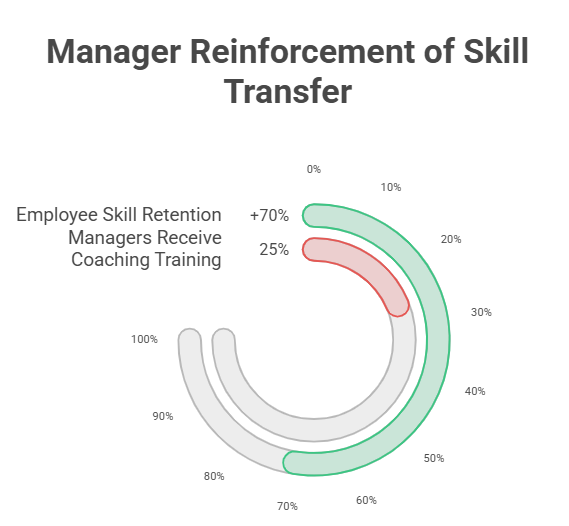
Source: ATD
Did You Know?
Research from the Association for Talent Development shows that employees are 70% more likely to retain and apply new skills when their manager actively reinforces learning on the job — yet fewer than 25% of managers receive any training on how to coach for skill transfer. Closing this “manager gap” is one of the highest-leverage L&D investments available.
Curious About Other Areas of Your Organization?
Explore our other free assessments and get a fuller picture of where you stand.
View All AssessmentsHow Ebullient Consultancy Builds Future-Ready Organisations
Ebullient Consultancy designs and delivers leadership reforging and workforce development programmes that build the future skills your organisation needs to compete in 2030 — not through training delivery alone, but through the cultural rewiring, team alchemy, and future mindset shifts that make those skills stick.
What distinguishes Ebullient’s approach is its starting premise. Most training providers begin with content — curriculum maps, e-learning modules, competency frameworks. Ebullient begins with context: the triple intersection of digital revolution, sustainability imperative, and the purpose movement that defines every leadership challenge worth solving in the next decade.
Technology should humanise work, not replace the judgment, ethics, and relational intelligence that define high performance. In an era where AI can execute tasks, the human differentiators — emotional intelligence, ethical reasoning, adaptive thinking — become more commercially valuable, not less. This is not a philosophical position for Ebullient. It is the design principle behind every programme it builds.
Practically, this means shifting the frame from “Human Resources” — a transactional, asset-management model — to “Human Beings” across the entire employee lifecycle: hiring, performance, development, rewards, succession. Organisations that make this shift do not simply get better engagement scores. They build the conditions in which future skills can actually compound over time.
Ebullient’s Core Programme Offer for Future-Ready Workforces
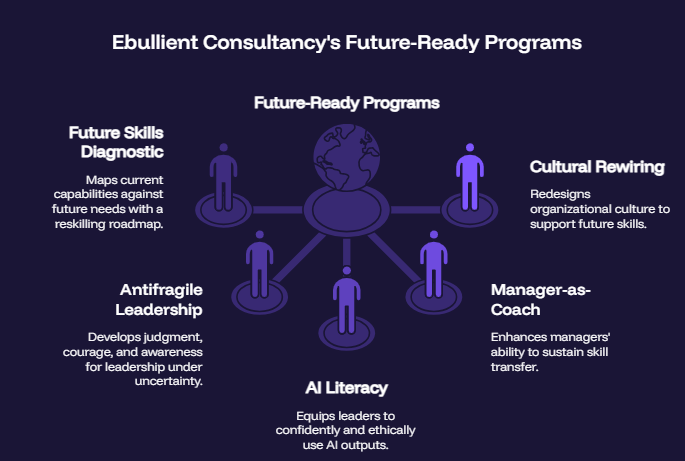
- A structured audit mapping your current workforce capability against the future skills required by your sector by 2027 and 2030, with a prioritised reskilling roadmap. Future Skills Diagnostic —
- Cohort-based immersive development that builds the judgment, courage, and systemic awareness required to lead under BANI conditions. Antifragile Leadership Programme —
- Enabling senior decision-makers to govern, interrogate, and leverage AI-generated outputs with confidence and ethical clarity. AI Literacy for Non-Technical Leaders —
- Equipping people managers to sustain skill transfer between formal training interventions — closing the gap that destroys most corporate training ROI. Manager-as-Coach Enablement —
- Organisation-wide initiatives that redesign the conditions in which future skills either survive or get suppressed by legacy culture. Cultural Rewiring Sprints —
Final Thoughts
The organisations that will lead their industries in 2030 are building their future-ready workforce today — not through reactive hiring, but through the systematic, deliberate work of cultural rewiring, leadership reforging, and future mindset development.
The future skills on the World Economic Forum’s radar are not abstract ideals. They are the concrete competencies your competitors are already embedding into leadership pipelines, team development programmes, and onboarding frameworks. The reskilling window — 2025 to 2027 — is the window in which differentiated action creates durable advantage. After 2027, what is now a competitive differentiator becomes the baseline requirement for participation.
The deepest challenge is not technical. It is the one Ebullient was built to solve: how do organisations grow wisdom, judgment, and courage fast enough to match the velocity of change? Not by downloading best practices. Not by running workshops. But by reforging — at the level of identity, mindset, and culture — the human beings who will carry those organisations through the complexity ahead.
Want to meet the team?
Start with a 30-min conversation. No commitment needed.
Frequently Asked Questions
What are the top 10 most in demand skills for the future 2030?
The WEF’s top future skills for 2030 include: analytical thinking, creative thinking, AI and big data literacy, technology design, resilience and adaptability, motivation and self-awareness, talent management, service orientation, systems thinking, and cross-functional agility. Organisations should map these against sector-specific context rather than applying them as a generic list.
What does the World Economic Forum say about skills 2030?
The WEFs Future of Jobs Report points out cognitive skills — mostly analytical and also creative thinking — are climbing the fastest. It also mentions that six in ten workers are likely to need serious reskilling first, before 2027.
How are future work skills 2030 different from today’s competency frameworks?
Today’s competency frameworks describe role-specific technical skills, and also the more general behavioural traits. Future work skills 2030 are cross-functional, combinatorial, and context-adaptive — describing how people operate across changing roles, tools, and team structures rather than performing a fixed set of tasks. The shift is from “what can you do” to “how quickly can you learn to do what doesn’t yet exist.”
How long does it take to build a genuinely future-ready workforce?
Building a future-ready workforce where future skills are embedded in culture — not just trained in programmes — takes a minimum of 18–36 months of sustained effort. The timeline depends on baseline capability, programme design quality, and the degree to which leadership actively reinforces new behaviours on the job. Organisations that invest in manager coaching as part of the programme design consistently see faster capability transfer.
What should HR leaders prioritise first when building organisational skills for the future?
Start with a structured future skills diagnostic to map the gap between current workforce capability and the competencies your business model will demand. Then design your L&D architecture around three to five priority skills — AI literacy, adaptive thinking, and emotional intelligence are the most universal starting points. Then build the cultural and managerial conditions that allow those skills to compound. Ebullient Consultancy’s team can facilitate this diagnostic conversation.