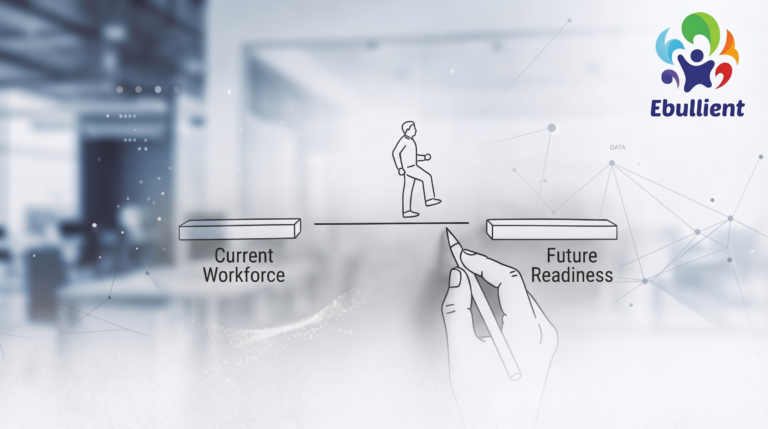
The most viable approach for closing the skill gap is to conduct a deep workforce skills analysis, identify the future competency needs, develop a personalized learning path, and on-going upskill employees through technology-enabled corporate training programs. Organisations that invest in both technical and soft skills development are now in a stronger position to equip AI-driven workplace transformation and balance long-term business growth.
Key Takeaways at a Glance
- The modern workplace is now experiencing proactive transformation, which is driven by AI, automation, digitalization, and an evolving business framework.
- Closing the skill gap has become a strategic approach for organizations which are looking for long-term competitiveness.
- Effective workforce skills analysis supports the analysis the current competency gaps and future workforce demands.
- Businesses that are adopting the best practices for bridging the corporate training skills gap to achieve higher productivity results , employee engagement, and retention.
- Organizations partnering with Ebullient Consultancy can build a future-ready learning ecosystems which is align employee capabilities with business goals.
Understanding the Skills Gap
The skills gap starts when employees’ existing competencies are aligned with organisational needs. This mismatch affects business and affects performance, innovation, and competitiveness.

Technical Skills
Emerging technologies such as artificial intelligence, cloud computing, cybersecurity, and data analytics need expertise, which leads to organizations struggling to find it internally.
Soft Skills
Leadership, communication, emotional intelligence, critical thinking, and collaboration have become actively valuable in the workplace as interconnected.
Digital Literacy
Organizations need employees who can adopt and use digital platforms, automation tools, and AI- driven technologies to enhance efficiency and improve decision-making.
Companies that fail to fulfill these gaps will face lower productivity, slower innovation, and employee turnover.

Source: Weforum
Did You Know?
According to the World Economic Forum Future of Jobs Report, nearly forty percent of existing workplace skills are expected to be different by 2030, so continuous learning becomes a business necessity instead of an option.
How AI-Ready Is Your Organization, Really?
Take our free 4-minute assessment and get a personalized report on your leadership fluency, governance, and workforce readiness.
Take the Free AI Readiness Assessment →Why Workforce Skills Analysis Matters
A systematic workforce skills analysis helps organisations to understand current capabilities , future workforce requirements and overal development.
Benefits include the following:

- Identifying competency gaps
- Aligning learning with business goals
- Enhancing workforce planning
- Building leadership pipelines
- Supporting digital transformation initiatives
- Improving employee engagement and retention
But also, conducting a regular workforce skills analysis, which makes sure that learning investments remain relevant and helpful.
Key Trends in Corporate Training

1. Personalized and AI-Powered Learning
Artificial intelligence is reshaping corporate learning by developing personalized learning paths tailored to employee strengths, weaknesses, career aspirations, and learning patterns.
AI-powered platforms can:
- Recommend bespoke
- learning paths
- Identify skill gaps
- Deliver real-time feedback
- Track down the employee’s progress
2. Microlearning and On-Demand Training
Modern professionals need flexible learning options that align with their busy schedules.
Microlearning offers:
- Short learning modules
- Mobile-friendly content
- Just-in-time learning
- Boosts knowledge retention
3. Soft Skills Development
Since automation handles the repetitive tasks, the human- centered capabilities are gaining importance, and yeah, the latest trends in soft skills training focus on :
- Emotional intelligence
- Organisational
- communication skills
- Leadership development
- Critical thinking skills
- Conflict management
4. Gamification and Interactive Learning
A gamified learning experience is increasingly engaging employees through simulations, scenario-based learning and other interactive learning formats and performance tracking.
5. Blended Learning Approaches
Blended learning integrates:
- Short courses
- Instructor-led workshops
- Coaching workshops
- Mentoring programs
- Collaborative learning experiences
This approach enhances learning performance through retention and practical application
Skills Gap Analysis Template
Organisations can use the following skills gap analysis template to identify workforce development priorities:
| Current Skill | Required Level | Current Level | Gap Identified | Recommended Training |
|---|---|---|---|---|
| AI Literacy | Advanced | Basic | High | AI Fundamentals |
| Leadership | Advanced | Intermediate | Medium | Leadership Development |
| Communication | Advanced | Intermediate | Medium | Soft Skills Training |
| Data Analytics | Advanced | Basic | High | Data Analytics Certification |
| Change Management | Advanced | Intermediate | Medium | Change Management Program |
A structured skills gap analysis template helps organizations make data-driven workforce development decisions.
Benefits of Corporate Training

Bridging the Skills Gap
Corporate training enables employees with the competencies that are needed for current and future job roles.
Improved Employee Engagement
Learning opportunities improve motivation, employee satisfaction, and organisational goals.
Enhanced Productivity
Skilled employees will perform the tasks more efficiently and accurately.
Leadership Development
Organisations must prepare the future for the leaders by navigating through targeted management and leadership programs.
Organizational Agility
Continuous learning allows businesses to implement it quickly to technological and market shifts.

Source: Weforum
Did You Know?
About 63% of employers say that skill shortages are the biggest obstacle for business transformation, so it really shows how workforce development programs.
Challenges in Implementing Corporate Training
Despite having so many benefits, organisations still have to face several challenges:

Time Constraints
Employees may struggle to maintain a balance between learning and operational responsibilities.
Budget Limitations
In-depth learning initiatives demand heavy investment in technology, content, and facilitators.
Measuring Impact
Evaluating the behavioral and performance improvements can be challenging.
Keeping Content Relevant
Rapid technological advancements require regular updates to the content as it has to keep changing.
Employee Engagement
When it comes to boosting learner motivation and keeping participation steady, that’s still an ongoing challenge.
Best Practices for Corporate Training Skills Gap Management
Organisations that are looking for long-term success must adopt the following best practices for corporate training skills gap management:

- Align learning with business objectives, so the training programs actually match strategic goals.
- Do regular skills assessments. These frequent evaluations help reveal emerging development needs, before they become a problem.
- Personalize the learning experiences, as in build prepare learning journeys, which boostes the engagement and overall effectiveness.
- Leverage technology too. AI-enabled learning platforms back scalability and personalization, in a practical way.
- Measure the business impact. Monitor the progress on productivity, performance, engagement, and retention outcomes.
- Foster a learning culture. Encourage continuous development across every organizational level, no exceptions, really.
These best practices for corporate training skills gap management support organisations to maximize ROI from learning and future-proof the workforce.
AI Readiness Score Card Free guide, instant download.
Get the Guide →Strategies to Close the Skills Gap
Organizations can help accelerate the closing the skill gap by practical way , regular skills assessments . They should also set up personalized learning pathways and use AI-powered learning tech so the process is adaptive, not just one-size-fits-all. On top of that, encouraging self-directed learning matters too, because people usually engage more when they can focus on their own progress.
And providing coaching and mentoring offers direction , especially when it is linked experiential learning, such as project work, or job simulations. Training should be connected back to business objectives.
Taken together, this supports sustainable workforce development and broader organizational growth.

Source: Weforum
Did You Know?
The World Economic Forum says that by 2030, about 170 million new jobs will be created globally, but also around 92 million positions might get displaced because of technological transformation, with a net uplift of roughly 78 million jobs.
Curious About Other Areas of Your Organization?
Explore our other free assessments and get a fuller picture of where you stand.
View All AssessmentsThe Future of Corporate Training
Corporate training is shifting, from compliance to a more strategic workforce transformation tool. Seeing the trends like immersive AR/VR learning, AI driven coaching, and analytics that are data led, that are really shaping what the next wave of employee development.
Companies that lean into these changes will be way more prepared for the upcoming workforce demands.
Final Thoughts
The future of work belongs for the organisations which are continuous learning and proactively upskilling workforce. As latest technologies are reshaping the industries, closing the skill gap is not about an HR initiative—it has become business imperative.
The latest World Economic Forum skills 2030 projections suggested that organisations need to prepare for importance for workforce transformation through reskilling and upskilling development.
By preforming regular workforce skills analysis, implementing a ssytematic skills gap analysis template, addressing training gaps examples, and equipping the best practices for corporate training skills gap management, businesses can build agile leadership and high performing future-ready teams.
At Ebullient Consultancy, we support organisations to bridge capability gaps through best corporate training solutions, leadership development programs, and workforce transformation strategies designed for the future of work.
Want to meet the team?
Start with a 30-min conversation. No commitment needed.
Frequently Asked Questions
What is a workforce skills analysis?
A workforce skills analysis is a well-organised assessment to assess employee capabilities compared with current and future business needs and identify development parameters.
What are skills gaps and training needs?
Skills gaps begin when employees lack the competencies to meet their job roles. Training and upskilling are the learning sessions that are designed to address those deficiencies.
Why is closing the skill gap important?
Closing the skill gap enhances overall productivity, employee engagement, promotes innovation, and gains organisational competitiveness.
What are common training gaps examples?
The common examples are: deficiencies in AI literacy, leadership readiness, communication gap, cybersecurity awareness, and data analytics.
What does the World Economic Forum predict for skills by 2030?
The World Economic Forum’s Skills 2030 outlook guides that nearly 40% of workplace skills will change, increasing demand for AI, analytical thinking, leadership, resilience, and collaboration skills.