Managers improve Communication in Hybrid Workplaces by systematizing communication channels, establishing clear expectations, navigating collaboration tools, promoting psychological safety, and reinforcing feedback loops. Construct communication flows, blends with Strategic Leadership behaviors, eliminates misalignment, enhances productivity, and ensures smooth flow of collaboration amongst remote and On-site teams
in hybrid environments.
Key Takeaways – At a Glance
- Communication in Hybrid Workplaces that enable decision-making, not just an information flow.
- Managers need to change their focus from controlling their teams to developing their team’s skills.
- Antifragile communication systems provide better performance than rigid structural systems.
- The effectiveness of communication during high-pressure situations depends on cultural factors.
- Asynchronous communication serves as a crucial element that enables businesses to grow their operations.
- The organisation must adopt leadership development programs that will establish a foundation for its future success.
What is the importance of managers' team communication in hybrid workplaces?
Communication in Hybrid Workplaces has evolved from being a soft skill to a key leadership competency. Organisations that implement flexible work models, the importance of communication in hybrid workplaces becomes vital for successful operational efficiencies. Managers are now responsible for bridging the gaps, embracing distributed teams, and improving engagement.
Here’s the reality for L&D teams: hybrid isn’t failing because of technology, but it struggles because of inconsistent communication frameworks. In our experience implementing leadership frameworks across all the industries and technology firms, communication breakdown is hardly about tools , but it’s always about the judgment under ambiguity.
This is where Ebullient’s philosophy becomes more important.
Managers must move beyond “sharing knowledge” and toward:
- Learning systems (continuous sense-making)
- Decision systems (clarity under pressure)
- Action systems (aligned execution)
Without this shift, even well-designed hybrid systems may be collapse into confusion and inefficiency.
Source: Leadership IQ
Did You Know?
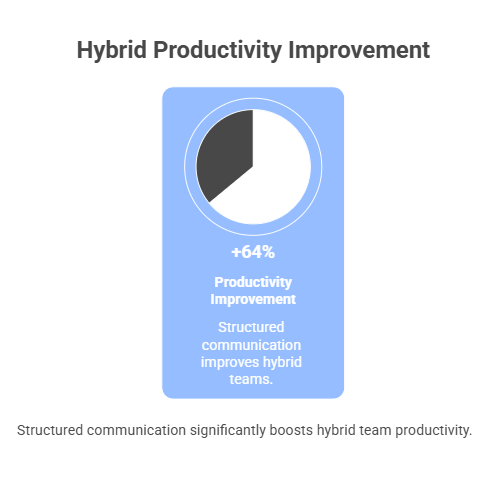
Hybrid productivity suffers less from distance because it faces greater difficulties through confusion. We observed that structured communication which hybrid teams use to work together better leads to a 64% productivity improvement.
Communication in Hybrid Workplaces consists of structured, active collaboration across remote and in-office teams using virtual and in-person channels. It significantly ensures clarity, alignment, and collaboration even when isolated. Effective communication directly influences productivity, employee satisfaction, and decision-making, which is essential for organisations to lead in a hybrid work environment.
Expanded Insight
Hybrid workplaces integrate flexibility with unambiguity. A classic hybrid model example involves employees working 2–3 days in the office and the rest far away. While this model provides flexibility, it creates communication gaps:
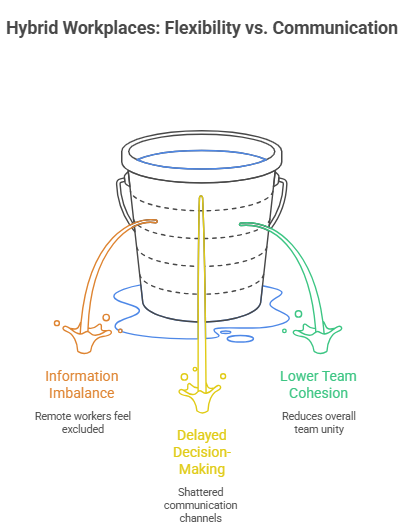
- Information imbalance between remote and office workers
- Delayed decision-making due to shattered channels
- Lower the overall team cohesion
In our consulting work with corporate clients, we’ve seen that teams without structured communication flow experience 40% more project delays.
The importance of managers’ team communication in hybrid workplaces supports in their role as connectors which make sures that no employee feels disconnected, nonetheless
of location.
What Are the Key Communication Challenges in a Hybrid Workplace?
The main communication challenges in a hybrid workplace encompass lack of visibility, contradiction messaging, digital burnouts, and Irregular participation amongst remote and in-office employees. These challenges disrupt collaboration, lower the trust, and build silos at workplace. Managing it needs structured communication protocols, inclusive meeting practices, and the right blend of synchronous and asynchronous communication strategies.
Major Hybrid Work Challenges:
| Challenge | Impact | Example |
|---|---|---|
| Lack of Visibility | Reduced accountability | Remote employees overlooked for promotions |
| Communication Overload | Burnout | Excessive meetings + messages |
| Tool Fragmentation | Confusion | Teams using multiple platforms inconsistently |
| Proximity Bias | Inequality | Office employees favored in decisions |
Screen fatigue is becoming a silent productivity killer. Employees spend an average of 5–6 hours daily on communication tools, leaving shorter time for deep work.
In our experience working with senior leaders, the biggest error is assuming communication will “automatically happen.” In hybrid environments, communication must be purposely designed that connects all of them.
How Can Managers Build Effective Communication in a Hybrid Workplace?
Managers can prepare for an effective communication in a hybrid workplace by creating foundation to set clear communication norms, determine channel usage, fostering transparency, and uplifting regular feedback. The organisation implements proper operational procedures through its established daily check-in and weekly meeting schedule which includes unplanned task updates that provide awareness and clarity to its staff. The organization creates an inclusive environment which values all perspectives because this practice enhances employee participation while reduces breakdowns in communication.
The major framework used in high-performing organisations:
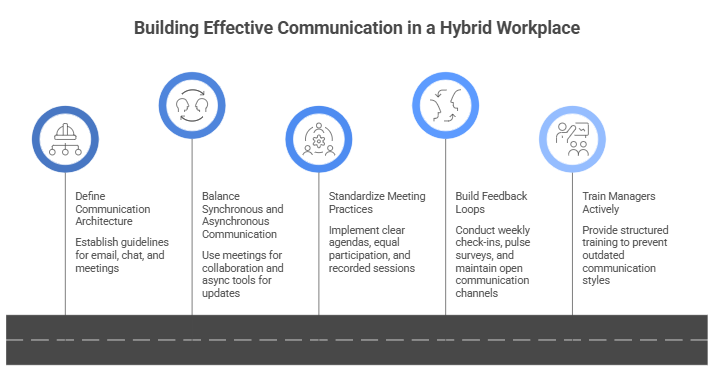
1. Define Communication Architecture
- What goes on the email, in chat, and is discussed in the meetings.
- The Response time expectations
- Documentation and Standard Operating Procedures (SOP’s)
2. Balance Synchronous and Asynchronous Communication
- Regular meetings foster collaboration amongst the team members.
- Use async tools to facilitate work.
3. Standardize Meeting Practices
- Setting clear targets and how to achieve them within a time period.
- Equal participation signifies that all of them are treated equally in that organisation.
- Recorded sessions are helpful for noting down the highlights for the meeting.
4. Build Feedback Loops
- Weekly check-ins are necessary to monitor the progress.
- Pulse surveys to measure employee sentiment in real-time.
- Open communication channels for transparent dialogue, and unobstructed pathways for information exchange.
5. Train Managers Actively
This is where most companies fail. Without effective training programs, managers come back with outdated communication styles.
Source: Forbes
Did You Know?
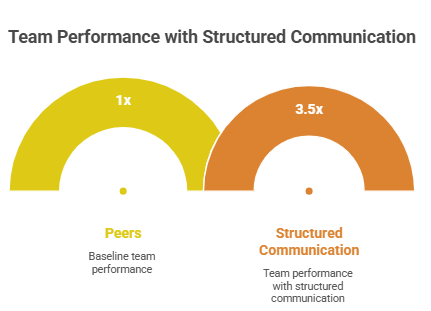
Structured communication frameworks are used by groups that are 3.5 times more likely to outperform their peers.
How does leading in a hybrid work environment impact communication strategies?
Leading in a hybrid work environment needs managers to switch from control-based communication to trust-based communication. Leaders must well defined on outcomes, clarity, and inclusivity rather than tangible presence.
This shift requires new leadership behaviors:
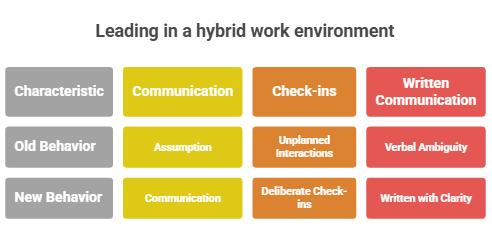
- Rely on communication instead of assumptions
- Deliberately check-ins instead of unplanned interactions
- Written with clarity instead of verbal ambiguity
In our consulting projects, leaders who align this model will get higher engagement scores. Hybrid leadership is less about supervision and more about orchestration—ensuring every team member, nevertheless of location, is aligned and empowered.
What role does hybrid work culture play in communication success?
A strong hybrid work culture provides inclusive, transparent communication and remains steady across all team members. Culture describes how information flows, how feedback is reviewed, and how employees engage with each other.
Culture doesn’t originate through policies, but it’s built through behavior.
Ebullient focuses on shifting from:
“Human Resources” → “Human Beings”
This means:
Employees are not information processors.
They are decision-makers navigating ambiguity
Managers must:
- Promotes open discussion
- Organize feedback loops
- Fosters psychological safety
Without a supportive culture, even the best communication techniques fail.
Source: Fierce
Did You Know?
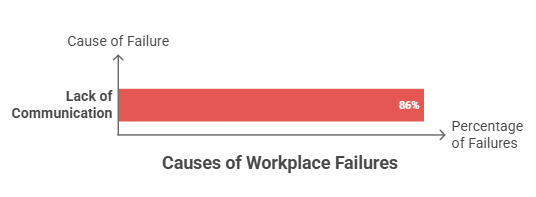
Lack of communication has been cited as the main reason for an estimated 86% of workplace failures.
How can managers measure communication effectiveness in hybrid teams?
Managers assess the communication in Hybrid Workplaces through employee engagement rate, feedback loops, and performance metrics. Data-driven insights supports and heps to identify gaps and enhance communication strategies.
Key Metrics to Track:
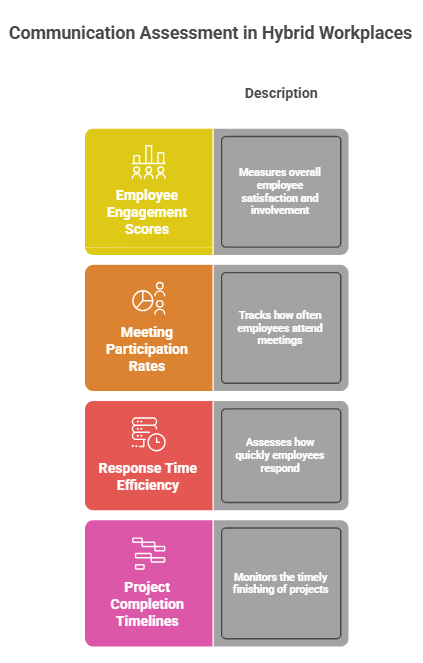
- Employee engagement scores
- Meeting participation rates
- Response time efficiency
- Project completion timelines
Advanced organisations are using pulse surveys and communication analytics tools to continuously redefine their strategies.
What are the hybrid workplace trends 2026 impacting communication?
The hybrid workplace trends 2026 recommends a shift toward AI-assisted communication, asynchronous-first workflows, and personalised employee engagement strategies. These trends are reshaping how teams collaborate and communicate.
Key Trends:
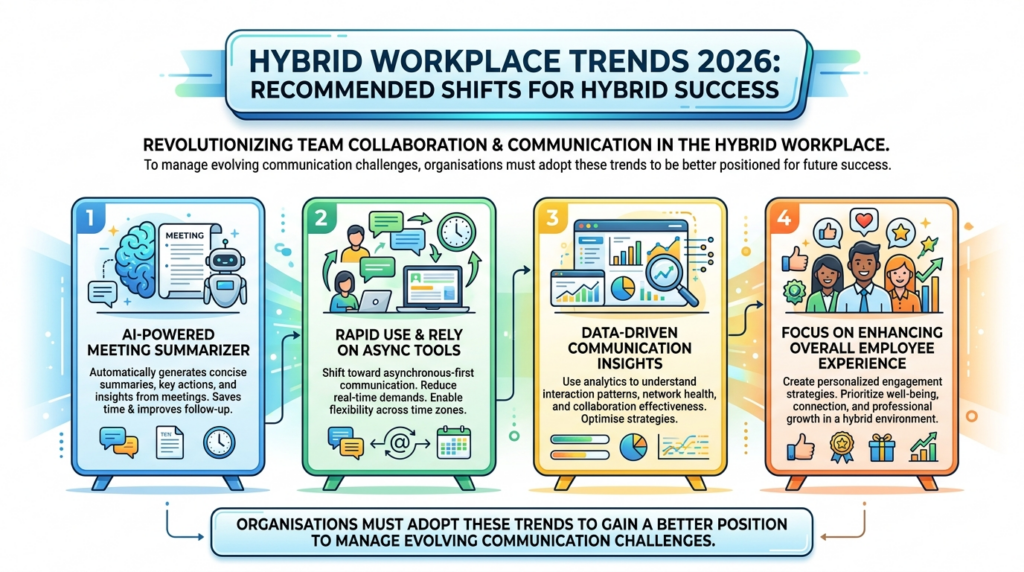
- AI-powered meeting summarizer
- Rapid use and reliance on async tools
- Data-driven communication insights
- Focus on enhancing the overall employee experience
Organisations must adopt these trends that help them to gain a better position to manage the evolving communication challenges in a hybrid workplace.
Why is structured communication the most critical success factor?
Structured communication improves consistency, role clarity, and accountability within the hybrid teams. Without any structure, communication may become shattered and ineffective.
Critical Framework:
- Define communication channels
- Establish response timelines
- Document decisions
- Create feedback mechanisms
In our experience working with large enterprises, structured communication frameworks improve productivity by up to 28%. It’s not about more communication—it’s about better communication.
A Critical Niche Insight: The Role of Asynchronous Communication in Hybrid Teams
One of the most overlooked element of Communication in Hybrid Workplaces is asynchronous communication.
Mostly organisations are still operating on reply heavily on team meeting culture, which cannot be scalable option working in a hybrid workplace culture.
Asynchronous communication enables employees to:
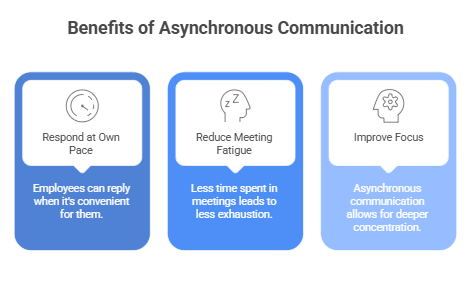
- Respond at their own pace
- Reduce meeting fatigue
- Increase focus and productivity
For example, a SaaS company we worked with reduced meeting hours by 40% by shifting to async updates and recorded briefings.
This method directly addresses hybrid work challenges such as time-zone differences and scheduling conflicts while improving overall efficiency.
How Ebullient Can Help
For decision-makers, communication in Hybrid Workplaces is not just a tool or training—but it’s an impactful capability transformation.
Ebullient consultancy equips this transformation through:
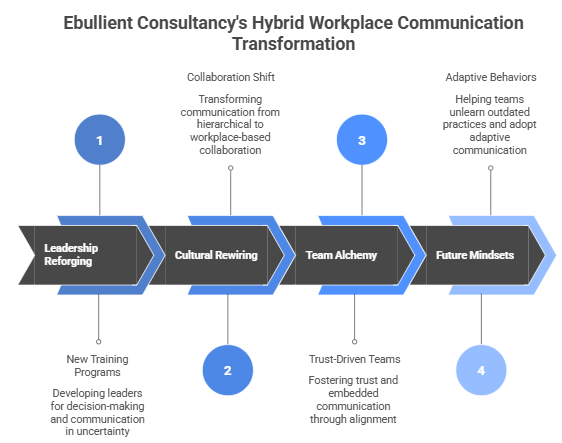
1. Leadership Reforging
The organization needs to develop new leadership training programs which equips leaders how to make decisions and communicate with others when facing uncertain situations.
2. Cultural Rewiring
Transforming communication from hierarchical flow to workplace-based collaboration.
3. Team Alchemy
Fostering trust-driven teams in which communication is embedded through alignment and not by control.
4. Future Mindsets
By helping teams through unlearning outdated communication practices and reacquired adaptive behaviors.
Their best comunication hybrid workplace training program focuses on:
- Real-world case study and hybrid scenarios
- Decision-making under ambiguity
- Preparing for communication resilience
Final Thoughts
The shifting toward hybrid work may be lasting, but the success of this model totally rely on how managers communicate. Communication in Hybrid Workplaces is no longer about coordination—it is about enabling human beings to think, decide, and act effectively in environments defined by uncertainty.
Managers who use clear communication methods will enable their teams to achieve high performance, whereas managers who rely on conventional methods will create a situation which leads to team members being less involved and working less effectively.
Frequently Asked Questions
Get answers to commonly asked questions about Ebullient.
How Can Managers Eliminate Communication Gaps in Hybrid Teams?
What is effective communication in a hybrid workplace?
The hybrid workplace needs structured tools and processes to achieve effective communication, which delivers clear messages to all team members who work remotely and in the office.
Why is communication important in hybrid workplaces?
The importance of communication in hybrid workplaces lies in maintaining alignment, reducing confusion, and ensuring equal participation across distributed teams.
What are common hybrid work challenges?
The three main challenges that arise during hybrid work include miscommunication and the lack of visibility, together with the problem of unequal information distribution.
How can managers improve communication in hybrid teams?
Managers establish better communication practices through the development of specific procedures that use appropriate tools for creating an environment that encourages people to share information.
What are the hybrid working benefits statistics?
Recent statistics about hybrid work show that employees become more productive while their job satisfaction increases and companies spend less money on operations.