

Leading Through Uncertainty in 2026 demands CXOs to align with adaptive decision-making, scenario planning, digital analytics, and resilient leadership. The most effective leaders integrates data-driven making with human-centric communication to navigate through uncertainty, manages stakeholders , and achieve sustain growth. Success rely on various factor such as agility, foresight, and the capability to lead through continuous disruption.
Key Takeaways – At a Glance
- Leading Through Uncertainty is vital for CXO competency to succeed in 2026.
- Adaptive decision-making and scenario planning are essential skills in today’s world.
- The 6 strategies for leading through uncertainty offer an effective framework.
- L&D plays an important role in building future-ready leadership.
- Organizations must be equipped with uncertainty leadership in their culture.
- Investing in the best CXO development program, which helps in driving long-term business resilience.
What Does Leading Through Uncertainty Mean for CXOs in 2026?
Leading Through Uncertainty for CXOs contributes taking high-stakes decisions without having complete information meanwhile maintaining organisational growth and stability. It includes risk management, aligning teams contribution, and adapting strategies in real world. CXOs aligns data insights, emotional intelligence, and agile leadership implement on organisations through unpredictable economic, technological, and geopolitical environment.
The definition of what is a cxo in business has evolved Today. Now CXOs are not only just functional heads—they are strategists who are responsible for navigating ambiguity. Unlike the traditional leadership models, what is cxo level leadership now requires cross-functional , faster decision-making, and drives continuous learning.
In our experience adopting leadership frameworks for financial services and IT sectors, CXOs are those who succeed in Leading Through Uncertainty implementing a dual mindset: they plan rigidly yet remain belended in execution. This builds with modern interpretations seen in leading through uncertainty book, where adaptability interchange rigid planning.
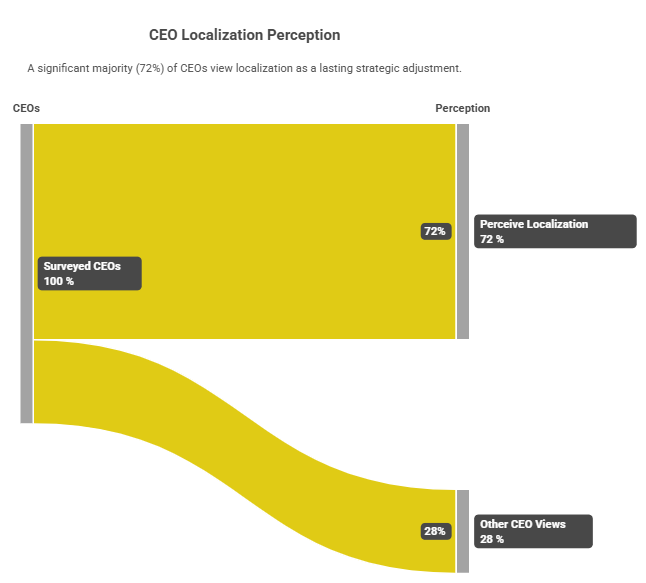
Source: EY
Did You Know?
The survey shows that 72% of CEOs view localization or regionalization as a permanent strategic change to handle operational disruptions.
How Managerially Effective Is Your Organization, Really?
Take our free 4-minute assessment and get a personalized report on your leadership fluency, governance, and workforce readiness.
Take the Free AI Readiness Assessment →Why Is Leading Through Uncertainty No Longer Optional for CXOs?
Leading Through Uncertainty is vital because businesses are now operate in environments which is driven by disruption—AI,GenAI , geopolitical shifts, and economic instability. CXOs have to respond quickly meanwhile balacing the long-term vision. The capability to manage ambiguity directly affects revenue , employee engagement, and organisational resilience.
Here’s the reality for L&D teams: leadership development has falling to move with disruption. Many executives still dependent on outdated frameworks for their strategic planning in uncertain times, which is an assumption for predictabe future.
In contrast, modern CXOs must:
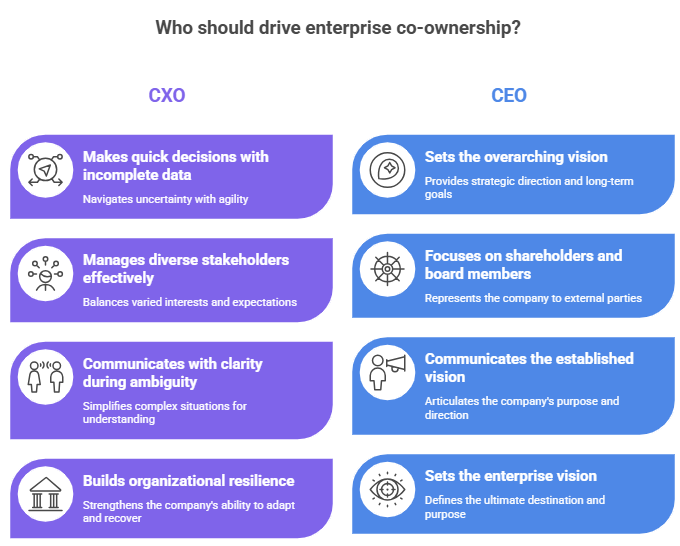
- Make quick decisions with incomplete data
- Communicate with clarity during ambiguity
- Managing diverse stakeholders effectively
- Build organisational resilience
The difference between cxo vs ceo is also getting narrowed. While CEOs set vision, CXOs now co-ownership of the enterprise. This is why it is important to invest in leading cxo training online and cxo programs is now accelerating across industries.
What Are the Core Skills Required for Leading Through Uncertainty?
The core skills for Leading Through Uncertainty are: adaptive thinking, scenario planning, emotional intelligence, digital fluency, and strategic agility. CXOs have to analyse the risks factor to anticipate disruptions, and guide the teams through change while balacing the role clarity and maintain trust. These competencies make sure wise decision-making and organisational resilience.
Let’s break starts:
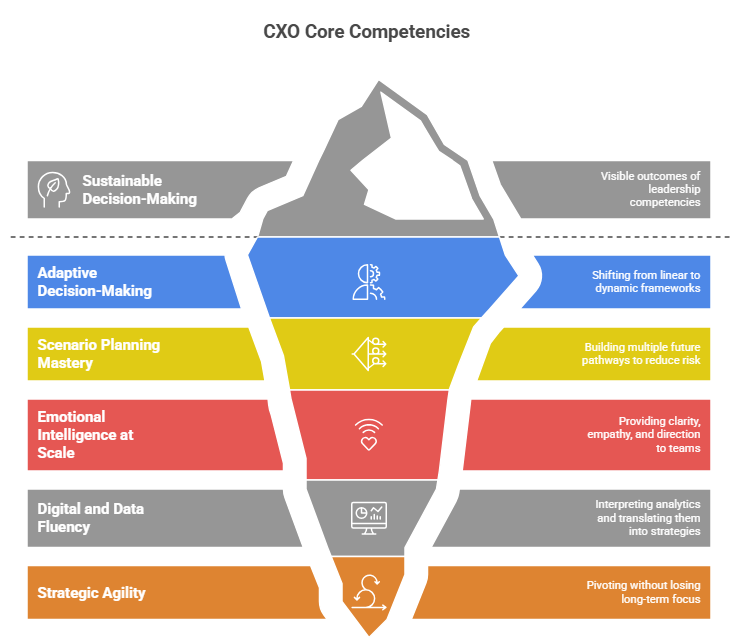
1. Adaptive Decision-Making
CXOs should shift from linear thinking to vigorous decision frameworks. Instead of saying “What’s the plan?”, they must ask “What are the possible outcomes ?”
2. Scenario Planning framework
Today’s strategic planning in uncertain times involves building multiple future paths. This helps in reducing risk and boosting readiness.
3. Emotional Intelligence at Scale
Leadership today is deeply human. Teams are looking for clarity, empathy, and direction, especially during crisis times.
4. Digital and Data Fluency
Data-driven insights are not an option; it is a necessity today. CXOs should focus on data analytics and translate them into actionable strategies.
5. Strategic Agility
The capability to pivot without affecting the long-term focus of center to Leading Through Uncertainty.
In practice, organisations that equpied with these capabilities into leadership pipelines outperform peers consistently.
What Are the 6 Strategies for Leading Through Uncertainty?
The 6 strategies for leading through uncertainty starts with scenario planning, transparent communication, agile execution, stakeholder alignment, continuous learning, and resilience building. These strategies helps CXOs to navigate disruptions effectively while balancing the operational stability and strategic direction.
Proven Framework
| Strategy | Description | Business Impact |
|---|---|---|
| Scenario Planning | Develop multiple future scenarios | Reduces risk exposure |
| Transparent Communication | Clear, consistent messaging | Builds trust |
| Agile Execution | Rapid iteration of plans | Faster response |
| Stakeholder Alignment | Unified leadership direction | Prevents confusion |
| Continuous Learning | Upskilling leaders | Sustains adaptability |
| Resilience Building | Strengthening systems & teams | Ensures continuity |
In our consulting work with manufacturing companies, applying these 6 strategies for leading through uncertainty reduces operational cost by nearly 30%.
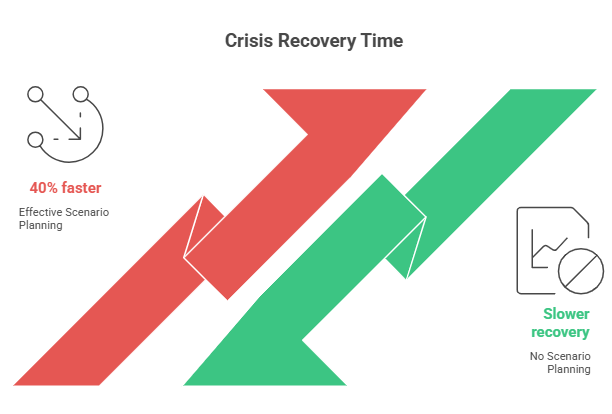
Source: Taggd
Did You Know?
Companies with the ability to have good scenario planning recover 40% faster from crises.
How Does Leading Through Change Differ from Leading Through Uncertainty?
Leading through change focuses on managing the known transitions, while Leading Through Uncertainty focuses on unknown, unpredictable scenario. These subsequent requires higher adaptability, quick decision-making, and greater resilience, as outcomes are undefined through process are constantly evolving.
Here’s the nuance:
Change is planned. Uncertainty is not.
In a transformation program, leaders can plot timelines and milestones. But in uncertain environments like economic downturns, AI disruption, or pandemic
—Leaders have to operate without any structured planning.
Insights from leading through uncertainty ted talk support this distinction: the most successful leaders are those who embrace uncertainty rather than resist it.
A Critical CXO Capability: Decision-Making Under Ambiguity
One of the most low rated aspects of Leading Through Uncertainty is cognitive ability in decision-making. CXOs often face “lack of consistent data” scenarios. Waiting for clarity which delays their action; acting too quickly increases the risk.
The solution lie in structured ambiguity frameworks:
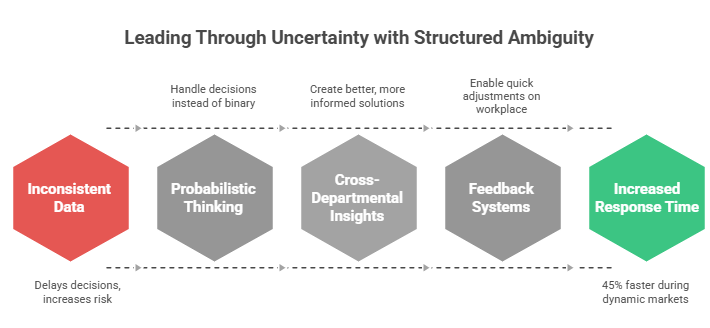
- Probabilistic thinking to handle decisions instead of using binary decision-making methods.
- Use insights from different departments to create better solutions.
- Develop feedback systems that will enable making quick adjustments in the workplace.
In our experience working with BFSI leaders, executing structured decision frameworks increases response time by 45% during dynamic market conditions.
This capability is now become essentail for all best cxo programs in india, where leaders are trained to operate effectively under uncertainty.
The Manager Effectiveness Framework Free guide, instant download.
Get the Guide →What Role Does Learning & Development Play in Leading Through Uncertainty?
L&D plays a vital role by Leading Through Uncertainty by fosters CXOs with adaptive skills, strategic thinking, and resilience. With structured training programs help leaders build their mindset and tools require to navigate volatility market landscape.
But it doesn’t stop there. Traditional leadership programs are no longer an feasible option.
Modern L&D strategies must include:
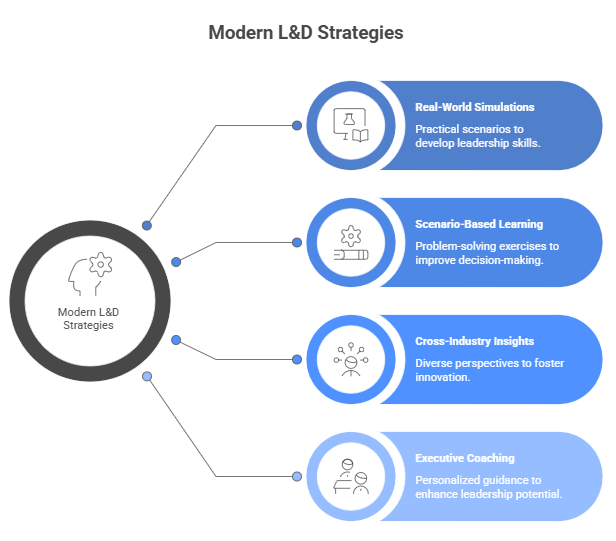
- Real-world simulations
- Scenario-based learning
- Cross-industry insights
- Executive coaching
Organisations that invest on leading cxo training online and executive development programs are experiencing measurable ROI in leadership effectiveness.
What Are the Best CXO Development Approaches in 2026?
The best CXO development approaches blends with experiential learning, real-world case studies, and strategic simulations. These programs deeply focus on agility, resilience, and data-driven decision-making to build readiness amogst leaders for uncertain environments.
Key Learning Models
| Approach | Benefit |
|---|---|
| Simulation-Based Learning | Real-world application |
| Peer Learning | Cross-industry insights |
| Coaching & Mentoring | Personalized growth |
| Digital Learning Platforms | Scalability |
Many best cxo programs in india now adopting these approaches to builds leaders for uncertainty-driven challenges.
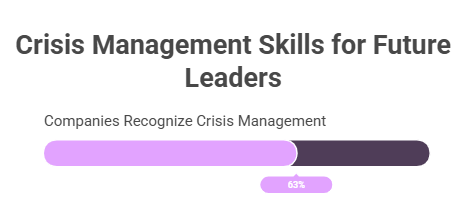
Source: Deloitte
Did You Know?
63% of organizations regard crisis management as one of the top three priorities for the development of future leaders.
How Can Organizations Build a Culture of Leading Through Uncertainty?
Organisations can prepare the Leading Through Uncertainty culture by embed agility, fostering innovation, and empowering leaders to make informed decisions. This focuses on alignment of leadership, systems, and processes to embrace adaptability and resilience.
Transformation begins with organisations shift:
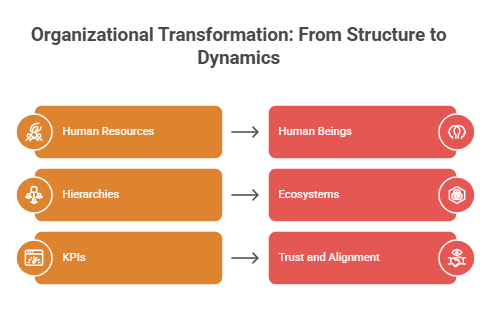
- From Human Resources → Human Beings
- From hierarchies → ecosystems
- From KPIs → trust and alignment
In our experience, organisations that emphasize team-level trust and psychological safety outperform those dependent solely on performance metrics.
This is where leading through change frameworks often fails because they address structure, not human dynamics.
Curious About Other Areas of Your Organization?
Explore our other free assessments and get a fuller picture of where you stand.
View All AssessmentsHow Ebullient Can Help CXOs Navigate Uncertainty?
Ebullient constancy offers specialized in building future-ready leaders for real-world complexity. Their programs are well- designed for CXOs who must perform in volatile environments.
Ebullient’s Approach:
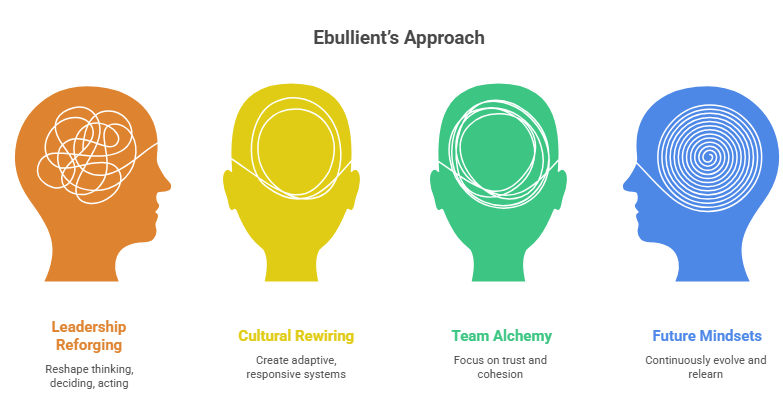
1. Leadership Reforging (Mindsets > Mechanics)
The program needs to develop leaders through more than skill acquisition, which includes equipping them to think, choose, and respond to uncertain situations.
2. Cultural Rewiring (Ecosystems > Pyramids)
Organisations need to develop adaptive solutions that require them to move away from conventional hierarchical structures.
3. Team Alchemy (Trust > KPIs)
The team establishes performance standards through their main focus on developing trust and building team cohesion, and achieving shared goals.
4. Future Mindsets (Unlearn → Relearn)
The program helps leaders develop their skills according to the evolving needs of current situations.
At its core, Ebullient’s mission is to humanize technology, corporations, and society—ensuring that innovation amplifies:
- Human dignity
- Creativity
- Care
The Leading Through Uncertainty requires leaders to manage business results while maintaining a balance between human and environmental well-being.
Final Thoughts
Leading Through Uncertainty is essential for CXOs in 2026. Organisations that invest in developing this capability will outperform competitors, retain talents, and achieve sustainable growth.
Leaders that promotes ambiguity, use data, and prioritise human-centric leadership will cultivate and set the benchmark for the next decade.
Want to meet the team?
Start with a 30-min conversation. No commitment needed.
Frequently Asked Questions
What is Leading Through Uncertainty?
The potential of leaders to make decisions and align organisations through unpredictable and volatile environments defines Leading Through Uncertainty.
What is the cxo full form?
CXO stands for Chief Experience Officer or Chief “X” Officer where “X” represents various executive roles like CEO CFO or CTO.
How is cxo vs ceo different?
The CEO assist the organisation overall while CXOs manage distinct functions but now contribute to developing companywide strategic plans.
Why is strategic planning in uncertain times important?
The organization uses strategic planning during uncertain times to prepare for multiple future scenarios which reduces risks and enhances their ability to adapt.
What are the best cxo programs in india?
The top programs in India provide training for CXOs which focuses on developing leadership agility and decision-making capacity and resilience through training programs offered by leading institutions and corporate training organizations.