

A leadership pipeline is a systematic process which helps organisation to identify, evaluate, and transition mid-level managers into future leadership role. Through competency mapping, experiential learning, behavioural transformation, and succession planning—that ensure to business to maintain sustained performance, leadership continuity, and organisational resilience in an increasingly competitive business landscape.
Key Takeaways – At a Glance
A leadership pipeline ensures there is a consistent supply of capable leaders across all departments.
Mid-level managers are vital for leadership continuity to achieve organisational vision.
Structured development programmes help in improving leadership readiness.
The behavioural transformation is a key factor for leadership success.
Investing in professional development for managers helps in driving measurable business outcomes.
A strong building leadership pipeline strategy may reduce hiring costs and retention.
Understanding leadership pipeline meaning
The leadership pipeline refers to a structured progression model which helps employees to prepare a smooth shift from one leadership level to the next one. For the mid-level managers, make sure they are equipped with innovation, a strategic mindset, operational efficiencies, and people management capabilities to lead teams effectively and transition into senior roles.
Why Is a Leadership Pipeline Critical for Mid-Level Managers?
Mid-level managers are the main pillar for the execution. It translates strategy into action plans. Without a strong leadership pipeline, organisations may face a leadership vacuum during development, progression, or crises.
In our experience enforcing these frameworks for large-scale companies, the major risk is not lack of insufficient talent but the lack of structured development. Managers who are high-potential may often remain inactive because they have a lack of confidence and guidance into leadership roles deliberately.
Here’s the reality for L&D teams: while promoting top performers without making them prepared for leadership roles & responsibilities leads to a sudden decline in performance, disengagement amongst the team and attrition.
A well-structured leadership pipeline addresses this by:
- Defining the clear role transitions
- Building leadership competencies early
- Aligning learning with business goals
- Ensuring continuity in leadership supply
Leaders must also be prepared for BANI environments—Brittle, Anxious, Nonlinear, Incomprehensible.
How Managerially Effective Is Your Organization, Really?
Take our free 4-minute assessment and get a personalized report on your leadership fluency, governance, and workforce readiness.
Take the Free AI Readiness Assessment →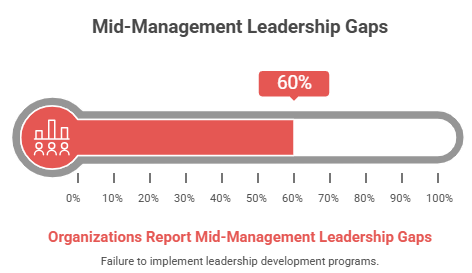
Source: linkedin
Did You Know?
The statistic that 60% of organizations report mid-management leadership gaps shows that organizations that fail to implement a leadership development program face challenges in developing their leadership capabilities.
How Does a Leadership Pipeline Impact Business Performance?
A structured leadership pipeline enhance the operational efficiency, increase employee engagement, and fosters success by equipping mid-level managers with quick decision-making, people management effectively, and gaining strategic thinking skills aligned with business objectives.
The impact must be measurable. Organisations with stronger pipelines consistently outperform competitors in terms of higher productivity and lower retention.
Let’s break it down:
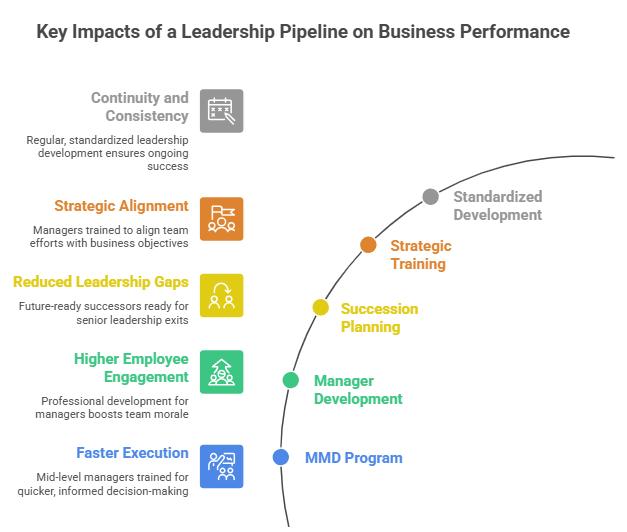
1. Faster Execution
Mid-level managers are trained through a Middle Manager Development (MMD) program which helps them to make quicker, more informed decision-making. They don’t escalate the task while taking authority and achieving excellence to fulfil the goal.
2. Higher Employee Engagement
Managers influence nearly 70% of employee engagement across the department at all levels. Investing in professional development progarms for managers directly impacts higher team morale.
3. Reduced Leadership Gaps
A robust building leadership pipeline strategy makes sure that whenever a senior leader exits, there is already a future-ready successor present within the organisation.
4. Strategic Alignment
Managers trained within a leadership pipeline must understand business objectives, which helps them to align team efforts collectively.
But it doesn’t stop there. The real value lies in continuity and regular consistency. Organisations that standardise leadership development outperform those who are dependent on ad-hoc training.
What Are the Key Stages of Building a Leadership Pipeline?
To Build a leadership pipeline which required high-potential managers, evaluating the competencies, planning structured learning paths, offering mentorship, and continuously monitoring the performance to make sure readiness for development of leadership roles.
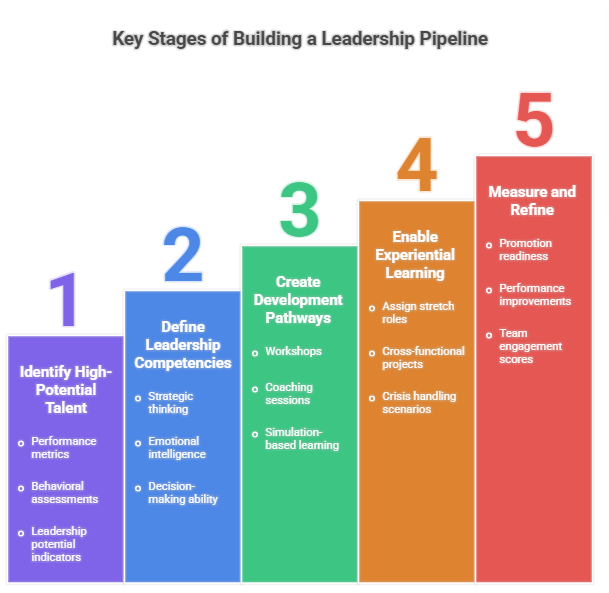
Stage 1: Identify High-Potential Talent
Not every managers have potential to become future leaders. It require to use data-driven tools:
- Performance Metrics & Metrology
- Behavioral Assessments Evaluations
- Leadership Potential Indicators (LPI)
Stage 2: Defining Leadership Competencies
All organisation should know what leadership looks like internally. It should includes:
- The Strategic thinking
- The Emotional intelligence
- Decision-making skills
Stage 3: Create Development Route
This is where how to develop leaders in your organization becomes actionable:
- Workshops
- Coaching sessions
- Simulation-based learning
Stage 4: Enable Experiential Learning
Assign stretch roles. Cross-functional projects. Crisis handling scenarios.
In our experience, this stage separates theoretical leaders from real ones.
Stage 5: Measure and Refine
Track:
- Promotion readiness
- Performance improvements
- Team engagement scores
A leadership pipeline book framework often emphasises continuous evaluation—and rightly so. Leadership development is iterative, not linear.
What Challenges Do Organisations Face While Developing Mid-Level Leaders?
What Challenges Do Organisations Face While Developing Mid-Level Leaders? Organisations have to face problem due to unclear competency frameworks, unstructured programs , lack of leadership exposure, and inadequate alignment amongst training and business outcomes, preparing to the ineffectiveness of leadership pipeline initiatives.
Here’s the truth: mostly organisations understand that they need to adopt leadership development, but few only execute it well.
Common Challenges
| Challenge | Impact |
|---|---|
| Undefined leadership criteria | Confusion in promotions |
| One-size-fits-all training | Low engagement |
| Lack of mentoring | Slow development |
| No measurement metrics | No ROI visibility |
Source: DDI
Did You Know?
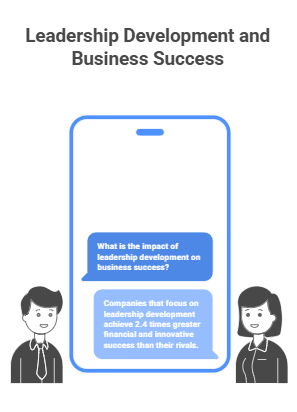
Companies that develop their leadership capabilities through dedicated programs experience 2.4 times higher financial success and innovative success compared to their competing companies.
How Can Organisations Design an Effective Middle Manager Development Program?
An effective middle manager development program intergrates competency-based training, live simulations, mentorship , and performance tracking to readiness leadership capabilities directly linked with organisational goals.
Designing this program requires precision.
The Core Feature are:
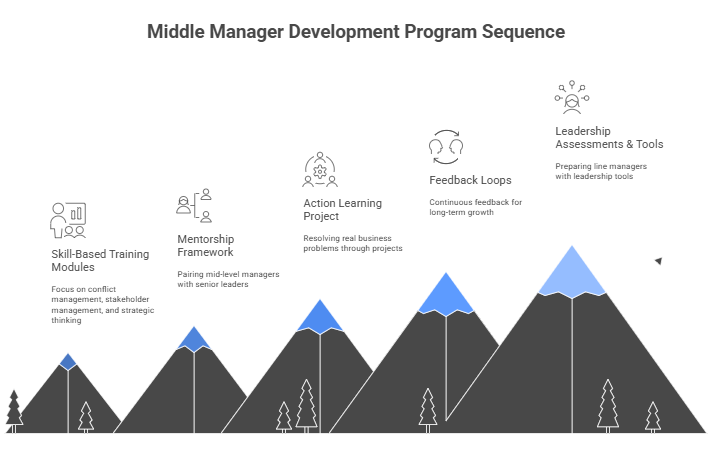
1. The Skill-Based Training Modules
Focus areas:
- Conflict management skills
- Stakeholder management
- Strategic thinking skills
2. The Mentorship Framework
Pairing mid-level managers with senior leaders.
3. An Action Learning Project (ALP)
Giving real insight to resolve business problems.
4. The Feedback Loops
With Continuous feedback that ensure long term growth for the organisation.
5. Leadership Assessments & Tools
Use tools to prepare line managers.
A structured leadership pipeline thrives when development is not theoretical but deeply experiential.
Why Is Succession Planning Critical in Leadership Pipeline Development?
Succession planning establish continuity by identifying and developing future leaders within the leadership pipeline, when enables to reduce disruption during transitions and maintaining business stability.
Here’s where many organisations fall short—they separate succession planning from leadership development.
That’s a mistake.
A robust leadership pipeline integrates both.
Key Benefits:
- Zero leadership vacuum
- Faster transitions
- Reduced external hiring costs
In our consulting experience, organisations that embed succession planning into their building leadership pipeline strategy achieve smoother leadership transitions and stronger organisational resilience.
Why Behavioural Transformation is the Core of a Future-Ready Leadership Pipeline?
Behavioural transformation is general overlooked , but it is the key factor for a successful leadership.
Mid-level managers must transition:
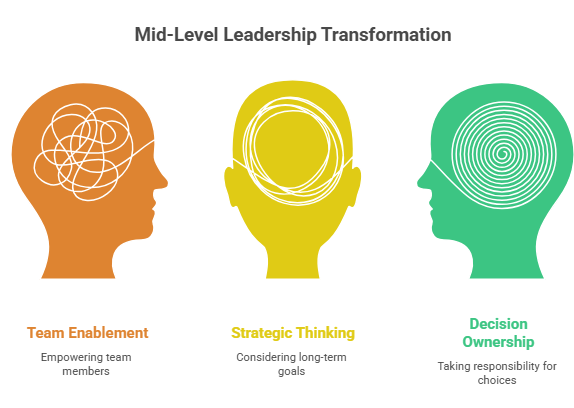
- From individual contributors → team enablers
- From operational focus → strategic thinking
- From task execution → decision ownership
This shift cannot be achieved through knowledge alone.
It requires: - Coaching
- Reflection
- Real-world application
In our work with large corporates, behavioural interventions have shown the highest ROI in leadership development. Technical skills get managers promoted. Behavioural skills make them successful leaders.
How Does Ebullient’s Purpose Align with Leadership Pipeline Development?
Ebullient consultancy aligns leadership pipelines to prepare future leaders to learn, decide, and under uncertainty meanwhile integrating human, technological, and sustainability on priorities.
Ebullient’s purpose is very clear:
To aim and help leaders to operate at the intersection of:
- Digital transformation
- Sustainability
- Purpose-driven leadership
This make sure that building leadership pipeline aims for the succession but it is to develop leaders for the future.
Their mission focuses on: - Humanising technology
- Building dignity-driven workplaces
- Creating antifragile leaders
This helps in aligning the organisations from managing “resources” to nurturing human beings.
How can organisations measure the success of a leadership pipeline?
Organisations can assess the success of a leadership pipeline through metrics which include internal promotion rates, leadership readiness scores, employee engagement levels, retention rates, and business performance indicators.
The following key metrics should be monitored. The leadership readiness index The succession coverage ratio The internal and external hiring ratio The employee engagement scores The manager effectiveness ratings
Data-driven leadership development has become mandatory for organizations.
The Manager Effectiveness Framework Free guide, instant download.
Get the Guide →What Are Practical Examples of Mid-Level Leadership Development?
Middle-level management examples such as managers handling the cross-functional teams, manging the client escalations, and foster operational improvements, all of them require structured leadership development.
Let’s look at real world scenarios:
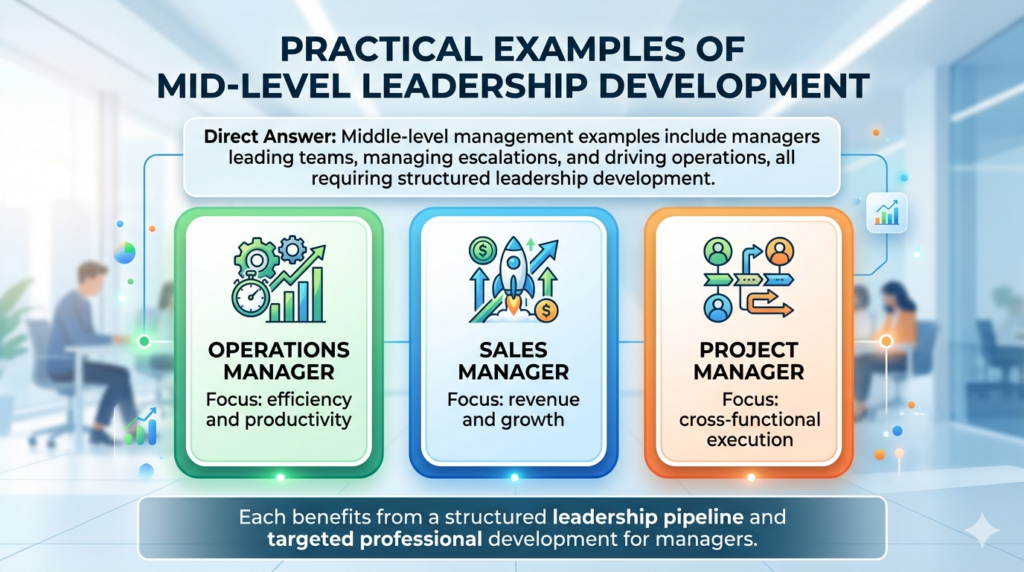
Example 1: Operations Manager
Managing the team productivity and achieving process efficiency. Take quick decision-making and people management skills.
Example 2: Sales Manager
Achieving revenue targets. That requires negotiation skill and strategic planning skills.
Example 3: Project Manager
Coordinates teams across all department. That requires stakeholder management expertise. Each of these inputs benefits from a structured leadership pipeline which helps in professional development for managers.
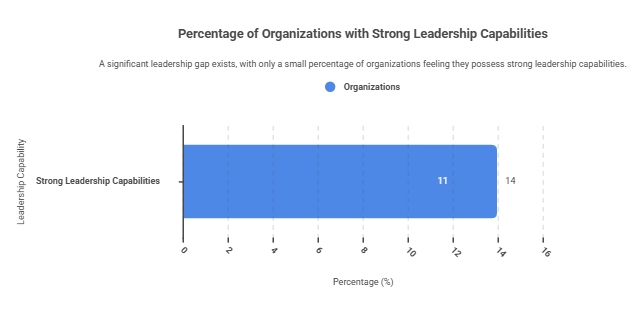
Source: LinkedIn’s Workplace Learning Index
Did You Know?
Recent research shows that only 11% to 14% of organizations believe they have strong leadership capabilities which reveal a persistent leadership gap issue that extends beyond temporary talent shortages.
Curious About Other Areas of Your Organization?
Explore our other free assessments and get a fuller picture of where you stand.
View All AssessmentsHow Ebullient Can Help Build a Leadership Pipeline?
The organization requires leadership development programs that need to focus on specific goals through customized programs which will evaluate their executive leaders’ performance.
Ebullient’s Approach
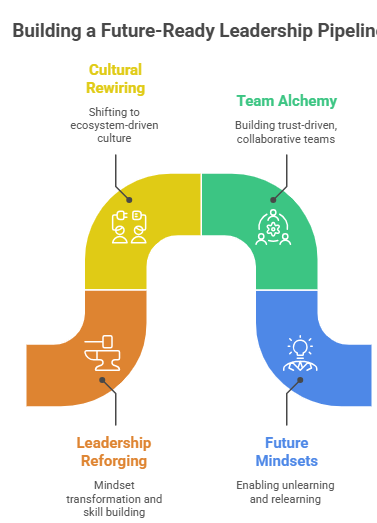
1. Leadership Reforging
The first step is to establish new ways for both leaders and their teams to approach their work through new leadership development programs.
2. Cultural Rewiring
Organizations need to transition from their existing hierarchical structures toward network-based operational ecosystems.
3. Team Alchemy
Organizations need to establish trust-based relationships which will enable their teams to work together effectively.
4. Future Mindsets
The program helps learners to acquire new knowledge while they can also forget existing information.
5. Scalable Frameworks
The organization requires permanent methods to support ongoing development of its leaders.
The way your organization develops leaders will become a strategic asset which your organization needs to develop instead of remaining an obstacle.
Final Thoughts
A leadership pipeline is an infrastructure. Organisations that invest in it don’t just develop leaders; they build resilience, agility, and long-term future growth .
Here’s what separates successful organisations: they aim for leadership development as a continuous system, not a one-time phase.
And that changes everything.
Want to meet the team?
Start with a 30-min conversation. No commitment needed.
Frequently Asked Questions
What is the best way to start building a leadership pipeline?
The process of building a leadership pipeline begins with organizations establishing leadership competencies and selecting high-potential employees, and organizing development programs that support their business objectives.
How long does it take to build an effective leadership pipeline?
Organizations require between 12 and 24 months to achieve measurable results from their programs, which depends on their program design and level of organizational dedication.
What is the role of HR in leadership pipeline development?
HR uses its strategic function to develop leadership development programs through training frameworks and organizational goal alignment with their leadership development initiatives.
How do you measure the success of a leadership pipeline?
Organizations measure their leadership pipeline success through four metrics which include promotion readiness and employee engagement and retention rates and business performance improvements.
Is a leadership pipeline relevant for small organisations?
Small organizations actually gain advantages from having a structured leadership pipeline system because it enables them to grow their operations while maintaining their need for leadership development.