A Management Training Program is a systematic learning and development session designed to enable current and aspiring managers with the leadership, communication, decision-making, performance management, and strategic thinking skills which is required to lead teams effectively. A well-designed program supports organisations to build stronger leadership pipelines, enhance employee engagement, boost productivity, and prepare managers to tackle business challenges with confidence.
Key Takeaways at a Glance
Insight | Implication |
Managers drive 70% of engagement variance | Manager quality is your highest-leverage retention lever |
Most managers receive no training before their first role | Reactive training is already costing you productivity and attrition |
First-time managers need a separate curriculum | Generic programs misserve your newest and most vulnerable leaders |
High-potential programs fill 80% of senior roles internally | Strategic talent pipelines reduce external hiring costs significantly |
Spaced learning improves retention by 50% | Program design matters as much as program content |
Measurement must be defined before launch | Post-hoc ROI analysis is rarely credible or actionable |
Ebullient Consultancy LLP offers bespoke, measurable programs | Purpose-built design outperforms off-the-shelf content every time |
Why Management Training Matters More Than Ever
Organizations many times promote high-performing employees into management roles because of their technical expertise. Yet managing people needs a completely different set of skills. Many new managers often facing barriers with delegation, feedback conversations, conflict resolution, team motivation, and performance management.
A well-designed program enables managers with the capabilities needed to lead teams, drive execution, blends employees with organisational goals, and navigate through uncertainty. Whether an organisation is preparing frontline supervisors, developing future leaders, or strengthening mid-level management, leadership readiness can no longer be left to chance.
At Ebullient, we believe leadership development must go beyond skill acquisition. Leaders today must learn, decide, and act under deep ambiguity—where there are no clear playbooks, and where human well-being, business performance, and technological advancement must be designed together rather than treated as competing priorities.
For many organizations, the question is no longer whether management development is necessary. The real question is whether the current leadership pipeline is strong enough to support future growth.
Organizations actively combines management training portals, coaching frameworks, and blended learning experiences to accelerate leadership readiness and build sustainable management capabilities.
What Is the Meaning of a Management Training Program?
Management training meaning, at its core, is the deliberate development of skills that separate great managers from accidental ones. It is not a one-day workshop. It is a structured, sequenced intervention that addresses mindset, behavior, and applied competency — designed to produce measurable results in team productivity and retention.
When organizations talk about manager training programs, they often mean one of several formats: cohort-based leadership academies, role-specific skill sprints, one-on-one coaching engagements, or blended learning journeys delivered through a management training portal. Each format serves a distinct population — from newly promoted team leads navigating their first 90 days to senior managers preparing for cross-functional leadership.
The distinction matters because conflating formats leads to poor ROI. In our experience implementing these frameworks for financial services firms and manufacturing conglomerates alike, the organizations that see the sharpest performance lift are the ones that match the training architecture to the learner’s career stage and business context — not the ones that buy the most content.
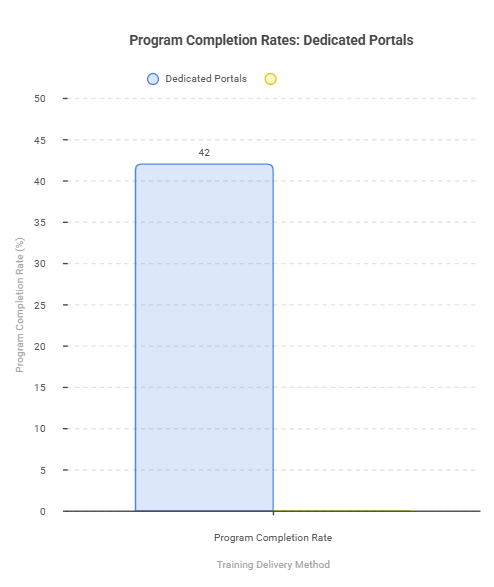
Source: Brandonhall
Did You Know?
Companies using dedicated management training portals report 42% higher program completion rates compared to those delivering training through generic email or shared drive distribution, according to Brandon Hall Group research.
What Are the Core Training Topics for Managers and Supervisors?
Training topics for managers and supervisors span three domains: people leadership (feedback, conflict resolution, psychological safety), operational leadership (goal-setting, delegation, performance reviews), and strategic leadership (business acumen, change management, stakeholder influence). A well-designed manager training program sequences these progressively rather than delivering them all at once.
Competency Domain | Key Skills Covered | Relevance Stage |
People Leadership | Active listening, coaching conversations, team motivation | First-time managers |
Operational Leadership | OKR setting, delegation frameworks, data-driven reviews | Mid-level managers |
Strategic Leadership | Executive communication, change management, P&L literacy | Senior managers |
Cross-functional Influence | Stakeholder mapping, negotiation, enterprise thinking | High-potential leaders |
The table above reflects a competency ladder — not a checklist. Organizations that try to address all four domains simultaneously, regardless of the manager’s level, typically see lower knowledge retention and weaker behavioral transfer. Sequencing is the design principle that separates effective corporate training companies in India and globally from those that simply sell content volume.
Why Does First-Time Manager Training Deserve Its Own Program?
First-time manager training is not a scaled-down version of senior leadership development. It addresses a fundamentally different psychological transition: moving from individual contributor to people leader. This shift needs a rewiring of identity, not just a transfer of skills. Without targeted first-time manager training, new managers default to managing the way they were managed — for better or worse.
The research supports this concern. McKinsey data indicates that companies lose between $7,000 and $12,000 per new manager per year in productivity drag during the first twelve months — most of it attributable to the absence of structured onboarding for managers specifically.
A first time manager course typically addresses three urgent gaps:
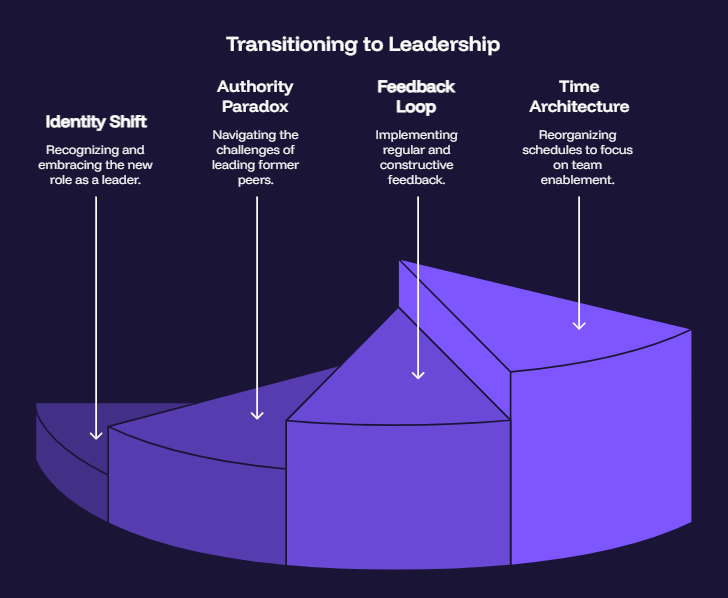
- The authority paradox — How to lead peers who were recently equals without creating resentment or abdicating decision-making.
- The feedback loop —How to speak honest, constructive feedback regularly not just saving it for annual reviews?
- The time architecture shift — How to reorganize a calendar from task-execution to team-enablement.
Books like The First 90 Days by Michael Watkins and The Making of a Manager by Julie Zhuo (often recommended as a first-time manager book) address these themes, but reading alone rarely produces behavioral change. Structured first-time manager training programs pair conceptual frameworks with practice scenarios, peer cohorts, and manager-to-manager coaching — because leadership is a contact sport, not a reading assignment.
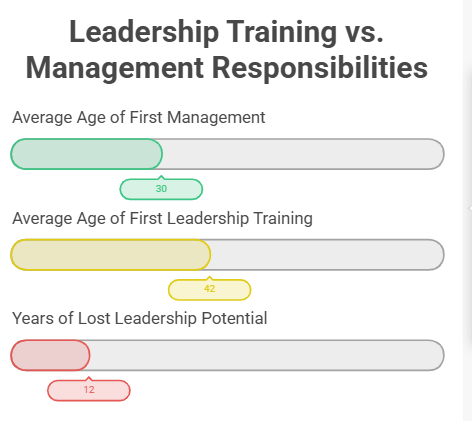
Source: HBR
Did You Know?
A Harvard Business Review study found that the average age at which managers first receive leadership training is 42 — yet the average age at which people first take on management responsibilities is 30. That 12-year gap represents a lost decade of potential leadership effectiveness inside your organization.
What Makes a High-Potential Development Program Different from Standard Manager Training?
A high potential development program targets the top 10–15% of your talent pool — individuals identified as likely to take on significantly larger roles within three to five years. Unlike standard manager training programs, which focus on current role performance, high-potential programs develop capability ahead of the next role’s demands, with deliberate exposure to stretch assignments, executive sponsorship, and enterprise-wide visibility.
This distinction has serious commercial implications. Organizations with mature high-potential pipelines fill 80% of senior roles internally (per Deloitte’s Global Human Capital Trends report), reducing the average cost-per-hire for director-level and above positions by 40–60%.
The architecture of a credible high potential development program includes:
- Identification criteria that go beyond current performance ratings to include learning agility, influence without authority, and adaptive thinking.
- Individual development plans co-created with senior sponsors — not HR alone.
- Action learning projects tied to live business challenges, not simulated case studies.
- 360-degree feedback loops that surface blind spots early, before they become career-limiting patterns.
- Cohort peer learning that builds cross-functional networks the organization will rely on for the next decade.
In our experience deploying these frameworks for technology companies and BFSI clients, the single biggest failure point is the identification process. Organizations that select high-potentials based solely on past performance often confuse high-performance with high-potential — two distinct constructs with different developmental needs.
How Do Sales Training Programs Fit Into a Broader Manager Development Strategy?
A sales training program for managers is not the same as sales skills training for individual contributors. Sales managers require a distinct curriculum: pipeline coaching skills, forecast accuracy, quota-setting logic, and the ability to replicate top-performer behaviors across a diverse team. When sales training programs are built into the broader manager training program architecture, conversion rates and team retention both improve measurably.
CSO Insights data shows that organizations with dynamic sales coaching programs achieve 28% higher win rates than those with informal or no coaching culture. The key design principle: a manager training program for managers in sales contexts must teach the manager to coach, not to sell.
What Are the Core Steps of Corporate Training Program Design?
Lorem ipsum dolor sit amet, consectetur adipiscing elit. Ut elit tellus, luctus nec ullamcorper mattis, pulvinar dapibus leo.

Source: Infopro learning
Did You Know?
In India, the corporate training scene is expected to touch around $4.5 billion by 2026, mostly pushed by a growing need for well laid out manager training courses in manufacturing, BFSI,and tech areas.
What Are the Core Steps of Corporate Training Program Design?
The corporate training steps that actually deliver measurable ROI tend to fit a six-phase model: starting with needs analysis, then learner segmentation, then curriculum design, content development, delivery execution, and finally impact measurement.
- Needs analysis: figure out the performance gaps using manager surveys, 360 data, exit interviews, the relevant business KPIs.
- Learner segmentation: sort and map your manager population by tenure, seniority, function, and yes geography too.
- Curriculum design: line up the competencies in a logical sequence. Add in spaced repetition moments, because the ATD research note suggests that spaced practice can lift retention by as much as 50% , more or less.
- Content development: pick the delivery modality (virtual, in-person, hybrid, asynchronous) based on your workforce reality , not whatever the vendor prefers.
- Delivery execution: roll out cohorts with visible milestones , peer accountability set ups, and manager-of-manager endorsement.
- Impact measurement: decide your Level 3 (behavioral change) and Level 4 (business outcomes) metrics before launch, not after.
How Do You Select the Right Manager Training Program?
The right manager training program , for managers blending leadership development goals with business strategy, organisational culture, and future workforce requirements.
Before selecting a solution, organisations should really evaluate
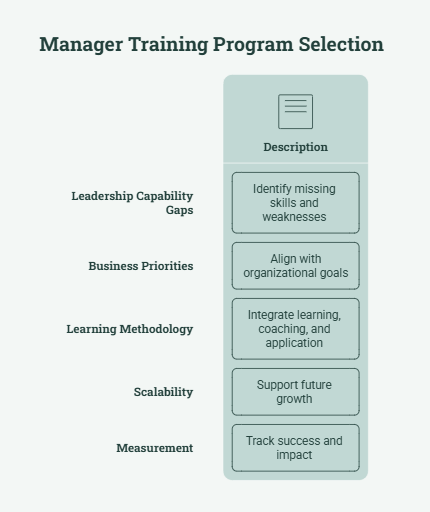
Leadership Capability Gaps
Which skills are currently missing, and where does the weak point identified?
Business Priorities
What organisational results are most important right now?
Learning Methodology
Does the program integrate learning, coaching, and practical application?
Scalability
Can the program support future growth?
Measurement
How will success be measured?
Organisations must look for learning partners who understand both leadership development and business transformation.
How Can Ebullient Consultancy Help You Build the Right Program?
For HR leaders and Learning & Development decision-makers, who are looking at manager training program options, with generic content platforms and one-size-fits-all workshops. Ebullient Consultancy operates differently.
Our approach focuses on these:
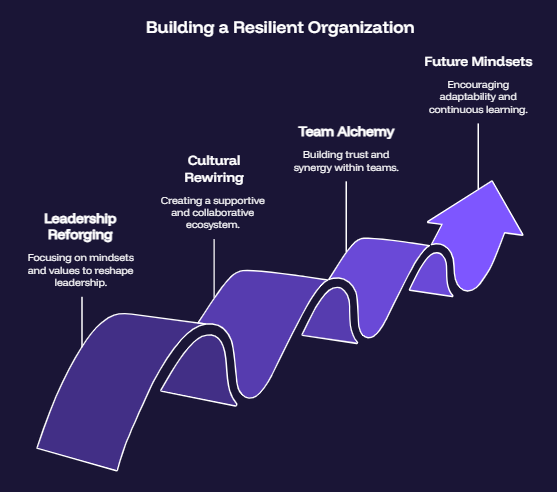
Leadership Reforging,
Mindsets before mechanics.
Cultural Rewiring,
Ecosystems before hierarchies.
Team Alchemy,
Trust before KPIs.
Future Mindsets
Unlearn → Relearn → Adapt.
We support organizations to move from seeing employees as just resources and instead recognizing them as actual human beings, with potential, imagination, and purpose.
That philosophy helps leaders to thrive in BANI environments while they build organizations that are more resilient, more adaptive, and human-centered.
If you are evaluating manager training programs for the first time, start with your data. Where is manager performance weakest? Where is attrition highest? Which teams consistently underperform despite strong individual talent? The answers to those questions are your curriculum brief.
Frequently Asked Questions
Get answers to commonly asked questions about Ebullient.
Why Do High-Performing Companies Invest in Management Training Programs?
What is a Manager Training Program?
A Manager Training Program is an organized learning journey designed to develop leadership, communication, coaching, decision-making, and people management capabilities for managerial performance effectively.
Is first-time manager training different from general management training?
Yes — significantly. First-time manager training addresses the identity and behavioral transition from individual contributor to people leader. General manager training programs assume a baseline of management experience and build on existing competencies.
How long should a manager training program be?
There is no universal answer — but programs shorter than six weeks typically cannot drive sustained behavioral change. In our experience, the most effective manager training programs run twelve to twenty weeks, combining live learning sessions every two to three weeks with application assignments in between.
What is a management training portal, and do we need one?
A management training portal is like a digital space that hosts tracks and really supports your training programs—usually a blend of LMS with communication tools, resource libraries, and progress dashboards.
Why should organizations invest in management training?
Organisations that are investing in management training see meaningful improvement in leadership effectiveness , employee engagement, productivity , retention, succession planning, and overall business performance.