

A CEO recently described her organization’s AI strategy this way: “We bought the licenses, we sent out the training video, and adoption is still near zero.”
She wasn’t describing a technology failure. The tools worked exactly as advertised. She was describing something far more common and far less visible — an organization that had prepared its software for AI and never actually prepared its people, its governance, or its own leadership for what genuine integration requires.
This is where the AI Readiness Scorecard for Leaders becomes useful. Not as another dashboard to fill in, but as a diagnostic for the five human and structural conditions that separate organizations getting real value from AI from those stuck with a slow-adopted pilot.
Key Takeaways at a Glance
- Tooling is rarely the bottleneck. The gap between AI adoption and AI value is a people-and-governance gap, not a technology gap.
- Five conditions predict readiness: leadership fluency, workforce judgment, data and governance foundations, cultural safety, and workflow embeddedness.
- More training and louder internal communications treat the symptom, not the cause, when adoption stalls.
- Leadership fluency is the highest-leverage starting point because it sets the ceiling for every other condition on this list.
- AI readiness is an ongoing organizational capability to build over years, not a project to complete in a quarter.
The Readiness Gap Isn’t Where Most Leaders Are Looking
Most AI readiness conversations focus on tooling: which platform, which model, which vendor. That’s the easiest part of the problem to solve and, increasingly, the least differentiating one. The tools available to a small organization today aren’t meaningfully behind what a large enterprise can access.
What actually separates organizations that get real value from AI isn’t the technology. It’s five specific, human and structural conditions that technology alone cannot create.
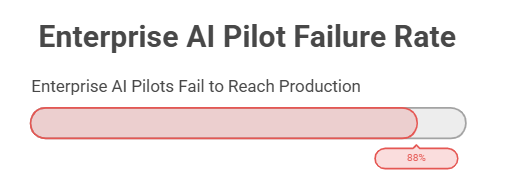
Source: IDC
Did You Know?
IDC research found that 88% of enterprise AI pilots fail to reach production, with the failures clustering around governance gaps, poor data readiness, and weak observability — not model quality.
The AI Readiness Scorecard for Leaders: 5 Conditions to Score
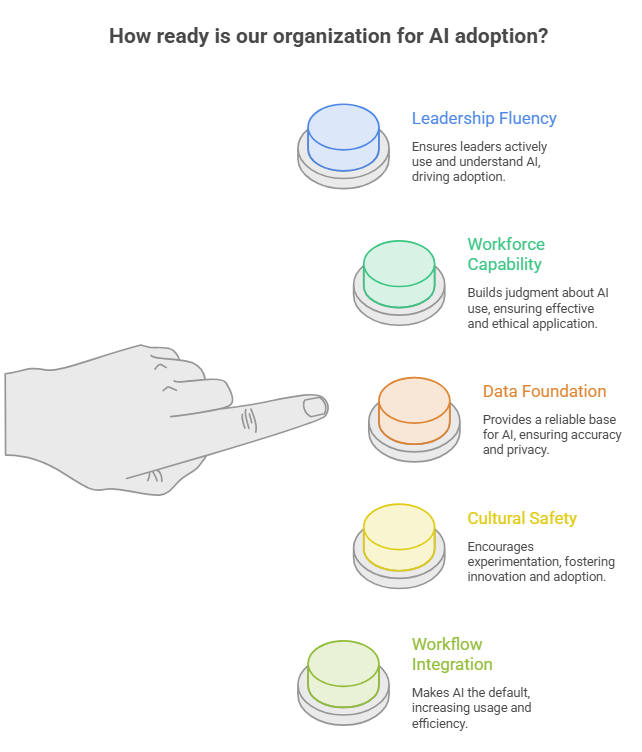
1. Leadership Fluency
Do senior leaders personally use AI tools in their own work, or is AI understood mainly as something delegated to a function, a team, or “the tech people”? An organization rarely outpaces its leadership’s own comfort with a capability.
2. Workforce Capability, Not Just Tool Training
Has the organization built genuine judgment about when to use AI, when to verify its output, and when to keep a task fully human — or has training stopped at “here’s how the interface works”?
3. Data and Governance Foundation
Is the underlying data organized and governed well enough for AI to build on with confidence? Do clear guardrails exist for privacy, bias, and where human sign-off is genuinely non-negotiable?
4. Cultural Safety for Experimentation
Do people feel safe trying AI tools and occasionally getting it wrong, or does visible AI use carry a quiet risk of looking like it’s cutting corners — pushing real adoption underground where leadership can’t see or manage it?
5. Workflow Embeddedness
Is AI built into the actual flow of daily work, so using it is the default path, or does it sit as a separate tool people have to consciously remember to open?
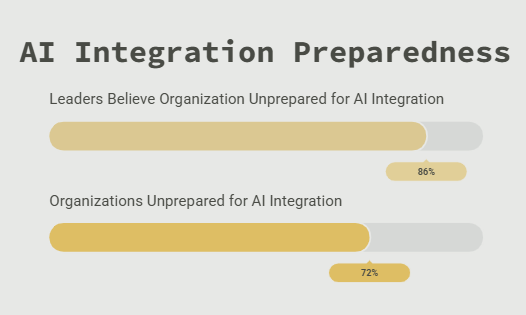
Source: McKinsey
Did You Know?
McKinsey’s 2026 State of Organizations research found that 86% of leaders believe their organization was not prepared to integrate AI into day-to-day operations, and 72% describe their organizations as unprepared to execute on the outcomes they expect from it. The strategy isn’t the gap. Execution capacity — specifically, people readiness — is.
How AI-Ready Is Your Organization, Really?
Take our free 4-minute assessment and get a personalized report on your leadership fluency, governance, and workforce readiness.
Take the Free AI Readiness Assessment →Why the Standard Fix Falls Short?
The conventional response to low adoption is more training and a louder internal communications push. This treats the symptom.
If leadership doesn’t visibly use the tools themselves, if the culture quietly penalizes visible experimentation, or if governance is unclear enough that people are nervous about what they’re actually allowed to do, no amount of training will move the number that matters.
Metric | Old Playbook | Next Practice |
Approach | Purchase licenses, run a training session | Treat AI readiness as an ongoing organizational capability |
Success metric | Login counts in month one | Workflow redesign and demonstrated judgment |
Leadership role | Sponsors and delegates | Uses the tools first, models the learning curve publicly |
Failure handling | Risk to be minimized or hidden | Information to be shared openly |
Time horizon | Completed project | Multi-year capability build |
What to Do About It This Quarter?
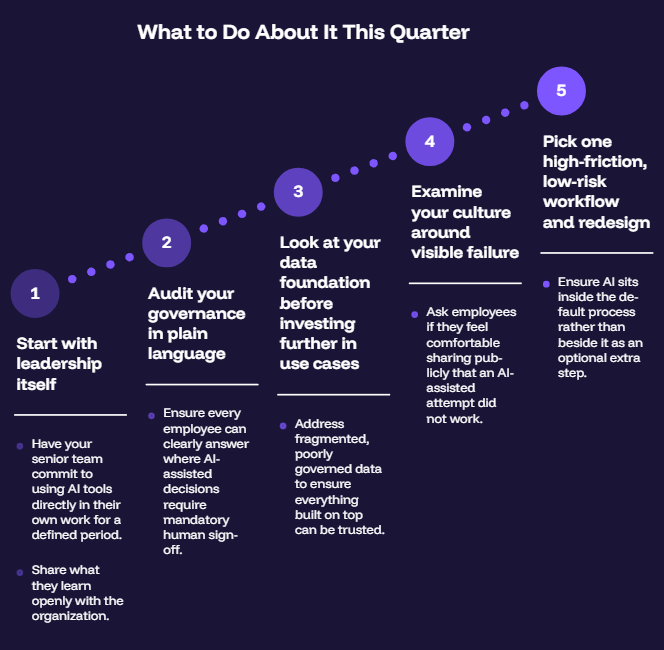
Start with leadership itself
It’s the highest-leverage and most commonly skipped step. Have your senior team commit to using AI tools directly in their own work for a defined period — not delegating the experimentation downward — and share what they learn openly with the organization. This single act does more for adoption than most formal rollout plans.
Audit your governance in plain language
Can every employee clearly answer where AI-assisted decisions require mandatory human sign-off, and where they don’t? If the honest answer involves hesitation, that ambiguity is quietly limiting both adoption and safety at the same time.
Look at your data foundation before investing further in use cases
A well-designed AI application built on fragmented, poorly governed data will simply amplify existing problems faster and more confidently than a human would have. This is unglamorous work, but it determines whether everything built on top of it can actually be trusted.
Examine your culture around visible failure
Ask a handful of employees, informally and confidentially if needed, whether they’d feel comfortable sharing publicly that an AI-assisted attempt at something didn’t work. If the honest answer is no, that discomfort — not the technology — is the real adoption barrier.
Pick one high-friction, low-risk workflow and redesign
It so AI sits inside the default process rather than beside it as an optional extra step. A single, well-embedded example does more to shift behavior organization-wide than a long list of available tools ever will.
AI Readiness Score Card Free guide, instant download.
Get the Guide →The Deeper Pattern
Every previous wave of technological change has tested the same underlying question, dressed in different clothing: does the organization treat the new capability as something to bolt onto existing ways of working, or as an invitation to genuinely reconsider how work itself should be done?
AI is simply the current, unusually fast-moving version of that same test. The organizations struggling most with AI readiness today are rarely lacking access to good tools. They are lacking the leadership courage to model uncertainty in public, the cultural safety that lets people fail small and learn quickly, and the patience to treat this as a capability built over years rather than a project completed in a quarter.
The technology changes every eighteen months. The human conditions that determine whether any technology gets genuinely adopted change far more slowly — and matter considerably more.
Source: McKinsey
Did You Know?
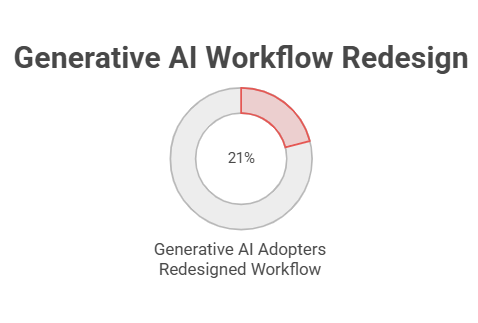
McKinsey identifies workflow redesign as the single highest-correlating factor with measurable AI impact on earnings — yet only 21% of generative AI adopters have fundamentally redesigned any workflow around it. Most organizations are still using AI beside the process, not inside it.
Curious About Other Areas of Your Organization?
Explore our other free assessments and get a fuller picture of where you stand.
View All AssessmentsHow Ebullient Helps You Close the Readiness Gap?
Most consultancies sell either a technology roadmap or a leadership offsite. Neither closes the gap on its own. Ebullient works across both, building a tailored program around wherever your organization actually scores lowest on the five conditions above — not a generic curriculum applied uniformly regardless of where the real bottleneck sits.
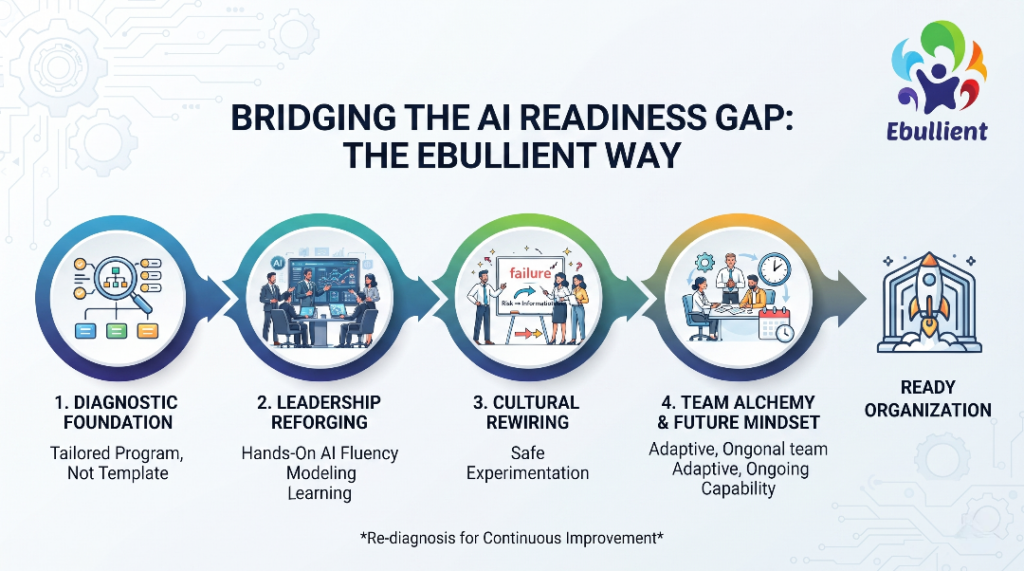
1. Leadership reforging
Senior teams build direct, hands-on fluency with AI in their own work first, so they can model the learning curve publicly instead of delegating it downward.
2. Cultural rewiring
We help surface where visible experimentation quietly carries risk to someone’s standing, and rebuild the norms so failure reads as information rather than a mark against the person who tried.
3. Team alchemy
Governance and workflow redesign happen together, with cross-functional teams, so guardrails and daily practice are built by the same people who’ll live inside them.
4. Future mindsets
Because the technology shifts every eighteen months, the program is built as an ongoing capability with periodic re-diagnosis — not a one-time workshop that goes stale by the next model release.
Every engagement starts with a diagnostic, not a proposal, so the program you get is built around where your organization genuinely stands — not a template pulled off the shelf.
Where Does Your Organization Actually Stand?
Scoring your organization informally against these five conditions is a useful start. To see where you stand across a fuller set of readiness dimensions, the Artificial Intelligence Readiness Assessment, part of Ebullient’s Wisdom Gap Diagnostics series, offers a genuine fifteen-question read — with the reasoning behind every answer laid out honestly alongside it.
Want to meet the team?
Start with a 30-min conversation. No commitment needed.
Frequently Asked Questions
What is an AI readiness scorecard for leaders?
It’s a diagnostic framework leaders use to assess whether their organization has the human and structural conditions — not just the tools — needed for AI adoption to actually stick, typically scored across leadership fluency, workforce judgment, governance, culture, and workflow design.
Why do AI rollouts fail even when the technology works?
Rollouts most often fail because leadership doesn’t visibly use the tools, governance is ambiguous, or the culture quietly discourages visible experimentation — not because the underlying technology is inadequate.
Which of the five readiness conditions should leaders address first?
Leadership fluency, because an organization rarely outpaces its own leadership’s comfort with a new capability. It sets the ceiling for every other condition on the scorecard.
How is AI readiness different from AI adoption?
Adoption measures how many people are using a tool. Readiness measures whether the organization has the leadership behavior, governance clarity, cultural safety, and workflow design to convert that usage into real, sustained value.
How long does it take to build genuine AI readiness?
It’s an ongoing organizational capability rather than a one-time project — most of the leaders who close the gap treat it as a multi-year discipline, not a quarter-long rollout.