
In today’s fast-evolving corporate world, success is no longer measured by profits alone. Investors, employees, and customers are now looking at how responsibly organizations operate — this is where ESG (Environmental, Social, and Governance) takes center stage.
For managers, understanding ESG is not just a compliance checkbox — it’s a leadership imperative. Integrating ESG into daily business decisions enhances brand reputation, drives long-term sustainability, and attracts top talent and investors. But where should managers start, and what should they prioritize? Let’s explore.
What Is ESG? A Quick Overview
ESG stands for Environmental, Social, and Governance, the three core pillars that assess a company’s sustainability and ethical impact:
Environmental (E) – How the organization impacts the planet (carbon footprint, waste management, energy efficiency, etc.).
Social (S) – How it treats people — employees, customers, communities, and stakeholders.
Governance (G) – How the organization is managed — ethics, transparency, compliance, and board practices.
A strong ESG strategy ensures a company contributes positively to society while remaining profitable and compliant.
Why Managers Must Pay Attention to ESG
Managers are at the frontline of implementing ESG principles — from decision-making and operations to people management.
Here’s why it matters:
Stakeholder Trust: Companies with strong ESG commitments are more trusted by customers and investors.
Risk Management: ESG helps identify and mitigate long-term risks related to regulations, climate change, or social backlash.
Talent Retention: Employees increasingly prefer working for responsible and ethical organizations.
Competitive Advantage: ESG leaders often outperform peers in brand perception, innovation, and resilience.
Step 1: Assess Where You Stand
Before setting ESG goals, managers must evaluate the organization’s current position.
Ask these key questions:
What are our biggest environmental impacts?
Are we promoting diversity, equity, and inclusion?
How transparent are our governance structures?
Conduct an ESG baseline audit — collect data, interview stakeholders, and identify strengths and gaps. This step sets the foundation for measurable improvement.
Step 2: Define Your ESG Priorities
ESG isn’t one-size-fits-all. Managers should align ESG goals with business strategy and industry standards.
For example:
A manufacturing company might prioritize energy efficiency and waste reduction.
A financial institution may focus on responsible lending and ethical investment.
A tech company could emphasize data privacy and digital inclusion.
The key is relevance — focus on issues that genuinely impact your operations and stakeholders.
Step 3: Engage and Educate Teams
ESG success depends on employee understanding and participation. Managers should:
Communicate why ESG matters and how every role contributes.
Create internal training programs on sustainability, ethics, and compliance.
Recognize and reward ESG-friendly behavior.
When employees feel empowered and aligned, ESG becomes part of the company culture rather than a top-down directive.
Step 4: Set Measurable Goals and KPIs
Vague goals lead to vague results. Managers must establish clear, measurable ESG objectives backed by performance metrics.
Examples:
Reduce carbon emissions by 30% in 3 years.
Achieve gender parity in leadership by 2026.
Ensure 100% supplier compliance with ethical sourcing.
Use ESG reporting frameworks like GRI, SASB, or TCFD to track progress and communicate transparently with stakeholders.
Step 5: Integrate ESG into Core Business Processes
To create lasting impact, ESG must be embedded into daily decisions:
Procurement: Choose sustainable suppliers.
Operations: Minimize waste and optimize energy use.
HR: Prioritize diversity, inclusion, and well-being.
Finance: Assess ESG risks in investments and budgeting.
When ESG is part of strategy, not a side project, results are more consistent and credible.
Benefits of ESG for Managers and Organizations
1. Improved Brand Reputation
Companies with strong ESG performance are seen as trustworthy and responsible. This enhances customer loyalty and market differentiation.
2. Easier Access to Capital
Investors are increasingly factoring ESG ratings into their decisions. Firms with strong ESG frameworks attract more investment opportunities and better financing terms.
3. Higher Employee Engagement
Workplaces that value ethics, sustainability, and fairness foster stronger employee commitment, leading to lower turnover and higher productivity.
4. Long-Term Profitability
A well-implemented ESG strategy reduces risks, improves efficiency, and enhances long-term profitability through innovation and stakeholder trust.
Challenges Managers Face in Implementing ESG
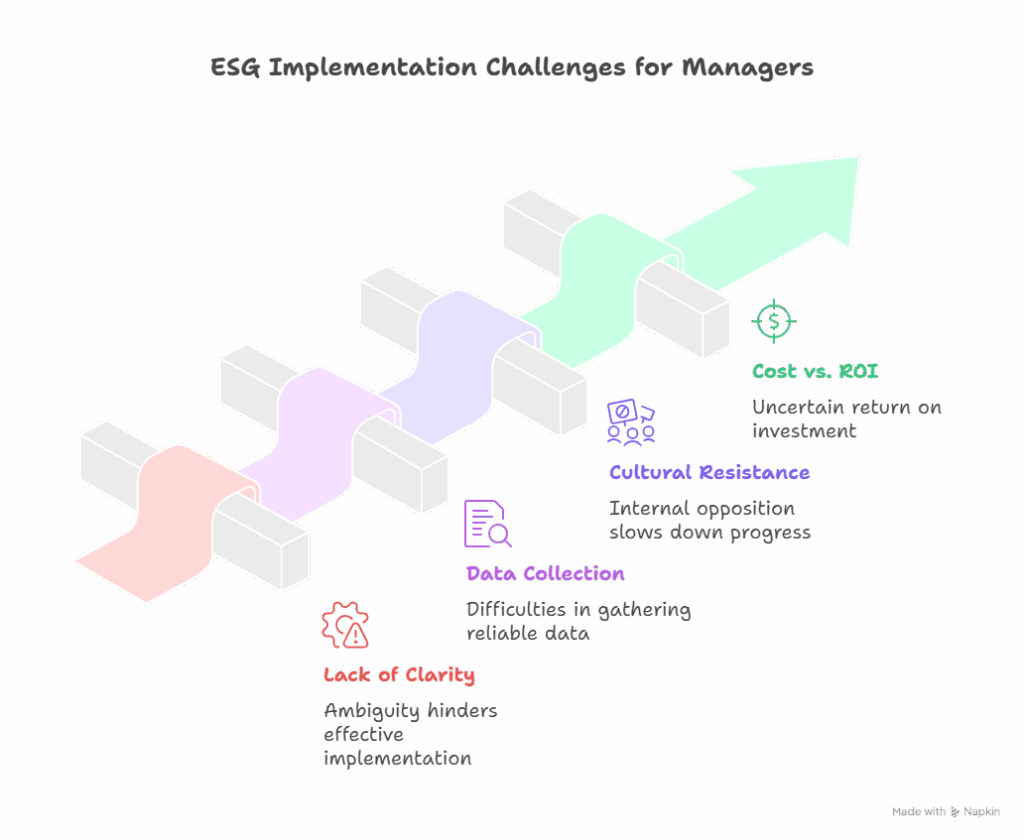
While ESG brings immense benefits, managers often encounter several obstacles:
1. Lack of Clarity or Standardization
There’s no single ESG framework, making it challenging to determine what to measure or prioritize.
2. Data Collection Difficulties
Tracking ESG metrics (like carbon emissions or social impact) requires new tools and consistent reporting mechanisms.
3. Cultural Resistance
Employees or leaders may view ESG as “extra work” unless the organization embeds it into its core culture.
4. Cost vs. ROI
Some ESG initiatives may appear expensive initially, making it tough to justify without a clear understanding of long-term value.
How Managers Can Lead the ESG Transformation
To make ESG truly effective, managers should:
Lead by example with ethical decision-making.
Encourage collaboration across departments.
Communicate ESG wins internally and externally.
Continuously learn through training and professional development.
Strong ESG leadership transforms not only businesses but also industries and communities.
The Future of ESG in Management
The future of business leadership will be defined by responsible innovation. ESG will evolve from being a compliance requirement to a core leadership competency.
Managers who adapt early — by understanding data-driven ESG strategies and sustainability reporting — will stand out as future-ready leaders.
Final Thoughts: Empower Your ESG Journey with Ebullient
Integrating ESG is not a one-time effort — it’s a continuous process of learning, adapting, and leading with purpose. For managers, this journey starts with awareness, grows through strategy, and succeeds through action.
At Ebullient Learning & Development, we specialize in managerial and leadership development programs that include ESG integration, sustainability leadership, and ethical governance.
Our expert-led training helps managers:
Understand ESG fundamentals and frameworks.
Build action plans aligned with corporate goals.
Lead teams toward sustainable growth and innovation.
Join Ebullient to future-proof your leadership skills and make a measurable difference in your organization’s ESG journey.
Frequently Asked Questions (FAQs)
1. What is ESG, and why is it important for managers?
ESG stands for Environmental, Social, and Governance. It’s essential for managers as it ensures ethical, sustainable, and compliant business practices, improving long-term growth and brand trust.
2. How can managers begin implementing ESG practices?
Start with an ESG audit, identify priority areas, set measurable goals, and integrate ESG principles into everyday business operations.
3. What are the main challenges in adopting ESG?
Common challenges include lack of data, unclear metrics, cultural resistance, and initial investment costs.
4. Can ESG improve profitability?
Yes. ESG-driven companies are more efficient, attract investors, and build stronger customer loyalty — all leading to better profitability.
5. How can Ebullient help managers with ESG training?
Ebullient offers practical, expert-led workshops to help managers integrate ESG into leadership, operations, and corporate strategy effectively.