Competency Framework Development is a strategic process that define the skills, behaviors, and knowledge is essentail for success in specific roles. It intergrates talent strategy with business goals, enhance performance, equips targeted training, and develops succession planning through measurable, role-based competency mapping and driving sustainable performance and long-term impact.
Key Takeaways – At a Glance
- Competency Framework Development aligns workforce capabilities with business goals.
- The performance measurement system requires behavioral indicators as an essential element.
- Human-centric design creates better employee engagement and improved work performance.
- Organisations require technology to enable their operations to be efficient and outperform their business while balancing support for their employees.
- Companies need industry-specific customization to maintain their business relevance.
- Purpose-driven frameworks create sustainable impact through their effective implementation.
What is Competency Framework Development and Why Does It Matter?
Competency Framework Development is the strategic process by developing role-specific competency models that outlines skillset, knowledge, and behaviors. It is significant because it establishing performance standards, leveraging workforce capabilities with business strategy, and enhances talent management decision. Organisations employ it to drive hiring, training, and management development with measurable, standard benchmarks.
In practice, what is competency framework exceeds beyond documentation. It becomes the foundation of talent strategy. In our experience adoption of these frameworks for financial services and IT firms, organisations having unstructured competency models will struggle with uncertain hiring decisions, unclear career paths, and inefficient training investments.
A resilient framework answers three vital questions:
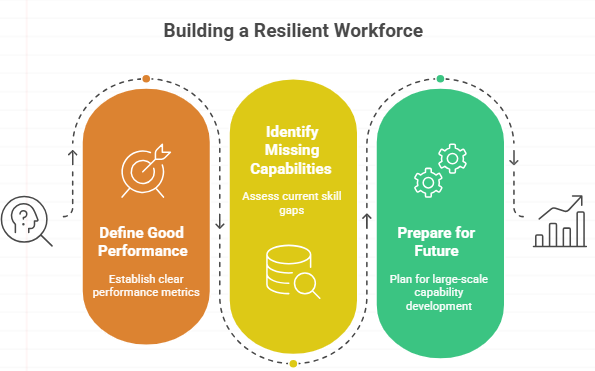
- What does “good performance” look like?
- What capabilities are we missing today?
- How do we prepare for those capabilities at a large scale?
When organisations deploy competency framework development in HRM, they move from instinct-based decisions to data-driven workforce planning. It also reshapes what a competency framework is: not a checklist, but a system that builds human capability in complex, emerging trends.
How Mature Is Your Framework, Really?
Take our free 4-minute assessment and get a personalized report on your leadership fluency, governance, and workforce readiness.
Take the Free AI Readiness Assessment →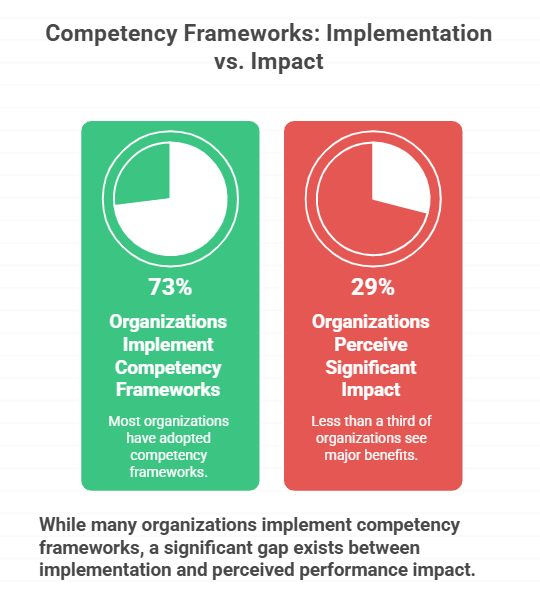
Source: Gartner
Did You Know?
Research shows that 73% of organizations implement competency frameworks, but only 29% of organizations find these frameworks to have substantial effects on their performance.
How to Develop a Competency Framework Step-by-Step?
To implement how to develop a competency framework, its a structured approach that defines objectives, identifies key roles, map required competencies, assesses with stakeholders, and aligns them into HR processes. This makes sure linking with business goals and adopting them across hiring, training, and performance management systems.
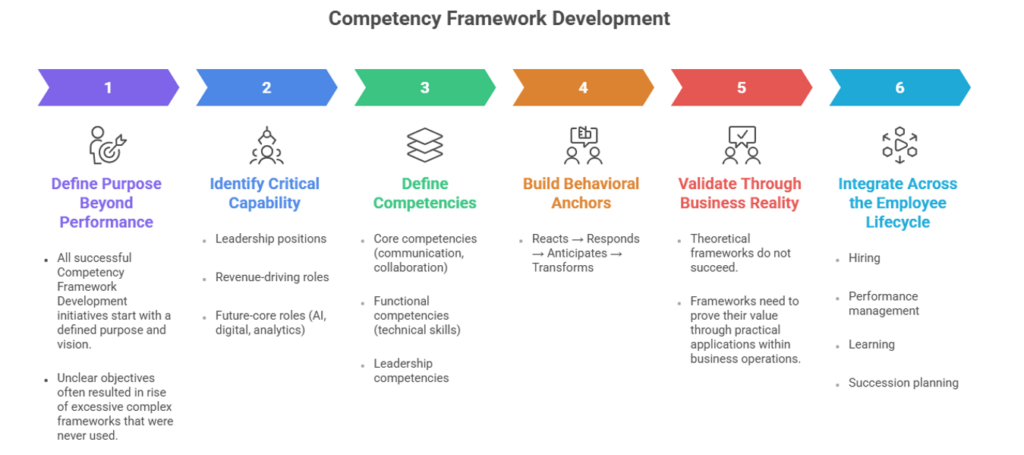
Step 1: Define Purpose Beyond Performance
Are you preparing the framework for leadership pipeline development, workforce upskilling initiative, or digital capability building? All successful Competency Framework Development initiatives start with a defined purpose and vision.
In our experience across manufacturing firms, unclear objectives often resulted in the rise of excessively complex frameworks that were never used.
Step 2: Identify Critical Capability
Focus on well-defined, highly impactful roles first. Not every role needs instant inclusion. By emphasizing:
- Leadership positions
- Revenue-driving roles
- Future-core roles (AI, digital, analytics)
Step 3: Define Competencies
Break competencies into three distinct layers:
- Core competencies (communication, collaboration)
- Functional competencies (technical skills)
- Leadership competencies
This is where most teams struggle. Using competency framework examples from your industry helps accelerate this stage.
Step 4: Build Behavioral Anchors
The competency framework needs to define specific behavior patterns that can be observed at different competency levels.
Reacts → Responds → Anticipates → Transforms
The framework requires the ability to assess competencies through established measurement methods.
Step 5: Validate Through Business Reality
Active involvement from leaders is necessary to ensure successful framework implementation because theoretical frameworks do not succeed. Theoretical frameworks need to prove their value through practical applications within business operations.
Step 6: Integrate Across the Employee Lifecycle
The process requires implementation in 4 areas, which include
- Hiring
- Performance
- management
- Learning
- Succession planning
This process develops frameworks into systems which organizations can use for practical purposes.
What Are the Types of Competency Frameworks?
The types of competency framework involves are: functional, leadership, and adaptive frameworks. Each of them offers their unique purpose, from defining organisational culture to provide specialized expertise and leadership readiness. Choosing the right intergrates by make sure relevance, scalability, and alignment with both business strategy and human development.
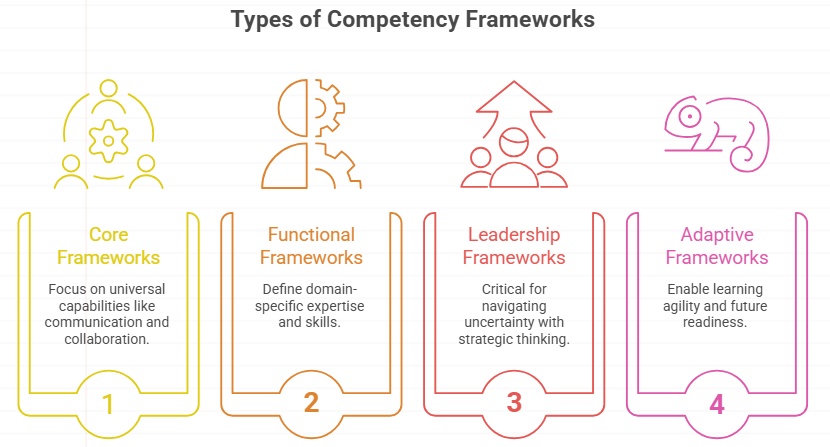
Core Frameworks (Human Foundations)
Focus on universal capabilities:
- Communication
- Collaboration
- Ethical decision-making
Functional Frameworks (Capability Depth)
Define domain-specific expertise.
Leadership Frameworks (Decision & Direction)
Critical for navigating uncertainty:
- Strategic thinking
- Courageous decision-making
- Systems thinking
Adaptive Frameworks (Future Readiness)
This is where modern organizations differentiate.
Adaptive frameworks enable:
- Learning agility
- Unlearning outdated practices
- Relearning emerging capabilities
In our experience, organisations that combines adaptive layers into their Competency Framework Development will outperform those using traditional models.
What Tools and Technologies Support Competency Framework Development?
Modern Competency Framework Development depends on digital tools like competency framework software and competency mapping tools to automate assessments, track skill gaps, and blend training initiatives. These tools overall increase the accuracy, scalability, and combines with HR systems, ensure data-driven talent development.
Key Tools Used by Organisations
| Tool Type | Role in Framework | Business Impact |
|---|---|---|
| Competency mapping tools | Identify skill and capability gaps | Faster decision-making |
| Competency framework software | Centralize and manage frameworks | Scalability |
| Learning Platforms | Deliver targeted development | Improved ROI |
| Analytics Engines | Track capability growth | Measurable outcomes |
But it doesn’t stop there. Technology should boost human capability, that cannot replace it.
Ebullient’s mission focuses on humanizing systems, make sure that digital tools enhance:
- Human dignity
- Creativity
- Care
This perspective transforms how organisations use competency framework software—as enablers, not controllers.
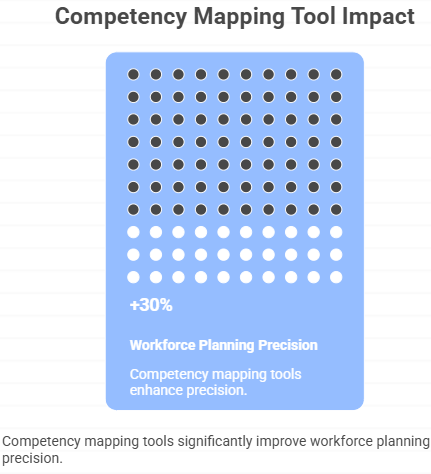
Source: Disprz
Did You Know?
Organizations that use competency mapping tools for integration improve the accuracy of their workforce planning by 30 percent.
How Do You Align Competency Frameworks with L&D Strategy for Real Impact?
Aligning Competency Framework Development with L&D strategy needs aligning the competencies lined up with training interventions, make sure that every program prepares for rest-oriented capabilities. This helps in transforming training from activity-based to outcome-driven, enhancing the key performance and achieving business goals.
A robust training framework template connects:
Competency → Capability gap → Learning journey → Behavior change
In practice, mostly organisations that heavily invest in training without having clarity on results.
To build a robust L&D competency framework, focus on:
- Role-based learning pathway
- Continuous skill assessment
- Bespoke learning journeys
Critical Niche Insight: Why Behavioral Anchors Make or Break Competency Frameworks
Behavioral anchors determine how competencies are seen at different levels, developing frameworks measurable and actionable. Without them, Competency Framework Development lacks clarity and fails to boost performance improvement.
This is the most neglected aspect. Many organisations determine the competencies but fail to specify how they look in action. For example:
“Leadership” without behaviors is vague
“Leadership” with defined actions becomes measurable
In high-performing organisations, behavioral anchors:
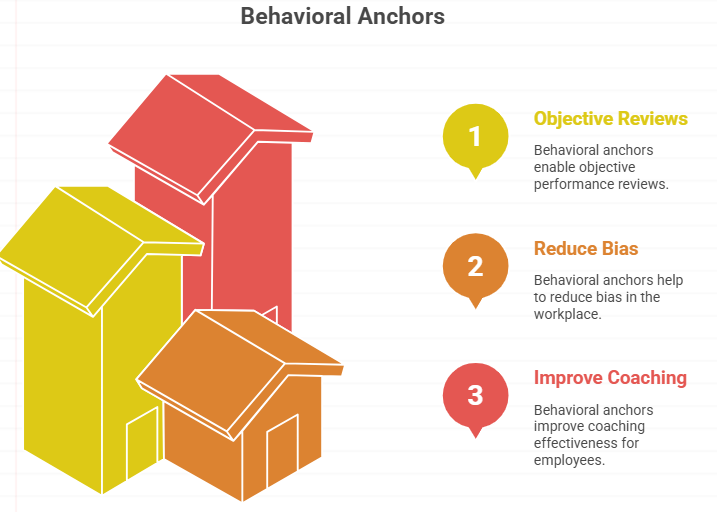
- Enable objective
- performance reviews
- Reduce bias
- Improve coaching effectiveness
What Are Real-World Competency Framework Examples That Drive Results?
Effective competency framework examples demonstrate how organisations integrate technical, behavioral, and adaptive capabilities into unified systems that drive performance and growth.
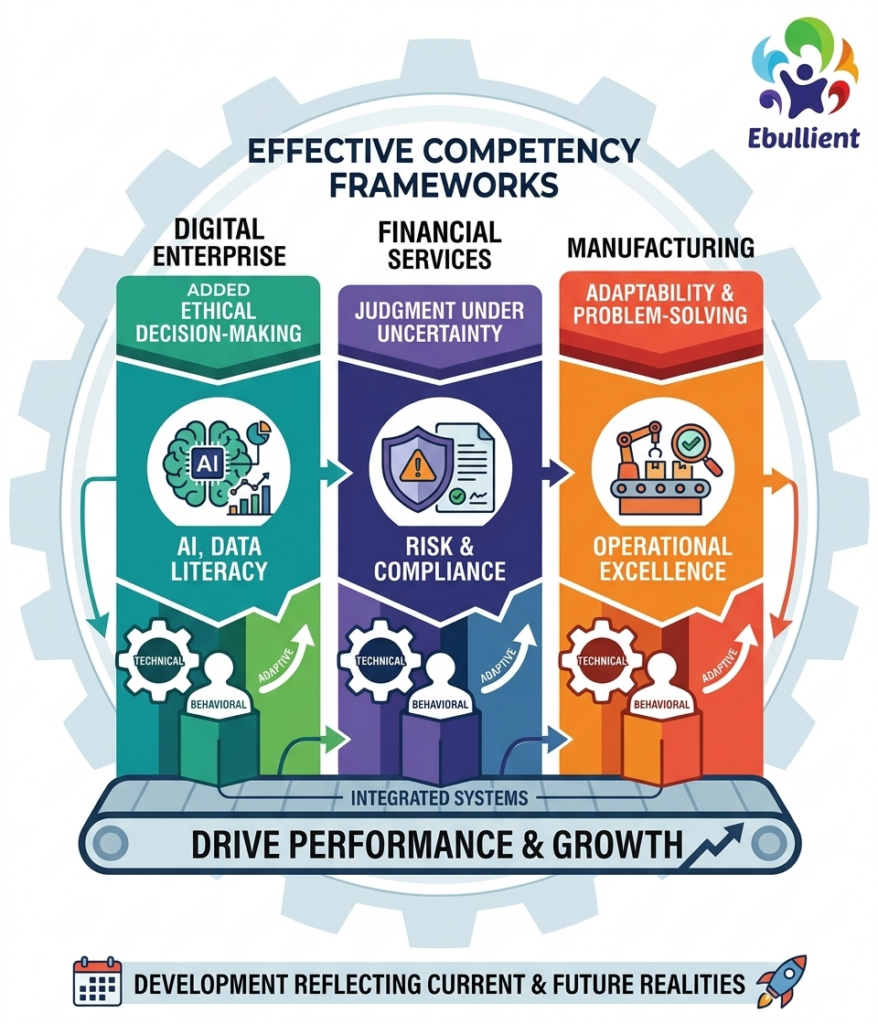
Example 1: Digital Enterprise
Digital Enterprise serves as the first example because it develops artificial intelligence capabilities together with the fundamental data analysis skills of its users. The program includes ethical decision-making as an additional component to its existing foundation.
Example 2: Financial Services
Financial services organizations concentrate their operations on risk assessment together with compliance requirements. The program requires its users to make decisions when faced with uncertain situations.
Example 3: Manufacturing
Manufacturing operations work towards achieving operational excellence through their activities while developing employees who can handle unexpected challenges.
These examples highlight a key truth: Competency Framework Development must shows both current and future prospects.
Competency Framework Maturity Free guide, instant download.
Get the Guide →What Are the Latest Competency Framework Development Trends?
Evolving Competency Framework Development trends are: AI-driven capability mapping, dynamic frameworks, and integration with purpose and achieving sustainable development goals. These trends’ main focus is on building adaptable, human-centric organisations that can respond quickly to continuous change.
Key trends that are reshaping the future:
- Shift from static to dynamic frameworks
- AI-powered skill insights
- Focus on adaptability and organisational resilience
- Alignment of ESG and purpose-driven strategies
The organisations that embrace these trends will develop a sustainable competitive advantage.
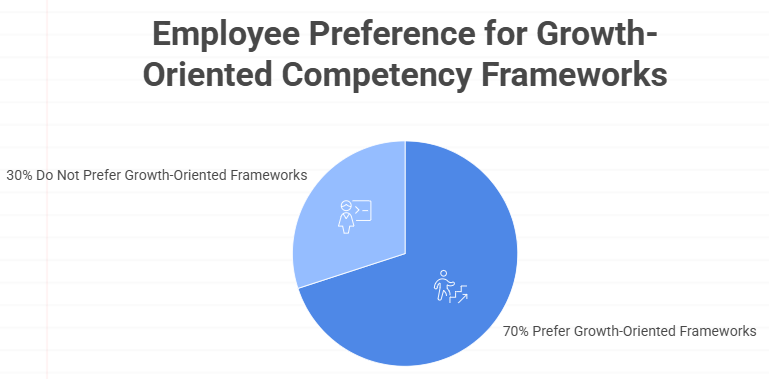
Source: GSDC
Did You Know?
According to the majority of respondents, 70% of employees preferred to work for organizations with clear, growth-oriented competency frameworks.
Curious About Other Areas of Your Organization?
Explore our other free assessments and get a fuller picture of where you stand.
View All AssessmentsHow Ebullient Enables Competency Framework Development for Future-Ready Organizations
Ebullient consultancy equips organisations to build for future-ready Competency Framework Development frameworks by combining human-centric design, leadership capability building, and digital scalability. This makesure organisations are allowed to operate effectively under ambiguity and continuous change.
Ebullient’s approach is distinct:
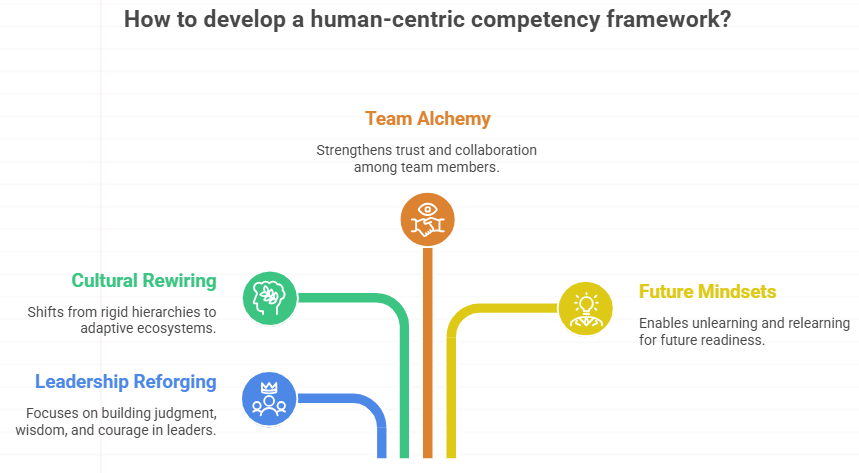
- Leadership Reforging: Building judgment, wisdom, and courage
- Cultural Rewiring: Moving from rigid hierarchies to adaptive ecosystems
- Team Alchemy: Strengthening trust and collaboration
- Future Mindsets: Enabling unlearning and relearning
This creates the best competency framework development training for employees that is deeply human-centric.
Final Thoughts
Competency Framework Development is a strategic enables organizations to transform their workforce by matching their required skills with actual business demands while achieving measurable performance enhancements.
In our experience, organizations that view their competency frameworks as dynamic systems instead of fixed documents achieve better results in maintaining their competitive advantage.
Want to meet the team?
Start with a 30-min conversation. No commitment needed.
Frequently Asked Questions
What is a competency framework?
The term competency framework describes a structured model that establishes the required skills and behaviors, and capabilities needed to succeed in particular job positions.
How to develop a competency framework effectively?
The process of developing a competency framework requires organizations to establish their objectives and identify required job roles, and then create competency maps, which they will use to implement their HR and L&D programs.
What are competency mapping tools?
Competency mapping tools function as digital solutions which organizations use to evaluate their employees’ skills and determine which areas require targeted skill development.
Why is competency framework development important in HRM?
The development of competency frameworks in HRM enables organizations to match employee skills with their business objectives which leads to better hiring practices and training methods and enhanced employee performance.
What are the types of competency frameworks?
The types of competency frameworks include core, functional, leadership, and adaptive frameworks designed for different organizational needs.