
In the modern business landscape, corporate governance is no longer just a compliance checkbox — it is kinda the main pillar of sustainable, investor-ready, and trust-worthy organisations. For Indian companies navigating SEBI rules, the Companies Act 2013, and also more and more sophisticated stakeholder expectations, getting governance right has never been more consequential.
Still, the gap between policy and practice stays wide. India’s PSUs are struggling with board diversity, boards behind first-time IPOs can be younger but less experienced, and AI governance is now moving faster than director readiness. The organisations that actually thrive in 2026 will be the ones that treat governance not as a legal obligation only, but as a strategic capability.
This blog explore the 7 essential corporate governance rules every Indian company must follow, updated with 2026 data, practical check lists , and actionable steps for leaders and boards.
Key Takeaways — At a Glance
| Key | Insight |
|---|---|
| Corporate Governance Fundamentals | Understand the principles of transparency, accountability, and ethical leadership. |
| 7 Essential Governance Rules | Learn the core governance practices every Indian company must follow in 2026. |
| Compliance & Regulatory Requirements | Navigate SEBI regulations, the Companies Act 2013, and ESG obligations effectively. |
| Emerging Governance Trends | Explore the impact of AI governance, cybersecurity, and sustainability reporting. |
| Common Governance Challenges | Identify and address barriers to effective governance implementation. |
| Building a Governance-Ready Culture | Develop leadership capabilities that embed governance into everyday business decisions. |
What Is Corporate Governance?
Corporate governance are the rules practices and processes, by which a company is basically directed controlled. It outlines the links between the board of directors, management, shareholders, regulators, and other stakeholders— while also making sure that the choices get made ethically, transparently, and with a long-term view that benefits all parties.
In India, the whole framework is mainly held up by three pillars :
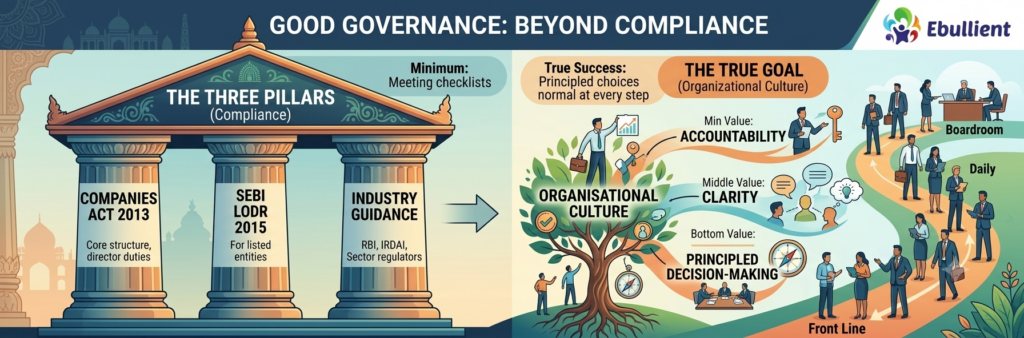
- Companies Act 2013 — the core legislation for company structure and director duties
- SEBI (Listing Obligations and Disclosure Requirements) Regulations 2015 — for listed entities, in particular
- Industry-specific guidance issued by RBI, IRDAI and other regulators for that sector
Good governance isn’t only about meeting compliance checklists. It is more about building a kind of organisational culture, where accountability, clarity, and principled decision-making become normal at every step— from the boardroom to the front line, daily.
Why Corporate Governance Matters for Indian Businesses in 2026
The business case for governance has never been stronger. Here is what strong governance delivers:
|
Governance Outcome |
What It Means in Practice |
|
Investor Confidence |
Transparent practices attract domestic and foreign capital; reduce cost of equity |
|
Fraud Prevention |
Independent oversight and audit committees minimise financial irregularities |
|
Sustainable Growth |
Ethical decision-making builds long-term resilience over short-term gains |
|
Regulatory Compliance |
Avoids SEBI penalties, MCA notices, and reputational damage |
|
Talent & Culture |
Governance-led organisations attract and retain better leaders and employees |
|
Board Effectiveness |
Structured oversight improves decision quality and strategic clarity |
Source: International Journal of Disclosure and Governance
Did You Know?
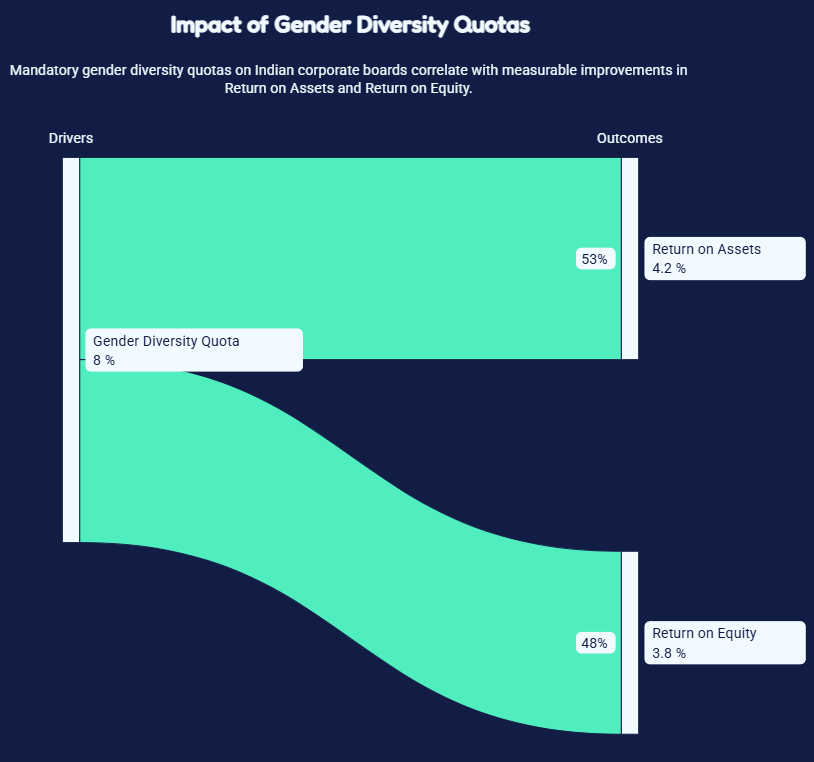
A 2026 study looking at 2,341 Indian listed companies found that businesses that followed India’s mandatory gender diversity quota on boards got a 4.2% jump in Return on Assets, and also a 3.8% rise in Return on Equity. It seems like the upside was most visible in family-controlled firms, tech-focused companies, and in boards that used to be all male.
7 Essential Corporate Governance Rules Every Indian Company Must Follow
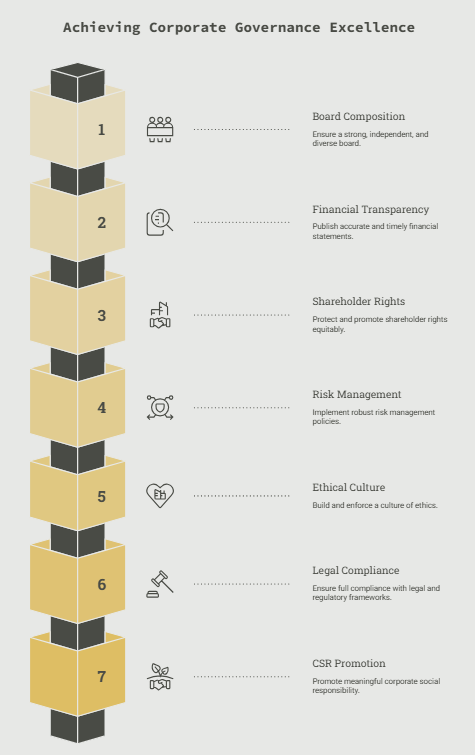
1 Maintain a Strong, Independent, and Diverse Board
- Listed companies have to make sure at least one-third are independent directors (SEBI LODR)
- For unlisted public companies, once the paid-up capital hits ₹10 crore +, then they should appoint at least one woman director, no exceptions
- For the top 2,000 listed entities, boards should include at least 6 directors, generally speaking
- Do board performance checks regularly, plus keep running skills matrix reviews, so gaps are visible
- Prioritise diversity—gender, know-how, and age— not only the paperwork style “independence”
Pro Tip: Independent directors add objectivity and can lower promoter-driven conflicts of interest. In 2026, Indian IPO boards are looking younger, so fresh perspectives are coming in, but onboarding has to be more structured.
2 Ensure Transparency in Financial Reporting
- Publish accurate, timely financial statements, quarterly for listed entities
- Engage independent auditors for the statutory audits
- Disclose all material facts, related party transactions and possible risk factors
- Keep a solid audit committee with at least three independent directors.
- File MCA returns and SEBI disclosures within the timelines set out, as required
Pro Tip: Financial transparency is the single highest-impact governance signal for institutional investors and credit rating agencies.
3 Protect Shareholders’ Rights Equitably
- Provide equal access to information and voting privileges across every share class
- Share the big calls quickly, think of dividends, mergers, and policy shifts.
- Support AGMs and e-voting so more shareholders can take part, really, maximum involvement
- Make sure minority holders aren’t pushed aside, especially in dealings with related parties
- Follow SEBI’s takeover code and the insider trading rules.
Pro Tip: Governance around related-party transactions is one of the top area of investor scrutiny in India. Boards that manages it proactively signal credibility
4 Implement Robust Risk Management Policies
- Set up a proper Risk Management Committee (this is mandatory for the top 1,000 listed entities)
- Mapping the risks across the financial, operational, cybersecurity, ESG and reputational prospects.
- Update risk register at least annually, and more frequently in a dynamic business context
- Make sure the board actually reviews the risk framework, not only the management
- In 2026, add AI governance data ethics into the risk matrix, no delays
Pro Tip: In India, AI adoption is picking up speed faster than in most markets globally, so boards get hit with a dual problem: using AI for growth, while also overseeing its risks in a responsible way.
5 Build and Enforce a Culture of Ethics
- Develop and publish a Code of Conduct for all employees, directors, and senior management
- Establish a functioning whistleblower policy with anonymous reporting channels
- Enforce strict anti-bribery and anti-corruption policies aligned with global standards
- Conduct regular ethics training for board members and senior leaders
- Set a clear ‘tone at the top’: governance culture starts with the board’s visible behaviour
Pro Tip: Ethics cannot be delegated to a compliance team. It must be demonstrated daily by leadership. This is where governance training for leaders delivers the highest ROI.
6 Ensure Full Compliance with Legal and Regulatory Frameworks
- The Companies Act 2013, covers board composition, director duties, AGM-related stuff, and CSR obligations.
- SEBI LODR Regulations cover continuous disclosure, insider trading controls, and independent director norms as well
- BRSR (Business Responsibility and Sustainability Reporting) is required for the top 1,000 listed companies yes it is mandatory
- Also keep proper, accurate minutes for board meetings and committee sessions, even those small decisions count
- Do annual internal audits, don’t just sit and wait for a regulatory inspection to uncover what is missing
Pro Tip: Compliance frameworks move in a way that most organisations can’t really track day-to-day operations.It helps to appoint a dedicated governance officer, or an external advisor, to watch for regulatory updates.
7 Promote Meaningful Corporate Social Responsibility (CSR)
- Section 135, Companies Act 2013 says if a company has net worth ₹500 crore or more, a turnover of ₹1,000 crore or more , or net profit ₹5 crore or more, then it has to spend at least 2% of the average net profits on CSR.
- Report CSR activities in a clear way in the annual report
- Get employees involved in CSR design and delivery, so culture alignment gets stronger
- Pick initiatives with social results that can be measured, not only brand visibility
- By 2026, boards are folding ESG into the governance routine, rather than keeping CSR as a separate track
Pro Tip: When CSR is done properly, it acts like a governance signal; it basically tells regulators, investors, and employees that the organisation takes its social licence to operate seriously.
Source: Excellence Enablers Corporate Governance Survey
Did You Know?
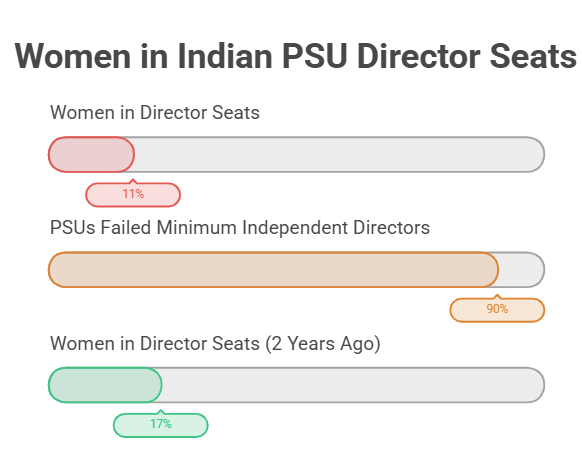
A March 2026 survey by Excellence Enablers found that women hold just 11% of director seats in India’s Maharatna and Navratna PSUs — a sharp drop from 17% just two years prior. More strikingly, 90% of surveyed PSUs failed to meet the legally mandated minimum number of Independent Directors in FY25. Seventeen major PSUs currently have no women directors at all.
Common Challenges in Implementing Corporate Governance in India
Despite measurable progressive framework barriers continue across sectors and company sizes. Understanding them is the first step to addressing them.
|
Challenge |
Why It Persists |
|
Promoter-Dominated Boards |
Family-owned structures resist independent oversight; related-party transactions often lack scrutiny |
|
Weak Internal Controls |
Inadequate monitoring systems create compliance blind spots and invite regulatory risk |
|
Limited Governance Training |
Directors and senior leaders often lack formal governance education; it is still treated as a legal function, not a leadership competency |
|
AI & Technology Governance Gap |
India’s rapid AI adoption is outpacing board readiness; few boards have a clear AI governance framework |
|
PSU Structural Gaps |
Government-nominated boards struggle with independence, diversity, and succession planning |
|
Resistance to Change |
Legacy organisations prioritise operational continuity over governance modernisation |
How to Build a Strong Governance Culture: A 5-Step Framework
Governance sort of happens through deliberate leadership action, and it has to keep going over time.
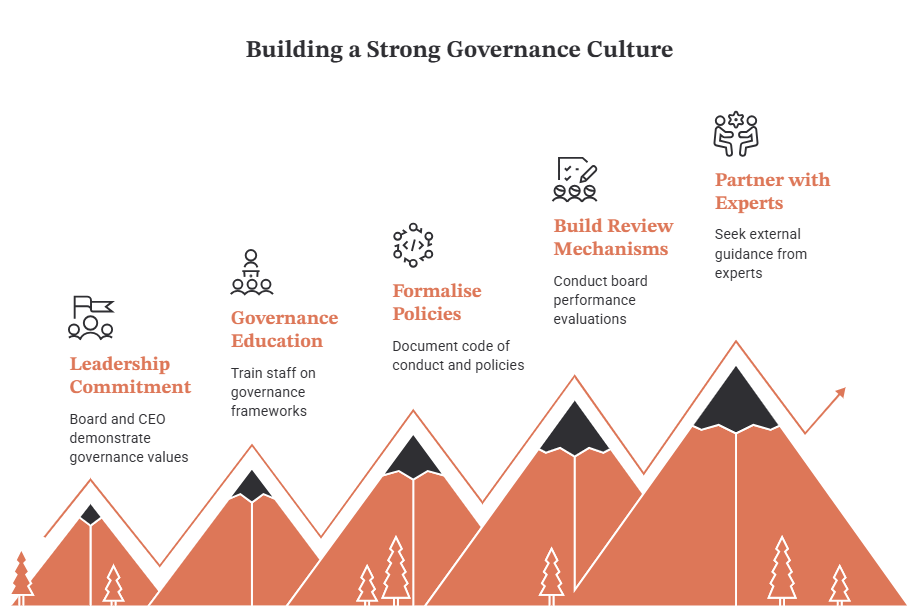
1. Start with leadership commitment — governance begins at the top, the board and CEO really need to show the values they expect the organisation to take on. The culture follows what people do, not documents.
2. Invest in governance education — train the onboarding members, directors, and senior leaders on governance frameworks and ethical decision-making. This is not only one of the exercises — it needs continuous development.
3. Formalise policies and processes — Proper documentation of code of conduct, set the whistleblower mechanism, list the conflict of interest policy, and compliance calendar. Clarity reduces ambiguity and the governance risks that come with it.
4. Build review and accountability mechanisms — do annual board performance evaluations, run audit committee reviews, and carry out internal audits. If it gets measured and managed.
5. Partner with governance and leadership experts — External facilitators and training partners support organisations to identify blind spots, benchmark against best practice, and initiate the capability build.
How Ebullient Helps Organisations Build Governance-Ready Leadership?
At Ebullient, we believe governance is a leadership capability. The organizations that govern the best are often the ones where the leaders, at every level, understand what they are responsible for, make choices with integrity, and communicate. Our programmes help governance-readiness along 3 different dimensions:
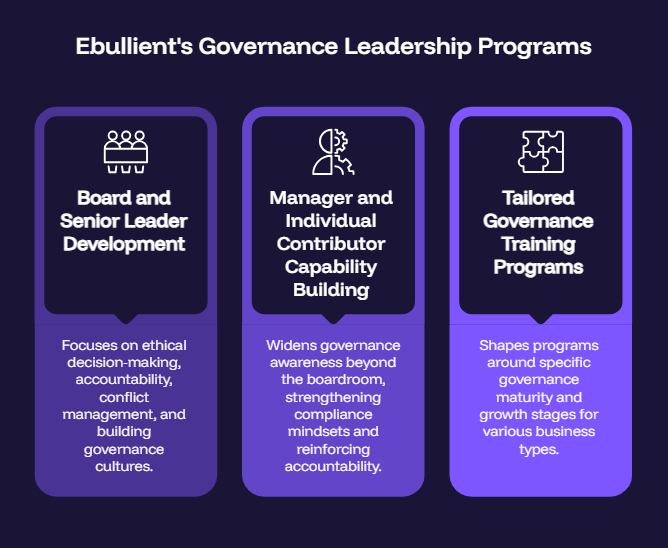
1. Leadership Development for Boards and Senior Leaders
We work with boards and C-suite leaders on the human side of governance: ethical decision-making under pressure, communicating accountability to stakeholders, managing conflicts of interest, and building cultures where governance behaviours are rewarded.
2. Capability Building for Managers and Individual Contributors
Governance fails at the implementation level when managers and teams don’t internalise its principles. Our capability-building programs basically widen governance awareness that is beyond the boardroom, helping make compliance mindsets stronger, growing feedback cultures, and reinforcing accountability across the entire organisation.
3. Tailored Governance Training Programs
Whether you are an SME setting up governance for the first time, a family-owned business going through the shift to independent oversight, or a listed company aligning with the changing SEBI requirements, we shape programmes around your specific governance maturity and growth stage.
Build a Future-Ready, Governance-Led Organisation

From board effectiveness to ethics culture to compliance capability — Ebullient designs leadership and governance programmes that drive real organisational change.

→ Talk to Our Team About a Custom Programme
Final Thoughts
Corporate governance is a boardroom imperative and a competitive differentiator. The companies that build governance into their leadership culture — rather than manage it as an annual compliance exercise — will attract better capital, retain stronger talent, and navigate disruption with greater resilience.
The 7 rules in this guide are a strong foundation. But rules alone do not create governance cultures — leaders do.
At Ebullient, we support organisations that build the leadership capability that turns governance principles into daily operation.
Frequently Asked Questions
Get answers to commonly asked questions about Ebullient.
Is Your Company Compliant with India's Latest Corporate Governance Regulations in 2026?
What are the key principles of corporate governance in India?
The 4 foundational principles are transparency, accountability, fairness, and responsibility. Now, in 2026, many organisations are quietly tacking on a 5th pillar of sustainability, and it kind of ties everything together—especially ESG integration, AI governance, and that stakeholder decision-making.
Why is corporate governance important for Indian companies in 2026?
India’s governance landscape is rapidly transforming: BRSR reporting is mandatory for top-1,000 listed companies, AI governance is a new board priority, and investor scrutiny of related-party transactions and board diversity. Companies that stay ahead of these prerequisite outperform those that respond actively.
What happens if an Indian company fails to comply with corporate governance norms?
Non-compliance can generate SEBI penalties , MCA enforcement actions, trading suspension, disqualification of directors, and significant reputational damage. The costs of non-compliance, financial plus reputational, are continuously invested in governance infrastructure.
What is the role of leadership training in corporate governance?
Governance frameworks only work as well as the people running them. Training board members, senior managers, and the leaders who manage functions in the day-to-day, on ethical decision-making, real accountability, and compliance awareness, is what turns governance documents into governance culture.
How can Ebullient help improve corporate governance in my organisation?
Ebullient builds custom leadership development and capability building programmes, they help strengthen governance at every level, from board effectiveness to an ethics mindset, right down to manager accountability. Connect with us on our website to see a programme shaped for your governance maturity and the growth stage of your organisation.