

Digital transformation for executives is strategic process of guiding organisation wide technology, culture, and operational shifts to improve business performance, customer experience, and innovation. Successful transformation needs executive sponsorship, clear business vision, workforce adoptability, data-driven decision-making, and ongoing leadership readiness. Organisations which sucessful achieve sustainable transformation it may consider it as a business strategy not just simply a technology project.
Key Takeaways at the Glance
- Digital transformation for executives is termed as a leadership challenge rather than just a technology challenge.
- Executive sponsorship considerably improves the transformation success rates.
- Culture, communication, and workforce readiness navigate through adoption.
- Organisations are beyond the project-based thinking its moving ahead toward continuous transformation.
- Culture impacts transformation results more strongly than technology deployment.
- Ebullient Consultancy supports organisations in redefining leadership, rewire culture, and build future-ready capabilities.
Why Digital Transformation Needs a New Leadership Mindset
Organisations are investing millions in emerging technologies, which are: automation platforms, analytics tools, and AI-powered systems. Still many transformation initatives fails to drive expected business results. The primary reason is not just about technology—it about the leadership.
Understanding what is digital transformation basically starts with recognising that it expands its scope from software implementation. It includes redefining processes, reshaping culture, building digital capabilities, and aligning people with strategic business objectives.
The most successful organisations understand that digital transformation for executives is not an IT role. Senior leaders need to be proactively championing change, communicating the vision, eliminating the barriers, and directing enterprise-wide adoption.
Research shows that organisations with highly engaging executive sponsors drive higher transformation success rates than organisations where leadership remains passive. The reason is simple: employees follow leadership behavior more closely allied with leadership messaging.
At Ebullient, we support leaders who must learn, decide, and act under deep ambiguity. They need to operate at the triple intersection of the digital revolution, the sustainability imperative, and the purpose movement.
This is where the future of leadership resides.
What Is the Role of Executives in Digital Transformation?
Executives redefine the strategic vision, handle the organisational alignment, allocate resources efficiently, manage transformation risks, and construct the accountability structures that fosters adoption. Without executive ownership, digital initiatives often remain as isolated technology projects that fail to create enterprise-wide business impact.
The Leadership Imperative
Mostly organisations have mistakenly delegate transformation entirely to technology teams. While technology leaders play a vital role, during sustainable transformation which requires prominence involvement from CEOs, CHROs, CFOs, business heads, and operational leaders.
In our experience transformation frameworks across financial services, manufacturing, healthcare, and professional services organisations, executive engagement gradually emerges as the strongest predictor of success.
Effective leaders focus on:
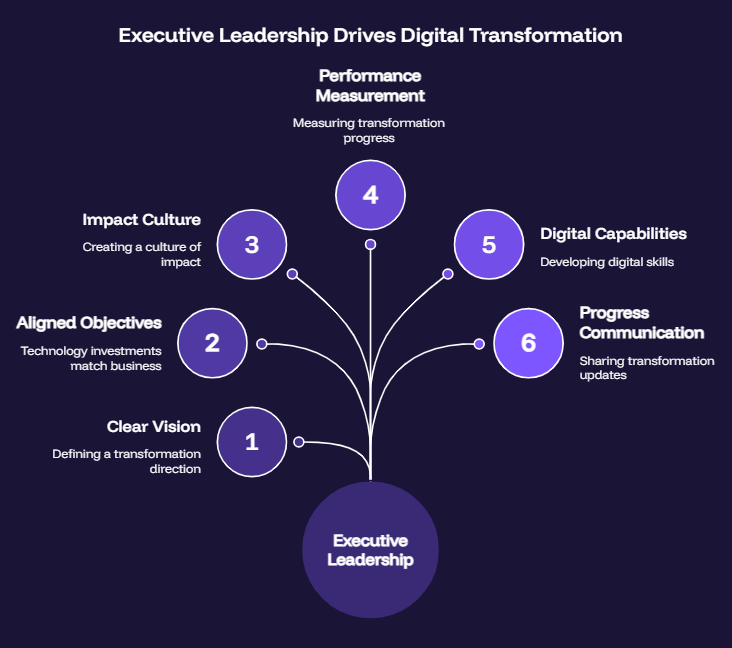
- Defining a clear transformation vision
- Aligning business objectives with technology investments
- Creating A Culture of Impact
- Measuring performance
- Developing digital capabilities across teams
- Communicating progress
The most successful examples of digital transformation in business occur when executives position transformation remains as a strategic growth initiative rather than an IT modernization exertion.
Executive Responsibilities Across Transformation Stages
| Transformation Stage | Executive Responsibility |
|---|---|
| Strategy Development | Define vision and business outcomes |
| Planning | Allocate resources and priorities |
| Implementation | Remove organizational barriers |
| Adoption | Encourage behavioral change |
| Optimization | Measure outcomes and refine strategy |
| Scaling | Expand successful initiatives across functions |
This leadership-driven approach is central to successful digital transformation for executive programs worldwide.
How Ready Is Your Organization for Transformation, Really?
Take our free 4-minute assessment and get a personalized report on your leadership fluency, governance, and workforce readiness.
Take the Free AI Readiness Assessment →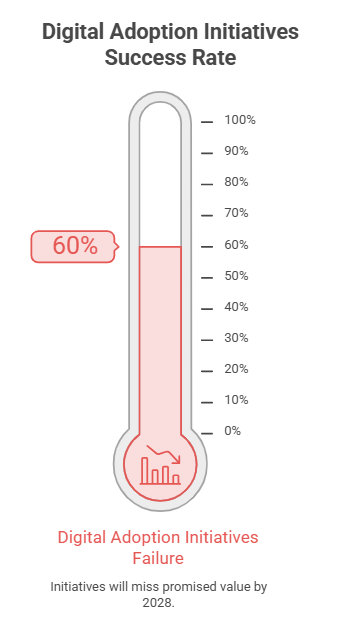
Source: Gartner
Did You Know?
Gartner foresees that by 2028, around 60% of digital adoption initiatives will end up missing the value they promised. It happens largely because organizations end up underinvesting in learning, development and workforce capability building.
Why Do Employees Resist Digital Transformation Initiatives?
Employees resist transformation when they are unable to understand the purpose, fear of job displacement, lack of required skills, or experience in an inconsistent leadership role. Executive communication and workforce enablement consistently reduce the resistance and adoption rate.
Understanding Human Behavior During Change
Technology adoption is hardly considered as a technical challenge. It is a human challenge.
Employees often ask questions such as:
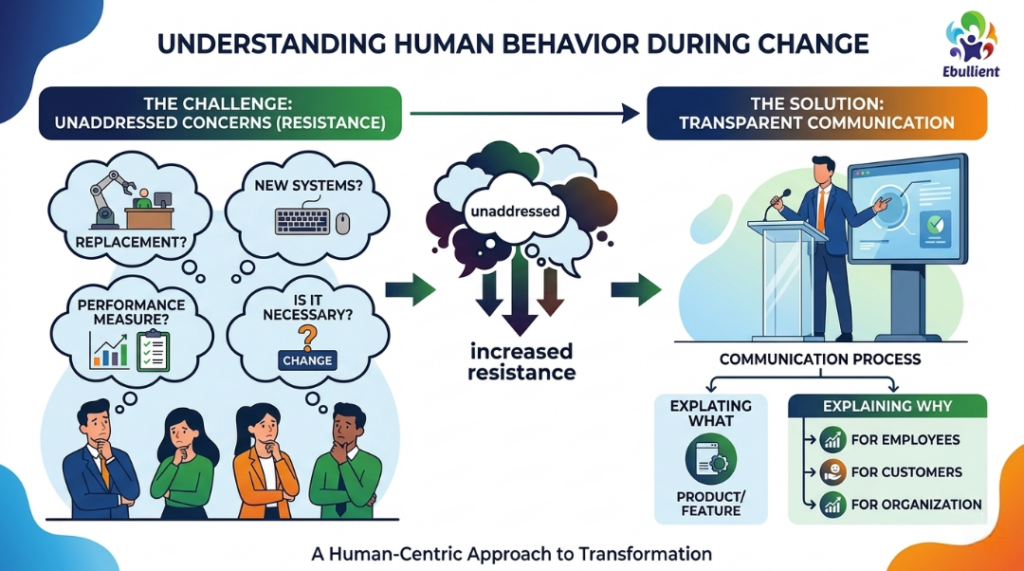
- Will automation replace my role?
- Will I be able to learn new systems?
- How will my performance will be measured?
- Is this change necessary?
When all of these concerns remain unaddressed, resistance rate increases.
The most effective digital transformation for executives initiatives is to prioritize transparent communication. Leaders explain not only what is changing but also why the change important towards employees, customers, and at the organisational level.
Organisations that achieve high adoption rates typically invest in:
- Change management programs
- Digital skills development
- Leadership communication campaigns
- Employee feedback mechanisms
- Effective Networking
This approach develops a long-term transformation success while maximizing digital transformation benefits.
How Can Executives Build a Digital-First Culture?
Executives create a digital-first culture by modeling desired behaviors, promoting innovation, rewarding experiments, investing in digital skills, and adopting technology into daily business operations.
Culture Is the Foundation of Transformation
Technology can be purchased but culture cannot.
A digital-first culture fosters:
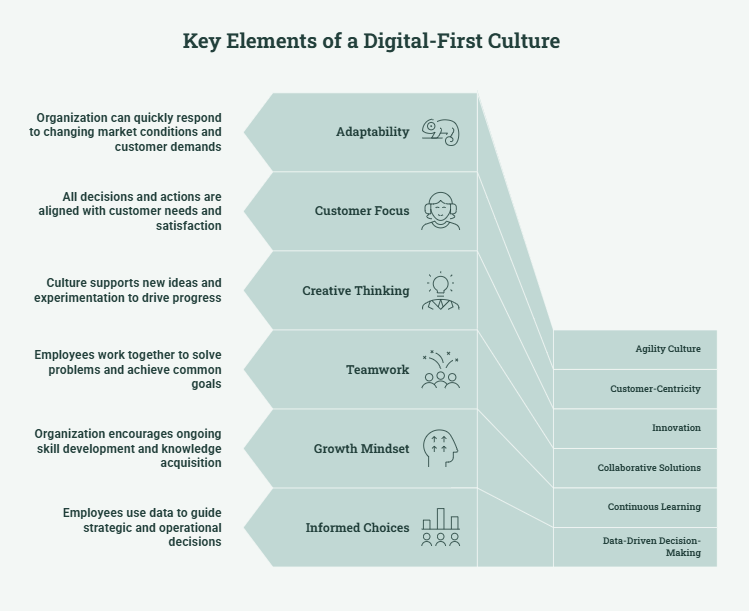
- Data-driven decision-making
- Continuous learning
- Collaborative Solutions
- Innovation
- Driving Change Through the Customer
- Agility Culture
But many organisations still mainly focuses on technology adoption, while the cultural readiness gets overlooked. And the gap is created between implementation and actual adoption.
So successful leaders have to understand how culture shapes the way employees respond to change.
Source: Gartner
Did You Know?
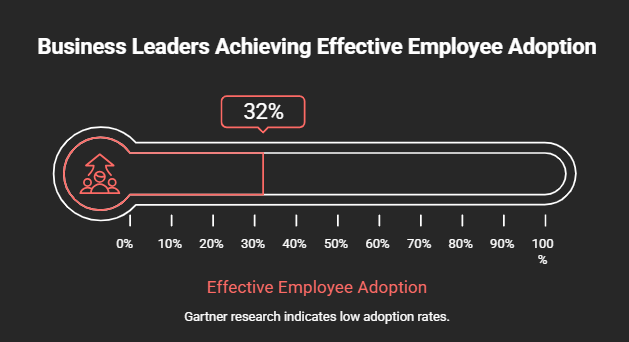
Gartner research says only 32% of business leaders report that they get good employee adoption through change efforts.
What Can Leaders Learn from Successful Digital Transformation Examples?
Successful organizations primary focuses on customer needs, invest in employees, and utilize data, keep strong executive ownership all the way through the transformation journey.
Lessons from Market Leaders
A few successful digital transformation examples show how much executive leadership matters.
Organisations which is recognised among the leading digital transformation top companies in India are constantly focused on:
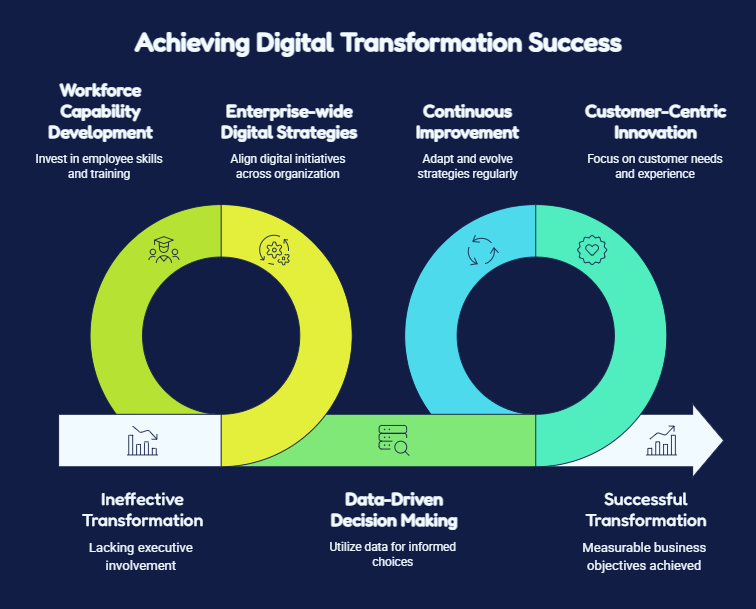
- Enterprise-wide digital strategies
- Workforce capability development
- Data-driven decision making
- Customer-centric innovation
- Continuous improvement
Examples across banking, telecommunications, manufacturing, and retail sectors show a common pattern:
- Leadership remains actively involved throughout the transformation lifecycle.
- The strongest transformation results occur when executives prove measurable business objectives rather than only focusing on technology deployment.
These lessons continue to reshape modern digital transformation industry overview discussions across industries.
The Organizational Transformation Checklist Free guide, instant download.
Get the Guide →What Are the Emerging Digital Transformation Trends Executives Should Watch?
Executives should montion AI adoption, intelligent automation, data analytics, cybersecurity modernization, digital workforce development, and the customer experience transformation as strategic priorities.
Key Trends Shaping Business Transformation
Now, digital transformation trends are indicating that organisations are embracing digitization and moving toward a more intelligent business transformation.
Some of the more noticeable trends, include :
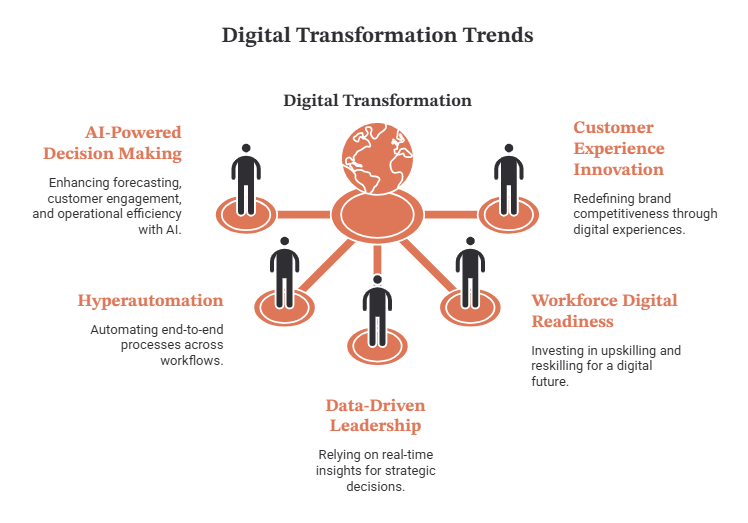
AI-Powered Decision Making
More organisations are adding AI in a practical way, to strengthen forecasting, strengthening customer engagement, and gaining operational efficiency.
Hyperautomation
Instead of only automating small tasks, businesses are actually automating end-to-end processes across the workflow.
Data-Driven Leadership
Executives depend on real-time insights so strategic decisions.
Workforce Digital Readiness
Upskilling, reskilling, and learning pathways have become a crucial investment area.
Customer Experience Innovation
Digital experiences are increasingly the thing that redefines brand competitiveness.
All in all, these developments are exactly why digital transformation for executives stays a boardroom priority.
How Can Executives Measure Transformation Success?
Transformation success can be measured using business results, adoption metrics, improvement in operations, customer satisfaction parameters, and workforce capability development, rather than technology-driven.
The Key Metrics
Leading organizations can be monitored:
| Metric Category | Examples |
| Financial | Revenue growth, cost savings |
| Operational | Productivity improvements |
| Customer | NPS, retention, satisfaction |
| Employee | Adoption rates, engagement |
| Innovation | Speed of implementation |
| Digital Maturity | Capability progression |
Executives who focus on measurable results will consistently maximize digital transformation benefits while maintaining accountability.
Source: Morgan Stanley
Did You Know?
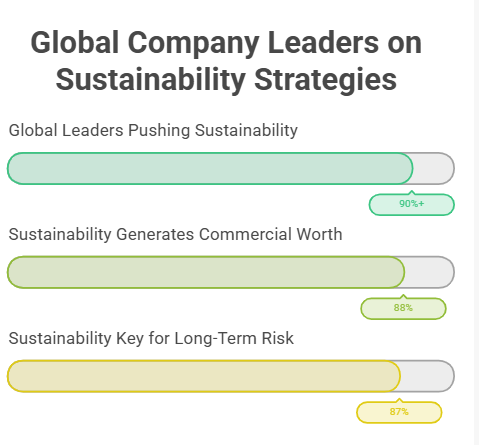
Over 90% of global company leaders say they are still pushing sustainability strategies in 2026, with 88% saying it generates commercial worth and 87% viewing it as key for long term risk management.
Curious About Other Areas of Your Organization?
Explore our other free assessments and get a fuller picture of where you stand.
View All AssessmentsHow Ebullient Consultancy Helps Organizations Accelerate Digital Transformation?
Ebullient Consultancy supports organizations in developing leadership capability, workforce readiness, change management excellence, and strategic alignment for achieving successful digital transformation adoption.
Our approach primarily focuses on four interconnected pillars:
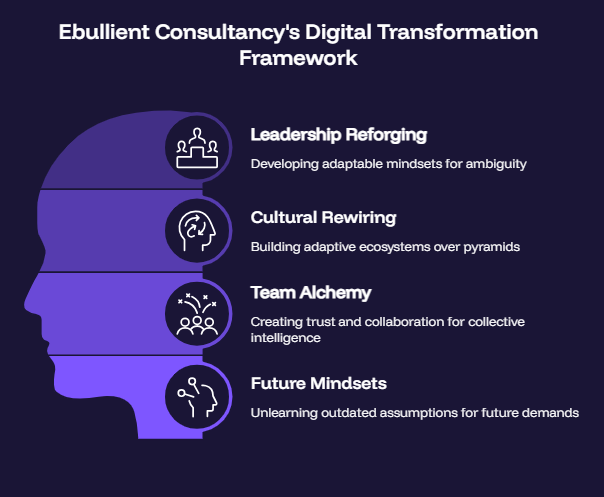
Leadership Reforging
Developing mindsets that can navigate under ambiguity, rather than just applying management techniques.
Cultural Rewiring
We aim to build adaptive ecosystems, not just keep reinforcing outdated organisational pyramids.
Team Alchemy
Creating trust, collaboration, and psychological safety that provides collective intelligence.
Future Mindsets
Helping leaders unlearn outdated assumptions and develop their capabilities demanded by the rapidly evolving future.
Organizations that are looking for executive program in digital transformation, the best digital transformation courses, or guidance from the best digital transformation consulting firm increasingly recognise that transformation success depends entirely on leadership capability as much as technological capability.
As transformation continues to transform the industries, executives who may lead from the front will determine whether their organisations will be ready to adopt technology or truly transform.
Want to meet the team?
Start with a 30-min conversation. No commitment needed.
Frequently Asked Questions
What is digital transformation?
Digital transformation is a process of integrating digital technologies and digital processes along with the broader digital capabilities across an organisation, to boost performance, improve customer experience, and increase business agility.
Why is digital transformation important for executives?
It matters because it helps with competitiveness, boosts operational efficiency, supports innovation, improves customer satisfaction, and also backs long-term growth for the business.
What are the key drivers of digital transformation?
The key drivers are commonly depending on the industry: changing customer expectations, technological advancements, competitive pressure, workforce readiness, and a rapid data-driven decision-making.
How can executives improve transformation adoption?
Executives can improve adoption using communicating clearly, ensuring leadership readiness, and investing in workforce training. They should also run change management programs consistently, and maintaining continous employees engagement.
What skills should leaders develop for digital transformation?
Leaders need to strengthen digital literacy, strategic thinking, the ability to interpret data, change leadership, innovation management, and stakeholder engagement skills as well.