
Leading global teams requires a fundamentally different operating model than leading a co-located team — not simply the same management style stretched across more hours. Once your team spans time zones and cultures, a few things start to loosen up right away, like the real time communication and the shared context, and also that informal trust building that usually happens in hallways or lunch rooms. The leaders who do well with global teams tend to swap those gaps for more deliberate mechanisms: async-first communication, documented context, and that trust built through consistency rather than proximity.
This shift matters more than ever. As organizations expand into distributed and international workforces, the leaders who thrive are the ones who stop trying to replicate in-office dynamics online and instead build practices designed for distance from the ground up.
Key Takeaways at a Glance
- Build globally capable leaders who turn cultural complexity into collaboration and business impact.
- Equip your leaders to navigate time zones, cultures, and complexity with confidence.
- Turn global team challenges into stronger collaboration, trust, and performance.
- Lead across borders with greater cultural intelligence, clarity, and confidence.
- Build leadership practices designed for today’s distributed and global workforce.
- Help your leaders connect cultures, align teams, and deliver results across borders.
What Actually Changes When a Team Goes Global?
Three operating assumptions collapse the moment a team crosses time zones:
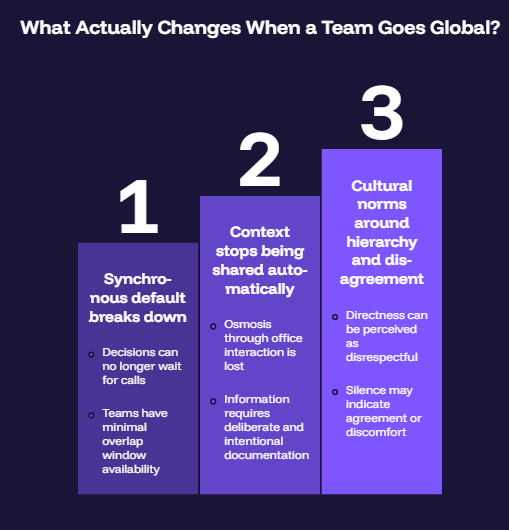
1. Synchronous default breaks down
A team spread across Bengaluru, London, and San Francisco has, at best, a two-to-three-hour overlap window — if any. Decisions can no longer wait for “let’s hop on a call.”
2. Context stops being shared automaticall
In a shared office, people absorb context by osmosis — overheard conversations, whiteboard sketches, body language in a hallway. Distributed teams lose all of it unless someone deliberately documents it.
3. Cultural norms around hierarchy and even disagreement and how people deliver feedbacks.
A directness that reads as efficient in Amsterdam can read as disrespectful in Tokyo. Silence in a meeting might mean agreement in one culture and discomfort in another.
A recent study found that 89% of white-collar workers are now part of a global virtual team — meaning this isn’t an edge case leaders can defer preparing for. It’s the default working condition for most of the modern workforce.
Leaders who miss this tend to over-rely on video calls at odd hours, under-document decisions, and misread silence as consensus — all of which erode trust faster than they build alignment.
How Leadership-Ready Is Your Organization, Really?
Take our free 4-minute assessment and get a personalized report on your leadership fluency, governance, and workforce readiness.
Take the Free Leadership Readiness Assessment →How Should Leaders Restructure Communication for Distributed Teams?
Effective global leadership treats asynchronous communication as the default, not the fallback. That means:
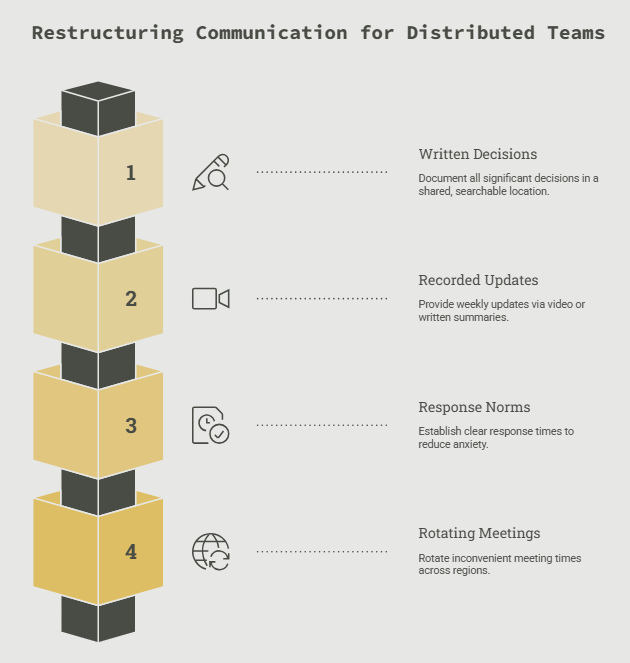
- Written decisions over verbal ones. Every significant decision gets documented — what was decided, why, and by whom — in a shared, searchable location. This protects team members who weren’t in the room (because for a global team, someone always wasn’t).
- Recorded updates instead of live-only meetings. Weekly updates recorded on video or written as structured summaries let every region absorb the same information on their own schedule.
- Response-time norms, not always-on expectations. Teams that make it clear you’ll respond within 24 hours, not that you need to jump on every message right away, usually lower the pressure of constantly checking Slack at 11pm.
- Rotating meeting times, if a live meeting is unavoidable, rotate the inconvenient hour across regions so that no single office ends up permanently stuck with the 6am or 10pm call.
Source: Ugp
Did You Know?
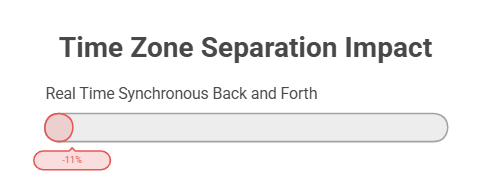
Every extra hour of time zone separation chips away at real time, synchronous back and forth by something like 11% , and it sounds minor, except it stacks up fast for teams that are split across different countries.
How Does Culture Change the Way Teams Should Be Managed?
Cultural intelligence isn’t a soft add-on to global leadership — it’s core operating knowledge. Three areas require the most deliberate attention:
Hierarchy and authority
In high-power-distance cultures, direct reports may be reluctant to challenge a leader’s idea openly, even when they disagree. Leaders need explicit mechanisms — anonymous input channels, structured “pre-mortems,” rotating devil’s-advocate roles — to surface dissent that won’t emerge naturally in a meeting.
Directness and feedback
Cultures vary widely in how feedback is delivered — some favor blunt, immediate correction; others favor indirect, context-rich framing. A global leader’s job isn’t to pick one style for the whole team, but to make expectations explicit: “On this team, we give feedback directly and early, and here’s why” — so the norm is chosen deliberately rather than defaulting to the leader’s home culture.
Silence and consensus
Silence after a question means different things in different cultures — agreement, discomfort, deep thought, or deference. Leaders who ask a direct follow-up (“Maria, what’s your take?”) Rather than reading silence like some kind of agreement , dont fall into the trap of false consensus.
Leadership Practice | Co-located Team Default | Global Team Adjustment |
Decision-making | Verbal, in real time | Written, documented, timestamped |
Meetings | Live, ad hoc | Scheduled, recorded, rotated across time zones |
Feedback style | Leader’s default cultural norm | Explicitly stated team norm |
Trust-building | Informal, proximity-based | Structured 1:1s, consistency over time |
Silence in discussion | Read as agreement | Actively checked, not assumed |
Is Your Leadership Pipeline at Risk? Free guide, instant download.
Get the Guide →How Do You Build Trust Without Shared Physical Space?
Trust in global teams is built through predictability, not proximity. Three practices consistently work:
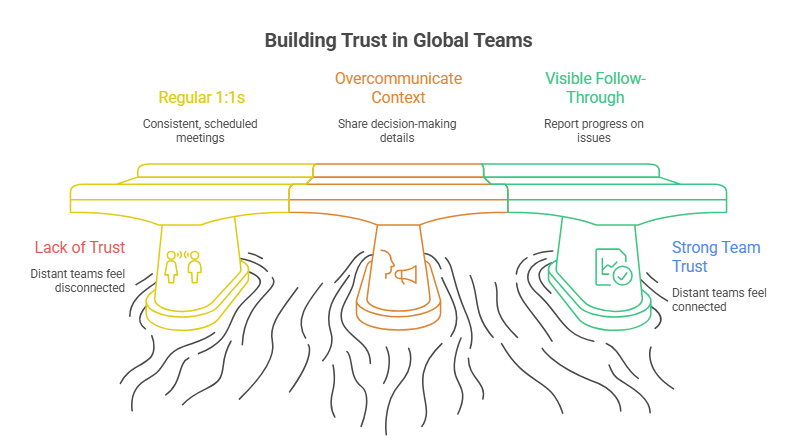
- Regular, structured 1:1s that happen on schedule regardless of workload — cancellation signals lower priority for the relationship, which lands harder across cultural and physical distance.
- Overcommunicating context, especially around decisions that affect people who weren’t part of the conversation. What feels like “too much detail” to a leader is often exactly the context a distant team member needs to feel included rather than managed around.
- Visible follow-through. When a leader says they’ll raise an issue or follow up on a blocker, doing so visibly — and reporting back even when the answer is “still working on it” — builds more trust across distance than any team-building exercise.
Source: ToI
Did You Know?
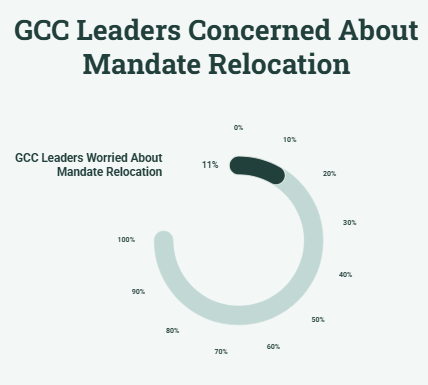
Talent shortages are coming up as this kind of strategic risk for India’s global capability center sector, like for GCCs in general, according to a PwC India–FICCI study. In it, 11% of GCC leaders say their global headquarters are actively looking at, or even moving mandates over to competing geographies , which is a bit of a concern.
Curious About Other Areas of Your Organization?
Explore our other free assessments and get a fuller picture of where you stand.
View All AssessmentsHow Ebullient Helps Leaders Navigate Global, Cross-Cultural Teams?
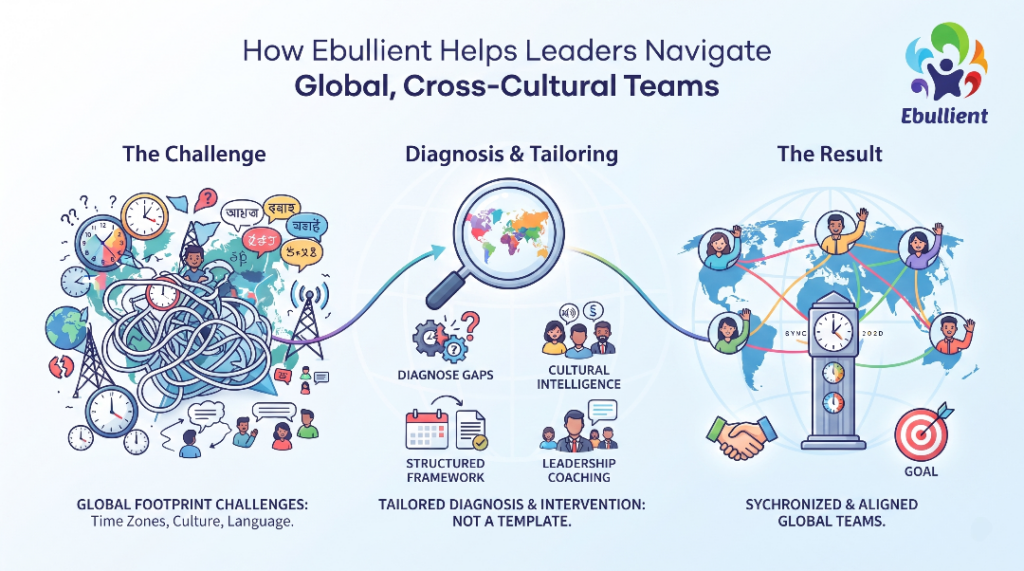
Every organization’s global footprint looks different — a team split across three metros isn’t the same challenge as one spanning twelve time zones and five languages. That’s why generic leadership training rarely moves the needle on distributed-team performance.
Ebullient Consultancy works with leadership teams to diagnose exactly where global collaboration is breaking down — whether it’s decision velocity, cultural friction in feedback, or uneven participation across regions — and builds a tailored intervention around it. That can mean cultural intelligence workshops calibrated to the specific regions a team spans, structured communication frameworks for async-first teams, or coaching for leaders managing their first fully distributed reporting line.
Instead of this one size fits all workshop, every engagement kicks off with figuring out the teams real working rhythm and that cultural blend, so the answer matches how the org actually moves day to day—not some template from a different context.
Want to meet the team?
Start with a 30-min conversation. No commitment needed.
Frequently Asked Questions
What is the biggest mistake leaders make when leading global teams?
The most common mistake is just defaulting to synchronous, real time communication as the main mode, scheduling calls at inconvenient hours instead of building async first workflows that respect the working hours of every region.
How many time zones can a team realistically work across?
There is no strict hard limit, but teams operating across more than 8 to 10 hours of difference really need to fully buy in on asynchronous habits,because the live overlap turns rare,or nonexistent.
Does leading a global team require learning every team member’s culture in depth?
Not exhaustively — but leaders should understand broad cultural dimensions like power distance, communication directness, and attitudes toward hierarchy, and stay curious about individual team members rather than relying on stereotypes.
How do you measure whether global team leadership is working?
Look for signals like decision velocity (are decisions stalling waiting for live discussion?), participation balance across regions (like is one office really taking over the discussions, or is it more evenly shared?), and then retention/engagement scores that are broken down by location.