
Capability building — the deliberate, compounding development of individual, team, and organizational competence — has overtaken hiring speed, headcount, and even technology spend as the clearest predictor of which organizations pull ahead.Unlike isolated training events, it embeds learning into daily workflows and leadership behavior — producing a durable competitive advantage that rivals cannot copy overnight.
Most companies win or lose not because of the strategy on the slide, but because of whether their people can actually execute it under pressure. That gap between a plan and the ability to deliver it is what capability building closes. Two companies with near-identical technology, budget, and market access can post wildly different results over a five-year horizon — one adapts, the other stalls. In our experience implementing these frameworks for financial services and manufacturing clients, this discipline isn’t a training line item. It’s the operating system that determines whether every other investment — new technology, market entry, restructuring — actually pays off.
Key Takeaways at a Glance
- Capability building is a compounding organizational asset; training is a depreciating event.
- Competitive advantage in business increasingly comes from organizational judgment that competitors cannot copy as fast as they can copy technology or pricing.
- Leadership capability development is what builds business resilience through capability building — particularly under BANI (Brittle, Anxious, Nonlinear, Incomprehensible) conditions.
- A working capability building framework aligns strategy, individual skill, and organizational systems at the same time — Ebullient Consultancy calls this the triple intersection.
- Transformation initiatives, including AI adoption, succeed or fail based on capability building — the tool is rarely the bottleneck; the workforce’s readiness to use it differently is.
What Is Capability Building?
Capability building is the systemic, ongoing development of the skills, judgment, and adaptive capacity an organization needs to perform — as distinct from training, which delivers content at a single point in time. Capability compounds; training expires.
Training transfers information. Capability building changes what people can reliably do when no one is watching and the situation isn’t in the manual. That distinction matters more than most L&D budgets acknowledge. A single workshop can raise awareness; it rarely changes behavior six months later. It works because it stacks three things on top of each other: the skill itself, the will to apply it under pressure, and the organizational systems — feedback loops, incentives, tools — that make the new behavior the path of least resistance.
Remove any one of the three and the investment quietly evaporates. This is why a real capability building framework always spans further than a training calendar; it touches how performance is measured, how managers coach, and how success is rewarded.
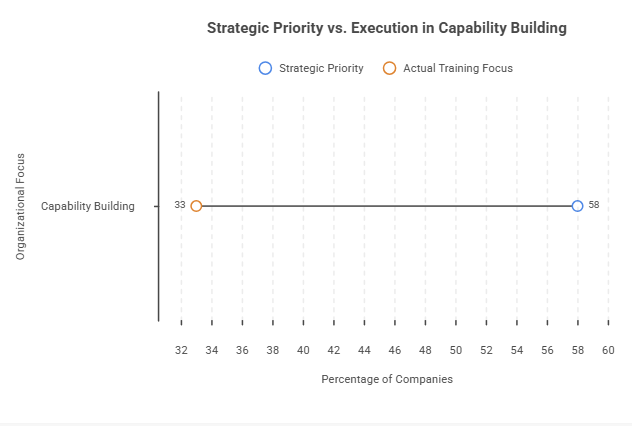
Source: McKinsey
Did You Know?
McKinsey’s global survey on organizational capabilities found that 58% of executives rank capability building among their top three strategic priorities — yet only a third of companies actually focus their training on the capability that drives the most business performance.
How Is Capability Building Different From Capacity Building?
Capacity building increases how much an organization can do — more headcount, more infrastructure, more budget. Capability building increases how well it does that work — sharper judgment, faster decisions, better execution. Conflating capability building vs capacity building is why many transformation budgets expand output without improving quality.
This distinction is where most organizational development consulting engagements go wrong. A company can hire fifty new relationship managers (capacity) without any of them being better equipped to handle a complex client escalation than the fifty who preceded them (capability). Capacity without capability just scales the existing skill ceiling — including its gaps.
Dimension | Capacity Building | Capability Building |
Primary focus | Volume and scale | Judgment and execution quality |
Typical investment | Headcount, infrastructure, budget | Skills, behavior, decision-making systems |
Time horizon | Often short-term, project-based | Long-term, embedded in culture |
What improves | How much the organization can produce | How well the organization performs |
Common failure mode | Overextension without competence | Slower to show ROI, but compounds over time |
How Mature Is Your Framework, Really?
Take our free 4-minute assessment and get a personalized report on your leadership fluency, governance, and workforce readiness.
Take the Free AI Readiness Assessment →Why Does Capability Building Create Competitive Advantage in Business?
Products, pricing, and technology can be copied within a fiscal quarter. The collective judgment of a workforce that has been deliberately developed over years cannot be replicated by a competitor’s press release. That’s what makes capability building a genuine, durable competitive advantage in business rather than a temporary edge.
We worked with a mid-sized regional bank facing the same regulatory pressure and digital disruption as its three closest competitors. All four had comparable technology budgets. What separated the bank that gained market share wasn’t a bigger IT spend — it was that its branch managers had been developed, over eighteen months, to make faster credit decisions within risk guardrails, instead of escalating every borderline case upward.
That single capability shift cut approval time by more than a third and became the reason customers stayed. Competitors could match the technology within a year. None of them could match the judgment that fast, because judgment isn’t purchased — it’s built.
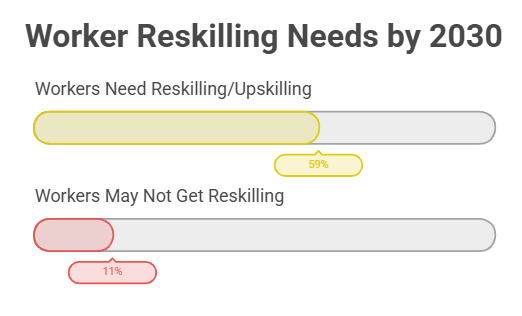
Source: WEF
Did You Know?
In the World Economic Forum’s Future of Jobs report it was found that about 59 out of 100 workers will need to be reskilled or upskilled by 2030— and 11 of those may not even get it. So that puts more than 120 million jobs, at risk of redundancy.
How Does Leadership Capability Development Drive Business Resilience?
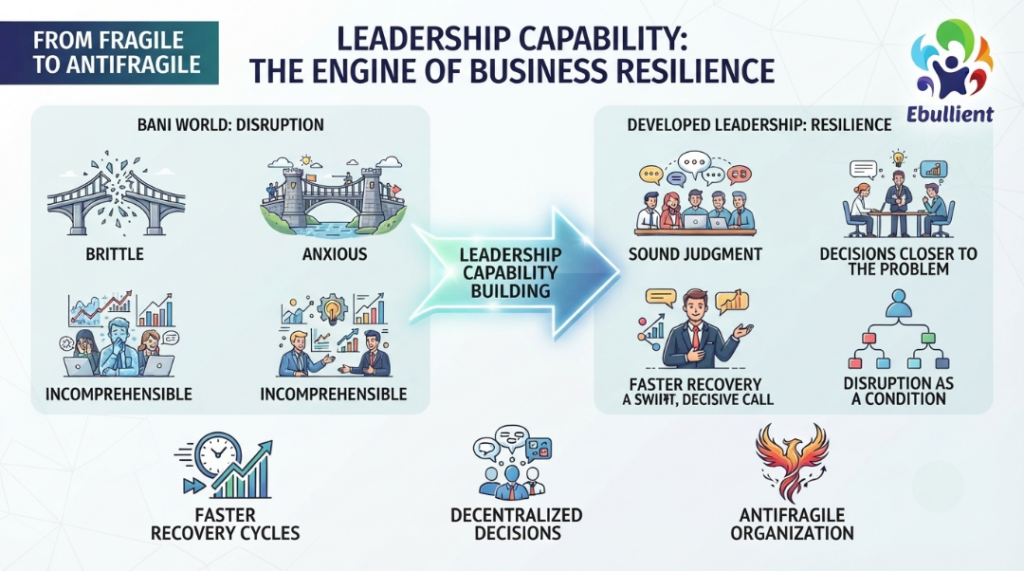
Leadership capability development builds the judgment leaders need to make sound calls under volatile, uncertain conditions — not just familiar ones. Organizations with deliberately developed leaders recover from disruption faster because decisions get made closer to the problem, without waiting for a crisis to travel up the chain.
The operating environment most leadership teams describe today isn’t just volatile and uncertain (VUCA) — it’s Brittle, Anxious, Nonlinear, and Incomprehensible (BANI). Systems that look stable can fail suddenly; small inputs can produce disproportionate outputs; and cause and effect stop lining up the way a five-year strategic plan assumes they will. Leaders trained only for VUCA-era predictability freeze in BANI conditions, because their instinct is to seek more data before deciding.
Business resilience through capability building looks different: it develops what we call antifragile leadership — leaders who don’t just withstand disruption but use it to sharpen decision-making, because they’ve practiced ambiguous scenarios long before a real one arrives. This is leadership capability development done right: fewer bottlenecked decisions, faster recovery cycles, and a workforce that treats disruption as a working condition rather than an exception.
What Does a Capability Building Framework Look Like in Practice?
An effective capability building framework aligns three elements at once — the business outcome being pursued, the specific skill or judgment gap standing in the way, and the organizational systems that will sustain the new behavior after the program ends. Programs that address only one element rarely survive past the first quarter.
We call this the triple intersection: strategy, individual capability, and organizational systems, developed together rather than sequentially. A leadership program built without reference to the business’s actual near-term decisions is theoretical. A skills initiative with no reinforcement in how managers coach or how performance gets measured decays within weeks. The framework only holds when all three points of the triangle move together — which is also why capability building is difficult to outsource entirely to a generic course library. It has to be built around the specific decisions your people are actually making.
How Can Organizations Start Building Capability Instead of Just Delivering Training?
Organizations can begin by auditing capability gaps against all three levels of the Triple Intersection Framework, embedding development into the flow of work rather than off to the side of it, and replacing completion metrics with measures of applied competence and business impact. Shifting from a training mindset to a capability-building mindset is a structural change, not a content change. It typically starts with a small number of deliberate moves:
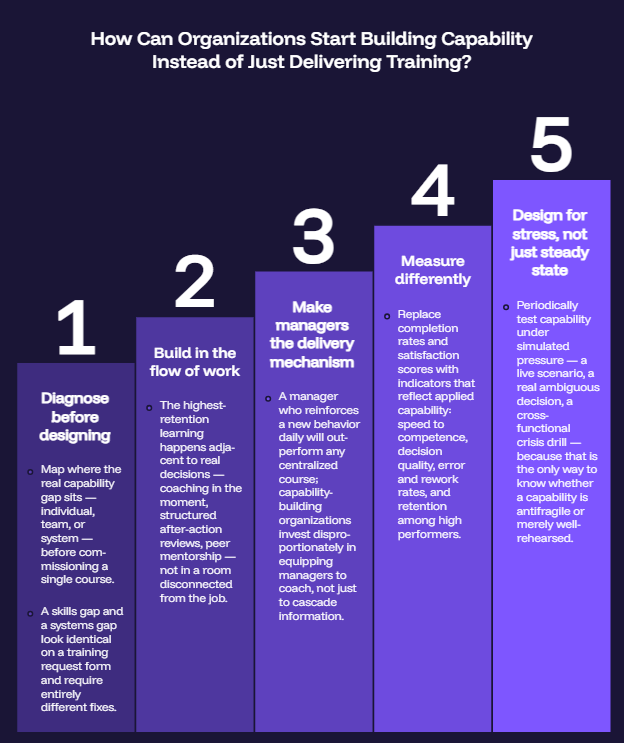
- Diagnose before designing. Map where the real capability gap sits — individual, team, or system — before commissioning a single course. A skills gap and a systems gap look identical on a training request form and require entirely different fixes.
- Build in the flow of work. The highest-retention learning happens adjacent to real decisions — coaching in the moment, structured after-action reviews, peer mentorship — not in a room disconnected from the job.
- Make managers the delivery mechanism. A manager who reinforces a new behavior daily will out-perform any centralized course; capability-building organizations invest disproportionately in equipping managers to coach, not just to cascade information.
- Measure differently. Replace completion rates and satisfaction scores with indicators that reflect applied capability: speed to competence, decision quality, error and rework rates, and retention among high performers.
- Design for stress, not just steady state. Periodically test capability under simulated pressure — a live scenario, a real ambiguous decision, a cross-functional crisis drill — because that is the only way to know whether a capability is antifragile or merely well-rehearsed.
Source: WEF
Did You Know?
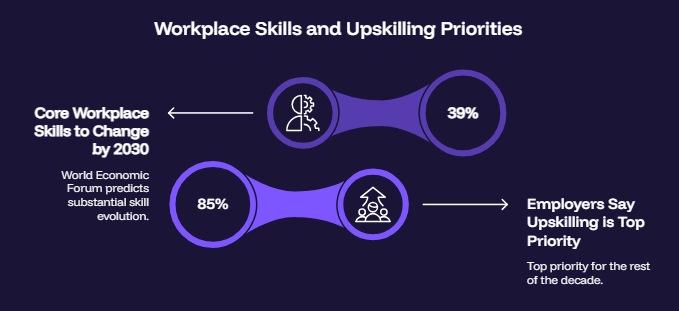
Employers now expect 39% of core workplace skills to change by 2030, according to the World Economic Forum — and 85% of employers say upskilling their workforce is a top priority for the rest of the decade.
Curious About Other Areas of Your Organization?
Explore our other free assessments and get a fuller picture of where you stand.
View All AssessmentsHow Ebullient Consultancy Can Help?
For HR leaders, L&D heads, and senior management evaluating where to invest next, the decision usually isn’t whether to build capability — it’s how to do it without another generic course library that nobody finishes. Ebullient Consultancy works as an organizational development consulting partner that designs capability building around your actual business decisions, not a template curriculum. As a corporate training company built specifically for organizations navigating BANI conditions, our programs combine leadership capability development, antifragile leadership training, and measurable organizational excellence training — mapped to the triple intersection of strategy, skill, and system so the change survives past the workshop.
Final Thoughts
The organizations pulling ahead over the next decade won’t be the ones with the largest capital reserves or the newest technology stack. They’ll be the ones whose people can absorb disruption, make sound calls with incomplete information, and turn a new tool into new performance within a single quarter. That is what capability building buys — not a training certificate, but an organization that gets structurally harder to compete with every year it compounds.
Want to meet the team?
Start with a 30-min conversation. No commitment needed.
Frequently Asked Questions
What is capability building in simple terms?
Capability building is of a deliberate sharpening of an organization’s shared skills and judgment, so people can end up performing reliably well even when situations are fresh, or not fully predictable— it gets built through steady coaching and supporting systems, not as some one time training event.
What is the difference between upskilling and capability building?
Upskilling typically refers to adding a specific new skill to an individual’s toolkit. Capability building is broader: it is the organizational discipline of ensuring skills translate into consistent, applied performance across individuals, teams, and systems — and that they keep compounding rather than expiring.
How long does it take to see results from capability building?
Early behavioral shifts are typically visible within 90 days when a program includes manager reinforcement and metric alignment; measurable business impact — faster decisions, fewer escalations — usually compounds over two to four quarters.
Is capability building only for large enterprises?
No. Mid-sized and growth-stage companies often see faster returns, because judgment gaps show up directly in customer experience and decision speed long before they’re visible in enterprise-scale reporting.
What’s the first step to building a capability building framework in-house?
Start by identifying the one business decision your teams currently make too slowly or too inconsistently, then design the skill, coaching, and metric changes around fixing that single decision before scaling the framework organization-wide.