

What Are Global Capability Centers, and Why Are They Growing in India?
A Global Capability Center (GCC) is a wholly owned offshore unit through which a multinational enterprise runs core, high-value functions — not just support work — directly out of a location like India. In 2026, India hosts over 2,100 GCCs employing roughly 2.4 million professionals. For CXOs, the binding constraint on GCC success is no longer talent supply. It is talent readiness — specifically, whether the leadership layer can operate under volatility instead of merely surviving it.
Key Takeaways at a Glance
India now hosts more than 1,800 Global Capability Centers, employing nearly 2 million professionals—yeah basically the largest GCC hub.
Growth is slowly shifting toward strategic ownership , where GCCs are taking on product and P&L responsibility
Leadership density, not hiring volume, is the major bottleneck constraining GCC scale-up.
The Overall India GCC ecosystem is forecast to land around USD 105–110 billion in market revenue by 2030.
GCC talent development must aligned with in depth functional, cross-cultural fluency, and decision-making built for BANI conditions.
Ebullient Consultancy’s triple intersection framework and HR-to-Human-Beings philosophy are built specifically for this leadership gap.
What Is Driving the Rise of GCCs in India in 2026?
India’s GCC sector has moved decisively past its cost-arbitrage origins. Roughly 60% of the world’s top 500 companies now operate a GCC in India, and the mandates handed to these centers have shifted from transactional back-office work to product engineering, AI platforms, and enterprise decision-making. Export value from the sector is estimated at approximately $98.5 billion in FY2026, with projections placing it near $110 billion by 2030 as the center count climbs toward 2,400–2,550.
This is not incremental growth. It is a structural repositioning of where global enterprises choose to build their most strategically important teams — and it is happening faster than most organizations’ leadership pipelines can absorb.
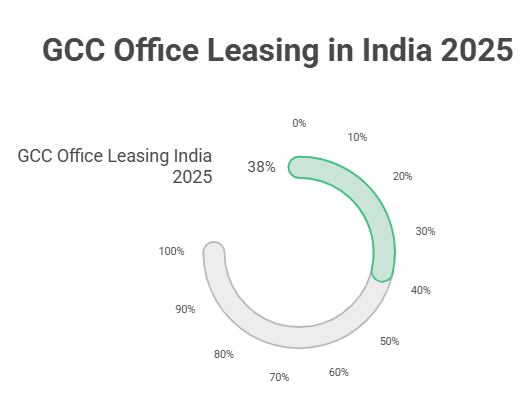
Source: JLL
Did You Know?
GCCs accounted for an estimated 38% of all office leasing across India’s top seven cities in 2025 — the highest volume ever recorded at roughly 31.3 million square feet.
What Is Driving the Explosive Growth of Global Capability Centers in India?
Global Capability Centers are growing in India because of a rare combination — a deep STEM talent pool, mature digital infrastructure, competitive operating costs, and a policy environment actively courting global enterprises. Together, these factors let companies build strategic capability, not just cost savings.
Ten years ago, a GCC in India meant a support function: IT helpdesk, transaction processing, basic analytics. That model no longer describes the India GCC ecosystem. In our experience implementing leadership frameworks for financial services and technology GCCs, we’ve watched mandates shift from “keep the lights on” to “own the roadmap.” A GCC head in Bengaluru today might report directly into a global product organization, with P&L accountability and a seat at the strategy table that didn’t exist a decade ago.
Three structural forces explain why global capability centres in India keep multiplying:
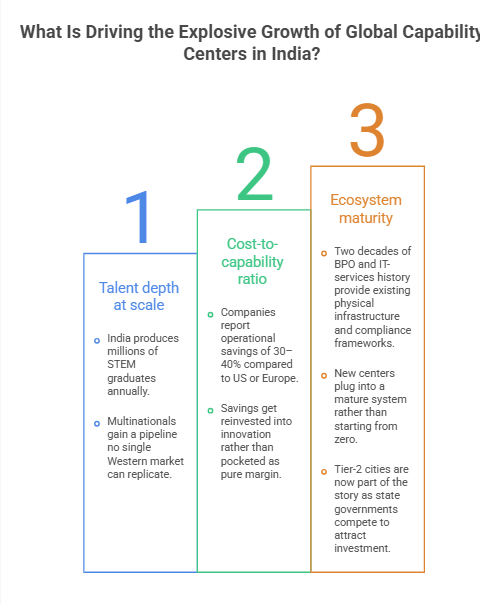
1. Talent depth at scale
India produces millions of STEM graduates annually, giving multinationals a pipeline no single Western market can replicate.
2. Cost-to-capability ratio
Companies building GCCs in India report operational savings in the range of 30–40% compared to running equivalent teams in the US or Europe — savings that get reinvested into innovation rather than pocketed as pure margin.
3. Ecosystem maturity
Two decades of BPO and IT-services history means the physical infrastructure, compliance frameworks, and vendor ecosystems already exist. New Global Capability Centers aren’t starting from zero; they’re plugging into a mature system.
Tier-2 cities — Mysuru, Nagpur, Nashik, Coimbatore, Jaipur — are now part of this story too, as state governments compete to attract GCCs with incentives and land parcels once reserved for manufacturing.
How Mature Is Your Framework, Really?
Take our free 4-minute assessment and get a personalized report on your leadership fluency, governance, and workforce readiness.
Take the Free AI Readiness Assessment →How Are Global Capability Centers (GCCs) in India Evolving from Cost Centers to Innovation Hubs?
GCCs in India are evolving into innovation hubs because global enterprises are relocating decision rights, not just headcount. Product ownership, R&D budgets, and even C-suite roles are increasingly based in India, turning centers built for cost efficiency into engines of strategic value.
This is the shift that separates a mature GCC from a legacy back office. Several global retailers and technology firms now run their largest engineering hub — anywhere in the world — out of an Indian city, not because it’s cheaper, but because that’s where the deepest bench of talent sits. Nearly 60% of the world’s top 500 companies have already established a GCC in India, and the newest cohort of centers is being built with innovation mandates from day one, not retrofitted into them years later.
The practical consequence for HR and L&D leaders: the skills a GCC needs to hire and develop have changed faster than most training curricula have caught up.
What Is the Real Talent Bottleneck Inside India’s GCCs Today?
It is tempting to assume India’s talent bottleneck is about volume. It is not. India produces roughly 1.5 million engineering graduates a year, and campus pipelines remain well established at the entry level. The actual constraint sits in the middle: professionals with 8–15 years of experience who combine technical depth, governance judgment, and cross-functional leadership. Without this layer, senior leaders become overloaded and junior staff are left without the guidance needed for long-term project stability.
Overall GCC attrition in India has actually improved, settling to a historic low of around 12.6% — below the broader technology sector’s 13–15%. But that headline number hides the metric CXOs should actually be tracking: the departure rate within the top 20% of the workforce, where churn remains stubbornly high, particularly among senior engineers and AI/ML specialists.
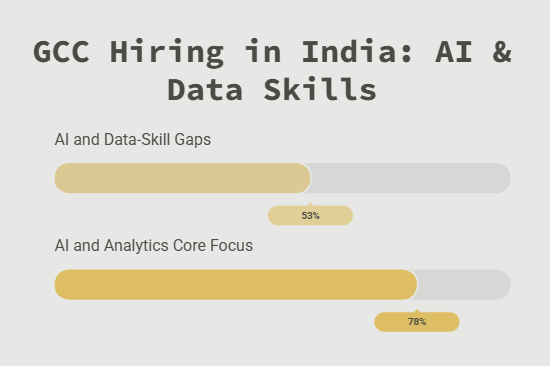
Source: millipixels
Did You Know?
Industry research on GCC hiring in India points to AI and data-skill gaps in the range of 53% among current GCC talent pools — even as roughly 78% of newly established GCCs name AI and analytics as a core capability focus from day one.
What Are the Top Global Capability Centers in India Today?
Top Global Capability Centers in India cover technology BFSI retail and engineering, and they cluster in Bengaluru Hyderabad Pune Chennai and the NCR. Their most common trait isnt about size, it’s more about how much control, i mean ownership really gets handed to the India team.
Bengaluru stays the anchor city for GCCs, probably the deepest technology plus product mandates. Hyderabad has turned into kind of a magnet for BFSI and engineering heavy centers, with multiple new large scale builds announced or already in progress. Pune and Chennai still hold solid manufacturing adjacent and R&D oriented GCCs, while the NCR patch of region is slowly becoming home to finance, consulting and shared services kind of setups. What really separates the strongest performers among the top global capability centers in India isnt just headcount it’s whether the India team owns outcomes end to end, from strategy right through to delivery.
GCC Maturity Stage | Primary Function | Leadership Structure | Training Priority |
Foundational (Year 1–2) | Cost efficiency, transaction processing | Ops managers, reporting to HQ | Process discipline, communication |
Scaling (Year 2–5) | Delivery ownership, cross-functional teams | Functional leads, local decision rights | People management, cross-cultural leadership |
Strategic (Year 5+) | Product ownership, P&L accountability | GCC head with board-level visibility | Strategic leadership, change management, antifragile decision-making |
How Can CXOs Build Antifragile Leadership Pipelines Inside a GCC?
Antifragile leadership isn’t built through an annual training calendar. It is built by deliberately exposing rising leaders to the kind of controlled stress that BANI conditions will eventually impose anyway — on the organization’s terms, not the market’s. Five shifts matter most:
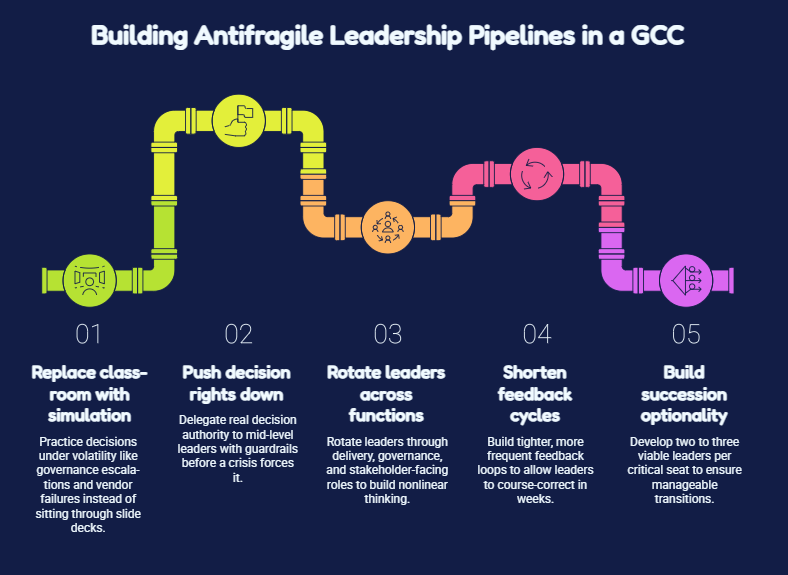
1. Replace classroom training with scenario simulation
Leaders develop judgment under volatility by practicing decisions under volatility — governance escalations, vendor failures, AI-compliance dilemmas — not by sitting through slide decks. Simulation-based development compresses years of “learning by crisis” into months of structured practice.
2. Push decision rights down before a crisis forces it
Many GCCs still route governance, compliance, and escalation decisions to a thin layer of senior or expatriate leadership. Deliberately delegating real decision authority to mid-level leaders — with guardrails — builds the judgment those leaders will need when volatility inevitably compresses response time.
3. Rotate leaders across functions and geographies
Cross-functional rotation — through delivery, governance, and stakeholder-facing roles — builds the kind of nonlinear thinking BANI conditions demand. Leaders who have only ever managed inside one function struggle when disruption crosses functional boundaries, which it almost always does.
4. Shorten feedback cycles
Annual performance cycles are too slow for skills with an 18-month half-life. Antifragile organizations build tighter, more frequent feedback loops so leaders can course-correct in weeks rather than waiting for the next formal review.
5. Build succession optionality, not single-threaded plans
A single named successor per role is a brittle plan. Antifragile GCCs deliberately develop two to three viable leaders per critical seat, which turns unplanned departures from a crisis into a manageable transition.
Tier-1 vs Tier-2 Cities: Where Should Talent Strategy Focus?
Location strategy is now inseparable from talent strategy. Tier-2 cities — supported by state-level incentives such as rental reimbursements and tax breaks — are absorbing a growing share of GCC expansion, but they solve a different problem than Tier-1 hubs do.
Dimension | Tier-1 Hubs (Bengaluru, Hyderabad, Pune, NCR) | Tier-2 Hubs (Coimbatore, Kochi, Jaipur, Nagpur) |
Share of GCC hiring | Dominant — Bengaluru alone hosts ~35–40% of India’s GCC base | ~12% of GCC hiring nationally and rising |
Talent depth | Deepest bench across AI, product, and platform roles | Strong graduate pipeline; thinner senior/leadership layer |
Attrition | Higher, especially among senior engineers and AI/ML talent | 10–15% lower than Tier-1 metros |
Cost structure | Premium real estate and compensation benchmarks | 30–40% potential talent cost reduction |
Best suited for | Flagship, IP-sensitive, and leadership-anchored mandates | Scaled delivery pods and second-hub diversification |
What Does a Future-Ready GCC Talent Strategy Look Like for CXOs?
A future-ready strategy treats talent volatility as a design input, not an exception to manage around. In practice, that means:
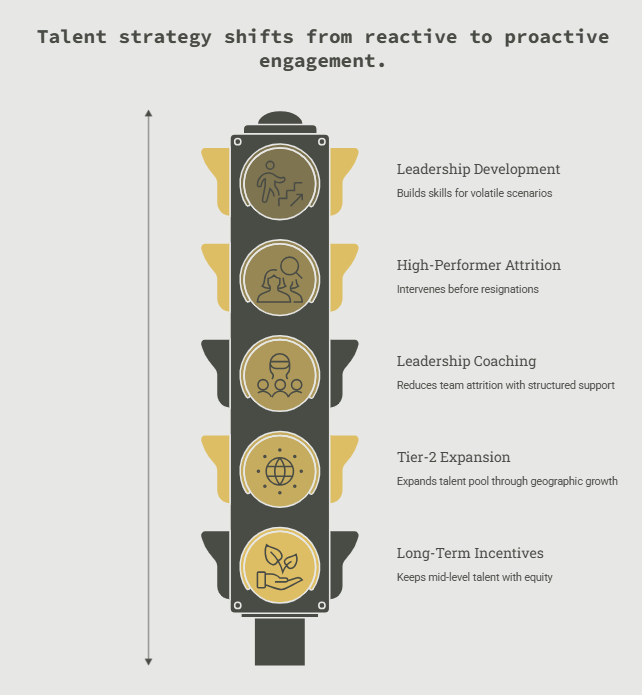
- Building leadership development around BANI-relevant scenarios rather than generic competency frameworks.
- Tracking high-performer attrition separately from headline attrition — and intervening before it shows up as a resignation.
- Investing 5–10 lakh rupees per manager annually in structured leadership coaching, which industry data links to measurably lower team-level attrition within a year.
- Treating Tier-2 expansion as a talent-diversification strategy, not just a cost play.
- Extending long-term incentives such as ESOPs and RSUs below the top leadership layer to retain the mid-level talent most exposed to poaching.
Curious About Other Areas of Your Organization?
Explore our other free assessments and get a fuller picture of where you stand.
View All AssessmentsHow Ebullient Can Help?
For HR and L&D leaders evaluating training partners, the return-on-investment question isn’t really whether to invest in GCC leadership training — the growth numbers already answer that. The real question is whether a training partner understands what leadership demands inside a GCC built at the triple intersection of the digital revolution, the sustainability imperative, and the purpose movement — the point where human and planetary well-being have to be designed together, not traded off for speed or cost.
Ebullient Consultancy exists to help leaders and organizations learn, decide, and act under deep ambiguity — exactly the condition most GCC leaders operate in daily, managing distributed teams inside institutions still shaped by Palaeolithic emotions, medieval-era hierarchies, and technology moving faster than either. Our mission is to humanize technology, corporations, and society: not by resisting the tools reshaping GCC work, but by rewiring the culture and capability around them, so technology amplifies human dignity, creativity, and care instead of eroding them.
Practically, for a GCC scaling its leadership bench, this means shifting from Human Resources to Human Beings across the employee lifecycle — hiring, performance, development, rewards, succession — while building antifragile leadership that thrives under BANI conditions (Brittle, Anxious, Nonlinear, Incomprehensible) rather than freezing under them. We do this through:
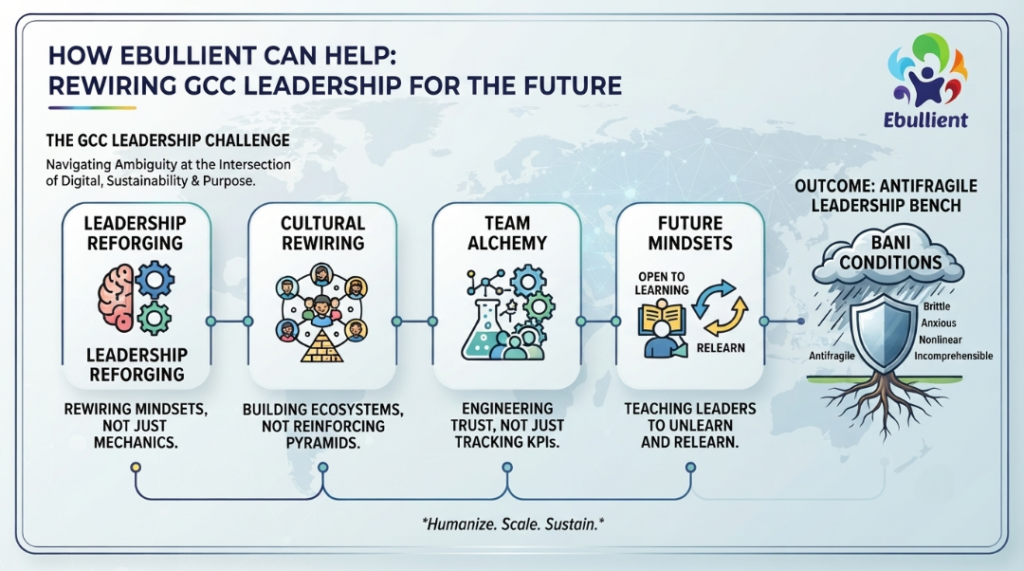
Leadership re-forging , it’s about rewiring mindsets, not only drilling mechanics.
Cultural rewiring — building ecosystems, not reinforcing those old pyramids.
Team alchemy — Engineering trust, not just tracking KPI’s.
Future mindsets — teaching leaders to unlearn and relearn, not just download best practices.
For a GCC moving from a foundational stage to a strategic one, this is the difference between a leadership bench that holds under pressure and one that cracks the first time growth outpaces preparation.
Want to meet the team?
Start with a 30-min conversation. No commitment needed.
Frequently Asked Questions
What exactly is a Global Capability Center (GCC)?
A GCC is a wholly owned strategic entity that a multinational company establishes offshore — often called a Global In-house Center (GIC) or captive center — to run core business functions directly, as an integrated part of the parent organization rather than a third-party vendor.
How is a GCC different from a traditional BPO or outsourcing setup?
A traditional outsourcing arrangement hands a function to an external vendor. A GCC keeps the function inside the company’s own structure, with direct control over IP, governance, quality, and strategic direction — which is why GCC mandates have expanded into product engineering, AI, and enterprise decision-making rather than staying confined to support work.
What is the single biggest talent risk for CXOs setting up a GCC in India?
It is the leadership readiness gap, not headcount availability. India has deep entry-level and mid-level technical talent, but a thin layer of professionals who combine technical depth with governance and cross-functional leadership judgment — exactly the layer a GCC depends on most during periods of volatility.
What does “antifragile leadership” mean in a GCC context?
Antifragile leadership goes beyond resilience. A resilient leader absorbs a shock and returns to how things were before. An antifragile leader — and the systems around them — uses volatility as a source of improvement, emerging with better judgment, sharper decision-making, and stronger teams than before the disruption.
Should a new GCC prioritize Tier-1 or Tier-2 cities in 2026?
Most CXOs should treat this as a both/and decision rather than either/or. Tier-1 hubs remain the right base for IP-sensitive, leadership-anchored mandates, while Tier-2 cities are increasingly suited to scaled delivery pods, offering lower attrition and meaningful cost advantages as a second-hub diversification strategy.