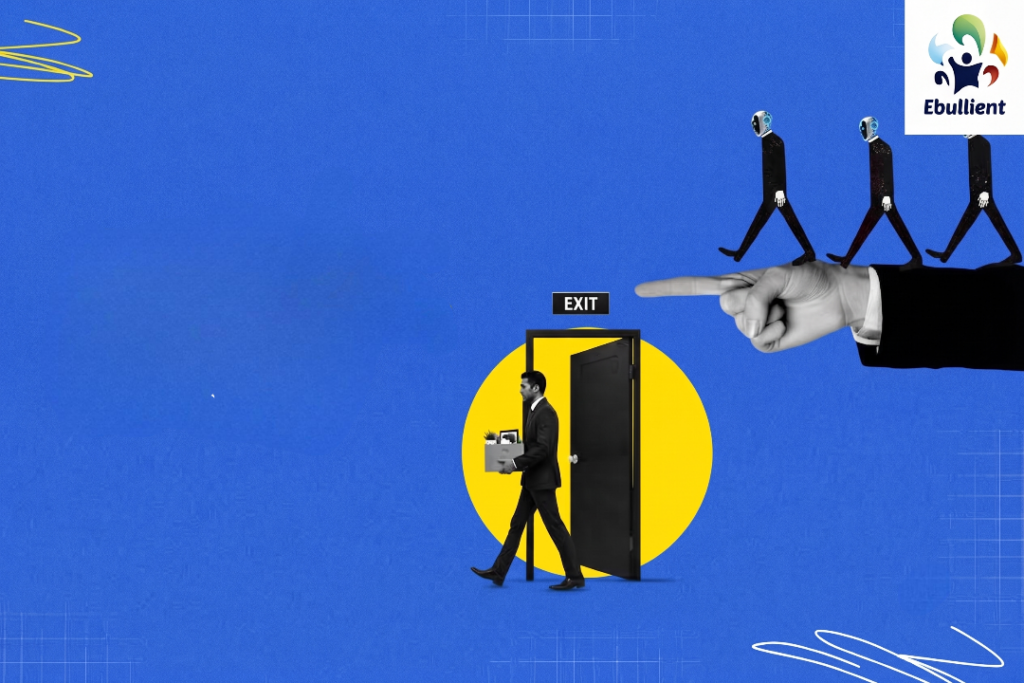
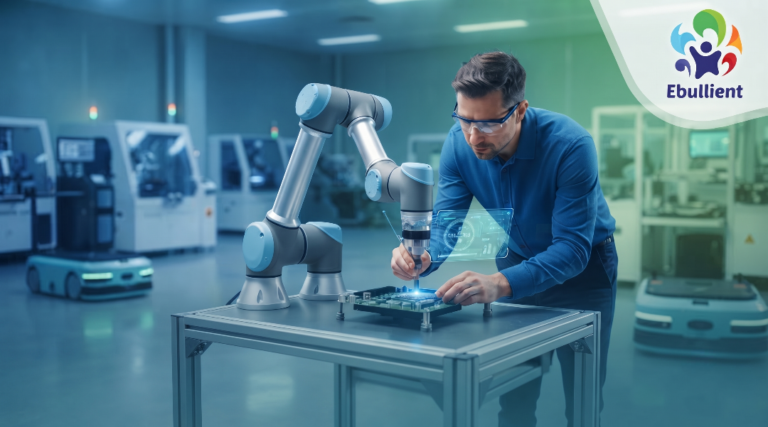
Industry 5.0 is the next evolution in industrial manufacturing, where human expertise and machine intelligence work in, deliberate partnership. In contrast to Industry 4.0’s automation first angle, Industry 5.0 puts human-centered thinking first, with an emphasis on sustainability and societal resilience too. Basically, it shifts smart factories from being efficiency machines into more people-powered systems,
Key Takeaways at a Glance
- Industry 5.0 centres on human-machine collaboration, not automation for its own sake
- Human-centric smart factories outperform purely automated peers on resilience and retention
- Cognitive ergonomics is the underinvested variable in most Industry 5.0 deployments
- Reskilling manufacturing workforce is the primary ROI lever — not technology selection
- Sustainability must be embedded in learning design, not delivered as a compliance module
- Ebullient Consultancy offers context-specific Industry 5.0 learning solutions built for operational environments
What Is Industry 5.0 and How Is It Different from Industry 4.0?
Industry 5.0 moves beyond digitisation and automation to restore the human element inside smart factories. Where Industry 4.0 asked “how do we automate this?” Industry 5.0 asks “how do we make technology serve people better?” The shift is philosophical as much as operational.
Industry 4.0 delivered these extraordinary efficiency gains , with connected machines , IoT-enabled supply chains and AI-powered quality control. But it also created a workforce anxiety crisis. Roles were eliminated faster than they were redesigned, and organisations found themselves with agile machines but rigid people strategies.
Industry 5.0 in manufacturing corrects this imbalance. It recognises that the most competitive factories of the next decade will not be the most automated — they will be the most adaptive. This means designing production environments where cobots (collaborative robots) augment human judgment, where data systems are transparent enough for frontline workers to interrogate, and where sustainability goals are built into the manufacturing logic itself.
The European Commission formally defines Industry 5.0 through three pillars: human-centricity, sustainability, and resilience. These are not aspirational add-ons. They are structural requirements for what it means to operate a modern smart factory.

Source: ECI
Did You Know?
In the European Commission’s Industry 5.0 report, it says that more than 70% of manufacturers who tested human robot cooperation frameworks, noted actual, measurable improvements in worker satisfaction as well as production flexibility, within 18 months.Efficiency without humanity is no longer considered competitive advantage.
How AI-Ready Is Your Organization, Really?
Take our free 4-minute assessment and get a personalized report on your leadership fluency, governance, and workforce readiness.
Take the Free AI Readiness Assessment →What Does a Human-Centric Smart Factory Actually Look Like?
A human-centric smart factory is one where automation carries the repetitive, dangerous, and physically demanding load — while human workers own judgment, creativity, and care. Every technology decision is filtered through a single question: does this amplify human dignity, or diminish it? In Industry 5.0, that question is non-negotiable.
In our experience working with manufacturing and industrial clients navigating digital transformation, the gap between ‘smart factory’ and ‘human-centric smart factory’ becomes visible almost immediately. Factories optimised purely for throughput generate high turnover, low engagement, and brittle dependency on specific machine configurations. Human-centric Industry 5.0 smart factories treat workers as human beings — not human resources — and design every system accordingly.
Consider a precision components manufacturer that deploys collaborative robotics not to reduce headcount, but to eliminate ergonomic strain from repetitive assembly. Workers move into quality oversight, process calibration, and continuous improvement roles. Real-time dashboards give them direct visibility into production metrics they can interrogate and influence. Output improves — but so does retention, safety incident rates, and the institutional knowledge held within the workforce.
This is Industry 5.0 in manufacturing: not a reduction in the human contribution, but a profound redesign of what that contribution is. The shift from ‘Human Resources’ to ‘Human Beings’ is not symbolic — it restructures hiring, performance design, development investment, and succession planning around the full range of human capacity, not just compliance with process.
The Critical Niche Factor: Cognitive Ergonomics as a Design Principle
Most Industry 5.0 implementation guides address physical ergonomics — the safe placement of cobots, the reduction of strain in manual tasks. Far fewer address cognitive ergonomics: the science of designing information environments that match human mental capacity.
In a fully connected smart factory, workers are exposed to enormous volumes of sensor data, alert notifications, and production dashboards simultaneously. Without deliberate cognitive design, this creates decision fatigue, alert blindness, and operator error — negating the safety gains from automation.
Leading Industry 5.0 organisations are now partnering with human factors specialists and L&D teams to audit the cognitive load placed on frontline workers. The result is simplified, role-specific dashboards; layered alerting systems that escalate only what demands immediate human judgment; and structured decision protocols built into workflow training. This is not a technology investment. It is a learning design investment — and it is the variable that separates high-performing human-centric factories from those that merely claim the Industry 5.0 label.
Why Is Reskilling the Manufacturing Workforce the Most Urgent Industry 5.0 Priority?
Technology deployment in smart factories consistently outpaces workforce capability development. This is not a technology problem — it is a culture and leadership problem. Reskilling the manufacturing workforce is not a welfare consideration; it is the primary multiplier on every automation investment. Factories that build human capability before and during technology rollout recover ROI faster, sustain quality more reliably, and build the antifragile resilience that BANI conditions demand.
BANI conditions — Brittle, Anxious, Nonlinear, Incomprehensible — describe the operating reality facing manufacturing organisations today. Supply chain volatility. Regulatory shifts. Energy constraints. Geopolitical disruption. No machine resolves these. Only people with developed judgment, well-supported by capable leaders, navigate them effectively.
The skills now required on a modern production floor have fundamentally changed. Mechanical dexterity and process memory remain valuable — but they are secondary to data literacy, systems thinking, the capacity to interpret AI-generated production insights, and the judgment to intervene effectively in real time. These are not skills you download. They are capabilities you grow through deliberate, embedded learning — the unlearn → relearn cycle that characterises genuinely future-ready workforces.
The best Industry 5.0 training programmes look nothing like conventional training. They are not classroom events delivered once and filed away. They are embedded into the production environment — bite-sized digital modules accessible on shift tablets, scenario-based simulations calibrated to the organisation’s specific machinery, and peer coaching structures that keep knowledge alive between formal sessions.
In our experience implementing these frameworks for industrial clients, the single most consistent failure point is not worker resistance to technology. It is the absence of leadership capability at the frontline manager level. Managers who cannot translate strategic Industry 5.0 goals into team-level behaviour change become the ceiling on transformation. This is where we focus development energy — and where generalist training providers consistently fall short. Leadership reforging — shifting mindsets rather than mechanics — is what actually moves the dial.
AI Readiness Score Card Free guide, instant download.
Get the Guide →What Does a Credible Industry 5.0 Implementation Guide Cover?
A reliable Industry 5.0 implementation guide addresses four sequential stages — workforce readiness assessment, technology-human interface design, capability development at scale, and continuous learning integration. Organisations that skip the readiness assessment stage consistently underestimate the behavioural change required alongside the technical change.
| Implementation Stage | Key Activity | Common Failure Point |
|---|---|---|
| Stage 1: Readiness Assessment | Audit current skill levels, identify critical roles, map cognitive demands | Overlooking frontline cognitive load |
| Stage 2: Interface Design | Cobot workflow design, dashboard simplification, alert hierarchy | Designing for engineers, not operators |
| Stage 3: Capability Development | Role-specific reskilling, manager enablement, data literacy training | One-size-fits-all training programmes |
| Stage 4: Continuous Learning Integration | Embedded learning, performance coaching, skills tracking | No feedback loop between L&D and production data |
Industry 5.0 sustainability goals — including circular manufacturing practices, energy reduction targets, and responsible supply chain management — must be integrated across all four stages, not treated as a compliance checklist. Organisations that embed sustainability into the manufacturing logic early create systems that self-correct toward lower waste and more efficient resource use, with workers who understand why these metrics matter.
Curious About Other Areas of Your Organization?
Explore our other free assessments and get a fuller picture of where you stand.
View All AssessmentsHow Ebullient Consultancy Supports Industry 5.0 Transformation
Ebullient exists to help leaders and organisations do what they don’t yet know how to do — to Learn, Decide, and Act under deep ambiguity. Industry 5.0 transformation is exactly that kind of challenge.
Our mission is to humanise technology, corporations, and society — not by resisting exponential tools, but by re-wiring culture and capability so that technology becomes an amplifier of human dignity, creativity, and care. In manufacturing contexts, this means working at the triple intersection of the digital revolution, the sustainability imperative, and the purpose movement — designing learning architectures that serve human and planetary well-being simultaneously, not as competing priorities.
As a specialist Industry 5.0 corporate training provider, Ebullient does not deliver catalogue programmes and leave organisations to self-administer. Every engagement begins with a structured diagnostic assessing the technical environment and the human capability landscape in parallel. From that foundation, we build phased Industry 5.0 learning solutions built around four disciplines:

Leadership Reforging
Shifting mindsets, not just mechanics. Leaders at every level build the judgment and courage to navigate BANI conditions — not just the skills to manage toward last quarter’s KPIs.
Cultural Rewiring
Moving from pyramid hierarchies to networked ecosystems of accountability. We help organisations shift from ‘Human Resources’ to ‘Human Beings’ across the entire employee lifecycle: hiring, performance, development, rewards, and succession.
Team Alchemy
Building the trust, psychological safety, and adaptive collaboration that make technology genuinely useful. A team that doesn’t trust each other cannot operate a human-centric smart factory.
Future Mindsets
Structured unlearn → relearn programmes that give workers and managers the cognitive agility to meet technology where it is — not where it was five years ago.
Every Best Industry 5.0 training programme we design is built on one principle: your workforce should not just survive disruption — it should grow stronger through it. That is not a training goal. It is antifragile leadership philosophy applied to every person on the floor.

Source: MI
Did You Know?
The Manufacturing Institute’s 2026 State of Workforce Training report found manufacturers now spend USD 31.9 billion annually on training — up from USD 26.2 billion in 2019 — and 54.4% of manufacturers surveyed say they are actively increasing those efforts. Yet only 29% of technicians describe themselves as “very prepared” for digital technologies.
Final Thoughts
The manufacturers leading Industry 5.0 right now are not necessarily those with the most sophisticated machines. They are those who recognised, earlier than their competitors, that human capability is the multiplier on every technology investment.
Industry 5.0 smart factories will not ultimately be defined by the automation they deploy. They will be defined by the people operating, improving, and innovating within them — people who are developed, trusted, and led with genuine intention.
In a world shaped by Palaeolithic emotions, medieval institutions, and godlike technology, the organisations that grow wisdom, judgment, and courage fast enough to match the velocity of change will lead the next era of manufacturing. The question is not whether your organisation needs Industry 5.0. It is whether your culture and leadership are ready to build it.
Want to meet the team?
Start with a 30-min conversation. No commitment needed.
Frequently Asked Questions
What is the core difference between Industry 4.0 and Industry 5.0?
Industry 4.0 optimised machines for efficiency, output , and tighter process control. Industry 5.0 kind of re-centrers the whole idea around people , it’s about crafting technology that strengthens human dignity, originality, and compassion—not just swapping out human labour. Industry 5.0 does not discard Industry 4.0 technologies; it redefines the purpose they serve.
Which industries are earliest adopters of Industry 5.0?
Automotive , pharmaceuticals , precision engineering , and electronics manufacturing are leading in many regions. These industries usually have strong automation maturity already , and at the same time they face rising sustainability compliance and workforce retention — the conditions that accelerate Industry 5.0 adoption.
How long does a typical Industry 5.0 implementation take?
A phased implementation typically spans 18 to 36 months for mid-to-large manufacturers. You can also see progress early, because readiness diagnostics and pilot programmes may show measurable outcomes within the first quarter , when there’s structured learning and leadership development.
What makes Ebullient Consultancy different from other corporate training providers?
Ebullient builds programmes from the floor upward — starting with the cognitive demands, leadership context, and cultural conditions of your specific organisation. As an Industry 5.0 corporate training provider rooted in the philosophy of humanising technology, every engagement is designed to rewire culture and capability simultaneously, not just deliver content.
How do Industry 5.0 learning solutions address sustainability?
The best Industry 5.0 learning solutions embed sustainability metrics — energy efficiency, waste reduction, responsible sourcing — directly into workflow training and performance design. Workers make sustainability-conscious decisions as part of normal production behaviour, not as an occasional audit exercise. Industry 5.0 sustainability becomes culture, not compliance.