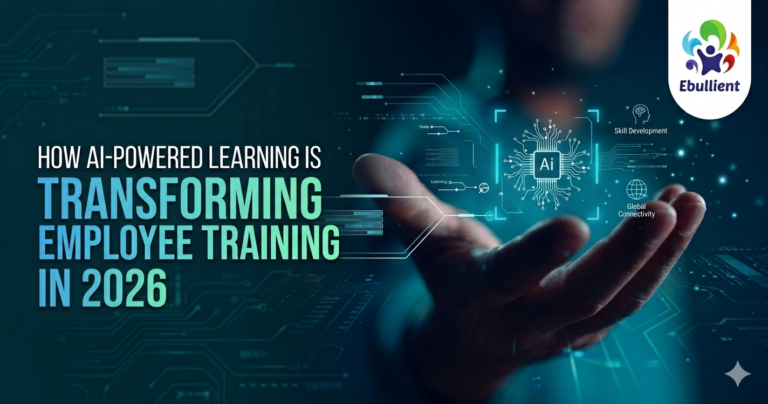
AI-powered learning is transforming employee training by adopting artificial intelligence, machine learning, and predictive analytics to personalize the learning experiences, find out the skill gaps, automate the process, and increase the overall workforce productivity. Organisations are more frequently implementing ai-powered learning platforms to offer adaptive, growth-oriented, and measurable training programs that align employee development with evolving business goals.
But the deeper transformation is not just technological. Leading organisations are now recognizing that learning is no longer about delivering static training modules. It is about helping people learn, decide, and act under deep ambiguity — especially at the intersection of digital disruption, sustainability pressures, and the growing demand for purpose-driven work cultures.
Modern enterprises are moving from managing “human resources” toward empowering human beings through intelligent, human-centered learning ecosystems.
Key Takeaways – At a Glance
- AI-powered learning is transforming employee training through predictive learning intelligence.
- Organisations implement intelligent learning systems to enhance team members’ capability to adapt and acquire new competencies.
- The human-centered AI learning ecosystems develop four essential skills, which include adaptability, judgment, creativity, and resilience.
- The future of learning involves continuous unlearning, together with relearning and collaborative intelligence.
- Organisations need to undergo cultural changes while their leadership needs to develop, for technology to bring about organisational transformation.
- Intelligent learning systems become more effective in organisations that treat them as human-centered systems, which results in stronger workforces that can withstand challenges.
Why Is AI-Powered Learning Becoming Essential for Employee Training?
Modern organisations not struggling from the lack of training content. The real challenge is providing the right learning experience to the right employee at the right time. Traditional learning systems seens to be a failure because they deal every learner the same way, irrespective of role, proficiency level, performance gaps, or company goals.
That is how ai-powered learning is changing corporate learning Strategy.
Companies are now adopting intelligent learning systems to create customized learning pathways, automate training recommendations, forecast skill shortages, and enhance learning engagement across distributed teams. The AI-driven systems provide continuous assessment of employee behavior together with their learning achievements and performance data which results in real-world training delivery transformation.
HR leaders and L&D teams need to understand that the current change requires them to adopt new technology. Organizations need to develop flexible workforces that can adapt to digital changes and automation while meeting their evolving business needs.
The growing use of remote work, together with hybrid teams and digital-first operations, has created an urgent need for organizations to develop learning systems that can scale and operate with advanced capabilities. Organizations that use AI-based learning platforms experience significant gains in employee engagement and productivity and compliance completion and internal mobility.

Source: Mckinsey
Did You Know?
The implementation of an AI-driven personalized learning system achieved a 30 percent boost in employee engagement while delivering a 25 percent enhancement in learning results.
What Is AI-Powered Learning in Corporate Training?
AI-powered learning adopt artificial intelligence technologies to personalize, automate, and enhance employee training experiences. The system analyzes employee behavior patterns and learning preferences, job role requirements and performance metrics to create personalized adaptive learning paths that meet individual learner needs.
The training programs that follow traditional methods base their entire structure on unchanging training modules and one-size-fits-all course structures. AI-driven systems operate differently. They are continuously learning from employee interactions and actively regulate training recommendations.
Here’s what most enterprises are focusing on: now employees don’t want generic training libraries. They expect learning experiences similar to personalized streaming or recommendation platforms.
An advanced AI-powered learning platform can:

- Recommend relevant training modules
- Identify employee skill gaps
- Automate assessments
- Provide intelligent feedback
- Predict future learning requirements
- language preferences,
- and future leadership potential.
This creates a learning culture centered on human growth rather than transactional training completion.
How AI-Ready Is Your Organization, Really?
Take our free 4-minute assessment and get a personalized report on your leadership fluency, governance, and workforce readiness.
Take the Free AI Readiness Assessment →Why Are Enterprises Investing in AI-Powered Learning Platforms?
Organisations that are heavily investing in AI-powered learning platforms which delivery workforce transformation, which depends on continuous upskilling and rapid capability development.
Static learning systems cannot keep pace with:
- evolving technologies
- changing customer expectations
- compliance updates
- emerging job roles
- automation-driven disruption
AI enables enterprises to shift from reactive training models to predictive learning strategies.
Key Business Drivers Behind Adoption
|
Business Challenge |
AI-Powered Solution |
|
Low employee engagement |
Personalized learning experiences |
|
Skill gaps |
Predictive skill analysis |
|
High training costs |
Automated content delivery |
|
Generic learning paths |
Adaptive recommendations |
|
Poor training ROI |
Data-driven learning analytics |
Large enterprises are using AI-powered online learning systems together with their hybrid workforce models to create uniform learning experiences that can be accessed from different locations.
A multinational IT company that operates in India, Europe, and Southeast Asia can use AI to create personalized learning modules for its new employees who start their work in different regions based on their language preferences, technical skills, compliance needs, and job responsibilities.
But organisations investing successfully in AI learning ecosystems are focusing on more than efficiency alone. They are redesigning how employees learn, collaborate, and evolve within rapidly changing business environments.
How Does AI-Powered Learning Improve Employee Performance?
The AI-based training system provides employees with customized training which addresses their skill gaps while delivering continuous educational programs that lead to success in their work performance.
The conventional training method fails to engage employees because it presents them with materials that do not relate to their work. AI-driven learning reduces that resistance.
The AI system determines proper training content for each employee by evaluating their work performance and their past assessments and their productivity measurements and their participation rates and their learning behavior patterns.
The system then provides relevant advice content.
The targeted method provides two advantages which include reduced learning burnout and improved knowledge retention.

Example: AI in Sales Training
A sales employee who needs to learn how to manage objections will automatically obtain three types of training materials which include microlearning modules and role-play simulations and AI-generated practice scenarios and personalized coaching recommendations.
High-performing employees will receive advanced training modules which focus on negotiation skills and leadership abilities.
Many organizations achieve better results from AI-powered learning benefits because they implement AI-powered learning programs for employee development.
What Are the Benefits of AI-Powered Learning for Employees?
The main benefit of artificial intelligence-powered learning systems allows them to create customized learning experiences for their users. Employees who equips training experiences tailored to their roles, goals, and performance require rather than universal content libraries.
The Major Benefits are:

1. Personalized Learning Paths
Employees can progress through learning programs that use customized learning recommendations to match their specific industry needs.
2. Faster Skill Development
The system enables rapid skill acquisition through its capacity to identify learning skill gaps at an early stage and recommend appropriate training solutions.
3. Better Learning Engagement
Interactive recommendations lead to higher student involvement and better course completion rates.
4. Continuous Feedback
Employees receive instant assessments and performance insights.
5. Improved Career Development
AI systems can align training recommendations with career progression opportunities.
The shift becomes especially visible in organizations adopting ai powered learning employee examples in the workplace initiatives for leadership development, compliance, and technical upskilling.

Source: MBS
Did You Know?
Most employees report that AI integration at their workplace delivers positive benefits, which include improved efficiency (67%), better access to information (61%) and enhanced innovation (59%), and improved quality of decision making (58%). Almost half (46%) also report AI use has increased revenue-generating activity.
How Is Generative AI Changing Learning and Development?
Generative ai in learning and development is support organizations to develop scalable, effective, and highly Immersive learning experiences fasterat an all-time. This changes everything and how enterprises prepare training content.
Instead of manually developing each & every module, organisations can now employ generative AI tools to:

- Develop and create training simulations
- Generate quizzes
- Explore multilingual content
- Build role-based learning paths
- Create conversational AI tutors
Generative AI also supports L&D teams to reduce content development cycles significantly.

For Example
A healthcare organisation launching new compliance training across multiple departments that uses generative AI to:
- Generate policy summaries
- Create interactive assessments
- Localize training material
- Develop chatbot-based learning assistants
This makes enterprise learning more scalable and cost-efficient.
The growing adoption of generative AI in learning and development is reshaping how organisations’ perspective towards workforce readiness over the next decade.
AI Readiness Score Card Free guide, instant download.
Get the Guide →What Features Should the Best AI Powered Learning Platform Include?
The best ai powered learning platform must go beyond the content hosting. It acts as a functional intelligent learning ecosystem which is capable of assessing to employee behavior and business requirements.
Essential Features
Feature | Business Impact |
Adaptive learning engine | Personalized training journeys |
Predictive analytics | Skill gap forecasting |
AI-based assessments | Faster evaluation |
Intelligent recommendations | Higher engagement |
Conversational AI support | Real-time assistance |
Learning analytics dashboards | ROI visibility |
Multilingual delivery | Workforce accessibility |
Organisations that are identifying and evaluating ai powered learning management system examples should adopt platforms that combine easily with:
- HRMS systems
- Performance management tools
- Collaboration platforms
- Enterprise analytics dashboards
Many enterprises require mobile-first learning experiences to support remote and field-based employees.
How Are AI-Powered Learning Employees in India Adapting to Digital Training?
As ai powered learning employees in india is rising rapidly as Indian enterprises are taking digital transformation initiatives.
Industries that are leading and adopting these technologies are:
- IT services
- BFSI
- healthcare
- manufacturing
- telecom
- retail
Indian organisations are totally relying on and using AI-driven learning ecosystems to:
- Support multilingual training
- Scale onboarding programs
- Enhance compliance training
- Enable remote learning
- Reduce training burnouts

Example: BFSI Sector
A banking organisation training more than thousands of frontline employees across India so that they can use AI to:
- Personalize compliance modules
- Recommend role-specific financial training
- Automate assessment workflows
- Regulate learning progress in the real world
This becomes especially important in sectors that are facing rapid regulatory and technological shifts.
The rise of hybrid work has also accelerated need for ai powered learning training online systems capable of supporting distributed teams.
What Are the Challenges of AI-Powered Employee Training?
While AI-powered learning provides significant benefits, execution challenges still exist.
Many organisations underestimate the operational complexity involved in adopting intelligent learning ecosystems.
Common Challenges:

Data Privacy Concerns
AI systems require employee data, together with their behavioral patterns for their operations.
Integration Complexity
The integration process between AI tools and legacy LMS systems experiences operational challenges.
Employee Resistance
Employees show skepticism toward AI technology because they have fear, distrust AI-generated results, and lack trust in automated assessment processes.
Content Quality Issues
AI systems produce low-quality educational materials, which result in decreased learning outcomes.
Bias in Learning Recommendations
Training AI models with incomplete datasets results in biased learning outcomes for students.
Organisations which are adopting ai-powered learning employee initiatives need to establish clear governance frameworks to make sure ethical AI practices are followed.
Curious About Other Areas of Your Organization?
Explore our other free assessments and get a fuller picture of where you stand.
View All AssessmentsWhat Most Organizations Get Wrong About AI Learning Implementation
Many companies assume that executing AI tools automatically enhances learning outcomes. That assumption creates problems.
A technology individual can’t transform employee learning.
The core value comes from:
- Aligning learning strategies with business goals
- Redesigning learning experiences
- Enabling manager participation
- Integrating performance data
- Measuring workforce impact
Here’s the reality for L&D teams: employees never resist learning technology. They resist due to irrelevant learning experiences.
Organisations that succeed with AI-powered learning employee strategies focus heavily on:
- Learner engagement
- Content quality
- Change management
- Business alignment
- Leadership sponsorship
That is why some enterprises see measurable results while others struggle despite large technology investments.

Source: LinkedIn
Did You Know?
The organizations that focus on tools instead of learning strategy and employee adoption process fail to achieve expected returns on investment from 60% of their enterprise AI learning initiatives.
How Ebullient Can Help Organizations Build AI-Driven Learning Ecosystems
Organizations that are exploring AI-powered learning may often struggle with one common issue: aligning technology adoption with workforce capability development.
That is where Ebullient consultancy can support the enterprise to go ahead with transformation initiatives.
Ebullient supports organizations:

- Design future-ready learning ecosystems
- Implement AI-driven training frameworks
- Build adaptive learning journeys
- Improve workforce capability mapping
- Strengthen leadership development
- Enable digital transformation learning strategies
The aim is not just about delivering training programs. The goal is to create measurable workforce results through intelligent learning experiences.
Ebullient helps organisations build cultures where technology amplifies:
- human dignity,
- creativity,
- care,
- and collaborative intelligence.
This means moving from managing “human resources” toward empowering “human beings” throughout the employee lifecycle.
For enterprises planning long-term workforce transformation, combining AI into learning and development is becoming a strategic necessity rather than an experimental initiative.
Final Thoughts
Employee training is aheading from static learning systems toward intelligent, adaptive, and performance enable learning ecosystems. Organisations that are highly dependent on generic training models will struggle to compete with rapid technological and workforce changes.
The enterprises are gaining a competitive edge by simply adopting AI tools. They are reshaping how employees learn, develop skills, and contribute to business growth. As workforce transformation accelerates, AI-powered learning will become a primary component of enterprise capability building, leadership development, and long-term organizational resilience.
The future of enterprise learning will belong to organisations capable of humanizing technology while building cultures rooted in purpose, creativity, judgment, and care.
Want to meet the team?
Start with a 30-min conversation. No commitment needed.
Frequently Asked Questions
What is AI- powered learning?
The AI-powered learning system uses artificial intelligence technology to create personalized employee training programs, which automatically suggest learning materials, track employee skill development needs and implement customized learning solutions for workforce training.
How does AI improve employee training
Artificial intelligence enhances employee training programs through its ability to study how learners interact with educational materials and to develop personalized learning experiences that include automatic evaluation processes and content suggestions based on student performance metrics and their educational requirements.
What is the best AI-powered learning platform?
The optimal artificial intelligence learning platform for organizations depends on their specific needs, which include their training goals and the number of employees and systems they want to integrate, and their need for analytic tools and custom learning experiences. Companies should choose systems that support expanding operations, provide personalized educational experiences, and use learning analytics.
Can AI replace corporate trainers?
AI technology will not completely eliminate the need for corporate trainers. Corporate trainers use AI technology to create personalized learning experiences, while AI handles repetitive tasks, and trainers can dedicate their time to coaching and mentoring and developing organizational capabilities.
What are the ai powered learning benefits for employees?
Artificial intelligence provides employees with multiple advantages through its learning system, which enables them to learn at their own pace while developing skills and accessing training materials anytime, which boosts their motivation to learn and creates better opportunities for professional advancement.
How is generative AI used in learning and development?
The implementation of generative AI technology in learning and development creates training materials that include simulations and quizzes, multilingual learning modules, and AI tutors and personalized learning recommendations that can be delivered to learners at scale.