
Digital transformation consulting helps enterprises to tranform business processes, technology ecosystems, workforce capabilities, and operating models so as to boost efficiency , customer experience, innovation, and long-term competitivenes. Through structured framework, strategy development, adoption of technology, and change in management, organisations can become future-ready while lowering operational risks and accelerating business growth.
Key Takeaways at a Glance
| Key Area | Business Impact |
|---|---|
| Digital Strategy Alignment | Connects technology investments with business goals |
| Process Automation | Improves efficiency and reduces operational costs |
| Data-Driven Decision Making | Enhances forecasting and business agility |
| Workforce Transformation | Develops future-ready leadership and employee capabilities |
| Customer Experience Enhancement | Increases retention and customer satisfaction |
| Cybersecurity & Governance | Reduces digital risks and compliance issues |
| AI and Emerging Technologies | Accelerates innovation and competitive advantage |
Why Is Digital Transformation Consulting Critical for Enterprises?
Digital transformation consulting offers enterprises with the practical expertise in frameworks, and execution strategies which are essentail to modernise operations, enhance customer experiences, and stay as competitive in rapidly changing market landscape. It supports organisations to blend technology investments to achieve measurable business results while managing transformation risks effectively.
Organisations across industries are facing intensifying pressure are experencing changing customer expectations, evolving technologies, regulatory requirements, and emerging competitors.Traditional business models may often struggling to staying up with these shifts.
According to multiple industry research studies, enterprises which are successfully executing digital transformation initiatives are experiencing stronger revenue growth, gaining operational efficiency, and achieving higher customer satisfaction scores compared to organisations that have delay transformation process.
The reason is simple: transformation is not just about fundamental technology problem. It is a about the human adaptation challenge.
Today’s leaders who are operating in a BANI world—Brittle, Anxious, Nonlinear, and Incomprehensible. Markets shift are becoming overnight. Customer expectations are rapdily evolving. Emerging technologies are reshaping the industries. Traditional management approaches are striving to keep pace with these facts.
This is where digital transformation consulting services play an important role. Consultants supports organidations to build structured roadmaps that minimize disruption meanwhile maximizing business value.
Source: Deloitte
Did You Know?
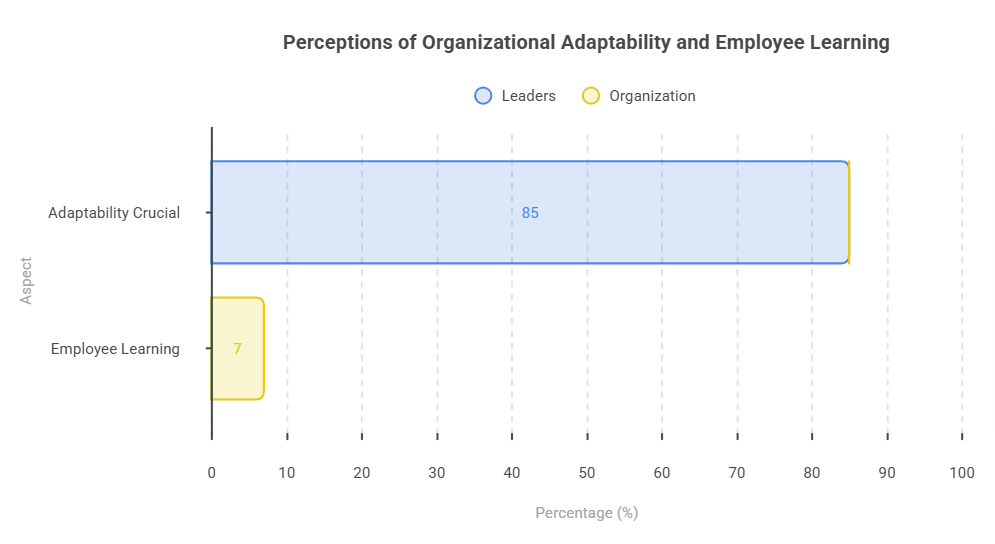
Deloitte’s 2026 Global Human Capital Trends report noted that about 85% of leaders think organizational adaptability is crucial for success, but only 7% say their organization really help employees keep learning and adapting continuously.
How Ready Is Your Organization for Transformation, Really?
Take our free 4-minute assessment and get a personalized report on your leadership fluency, governance, and workforce readiness.
Take the Free AI Readiness Assessment →What Does a Digital Transformation Consulting Engagement Include?
An in-depth transformation consulting engagement typically involves: digital maturity assessment, business analysis, adption of new technology, implementation planning, workforce transformation, governance frameworks, and performance management systems.
A successful transformation journey follows several phases, which are:
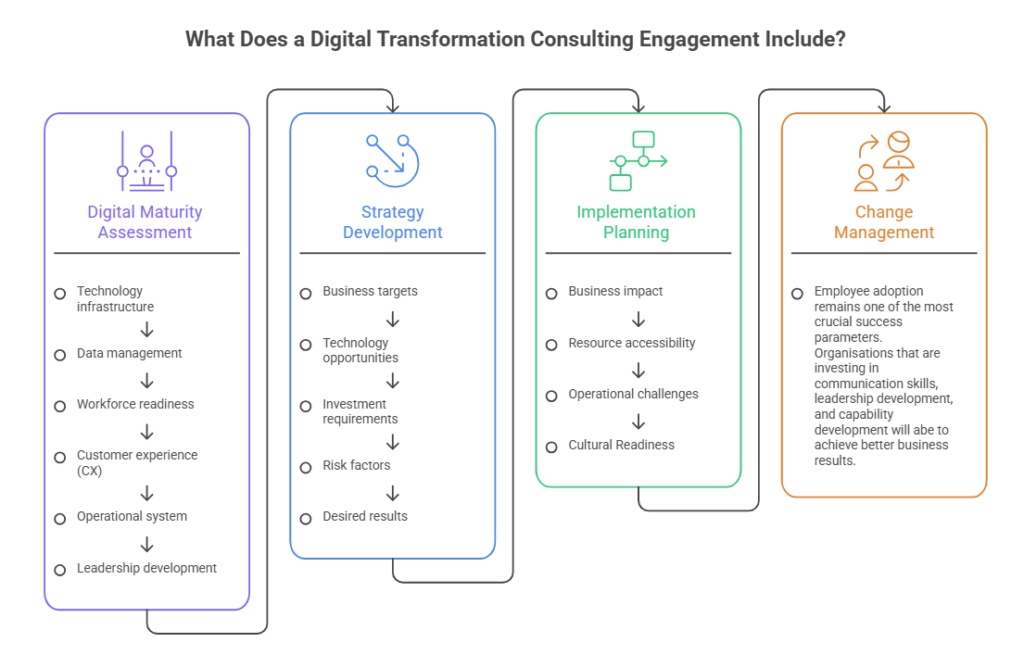
1. Digital Maturity Assessment
Organisations need to evaluate their current capabilities across:
- Technology infrastructure
- Data management
- Workforce readiness
- Customer experience (CX)
- Operational system
- Leadership development
This assessment initiates the actual baseline for transformation planning.
2. Strategy Development
Consultants identify:
- Business targets
- Technology opportunities
- Investment requirements
- Risk factors
- Desired results
The objectives are created for a roadmap that enables business growth rather than technology adoption for its own benefit.
3. Implementation Planning
Transformation initiatives are more valued based on:
- Business impact
- Resource accessibility
- Operational challenges
- Cultural Readiness
This phase helps in reducing implementation risks.
4. Change Management
Employee adoption remains one of the most crucial success parameters. Organisations that are investing in communication skills, leadership development, and capability development will abe to achieve better business results.
How Does Digital Transformation Improve Enterprise Performance?
Digital transformation consulting helps in improving enterprise performance by streamlining operations, quick decision-making, lowering costs, boosting customer engagement, and allows faster responses to market changes.
The impact can be witnessed across multiple business functions such as:
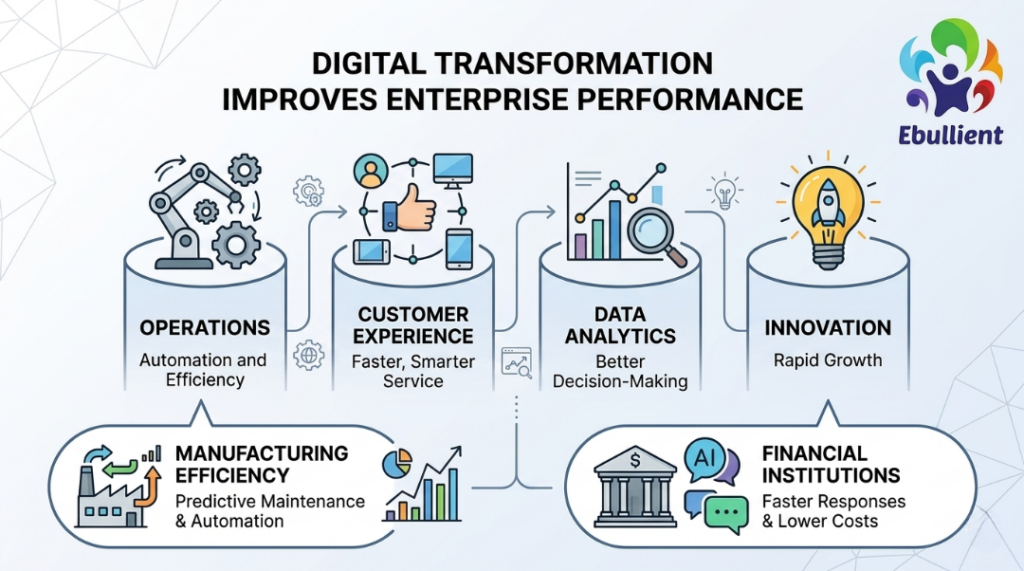
Operations
Automation reduces repetitive manual task, thus allowing employees to focus on higher-priority work.
Customer Experience
Digital platforms offer personalized and smoother customer interactions across multiple channels.
Data Analytics
Organisations that are gaining real-time visibility into performance metrics are equipped with faster and more accurate decisions.
Innovation
Modern technology ecosystems allow rapid experimentation, product development, and market responsiveness.
Consider a manufacturing company that is facing challenges with production inefficiencies. By using process automation together with predictive analytics, the organisation can cut down on downtime, improve the overall quality of output, and ensure inventory management works smoothly.
Similarly in, financial institutions that deploy AI-based customer service platforms often manage to enhance the response times while also lowering support costs.
The Growing Role of Emerging Technologies in Enterprise Transformation
The latest emerging trends in information technology which are transforming how enterprises will operate, compete, and innovate. Technologies such as artificial intelligence (AI), cloud platforms, advanced analytics, cybersecurity, and intelligent automation are becoming crucial and are responsible for transformation strategies.
Key technologies driving transformation include:
| Technology | Enterprise Application |
| Artificial Intelligence | Predictive analytics, automation, customer insights |
| Cloud Computing | Scalability, flexibility, cost optimization |
| Robotic Process Automation | Process efficiency and productivity |
| Advanced Analytics | Data-driven decision-making |
| Internet of Things | Real-time monitoring and operational visibility |
| Cybersecurity Platforms | Risk management and compliance |
Organisations that are integrating these technologies will be successful in building stronger business resilience and innovation capabilities.
The most successful transformation programs integrate technology implementation along with workforce capability development, which ensures that employees can leverage new systems effectively.
What Are the Top Digital Transformation Consulting Trends 2026?
The leading digital transformation consulting trends in 2026 mostly center on AI integration, human-centered transformation, sustainability-driven innovation, cybersecurity resilience, and enterprise-wide digital capability development.
These few trends are also redefining the consulting priorities are:
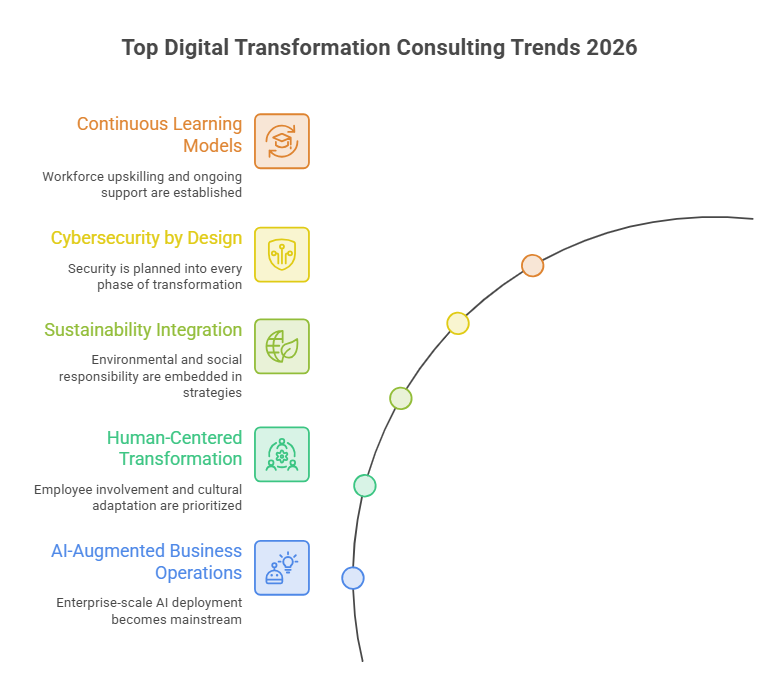
AI–Augmented Business Operations
Organisations are moving beyond experimentation, toward enterprise-scale AI deployment.
Human-Centered Transformation
Companies are realizing that real transformation needs employee involvement, leadership readiness, and Cultural adaptation.
Sustainability Integration
Environmental and social responsibility goals are getting embedded into transformation strategies.
Cybersecurity by Design
Security is being planned into every phase of digital transformation.
Continuous Learning Models
Organisations that are investing a lot in workforce upskilling , are also setting up continuous support so the team can adapt as technology evolves.
All of these shifts are reshaping digital transformation consulting for enterprises in India and globally.
Source: Meltingspot
Did You Know?
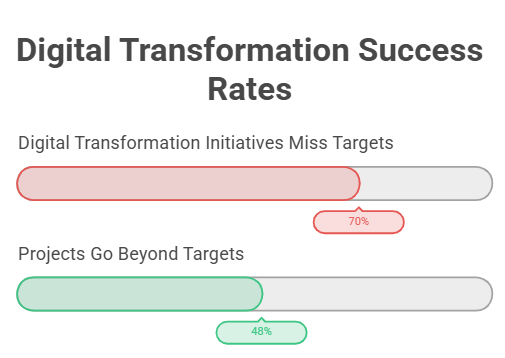
In 2026, around 70% of digital transformation initiatives still miss what they were aiming for, even after years of effort , and trillions of dollars put into it. A Gartner survey suggests that only roughly 48% of projects actually go beyond their targets. And on a global scale those setbacks are said to burn through about $2.3 trillion every year.
Why Does Leadership Reforging Matter More Than Digital Adoption?
Future readiness depends less on the technology execution part and more on leadership transformation. Organisations require leaders who are capable of making informed decisions in environments characterised by uncertainty, complexity, and rapid change.
Many organisations focus on training leaders in new tools.
Few help leaders develop new ways of thinking.
Leadership reforging involves:
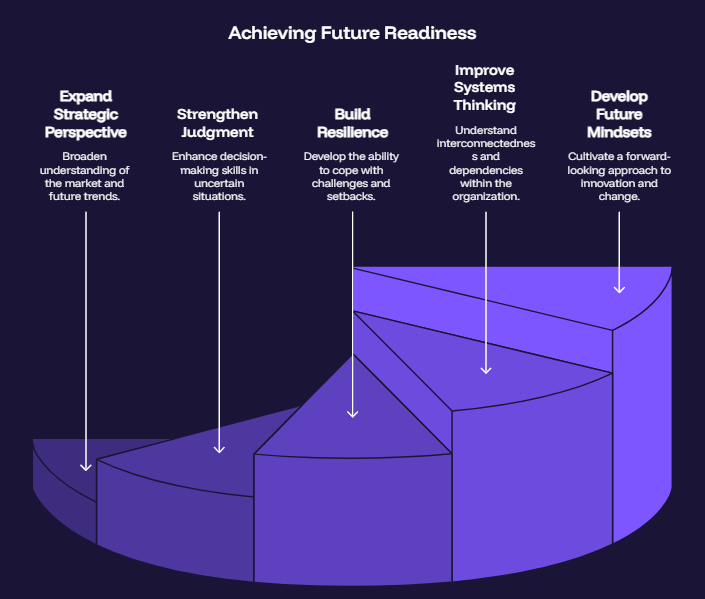
- Expanding strategic perspective
- Strengthening judgment under ambiguity
- Building emotional resilience
- Improving systems thinking
- Developing future-focused mindsets
This represents one of the fastest-growing areas of emphasis within the best digital transformation consulting training programs worldwide.
The Organizational Transformation Checklist Free guide, instant download.
Get the Guide →How Should Enterprises Select a Digital Transformation Consulting Partner?
Organisations needs to evaluate consulting partners based on industry expertise, execution planning & capability, change in management, Technological literacy, measuring results, and long-term support capabilities.
Decision-makers must be assess:
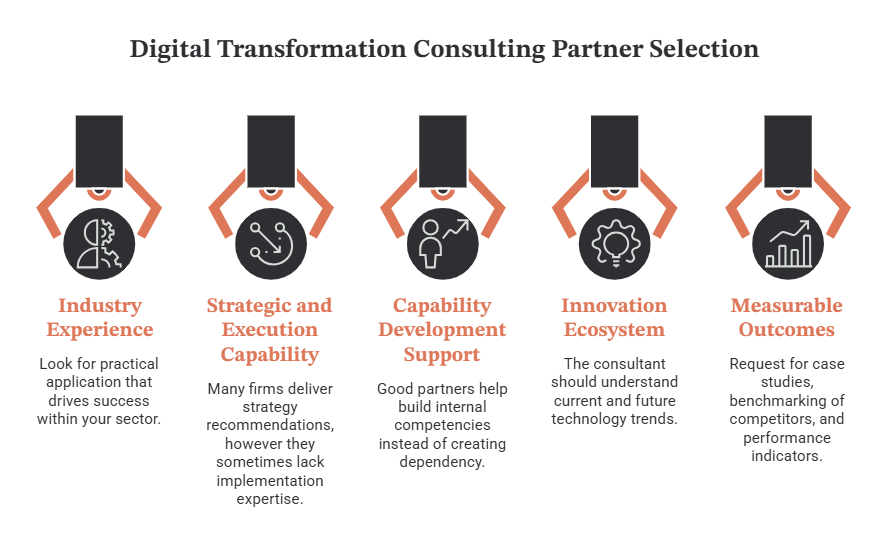
Industry Experience
Looks for practical application which drive success within your sector.
Strategic and Execution Capability
A lot of firms deliver strategy recommendations, however they sometimes lack implementation expertise.
Capability Development Support
Good partners help build internal competencies instead of creating dependency.
Innovation Ecosystem
The consultant should understand current and future technology trends.
Measurable Outcomes
Request for case studies, benchmarking of competitors, and performance indicators.
Many executives look at industry reports and also those consulting firm rankings, to compare service providers. However, rankings should complement—not replace—direct evaluation of expertise, cultural fit, and business alignment.
The best consulting relationships aim for business outcomes rather than technology deployment.
Source: Gartner
Did you know?
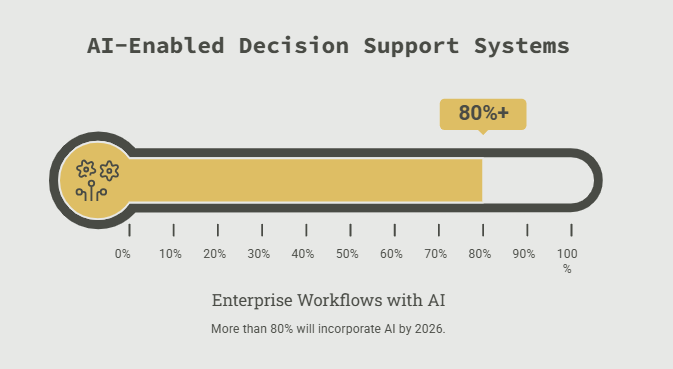
Industry analysts predict that by 2026 , more than 80% of enterprise workflows will incorporate AI-enabled decision support systems, so digital readiness becomes a strategic necessity instead of just a competitive advantage.
Curious About Other Areas of Your Organization?
Explore our other free assessments and get a fuller picture of where you stand.
View All AssessmentsHow Can Ebullient Consultancy Help Enterprises Accelerate Digital Transformation?
Ebullient Consultancy supports enterprises to navigate through complex transformation challenges by aligning strategic advisory services, leadership development, organisational capability building, and future-focused transformation frameworks.
Unlike traditional consulting firms which are mainly focuses on technology execution, Ebullient Consultancy focuses on human transformation alongside digital transformation.
Its approach is built around 4 core pillars:
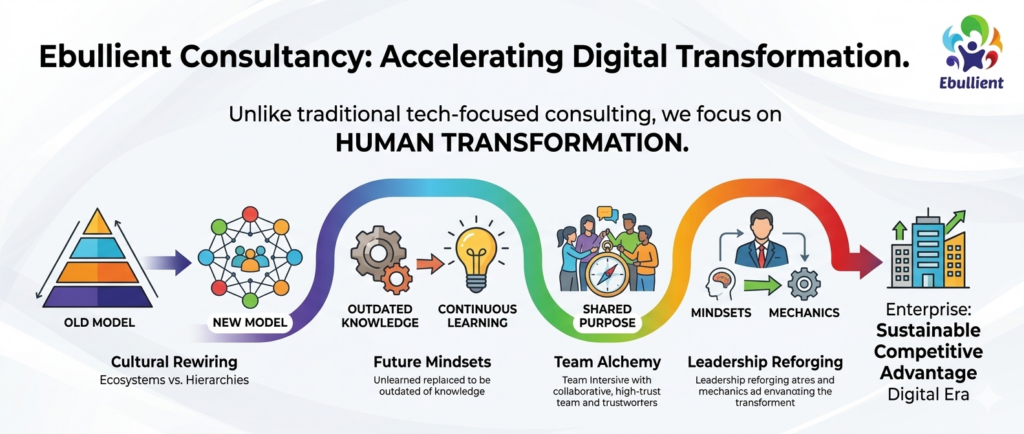
Leadership Reforging
Fostering mindsets before mechanics.
Cultural Rewiring
Creating ecosystems rather than hierarchies.
Team Alchemy
We are building trust, collaboration, and a shared purpose.
Future Mindsets
Helping leaders to unlearn the outdated knowledge and embrace continuous learning.
For organisations which are discovering digital transformation consulting for enterprises in India, Ebullient offers a practical, business-focused approach that blends technology investments with measurable organisational results.
As digital transformation consulting trends in 2026 keeps evolving, enterprises that embrace structured transformation frameworks , invest in building capability and continuous innovation will be best positioned to create a sustainable competitive advantage.
Want to meet the team?
Start with a 30-min conversation. No commitment needed.
Frequently Asked Questions
What is digital transformation consulting?
Digital transformation consulting helps organisations to modernize their business processes, adopting new technology, improve workforce capabilities, and operating models to drive measurable business improvements.
Why do enterprises need digital transformation consulting services?
Most organizations want to reduce those transformation risks, raise the chances that delivery will land on target, accelerate experimentation and innovation, and make sure technology aligns with business goals.
What industries benefit most from digital transformation consulting?
Across the industries, like in banking, manufacturing, healthcare, retail, logistics, education, telecommunications, and professional services, and have experience benefit significantly from those transformation initiatives.
How do digital transformation companies in India support enterprise growth?
Leading digital transformation companies in India help organizations, modernize the way they run things, elevate the customer experience, harden their resilience to disruption, and then keep building future-ready skills and capabilities
Why is leadership critical to transformation success?
Technology allows for the change, but leaders have to decide how well an organisation can adapt, learn, and create value from it during uncertainity.