The AI Skills Gap Isn't a Training Problem — It's a Leadership Problem
Corporate AI training budgets are rising fast: most L&D leaders expect to spend more on AI-related training this year than last, and organizations are rolling out new tools faster than most teams can absorb them. And yet the skills gap most companies report isn’t closing. It’s widening.
The reason isn’t a shortage of courses. It’s that most AI talent development strategies are still built on an assumption that no longer holds: that the current wave of disruption is temporary, and that a training plan just needs to bridge the gap until things stabilize. As one senior leader put it while reflecting on the last two years of her organization’s history, “Every framework we used to plan with assumed the ground would eventually stop moving. It hasn’t stopped moving. I don’t think it’s going to.”
That’s the real starting point for AI talent development done well: not a better course catalogue, but a leadership capacity to build capability inside conditions that are not going to resolve into something calmer on a predictable timeline.
KEY TAKEAWAYS AT A GLANCE
- AI skill gaps aren’t closing because most AI talent development strategies are built for a temporary disruption, not a permanent operating condition.
- VUCA, BANI, and RUPT are three lenses on one reality — and each explains a different way AI-era training plans break down.
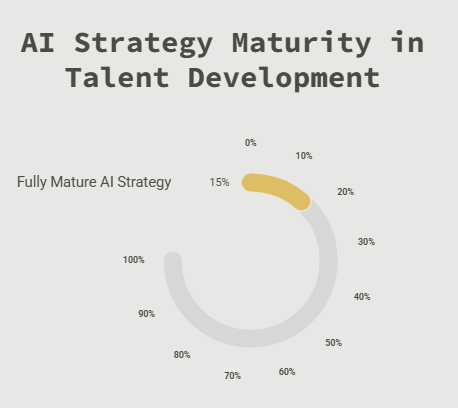
- Only 15% of organizations report a fully mature AI strategy for talent development — most are still improvising.
- Five specific leadership capacities separate organizations building durable AI talent pipelines from those stuck in reactive retraining cycles.
- Ebullient’s Wisdom Gap Diagnostics assessment benchmarks exactly where your organization’s AI talent development readiness stands today.
Three Acronyms, One Reality: VUCA, BANI, and RUPT in the Age of AI
VUCA (volatile, uncertain, complex, ambiguous), BANI (brittle, anxious, nonlinear, incomprehensible), and RUPT (rapid, unpredictable, paradoxical, tangled) are often treated as competing frameworks. For AI talent development, they’re more useful read together — three lenses on the same underlying problem.
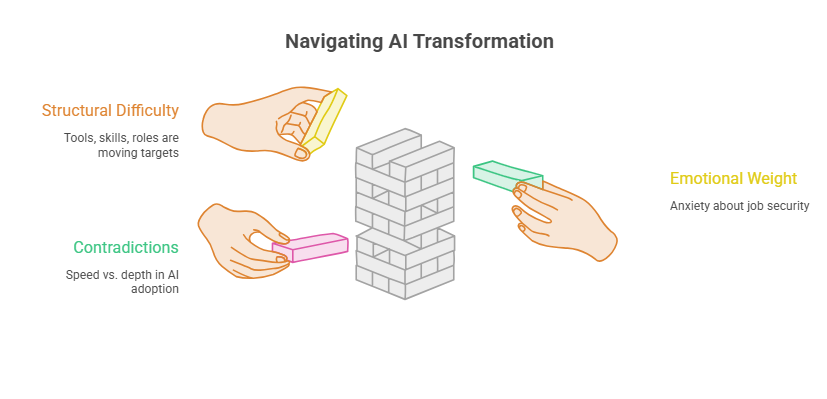
VUCA names the structural difficulty
The tools, the skills that matter, and the roles they reshape are all moving targets at once. A curriculum built around this quarter’s leading AI tool can be outdated before the cohort finishes it.
BANI names the emotional weight
Employees aren’t just being asked to learn new software — many are absorbing real anxiety about whether their role will exist in its current form. A training plan that ignores this psychological layer will underperform even with excellent content.
RUPT names the contradictions
Organizations need to move fast on AI adoption and build genuinely deep judgment at the same time. Speed and depth pull in different directions, and leaders who try to resolve that tension by picking one tend to under-invest in the other.
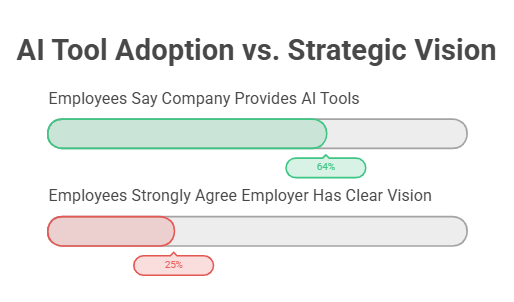
Source: Employee Training Statistics
Did You Know?
64% of employees say their company provides AI tools, but only 25% strongly agree their employer has a clear vision for how to use them — a near-textbook BANI gap between access and direction.
AI Tool Adoption vs. Strategic Vision
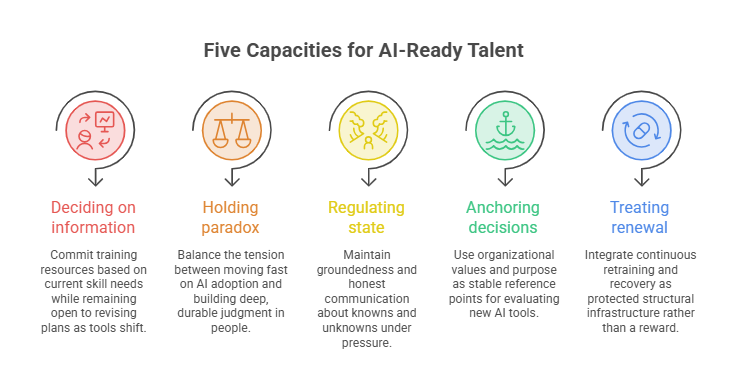
1. Deciding well on incomplete information
Waiting for a settled AI tool landscape before committing to a training investment is itself a decision — usually a costly one. The capacity that matters is committing training resources to the best available read of where skills will matter, while staying genuinely open to revising the plan as the tooling shifts.
2. Holding genuine paradox without forcing false resolution
Moving fast on AI adoption while building deep, durable judgment in your people aren’t puzzles with one correct answer. Leaders who resolve the tension by choosing speed alone produce shallow adopters; leaders who choose depth alone fall behind. Both have to be held as legitimate, simultaneously.
3. Regulating one’s own state under real pressure
Neither projecting false confidence about AI’s impact on jobs, nor visibly transmitting unfiltered anxiety, serves a team well. The more valuable capacity is genuine groundedness paired with honest, contained communication about what’s actually known and unknown.
4. Anchoring AI decisions to organizational values
When the pace of change makes it impossible to fully evaluate every new tool or model, stated values and purpose become one of the few stable reference points for deciding what to build in-house, what to buy, and what to leave alone.
5. Treating renewal as infrastructure, not a reward
Continuous retraining cycles without built-in recovery burn out exactly the people an organization is trying to develop. In a genuinely continuous disruption, renewal has to be structural — scheduled and protected — rather than something teams get to once the pace calms down.
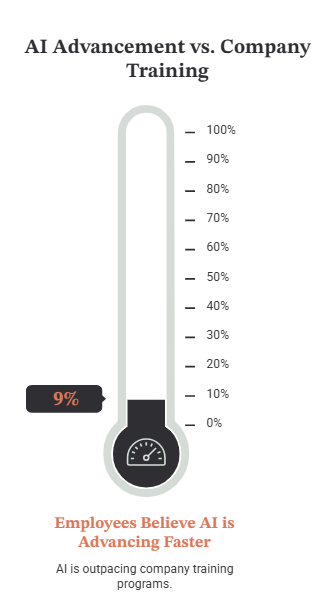
Source: TalentLMS
Did You Know?
49% of employees believe AI is advancing faster than their company’s training programs — meaning roughly half the workforce already senses the gap this article is describing.
Why the Standard AI Training Playbook Falls Short?
The standard fix borrows against a return to stability that increasingly doesn’t arrive on schedule. The next-practice version stops borrowing against it.
Old Playbook | Next Practice |
Treat AI upskilling as a one-time course rollout tied to a tool launch. | Build AI capability as continuous infrastructure — a standing practice, not a project. |
Centralize decisions about which AI tools and skills to invest in with IT or L&D alone. | Distribute AI tool evaluation and adoption to frontline teams, inside clear guardrails. |
Wait for AI to “settle down” before building a formal capability framework. | Accept that the tooling will keep shifting, and plan against several plausible futures at once. |
Measure success by course completion rates and hours logged. | Measure success by demonstrated proficiency and where skills actually show up in the work. |
What to Do About AI Talent Development This Quarter?
- Audit who actually holds decision rights over new AI tool adoption in your org, and deliberately distribute that authority further, with clear guardrails.
- Replace one-off AI training rollouts with a standing quarterly capability review, rather than treating upskilling as a single project with an end date.
- Build two or three plausible future scenarios — including one where your current AI tool set is largely obsolete in 12 months — into your L&D planning.
- Give managers a simple script for talking honestly about AI-driven uncertainty: clear about what’s genuinely unknown, concrete about what’s known and what happens next.
- Track demonstrated proficiency and applied use as your core AI training metric, not completion rates.
- Build renewal into the retraining cycle itself, rather than treating it as something teams earn once the pace of change slows down.
Source: Careertrainer
Did You Know?
Only 15% of organizations have a fully mature AI strategy for their talent development initiatives — the other 85% are building the plane while flying it.
How Ebullient Helps: Tailored Solutions for AI-Ready Leadership?
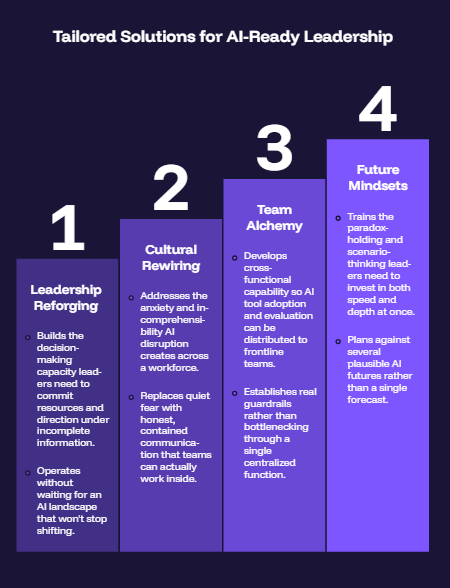
Closing the AI skills gap isn’t a curriculum problem — it’s a leadership capability problem. Ebullient works with organizations on the specific capacities this article describes, translated into practical, applied programs:
Leadership Reforging
Builds the decision-making capacity leaders need to commit resources and direction under incomplete information, without waiting for an AI landscape that won’t stop shifting.
Cultural Rewiring
Addresses the anxiety and incomprehensibility AI disruption creates across a workforce, replacing quiet fear with honest, contained communication that teams can actually work inside.
Team Alchemy
Develops cross-functional capability so AI tool adoption and evaluation can be distributed to frontline teams with real guardrails, rather than bottlenecked through a single centralized function.
Future Mindsets
Trains the paradox-holding and scenario-thinking leaders need to invest in both speed and depth at once, and to plan against several plausible AI futures rather than a single forecast.
WHERE DOES YOUR ORGANIZATION ACTUALLY STAND?
The Wisdom Gap Diagnostics assessment gives leaders an honest, evidence-based read on AI talent development readiness — with the reasoning behind every answer laid out alongside it. Not guesswork. A real benchmark.
Frequently Asked Questions
Get answers to commonly asked questions about Ebullient.
Is Your AI Reskilling Strategy Future-Ready?
What is AI talent development?
AI talent development is the ongoing practice of building an organization’s capability to use, evaluate, and adapt to AI tools and AI-shaped roles. Unlike a single training rollout, it treats skill-building as continuous infrastructure rather than a one-time project tied to a specific tool launch.
Why do most AI training programs fail to close the skills gap?
Most programs are built around the assumption that AI disruption is a temporary phase to train through. Because the tooling and required skills keep shifting, static curricula go stale quickly, and completion-based metrics reward finishing a course rather than building applied proficiency.
How is AI talent development different from traditional upskilling?
Traditional upskilling typically targets a known, relatively stable skill. AI talent development has to account for a moving target — tools, workflows, and role definitions that can change within a single training cycle — which is why it requires different planning and measurement approaches.
What leadership capacities matter most for AI-ready teams?
Five stand out: deciding well without full information, holding the paradox of speed and depth simultaneously, staying grounded under pressure, anchoring decisions to organizational values, and treating renewal as a built-in discipline rather than an afterthought.
How can organizations measure AI talent development readiness?
A useful readiness check looks at whether decision rights for AI tools are distributed, whether planning accounts for multiple future scenarios, and whether success is measured by proficiency and applied outcomes rather than training hours logged. A structured assessment can benchmark this more precisely than an internal gut check.