
Somewhere in most organizations sits a competency framework document, carefully designed several years ago, listing traits like “strategic thinking,” “collaboration,” and “results orientation.”
It’s referenced in the performance review template. Almost nobody outside HR can recall the last time it genuinely changed a hiring, promotion, or development decision.
This is not a rare failure. It’s closer to the default outcome, and it’s worth understanding exactly why before building or rebuilding one. This Competency Framework Blueprint lays out what actually separates a framework that shapes real decisions from one that just sits in a folder.
Key Takeaways at a Glance
- The gap between a competency framework and a competency system is simple: a framework exists; a system gets used.
- Seven design principles separate the two — built for the future, behaviorally specific, multi-source, performance-vs-potential, calibrated, regularly reviewed, and inclusive of exploration alongside execution.
- Design work is roughly a third of what makes a framework actually drive performance. The remaining two-thirds is the discipline of keeping it used, current, and consistently applied.
- Conflating current performance with future potential is one of the most common and costly errors in talent systems.
- A framework built entirely around disciplined execution quietly teaches an organization that leadership means mastering what already exists — not navigating toward what doesn’t yet.
A Framework Nobody Uses Is a Document, Not a System
The gap between a competency framework and a competency system is simple to state and easy to miss in practice: a framework exists; a system gets used. Most organizations have the former and believe they have the latter, because the document is well written, formally launched, and occasionally cited.
What determines whether it’s actually a system is whether it shapes real decisions — who gets hired, who gets promoted, what gets coached — when nobody is required to reference it.
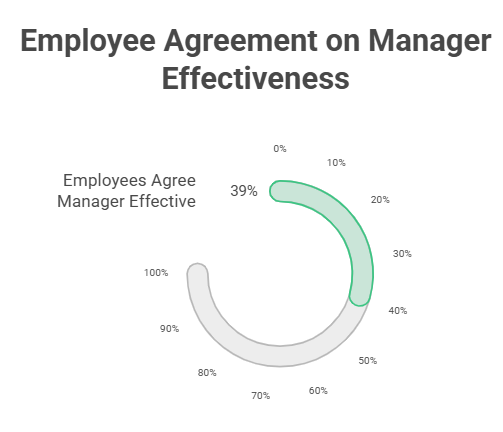
Source: Gartner
Did You Know?
A 2026 Gartner survey found only 39% of employees agree their manager is effective at providing clear developmental feedback. Relying on a single manager’s impression, principle 3’s warning, isn’t a theoretical risk — for most employees, that impression is already falling short on its own terms.
Seven Design Principles That Actually Drive Performance
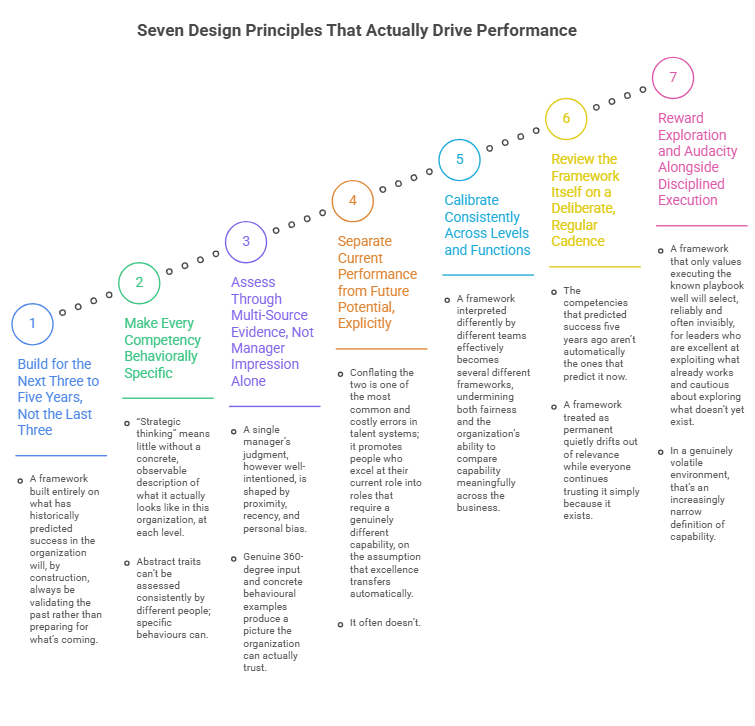
1. Build for the Next Three to Five Years, Not the Last Three
A framework built entirely on what has historically predicted success in the organization will, by construction, always be validating the past rather than preparing for what’s coming.
2. Make Every Competency Behaviorally Specific
“Strategic thinking” means little without a concrete, observable description of what it actually looks like in this organization, at each level. Abstract traits can’t be assessed consistently by different people; specific behaviours can.
3. Assess Through Multi-Source Evidence, Not Manager Impression Alone
A single manager’s judgment, however well-intentioned, is shaped by proximity, recency, and personal bias. Genuine 360-degree input and concrete behavioural examples produce a picture the organization can actually trust.
4. Separate Current Performance from Future Potential, Explicitly
Conflating the two is one of the most common and costly errors in talent systems; it promotes people who excel at their current role into roles that require a genuinely different capability, on the assumption that excellence transfers automatically. It often doesn’t.
5. Calibrate Consistently Across Levels and Functions
A framework interpreted differently by different teams effectively becomes several different frameworks, undermining both fairness and the organization’s ability to compare capability meaningfully across the business.
6. Review the Framework Itself on a Deliberate, Regular Cadence
The competencies that predicted success five years ago aren’t automatically the ones that predict it now. A framework treated as permanent quietly drifts out of relevance while everyone continues trusting it simply because it exists.
7. Reward Exploration and Audacity Alongside Disciplined Execution
A framework that only values executing the known playbook well will select, reliably and often invisibly, for leaders who are excellent at exploiting what already works and cautious about exploring what doesn’t yet exist. In a genuinely volatile environment, that’s an increasingly narrow definition of capability.
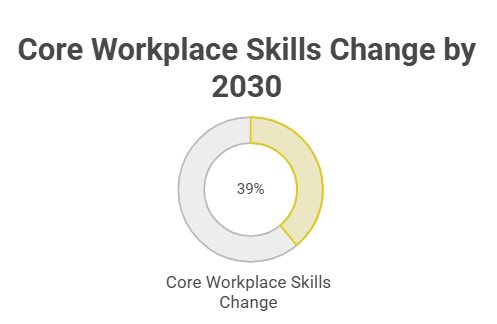
Source: WEF
Did You Know?
The World Economic Forum’s Future of Jobs Report projects that 39% of core workplace skills will change by 2030. A framework built on what worked for the last three years, principle 1’s warning, is being validated against a baseline that’s already a third of the way toward obsolete.
Core Workplace Skills Change by 2030
The standard fix commissions a well-designed competency framework, launches it formally with a briefing deck, embeds it in the performance review template, and treats the design work as complete. Design work is maybe a third of what makes a framework actually drive performance; the remaining two-thirds is the discipline of keeping it used, current, and consistently applied.
| Old Playbook | Next Practice |
Scope | Commission a well-designed framework document | Treat the framework as a living instrument requiring active ownership |
Launch | Formal briefing deck, embedded in the review template | Same launch, plus a senior owner who makes its use non-optional |
Completion | Design work marks the project as done | Design is roughly a third of the work; use and upkeep are the rest |
Review | Revisited rarely, if ever, once launched | A genuine, deliberate review cadence built in from the start |
Source: Forbes
Did You Know?
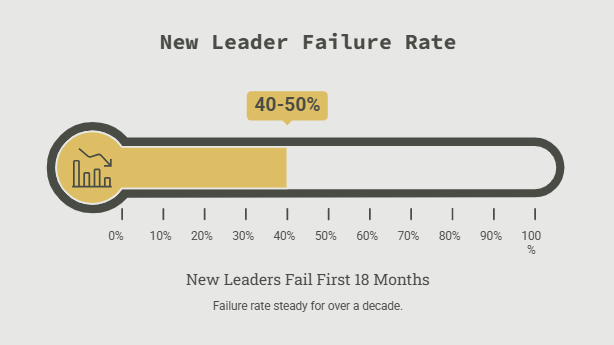
Between 40% and 50% of newly promoted leaders fail within their first 18 months — a figure that has held remarkably steady for over a decade across multiple studies. Principle 4’s warning about conflating performance with potential is very likely a meaningful part of why.
What to Do About It This Quarter?
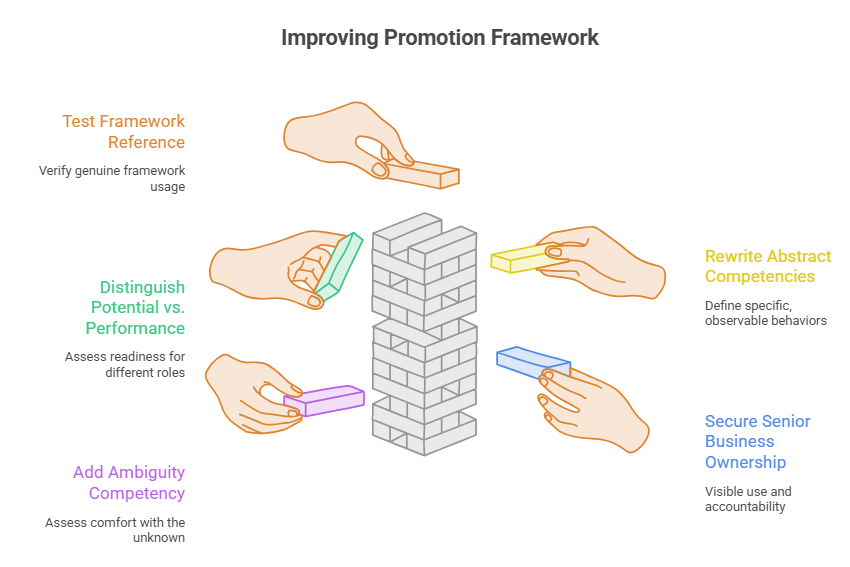
Test whether it’s a system or a document
Pick three recent promotion decisions and ask whether the framework was genuinely referenced in making them, with specific evidence against specific competencies, or whether it was cited afterward to justify a decision made on other grounds. The honest answer here is usually clarifying.
Rewrite your most abstract competencies
Take your three most abstract competencies, the ones that sound good in a values deck but would be hard for two different people to assess consistently, and rewrite them as specific, observable behaviors at each level. This single exercise often reveals how much of the current framework is aspiration dressed as assessment criteria.
Check how potential gets distinguished from performance
If strong current performers are consistently the ones identified as high potential, without a separate, explicit assessment of readiness for a genuinely different kind of role, that conflation is very likely already producing promotions that later disappoint.
Check who actually owns the framework
If ownership sits entirely with HR or L&D as a functional responsibility, find a senior business leader willing to visibly use it in their own talent decisions and hold others accountable to it. Ownership without visible senior use rarely survives contact with real organizational pressure.
Add a competency for ambiguity
Regardless of how complete your framework otherwise feels, add one explicit, assessed competency around comfort with ambiguity, willingness to explore the unknown, and well-reasoned risk-taking, sitting alongside your existing execution-oriented competencies. Most frameworks currently have no place for this at all.
The Deeper Pattern
Every competency framework is, underneath its language of skills and behaviours, a statement about what an organization believes leadership actually is.
A framework built entirely around disciplined execution of the known quietly teaches an organization that leadership means mastering what already exists. A framework that also values exploration, ambiguity, and audacity teaches something different: that leadership means being genuinely capable of navigating toward what doesn’t yet exist.
Most organizations don’t choose this distinction deliberately; it emerges by default from whichever competencies happened to get written down first, often years ago, under very different conditions. Building the framework well, and revisiting it honestly, is one of the few genuinely structural ways an organization can decide, on purpose, what kind of leadership it actually wants to produce.
How Ebullient Helps Build a Framework That Gets Used?
Most competency framework projects end at the launch deck. Ebullient works with organizations through the two-thirds that actually determines whether a framework becomes a system: ownership, calibration, and a genuine review cadence.
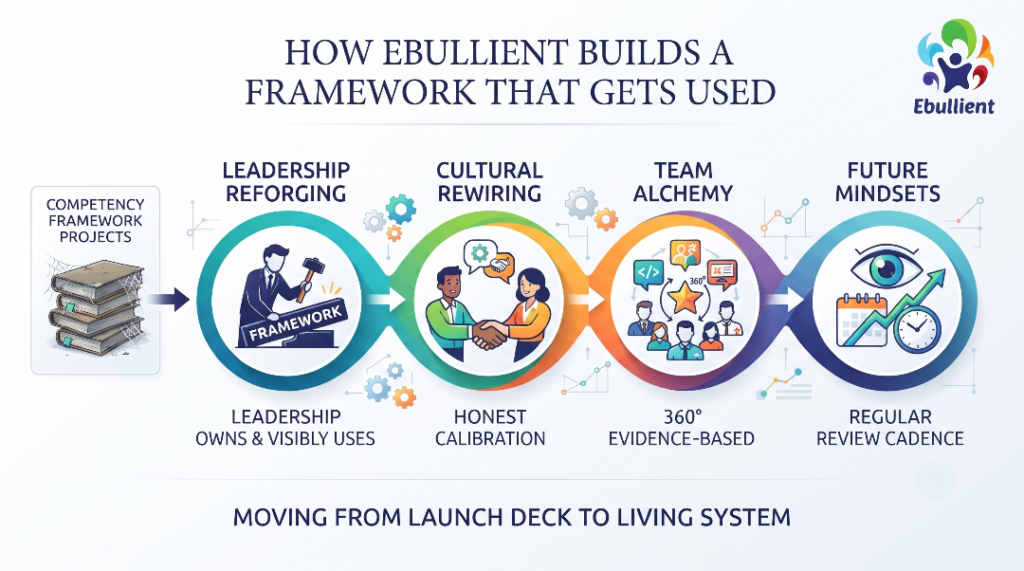
Leadership reforging
Senior leaders build the habit of visibly using the framework in their own hiring and promotion decisions, so ownership stops sitting entirely with HR.
Cultural rewiring
We help build the norms that let uncomfortable calibration conversations happen honestly, rather than letting different teams quietly interpret the same competencies differently.
Team alchemy
Multi-source, 360-degree assessment gets built with the cross-functional teams who’ll actually use it, replacing single-manager impression withevidence the organization can trust.
Future mindsets
A deliberate review cadence is built in from day one, so the framework keeps pace with what’s actually predicting success, not just what predicted it five years ago.
How Mature Is Your Framework, Really?
To see how mature your own organization’s competency framework is across these dimensions and more, the Competency Framework Maturity Assessment, part of Ebullient’s Wisdom Gap Diagnostics series, offers a direct, ten-question read, with the reasoning behind every answer laid out alongside it.
What Makes a Competency Framework Effective?
Frequently Asked Questions
Get answers to commonly asked questions about Ebullient.
What’s the difference between a competency framework and a competency system?
A framework exists as a document; a system gets used. What determines the difference is whether it shapes real hiring, promotion, and coaching decisions when nobody is required to reference it.
Why do competency frameworks stop being used after launch?
Most frameworks are treated as complete once designed and formally launched, without the ongoing ownership, review cadence, and senior-level use that keep them relevant — design is roughly a third of the work; the rest is upkeep.
Why is separating performance from potential so important?
Conflating the two promotes people who excel in their current role into roles requiring genuinely different capabilities, on the assumption excellence transfers automatically — it often doesn’t, and this conflation is linked to high rates of new-leader failure.
How often should a competency framework be reviewed?
On a deliberate, regular cadence — the competencies that predicted success five years ago aren’t automatically the ones that predict it now, and a framework treated as permanent quietly drifts out of relevance.
Who should own a competency framework?
Ideally a senior business leader who visibly uses it in their own talent decisions, not HR or L&D alone as a functional responsibility — ownership without visible senior use rarely survives real organizational pressure.