
An organization proud of its diversity numbers ran a simple exercise: plot representation of women at every level, from entry to the executive committee, on a single chart.
The line at entry level looked healthy. By the time it reached senior leadership, it had thinned to almost nothing. Nobody in the room had seen that shape before, because nobody had ever asked the data to be presented that way.
The organization wasn’t short on talented women. It had a pipeline that leaked, quietly and consistently, at a specific point nobody had been measuring — which is exactly the problem Building Women Leadership Pipelines has to solve: not attracting more women in, but fixing the specific transitions where they stop advancing.
Key Takeaways at a Glance
- The gap rarely opens at hiring. It opens progressively, at identifiable transitions — first-line management, director-level P&L roles, and the return from a career break.
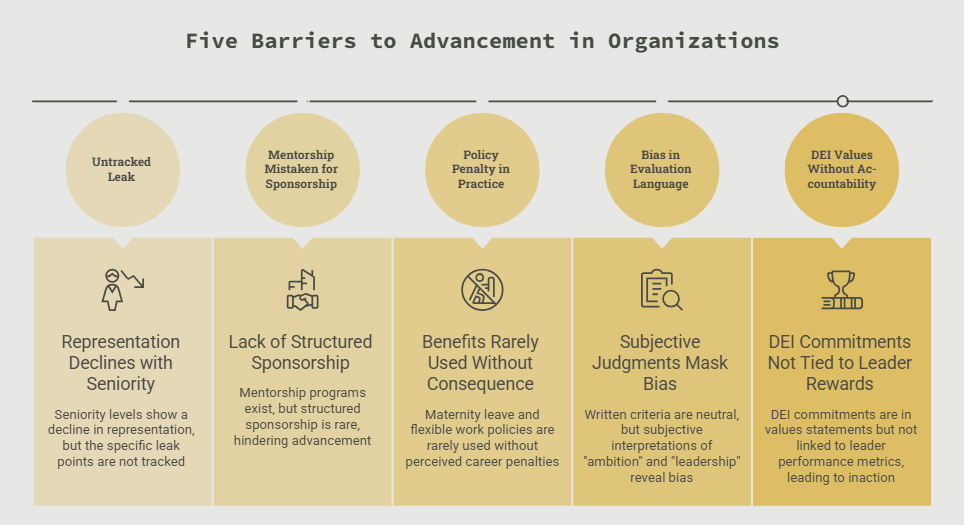
- Five barriers explain most of the leak: untracked representation data, mentorship mistaken for sponsorship, policy that carries a quiet penalty, bias hidden in evaluation language, and DEI commitments disconnected from leader accountability.
- Fixing recruitment without fixing these transition points changes the shape of the entry line and leaves the leak exactly where it was.
- The single highest-leverage first step is plotting representation explicitly by level, not as one aggregate company-wide number.
- Structure beats good intentions — sponsorship, transparent evaluation, and tracked accountability don’t rely on individual goodwill to produce a fair outcome.
The Problem Usually Isn’t at the Entry Point
Most organizations that struggle with women’s leadership representation are not struggling to hire or attract women into the workforce. The gap opens progressively, at specific, identifiable transitions: the move into first-line management, the move into a director-level role with P&L accountability, the return from a career break into a trajectory that hasn’t quietly been reset. Fixing recruitment without fixing these transition points changes the shape of the entry line and leaves the leak exactly where it was.
Source: McKinsey
Did You Know?
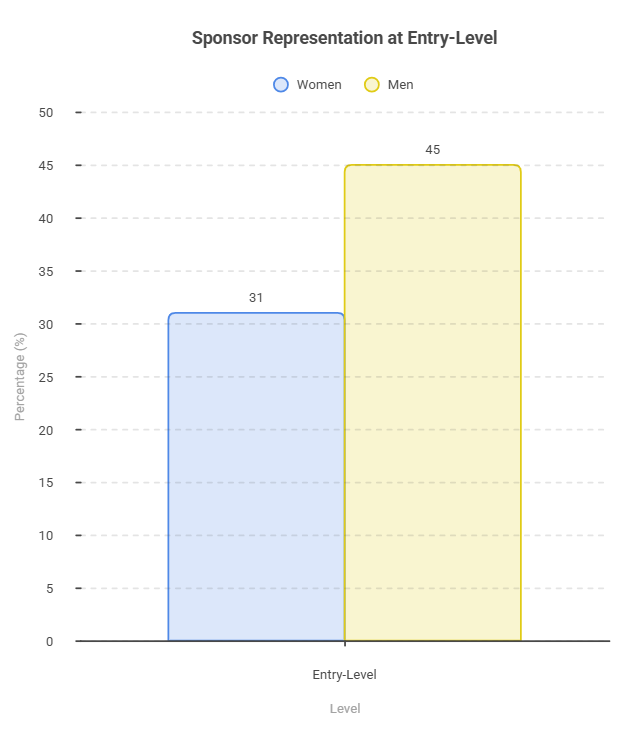
McKinsey and LeanIn’s Women in the Workplace report found only 31% of entry-level women have a sponsor, compared to 45% of men — and employees with a sponsor are nearly twice as likely to be promoted. The gap this barrier describes isn’t a perception problem; it’s measurable and it starts on day one.
Five Barriers Worth Naming Directly
1. The Untracked Leak
Representation narrows with seniority, and almost nobody has plotted it explicitly by level. Without that specific view, the organization can genuinely believe it’s doing well based on aggregate numbers that hide exactly where the problem sits.
2. Mentorship Mistaken for Sponsorship
Mentorship helps someone grow. Sponsorship is a senior leader actively using their own influence to advocate for a specific person in rooms she isn’t in. Many organizations have real mentorship programs and almost no structured sponsorship, and then wonder why development isn’t converting into advancement.
3. Policy That Exists on Paper and Carries a Quiet Penalty in Practice
Maternity leave, flexible work, and career-break re-entry policies often meet or exceed compliance requirements, and are still rarely used without some cost to visibility or perceived ambition. A benefit nobody uses without consequence isn’t really a benefit.
4. Bias Hidden Inside Evaluation Language, Not Policy
Written criteria are usually neutral. How “ambition,” “readiness,” and “leadership presence” get read in practice, in the room, during calibration, is where bias most often actually lives, and it’s rarely visible without deliberately auditing patterns in how those judgments get made.
5. DEI Commitments That Live in Values Statements, Not in Leader Accountability
When advancing women’s leadership isn’t tied to how the leaders responsible for it are themselves measured and rewarded, the commitment tends to survive as language and quietly fail as practice.
Why the Standard Fix Falls Short
The standard fix launches a women’s leadership development program, tracks overall representation as a single company-wide number, and treats the initiative as complete once the program has run for a year. It tends to add a program on top of an unchanged system. The next-practice version changes what the system itself measures and rewards.
| Old Playbook | Next Practice |
Program | A women’s leadership development program, run once | Structured sponsorship, tracked as a distinct, ongoing practice |
Measurement | Overall representation as one company-wide number | Representation tracked explicitly by level and by transition point |
Policy | Assumed to work because it exists on paper | Audited for how it’s actually used, and by whom, without penalty |
Bias | Assumed absent because criteria are written as neutral | Evaluation language and calibration patterns directly audited |
Accountability | A separate initiative running alongside real accountability | An explicit, measured part of how senior leaders are evaluated |
Source: CNBC
Did You Know?
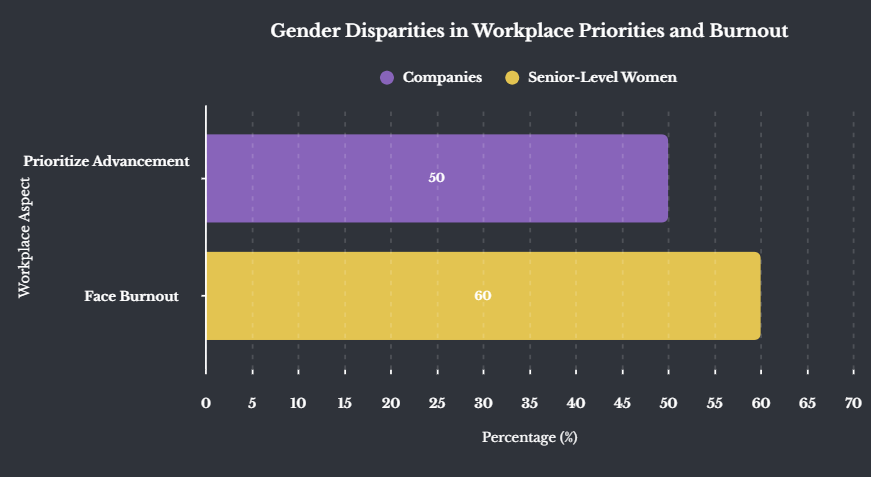
Only 50 percent of companies prioritize women’s career advancement as a stated commitment, reflecting a multi-year decline from the Women in the Workplace study. Meanwhile, 60 percent of senior-level women face frequent burnout, which is almost double the rate for men at that level.
What to Do About It This Quarter?
Plot representation by level
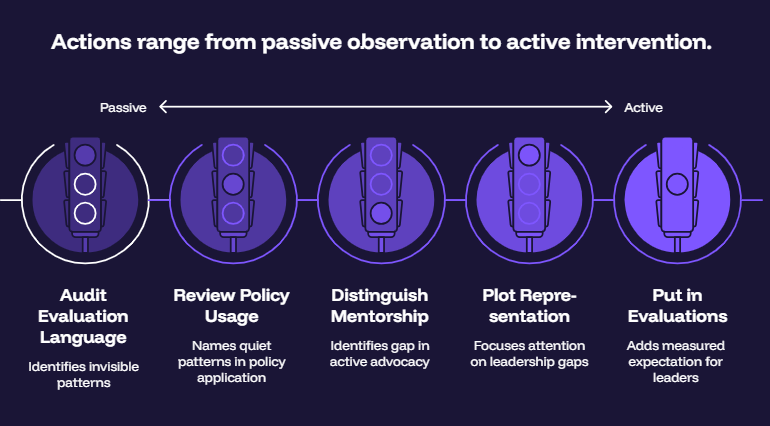
Don’t stop at “women in leadership” as a single number; break it down by every level between entry and executive committee, and identify exactly where the line thins most sharply. That single chart usually does more to focus an organization’s attention than months of general discussion.
Distinguish mentorship from sponsorship, explicitly
Ask five senior leaders a direct question: name a specific woman two levels below you whose advancement you are actively advocating for, by name, in rooms she isn’t in. If the honest answer is a long pause, that’s the gap, and it’s a more useful diagnostic than any survey.
Review how policies are actually used
Look specifically at what happens to visibility, project allocation, and promotion timing for people who use parental leave or flexible work, compared with those who don’t. If a quiet pattern exists, name it directly rather than assuming the policy itself has solved the problem.
Audit evaluation language directly
Pull recent performance review language for a sample of your leadership pipeline and look specifically at how ambition, confidence, and executive presence get described for men and women in comparable roles. Patterns here are often invisible until someone deliberately looks for them, and rarely survive that scrutiny unchanged.
Put it in leaders’ own evaluations
Add a specific, measured expectation around advancing women’s leadership to how your senior leaders themselves are evaluated, not as an HR-owned initiative running in parallel, but as a genuine part of their own performance conversation.
Source: WRTW
Did You Know?
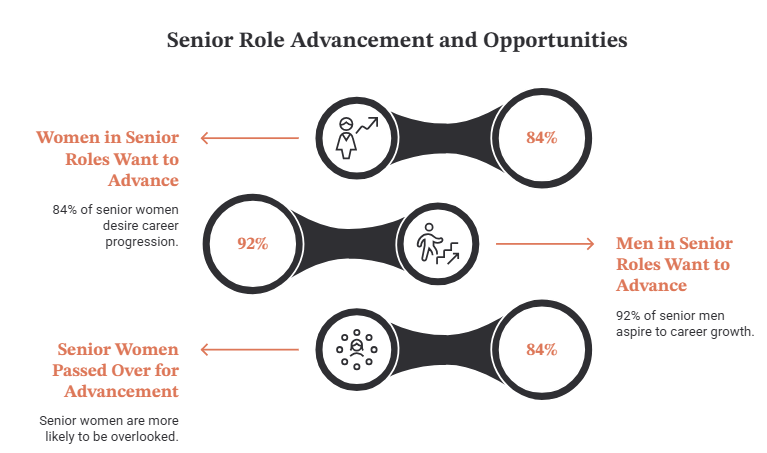
Up at the top of the pipeline the gap is just as stark—84% of women in senior roles want to advance, compared to 92% of senior men, and senior women are more likely than men to say they’ve been passed over. They also don’t see a clear path forward.
The Deeper Pattern?
Inclusion, examined closely, is really a question about where an organization chooses to place its trust, and trust is rarely distributed evenly by accident; it follows whatever pattern historically felt safest to whoever was doing the trusting. Breaking that pattern doesn’t happen through good intentions stated in a values document, because good intentions were very likely already present at every previous point the pattern held.
It happens through deliberately building new structures — sponsorship, transparent evaluation, tracked accountability — that don’t rely on individual goodwill to produce a fair outcome. An organization that leaves inclusion to individual discretion will keep reproducing whatever pattern discretion has always favoured. An organization willing to build structure around it gives itself a genuine chance at something different.
How Ebullient Helps Build the Pipeline?
A women’s leadership program layered on top of an unchanged system rarely survives past its first cohort. Ebullient works with organizations to change what the system itself measures and rewards, so advancement stops depending on which leaders happen to notice talent and starts depending on structure.
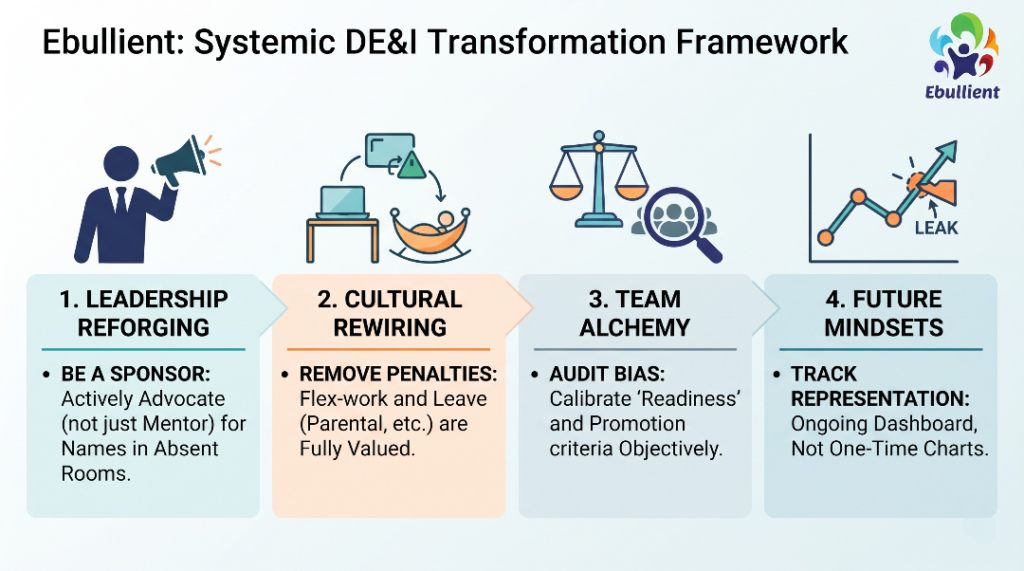
1. Leadership reforging
Senior leaders build the specific sponsorship habit — naming and advocating for individuals by name in rooms they aren’t in — rather than defaulting to mentorship and assuming it’s enough.
2. Cultural rewiring
We help surface where policy use quietly carries a visibility or ambition penalty, and rebuild the norms so using parental leave or flexible work stops being read as reduced commitment.
3. Team alchemy
Evaluation language and calibration patterns get audited with the leadership teams who run them, so bias in how ‘readiness’ gets discussed becomes visible and correctable at the source.
4. Future mindsets
Representation tracking by level and by transition point is built as an ongoing dashboard, not a one-time chart, so the leak stays visible long after the initial diagnostic.
Where Does Your Pipeline Actually Leak?
To see where your own organization stands across all ten dimensions of this, not just these five barriers, the Women Leadership Inclusion Index, part of Ebullient’s Wisdom Gap Diagnostics series, offers an honest, ten-question read, with the reasoning behind every answer laid out alongside it.
Why is a women leadership pipeline important for organisations?
Frequently Asked Questions
Get answers to commonly asked questions about Ebullient.
Why do women’s leadership pipelines leak even when hiring is diverse?
The gap rarely opens at entry. It opens progressively at specific transitions — the move into first-line management, the move into a P&L role, and the return from a career break — which recruitment fixes alone don’t touch.
What’s the difference between mentorship and sponsorship?
Mentorship helps someone grow through advice and guidance. Sponsorship is a senior leader actively using their own influence to advocate for a specific person, by name, in rooms she isn’t in — and it’s a far stronger predictor of advancement.
Why do maternity leave and flexible work policies fail to close the gap?
Because policies that exist on paper often carry a quiet cost in practice — reduced visibility, fewer stretch assignments, slower promotion timing — for the people who actually use them, even when the policy itself meets or exceeds compliance requirements.
Where does bias actually show up if written evaluation criteria are neutral?
In how criteria like ‘ambition,’ ‘readiness,’ and ‘leadership presence’ get read and discussed in the room during calibration — a pattern that’s rarely visible without deliberately auditing evaluation language.
What’s the single highest-leverage first step for building a women’s leadership pipeline?
Plotting representation explicitly by level, rather than as one aggregate company-wide number, so the organization can see exactly where the line thins most sharply.