

Retaining key talent during an acquisition means identifying the specific people whose departure would destroy deal value, and giving them a compelling, credible reason to stay before uncertainty pushes them toward the exit. It requires speed: the highest-value employees are also the most employable, and they start taking recruiter calls within days of the announcement, not months.
Key Takeaways at the Glance
- Retaining key talent during an acquisition is related to protection of specific critical individuals, not hitting a combing headcount retention percentage.
- Top performers often leave first, which is driven by optionality, identity loss, and sharper signal-reading — not being disengagement.
- Build a confidential flight-risk list along with using criticality, market demand, engagement history, and manager judgment, and refresh it monthly.
- Cash matters, but role clarity, career pathway, manager quality, and direct leadership access are equally powerful retention levers.
- Systematic retention packages in milestone tranches, and start the work during diligence — not after signing.
What Does Retaining Key Talent Actually Mean in an Acquisition?
Retaining key talent during an acquisition is not the same as reducing overall attrition. A deal can hit its headline retention number — say, 90% of headcount retained at 12 months — and still fail, because the 10% who left were the technical lead who understood the legacy codebase, the client-facing partner who controlled the relationship, or the plant manager who kept quality consistent.
Blanket retention bonuses spread across an entire acquired workforce protect the wrong people at the wrong cost. Effective retention work starts by naming individuals, not headcount percentages.
Source: Yomly
Did You Know?
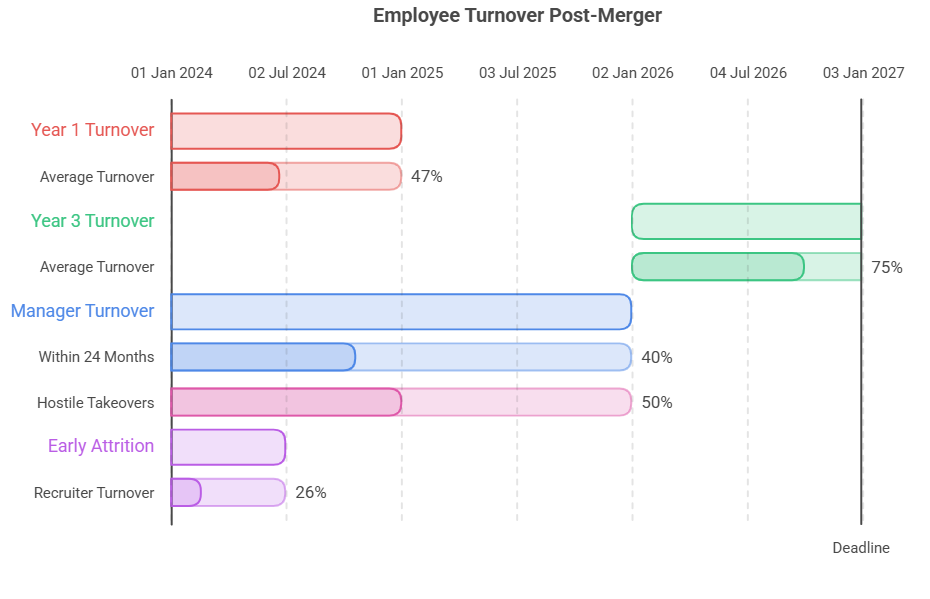
Average employee turnover after a merger runs 47% in Year 1 and 75% by Year 3, against a normal voluntary turnover baseline of roughly 13% (EY). Acquired firms lose 4 in 10 managers within 24 months — three times the rate of companies not going through a deal — and that figure jumps above 50% in hostile takeovers. Recruiters and marketing roles see the steepest early attrition, with recruiter turnover as high as 26% post-acquisition (Revelio Labs).
Is Your Organization Truly Ready for Leadership Development?
Take our free 4-minute assessment and get a personalized report on your leadership fluency, governance, and workforce readiness.
Take the Free Leadership Readiness Assessment →Why Do Top Performers Leave First After a Deal Closes?
Counterintuitively, it’s usually the strongest performers — not the weakest — who leave fastest after an acquisition. Three forces are at work:
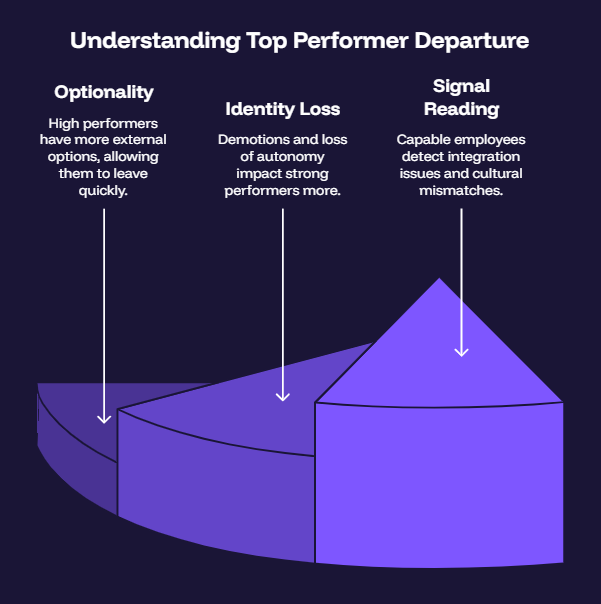
- Optionality: High performers have the most external options, so they can afford to leave the moment the situation feels uncertain, while lower performers may have fewer alternatives and simply wait it out.
- Identity loss: Acquisitions often mean a demotion in scope even without a title change — a country head becomes a regional report, a founder becomes an employee. Strong performers are more attached to autonomy and status, so this loss lands harder.
- Signal-reading: Capable employees are typically better at reading organizational signals, and they notice early when integration planning is thin, communication is vague, or the acquirer’s culture doesn’t match what was promised during diligence.
How Do You Identify Which Employees Are Flight Risks?
Retention planning has to start before signing, not after close — by the time an employee has one foot out the door, most retention levers lose their effect. A structured flight-risk map typically layers four inputs:
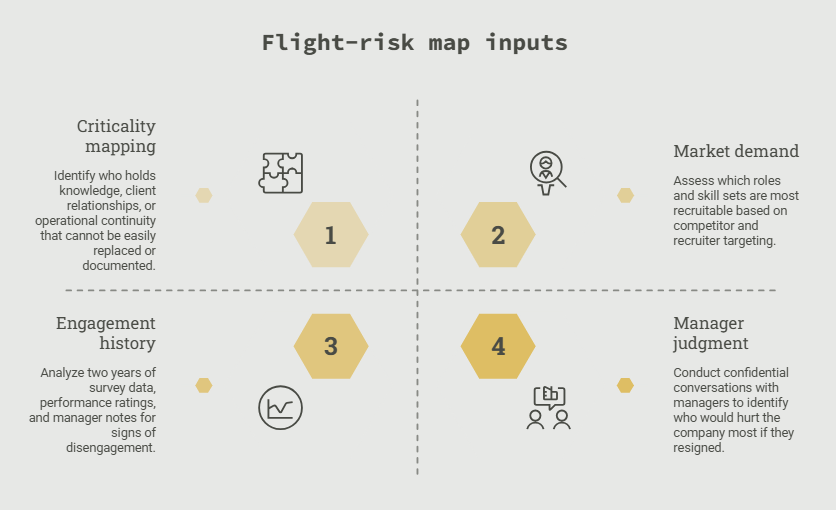
- Criticality mapping — who holds knowledge, client relationships, or operational continuity that cannot be easily replaced or documented in time?
- Market demand — which roles and skill sets are most recruitable right now, based on how actively competitors and recruiters are targeting that function?
- Engagement history — pull the last two years of engagement survey data, performance ratings, and manager 1:1 notes for early signs of disengagement that predate the deal.
- Manager judgment — a structured, confidential conversation with direct managers, asking specifically “who would hurt us most if they resigned tomorrow?” rather than “who is a strong performer?”
The output should be a short, confidential list — typically the top 3-8% of the combined workforce — reviewed and refreshed monthly through the integration period, not treated as a one-time exercise done during diligence.
Source: Taggd
Did You Know?
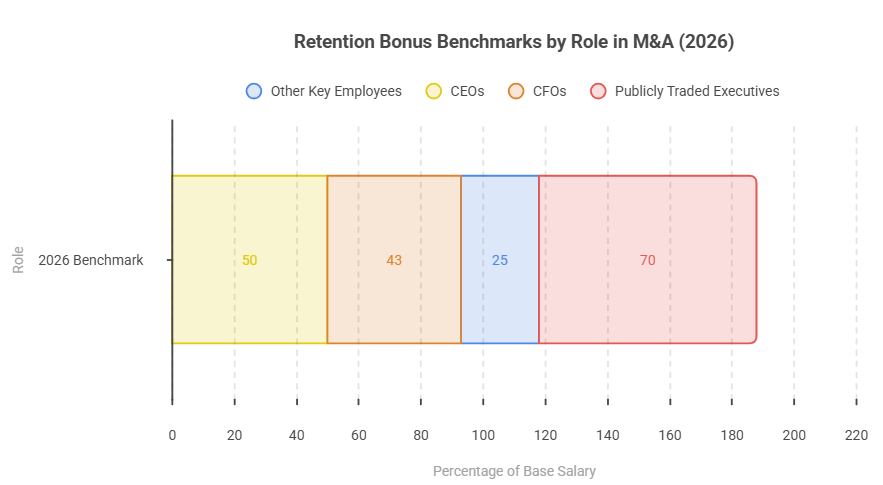
Nearly 60% of organizations now use retention bonuses during M&A, with 2026 benchmarks running from roughly 25% of base salary for other key employees up to 50% for CEOs and 43% for CFOs — and executive packages at publicly traded companies can reach 70-100% of base salary, typically paid in tranches over 6 to 36 months post-close.
What Retention Levers Actually Work — Beyond Money?
Cash retention bonuses matter, but money alone rarely holds a genuinely marketable employee who has decided the new organization isn’t for them. The levers that consistently move the needle alongside compensation are:
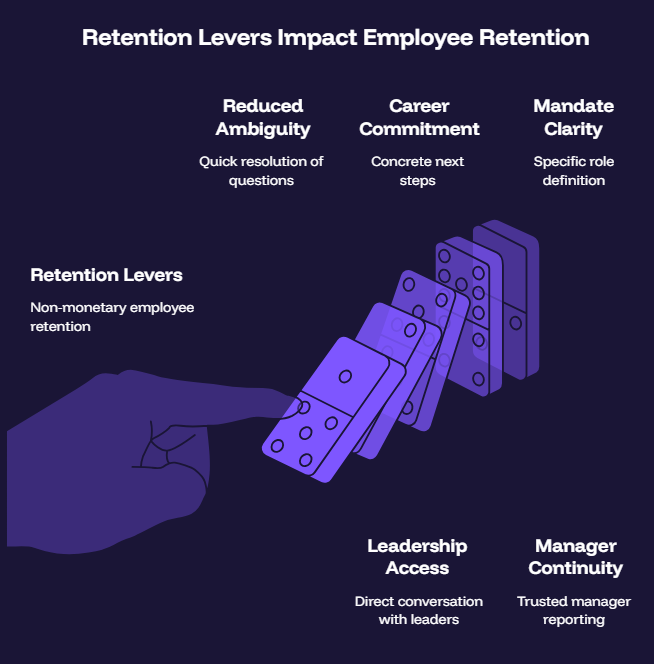
- A named, credible mandate. Tell the person specifically what their role looks like in the combined entity within the first two weeks, not “we’ll figure out org design later.”
- Direct access to deal leadership. A short, honest conversation with a senior integration leader — not a generic town hall — signals the person is genuinely on the retention list.
- Career pathway commitment. A concrete next step (promotion timeline, new scope, sponsored development) rather than a vague assurance that “opportunities will open up.”
- Manager continuity or manager quality. Where possible, keep flight-risk employees reporting to a manager they already trust; where that’s not possible, prioritize matching them with a strong manager over an available one.
- Reduced ambiguity, fast. Uncertainty about systems, reporting lines, titles, and benefits is corrosive on its own — resolving the practical questions quickly removes a reason to leave that has nothing to do with the deal’s merits.
Is Your Leadership Pipeline at Risk? Free guide, instant download.
Get the Guide →How Should Retention Bonuses and Packages Be Structured?
Structure | How It Works | Best For | Watch-Out |
Cash stay bonus | Lump sum at signing plus a second tranche at a milestone (e.g., 12 months) | Fast-moving deals where speed matters most | Loses power once the second tranche is banked |
Equity / vesting acceleration | New equity grant or acceleration of existing unvested equity | Senior leaders and technical talent wanted long term | Less effective if employees don’t trust the acquirer’s stock |
Retention + performance hybrid | Bonus tied partly to staying, partly to integration milestones | Roles central to synergy delivery | Requires clear, fair milestones set early |
Role and scope upgrade | Expanded mandate, new title, or leadership of a combined function | High performers motivated by growth | Must be genuine and resourced, not a title change only |
Deferred milestone bonus | Smaller amounts paid at 3, 6, 12, and 18 months | Mid-level critical talent, extended risk period | Long horizons feel less real vs. an immediate competing offer |
What Should Happen in the First 30/60/90 Days?
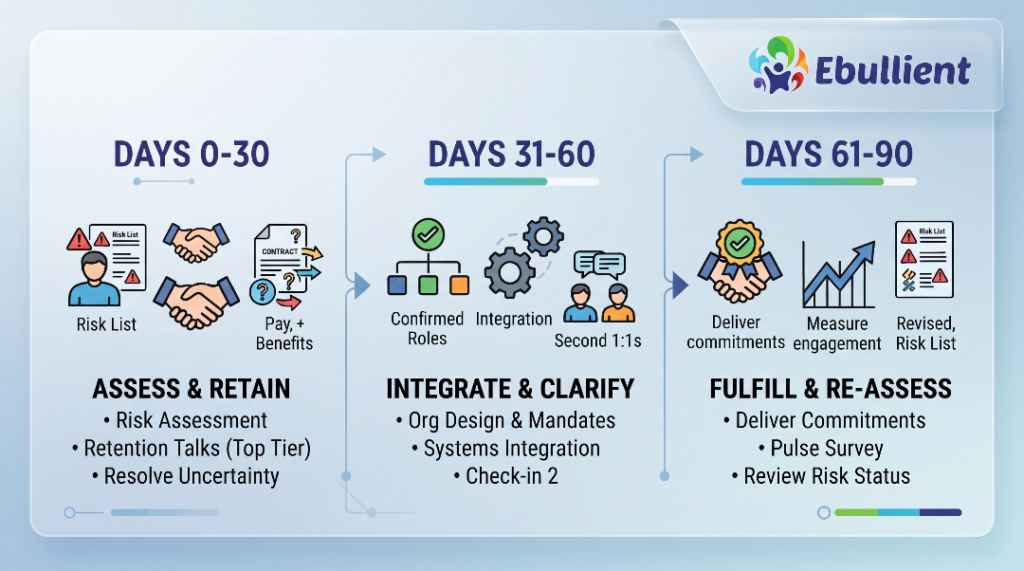
- Days 0-30: Finalize the flight-risk list, deliver personal retention conversations to the top tier before the broader announcement lands publicly, and resolve practical uncertainty (pay, benefits, reporting lines) as fast as legally possible.
- Days 31-60: Confirm new org design and role mandates for retained talent in writing, begin integration of systems and processes that affect daily work, and hold a second round of 1:1s to catch anyone whose risk level has changed.
- Days 61-90: Deliver on any commitments made in Days 0-30 (promotions, scope, first bonus tranche), measure engagement through a pulse survey, and re-run the flight-risk assessment — the list at Day 90 is rarely identical to the list at Day 0.
How Do You Retain Talent During a Hostile or Contested Deal?
Hostile or contested acquisitions compress the retention timeline sharply, since manager-level turnover in hostile deals runs above 50% — employees assume the worst by default and act on it faster. In these situations, retention work needs to start pre-signing wherever legally possible (through clean-team arrangements), lean more heavily on direct personal outreach than written communication, and be honest about what’s still unknown rather than over-promising to buy time — employees in contested deals are unusually alert to spin, and a broken early promise accelerates the exact departures the plan was meant to prevent.
How Do You Measure Whether Your Retention Strategy Is Working?
Track a small set of leading and lagging indicators through integration rather than waiting for the 12-month attrition number:
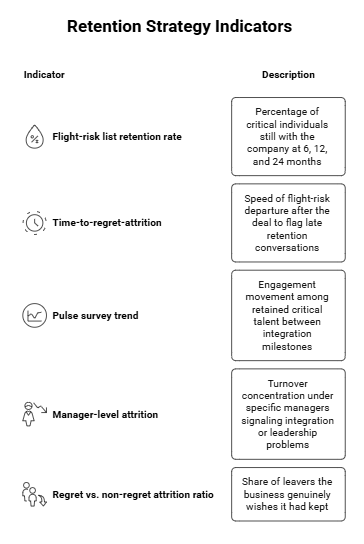
- Flight-risk list retention rate — of the named critical individuals, what percentage are still with the company at 6, 12, and 24 months (the metric that matters far more than blended headcount retention)?
- Time-to-regret-attrition — how quickly after the deal does a flight-risk departure happen, which flags whether retention conversations landed too late?
- Pulse survey trend — is engagement among retained critical talent moving up or down between integration milestones?
- Manager-level attrition — is turnover concentrated under specific managers, which often signals an integration or leadership problem rather than a market one?
- Regret vs. non-regret attrition ratio — of everyone who leaves, what share does the business genuinely wish it had kept?
Source: HBR
Did You Know?
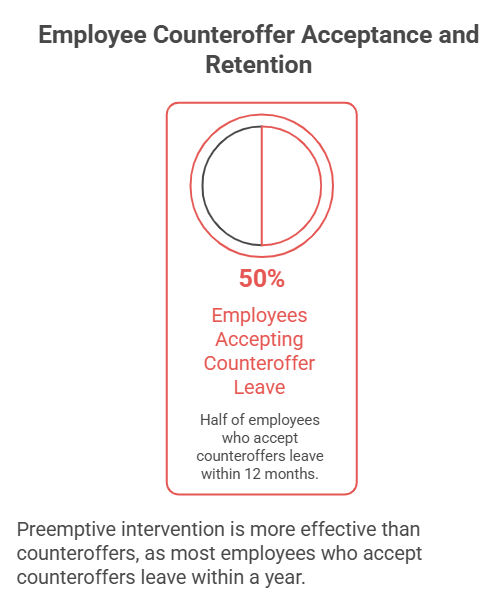
Researchers largely agree that preemptive intervention is sort of a better approach for handling employees’ wandering eyes than just waiting around for someone to get an offer, and then trying to swing in with a counteroffer. CEB’s data indicates that 50% of employees who accept a counteroffer end up leaving within 12 months
Curious About Other Areas of Your Organization?
Explore our other free assessments and get a fuller picture of where you stand.
View All AssessmentsHow Ebullient Tailors Retention Solutions to Every Deal ?
No two acquisitions carry the same retention risk, so Ebullient doesn’t run a single template across every engagement — the diagnostic and delivery model flexes to the deal itself:
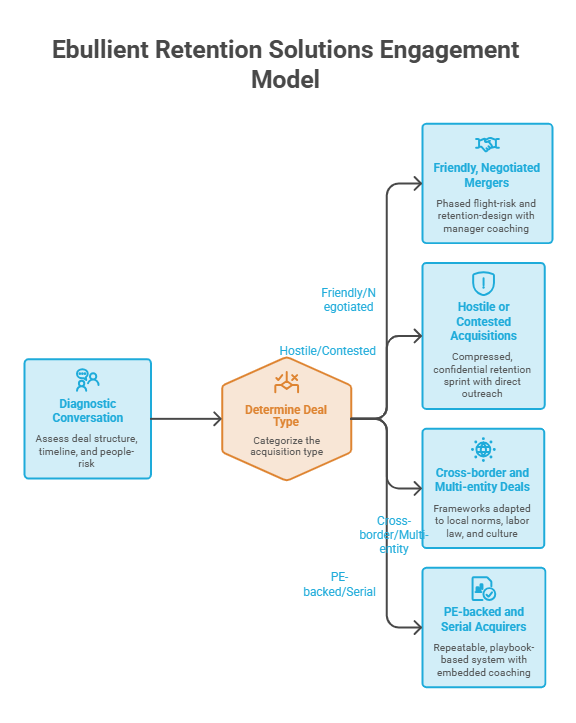
- Friendly, negotiated mergers: A phased flight-risk and retention-design engagement built into the existing integration timeline, with manager coaching rolled out alongside org design.
- Hostile or contested acquisitions: A compressed, confidential retention sprint — clean-team-compatible flight-risk mapping and direct leadership-outreach scripting delivered in days, not weeks, given how fast trust erodes in contested deals.
- Cross-border and multi-entity deals: Retention frameworks adapted to local compensation norms, labor law, and cultural expectations around job security, rather than a single global bonus structure applied uniformly.
- PE-backed and serial acquirers: A repeatable, playbook-based retention system built once and reused across a portfolio, with manager coaching embedded as a standing capability rather than rebuilt per deal.
Every engagement starts with a short diagnostic conversation to understand deal structure, timeline, and where the real people-risk sits — the recommendation that follows is built around that specific deal, not a generic retention checklist.
Want to meet the team?
Start with a 30-min conversation. No commitment needed.
Frequently Asked Questions
How long after an acquisition should retention bonuses last?
Most effective retention packages usually run about 12-24 months, and they are often set up in tranches, like at signing, 12 months, and again at 24 months instead of being one lump sum. That’s because if there is one early payout, the incentive just… goes, once it’s banked, and then people are less likely to stay around.
Should retention bonuses be offered to everyone or only critical talent?
Retention bonuses work best when targeted narrowly at the confidential flight-risk list — typically 3-8% of the combined workforce — rather than spread broadly, since blanket bonuses dilute the budget available for the people whose departure would actually hurt the deal.
What percentage of employees typically leave after an acquisition?
Research from EY puts average post-merger turnover at 47% within the first year and 75% within three years, well above the roughly 13% baseline voluntary turnover rate for companies not going through a deal.
Is money the most effective way to retain key talent after a deal?
No — compensation matters, but role clarity, a credible mandate, manager quality, and direct access to leadership consistently influence marketable employees as much as or more than cash alone, especially for senior and technical talent with strong external options.
When should retention planning start relative to deal close?
Retention planning should start during diligence, before the deal signs, since flight-risk identification and early personal outreach are most effective before uncertainty has had time to push critical employees toward outside offers.