

Mergers and acquisitions are won or lost on paper long before anyone notices the real risk: two groups of people who have never worked together suddenly have to. Financial due diligence gets months of attention. Cultural due diligence often gets a single slide. That imbalance is why so many well-structured deals underperform once integration begins.
What Is Culture Clash in a Merger, and Why Does It Happen?
Culture clash is the friction that occurs when two organizations with different norms, decision-making styles, and unwritten rules are forced into a single operating structure. It happens because culture is rarely written down, so neither company can fully diagnose the other’s until the merger is already underway.
Every organization develops its own implicit rulebook: how fast decisions get made, how directly people give feedback, how much hierarchy matters, and what “good work” actually looks like day to day. These norms form gradually and are rarely audited the way financial systems are. When two companies combine, employees on both sides discover — often in a tense meeting or a missed deadline — that their assumptions about “how things work” were never shared to begin with.
Source: Financier Worldwide
Did You Know?
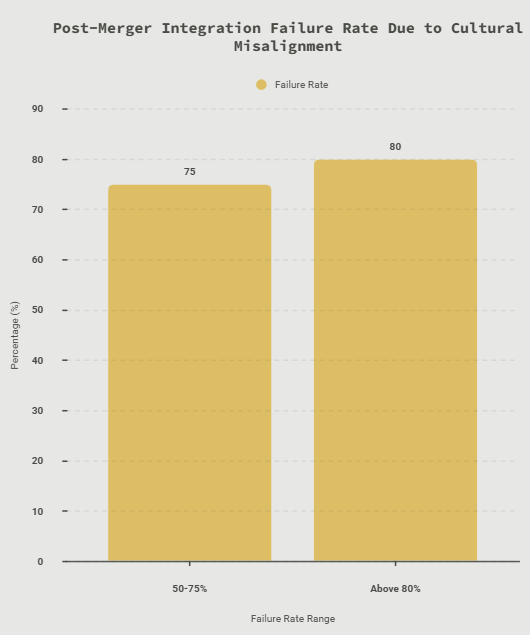
Studies on post-merger integration put the failure rate due to cultural misalignment anywhere between 50 and 75 percent, with some analyses placing it above 80 percent — making it one of the most consistently cited causes of M&A underperformance across three decades of research.
How Healthy Is Your Organizational Culture, Really?
Take our free 4-minute assessment and get a personalized report on your leadership fluency, governance, and workforce readiness.
Take the Free Organizational Culture Assessment →What Are the Warning Signs of Culture Clash?
The warning signs of culture clash typically surface within the first 90 days: rising voluntary departures starting to climb for the strong performers, then suddenly there’s decision paralysis as people kind of wait around for clarity on who actually holds authority . After that, informal “us vs them” talk starts creeping into the meetings and the internal messages.
Leaders often miss these signals because they look like ordinary integration friction rather than a structural problem. A single missed deadline is normal. A pattern of missed deadlines traced back to two teams operating on different approval chains is a culture signal. Watching for the pattern, not the incident, is what separates early intervention from a late-stage retention crisis.
Source: Sage journal
Did You Know?
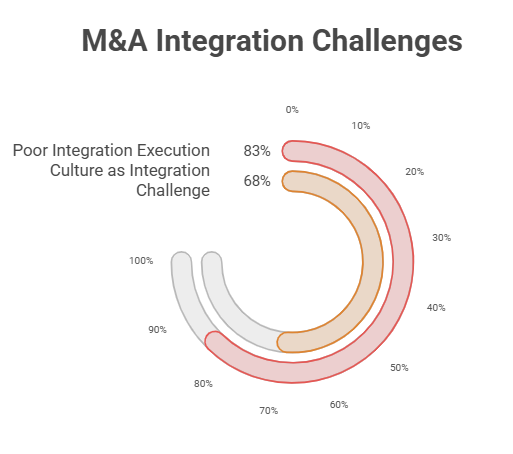
Industry surveys published in 2026 found that 83 percent of M&A practitioners point to poor integration execution — not deal selection or valuation — as the leading cause of failure, and 68 percent name culture specifically as their single biggest integration challenge.
The Organizational Transformation Checklist Free guide, instant download.
Get the Guide →
Warning Sign | What It Usually Means | Typical Root Cause |
Rising attrition among top performers | Talent doesn’t see a future in the combined culture | Unclear career paths or lost autonomy |
Decision paralysis | Nobody knows whose process now applies | Conflicting decision-rights and approval chains |
“Us vs. them” language | Identity threat, not just operational friction | No shared narrative for the combined entity |
Duplicate meetings for the same decision | Legacy governance structures still running in parallel | Integration plan addressed org charts, not workflows |
Silence in cross-team meetings | Psychological safety hasn’t transferred across the merger | Trust hasn’t been rebuilt between legacy groups |
How Do You Diagnose Cultural Differences Before They Become a Problem?
Diagnose cultural differences early before they escalate, really benefits from some structured cultural due diligence process, run in parallel with the financial one rather than after the deal closes. This typically combines leadership interviews, employee surveys, and observation of how each organization actually makes decisions.
Financial due diligence answers “what are we buying.” Cultural due diligence answers “who are we buying, and will they work with who we already have.” Skipping this step doesn’t eliminate the risk — it just delays discovery until integration is already underway and the cost of fixing misalignment is far higher.
A practical cultural due diligence process includes:
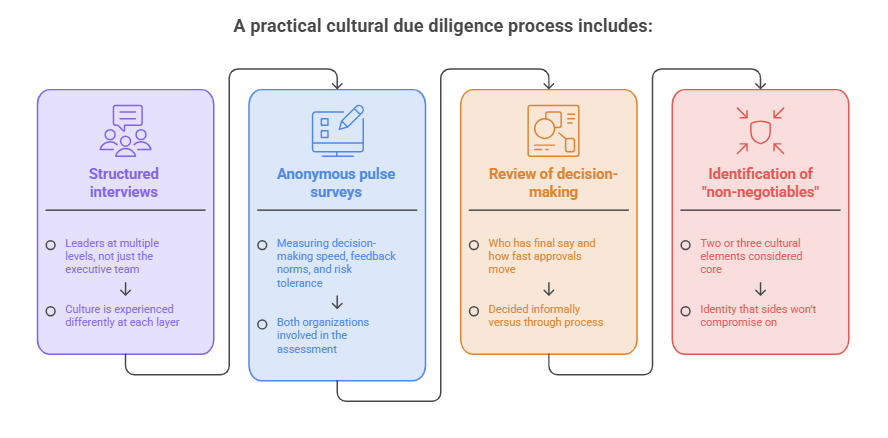
- Structured interviews with leaders at multiple levels, not just the executive team, since culture is experienced differently at each layer
- Anonymous pulse surveys measuring decision-making speed, feedback norms, and risk tolerance in both organizations
- A review of how each company actually makes decisions in practice — who has final say, how fast approvals move, and how much gets decided informally versus through process
- Identification of “non-negotiables”: the two or three cultural elements each side considers core to its identity and won’t compromise on
Should You Merge Cultures, Absorb One Into the Other, or Keep Them Separate?
There is no single correct integration model — the right approach depends on why the deal was done in the first place. A merger for talent and innovation usually calls for preserving the acquired culture, while a merger for cost synergy or market consolidation often requires faster standardization.
Getting this decision wrong is one of the most common integration mistakes. Leaders frequently default to “one culture, one company” because it feels tidier on an org chart, even when the deal’s actual value depended on keeping the acquired team’s distinct way of working intact.
Source: IMAA
Did You Know?
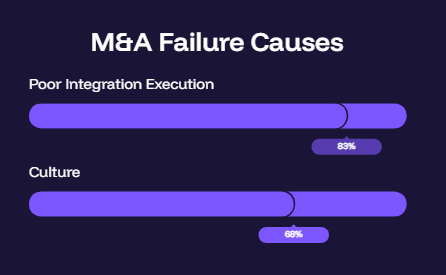
Industry surveys published in 2026 found that 83 percent of M&A practitioners point to poor integration execution — not deal selection or valuation — as the leading cause of failure, and 68 percent name culture specifically as their single biggest integration challenge.
Integration Model | Best Fit When | Key Risk |
Full merger (one culture) | Deal rationale is cost synergy, scale, or consolidation | Loses the distinct capabilities that made the target attractive |
Absorption (acquirer’s culture dominates) | Target is small relative to acquirer, or was underperforming | Talent flight if acquired employees feel erased |
Preservation (target stays distinct) | Deal rationale is innovation, talent, or a new market capability | Coordination overhead; risk of a “company within a company” |
Best-of-both (deliberate new culture) | Both organizations bring valuable, complementary strengths | Slowest to execute; requires sustained leadership investment |
What Should Leaders Do in the First 100 Days to Manage Culture Clash?
The first 100 days should focus on over-communicating a shared narrative, clarifying decision rights explicitly, and creating structured opportunities for cross-team collaboration before informal cliques form along legacy company lines.
Silence is the fastest way to lose control of the culture narrative. When leadership doesn’t explain what’s changing and why, employees fill the gap with rumor, and legacy identities harden into opposing camps. A clear, repeated narrative — delivered consistently by leaders on both sides — is one of the highest-leverage tools available in this window.
Priority actions for the first 100 days:
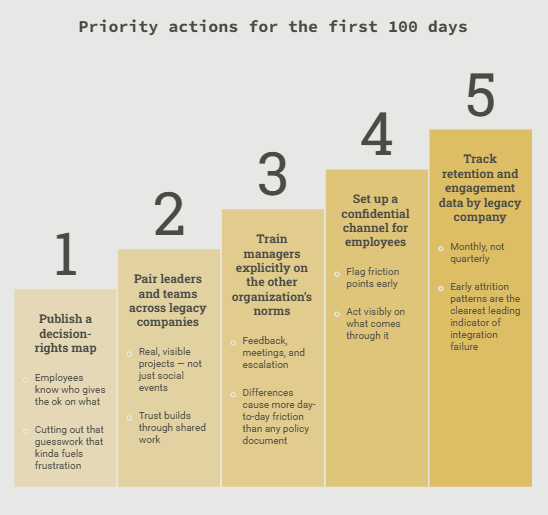
- Publish a decision-rights map so employees know who gives the ok on what, cutting out that guesswork that kinda fuels frustration
- Pair leaders and teams across legacy companies on real, visible projects — not just social events — so trust builds through shared work
- Train managers explicitly on the other organization’s norms around feedback, meetings, and escalation, since these differences cause more day-to-day friction than any policy document
- Set up a confidential channel for employees to flag friction points early, and act visibly on what comes through it
- Track retention and engagement data by legacy company monthly, not quarterly, since early attrition patterns are the clearest leading indicator of integration failure
What Are the Most Common Mistakes Leaders Make During Cultural Integration?
The most common mistake is treating culture as a communications problem to manage after the deal, rather than a structural risk to plan for before it. Leaders frequently assume that a well-crafted values statement or a joint kickoff event will resolve differences that are actually rooted in day-to-day operating mechanics.
A second common mistake is appointing integration leadership entirely from the acquiring company. Even with good intentions, this signals to the acquired organization that its perspective carries less weight, which undermines trust before integration work has even started. Balanced representation in integration governance sends a very different signal.
A third mistake is moving too slowly on decision rights. Ambiguity about who approves budget, hiring, or product changes doesn’t feel dangerous in week one, but by week eight it has quietly trained both organizations to route around each other, and those workarounds are difficult to unwind later.
Mistakes worth actively avoiding:
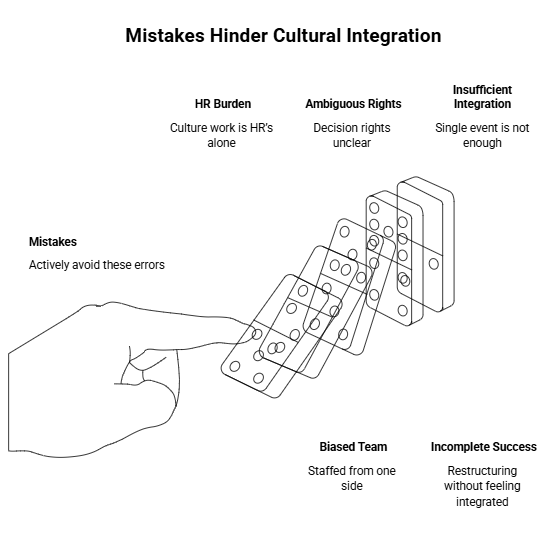
- Treating a single town hall or values workshop as sufficient cultural integration work
- Staffing the integration team entirely from one side of the deal
- Leaving decision rights ambiguous for more than the first few weeks
- Measuring “integration success” only through completion of organizational restructuring, without checking whether people actually feel integrated
- Assuming culture work is HR’s job alone, with no accountability from operating leaders
How Do You Measure Whether Cultural Integration Is Working?
Cultural integration success is measured through a combination of retention data, employee sentiment surveys, and behavioral indicators like meeting attendance and cross-team collaboration rates — tracked separately by legacy company until the gap closes.
Tracking these metrics by legacy company, rather than as a single blended number, matters because a healthy overall average can hide a serious problem in one group. If acquired-company attrition is running well above the acquirer’s baseline, the combined number will look fine right up until it doesn’t.
Beyond the headline numbers, useful leading indicators include how often cross-legacy-company teams collaborate voluntarily versus only when required, how quickly new hires from either side are absorbed into informal networks, and whether internal promotions begin flowing across the old company boundaries rather than staying confined within them. A useful benchmark: once promotions, project staffing, and voluntary collaboration stop tracking along legacy company lines, integration has genuinely taken hold rather than existing only on the org chart.
Curious About Other Areas of Your Organization?
Explore our other free assessments and get a fuller picture of where you stand.
View All AssessmentsHow Ebullient Consultancy Helps Leaders Navigate Culture Clash?
Every merger carries its own cultural fingerprint, which is why generic integration playbooks so often fall short. Ebullient Consultancy works with leadership and HR teams to design tailored cultural due diligence, integration, and change management solutions built around the specific deal, the specific organizations, and the specific risks involved — not a one-size-fits-all template.
Our engagement typically includes:
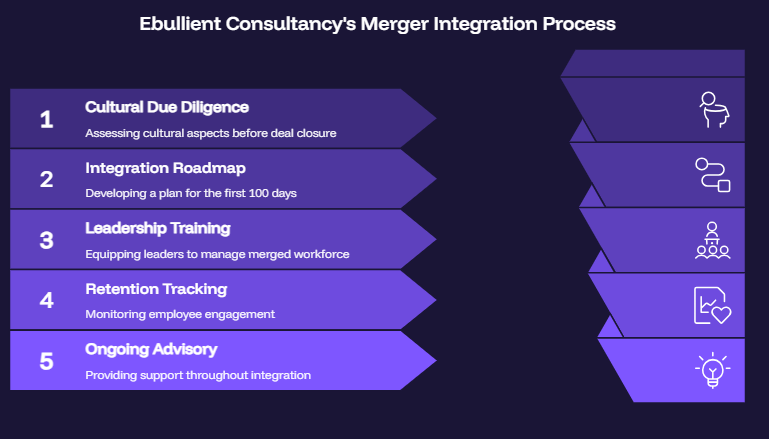
- Cultural due diligence assessments run alongside financial diligence, surfacing decision-making norms, leadership styles, and non-negotiables before the deal closes
- A customized integration roadmap for the first 100 days, including a decision-rights map, communication cadence, and cross-team collaboration structure
- Manager and leadership training on navigating a merged workforce, feedback norms, and cross-legacy-company communication
- Retention and engagement tracking frameworks that monitor legacy-company data separately until true integration is achieved
- Ongoing advisory support through the 12- to 24-month integration window, adapting the approach as the organization evolves
Whether you are heading into a merger of equals, an acquisition for talent and capability, or a consolidation play, Ebullient Consultancy builds a solution around your deal’s actual rationale — helping you protect the value the transaction was meant to create.
Want to meet the team?
Start with a 30-min conversation. No commitment needed.
Frequently Asked Questions
What is the main cause of culture clash in mergers and acquisitions?
Culture clash mainly stems from unstated, unexamined norms — how decisions get made, how feedback is delivered, how much autonomy people expect — that were never surfaced or compared before the deal closed.
How long does it typically take to integrate two company cultures?
Meaningful cultural integration typically takes 12 to 24 months, though the first 100 days largely determine whether the process trends toward alignment or toward entrenchment.
Can culture clash cause a merger to fail even if the financial logic is sound?
Yes. Financially solid deals can still slip and regularly under deliver against what they were projected to bring in when cultural integration is mishandled. You end up losing key talent, decisions stall and people disengage erode the value the deal was meant to capture.
Who should own cultural integration during a merger?
Cultural integration works best as a shared responsibility between HR/People leadership and business unit leaders, with visible, active sponsorship from the CEO — not as a standalone HR initiative.
Should smaller acquisitions still go through a formal cultural due diligence process?
Yes. Even small acquisitions benefit from a lightweight cultural assessment, since misalignment on decision-making and communication norms can disrupt a small, high-context team even faster than a large one.